Live Q&A with Ben Greenfield + LIFE Network
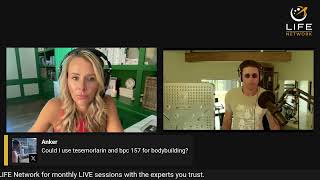
Ben Greenfield answers audience questions on detox methods, supplement timing, tendon recovery with peptides like BPC-157, cryotherapy for joint pain, and blood flow restriction training. He covers practical options from transdermal glutathione to eccentric loading and cautions against herbal detoxes for children.
Questions this video answers
Morning (generally energizing for many people).
250–500 mg (mentioned as common supplemental amounts).
Four-count inhale, eight-count exhale (1–2 minutes before/during/after meals); or right-nostril/alternate nostril breathing.
Mimosa pudica (mentioned as a common ingredient in parasite/‘detox’ products).
1,000 mg of tesamorelin in the morning (mentioned as an example).
Chapters
All right. And Eva's in the background. Gonna get all of your accounts streaming.
Okay, Here we go. All right. We are live with the one, the only Ben Greenfield, co founder of Live Network. Ben, thank you so much for being here today. Grateful for you as always.
Hey.
Hi.
So we have Live Today. So if you have questions, let us know where you're tuning in from. Drop them in the chat. We will be pulling as much as we can from Live questions and then we have a bunch already that have came in too. So we will do our best. And I know Ben goes deep on some of these, so trying to get through these and if we're not able to get to all of them, we will do our best to answer them inside Life Network as well. So thanks for tuning in, everyone. So, Ben, we are going to get to. First and foremost, we have one that came through so Lumit Life products. So this person needs to cleanse my 7 year old son or 7 year old from, I don't know if it's a son from a series of painkillers administered and laxatives in the hospital for five days. Are these products safe on kids and what and, or what clean products used to detox. Much appreciated.
I don't know if Lumati Life is the same Lumati Life as the company I've worked with before in San Diego who does things like hydrogen baths, red light therapy, more of like a mitochondrial optimization type of approach.
Which, you know, typically if you're looking at something like painkillers, antibiotics, pharmaceuticals, et cetera, the number one thing you want to look at are liver detox pathways. And the thing to think about with kids is that a lot of the herbs that are used to support liver detox pathways are not safety tested in children. I mean, for example, I just read a great book called Between a Shot and a hard Place by Dr. Joel Warsh in which he talks about potentially mitigating some of the effects of vaccines on children or vaccine adjuvants or fillers on children by looking at things like milk thistle extract, N acetylcysteine, some of these things that support liver detox pathways. It's just as tough to say for a seven year old, the long term safety data. I would say if it were my kids and my kids were they had taken some form of a pharmaceutical or something that I knew they needed to be detox from. Maybe they just like spent, I don't know, an hour trying to board an airplane and we're stuck in the jet bridge just sucking in jet Fuel for an hour. There's all sorts of times when our precious kids get exposed and we get exposed to toxins and pollutants. I think the safest would be a glutathione. And you could even use a glutathione that bypasses oral absorption and digestion, which can be a little bit more difficult for children. So now you can get glutathione topical sprays. Like one company called Oro Auro makes those. Another company, Pepsual, who we've been working with on the peptide front lately, they have a glutathione patch and it's like a long term transdermal absorption of glutathione. Those would be examples. Of course, I'm not a doctor. Don't take this as medical advice. The other thing of course you have to realize is that God created us with some pretty impressive internal filtration and detoxification methods that if supported, work pretty well. And by supported, I mean movement, walking, moving, exercising, breath and breath work and then.
Passing stools and.
Supporting digestion through both promotility agents that would be including things like ginger, for example, and insoluble fiber in the diet. And then also things that support detoxification through the stool, which would just be like healthy bowel movements. And again, movement helps with that, hydration helps with that. So those are a few things to think about. But as far as Lumati life specifically, I am not sure. I do know that when I was down there at their office in San Jose, they were selling third party a company that produces a product that is a detox product that's a traditional parasite cleanse, the main ingredient in it. And in many parasite cleanse and detox products. It's called Macusa Apudica, I think it's called. And you'll find this in many of the cleanses people use where they'll take a picture, this is totally gross. They'll take a picture of the toilet and say, oh, I had a parasite, a parasite came out. Well, if you look on PubMed, there's multiple case studies or research studies showing that mimosa pudica is notorious for causing, I don't know how to say this any other way, causing your ass to blow its nose. It causes a large discharge of mucus from the colonial mucoid. Plaques are commonly mistaken for parasites. And a lot of people like, oh, I just did a massive parasite cleanse. They're like moving around the toilet and in most cases you're just basically discharging mucus from your butthole. And paying a lot of money to do so.
So maybe save your money then. But it could be a good cleanse. Okay, so super good advice. Yeah. And as anything, it's, you know, know, not medical advice, but always incredible advice from you. So thank you. Another person is asking, can you do another podcast with Jack Dorsey? Anything in the works there, Ben?
I text Jack occasionally, but we have not planned a podcast yet.
It's a good idea though. I. Look, I'll take my little old school yellow, post it and I'll tell them people have been asking.
I'll text them today, I promise.
Hey Jack, we need you back. Love it. Good. Cool. We'll make sure to get that in the works. Hopefully this next person Sona what's the best time to take niacinamide?
You know, it tends to be energizing. For some people, it's a precursor to nad, so it helps with some of the same repair mechanisms that occur during a night of sleep. Most people feel best taking it in the morning just because it can be a little bit energizing.
And a lot of people, by the way, you can take whatever 250, 500mgs of niacinamide and it will cause your body to upregulate its own NAD production pathways and NAD recycling pathways. So it's kind of like almost like the cheapo hack for nad. It doesn't keep it elevated for a very long period of time. But if you look at the ingredient label for like done for you, NAD supplements like Qualia NAD or BioStack NAD region, like the active ingredient is niacinamide. And then they're just combining that with other things that keep the NAD hanging around for a longer period of time versus directly consuming an NAD precursor, which would be like true Niagen NR or an NMN supplement which doesn't require the conversion. And there's kind of like there's so many different.
Beliefs, I guess, in the nutrition sector about which is superior. And you could make a case for any nad, NR or nmn, but the ones with nad, it's technically just niacinamide.
Okay, good to know. Awesome. Okay, next one from Martin. I don't know if this is alive, but I'd love some thoughts on tendon damage recovery, please.
Tendons are, I mean, unlike meniscus or even ligaments, you got pretty good blood flow. The main, you know, I guess the main things that I think would be the biggest dial movers for tendon recovery is once the initial inflammatory period has subsided, tendons respond really well to Eccentric loading. So there's a classic study on speeding up Achilles tendonitis via doing reverse calf extensions where you're like on the edge of a stair and slowly lowering yourself during the negative phase tendons as the fibers realign and the tissue heals. Really like eccentric loading. So I don't know if we're talking about a shoulder, a knee, an ankle, whatever, but once you're past the initial inflammatory phases and able to move pain free. Eccentric loading for the tenon works really well. If you look at.
BPC157 and TB500 peptides, both of them have effects on tendon healing that I'm pretty impressed with. And I think a lot of people are aware of those these days.
When you look at the cross linking of fibers and the healing factors necessary to repair tendons, I think you can make a case for something that's going to help to dissolve fibrin. This would be like proteolytic enzymes, serrapeptase.
Silkworm extract. I like, I'm biased, but I like Kion Flex. A lot of my athletes, friends, et cetera, will do three of those in the morning on an empty stomach, three in the evening on an empty stomach. On an empty stomach. Because a lot of these enzymes that help with soreness and healing will just work on the food in your stomach. And if you take them with food in your stomach, so separate them by about two hours from a meal and then. Probably the most useful thing I do for injuries or for my friend's injuries when we need to heal stuff up fast, is kind of like a 1, 2, 3 combo. And I think about it like this. The first thing you want to do is transdermal administration of something that is going to assist with healing blood flow or relaxing a cramped or spasm muscle. This would be like a topical magnesium lotion. Traumeel T R A U M E E L, which is like an over the counter that you can get at cvs, Walgreens, Arnica, cbd. Any of these done for you blends. And then to drive it deeper into tissue, you would then put something like red light electrical muscle stimulation pads, pemf. Any modality that you have like that, that's kind of like a technology for improving blood flow. My top two favorites would be PEMF or red light therapy. If you can get either on top of the transdermal and then typically what you can do is after you've done that, ice it and then heat it again. So it's kind of like a transdermal heat Electricity, cold, heat, electricity, sandwich, and just doing that one or two times a day. It sounds kind of laborious, but just whatever, while you're doing emails or whatever you normally do, it can speed up healing pretty dramatically. I mean, I learned that back when I was racing Ironman from a guy who worked with Tour de France cyclists to get them back in business super fast. And he did transdermal. And then what he would do is the transdermal and then he'd put electrical nodes like electrical muscle stimulation on top of that and then heat and then switch to ice and go back to heat.
Okay, very cool. So to kind of piggyback off of injuries in a way, would you recommend cryotherapy for someone with joint pain that so far appears to be some sort of arthritic inflammation flare up?
Yeah. Paradoxically, cold, which you think would make joints more stiff, can assist with pain pain long term because you get a rebound increase in blood flow to the tissue after the cold has subsided. It can be cryotherapy. I'm a bigger fan of cold water immersion due to a more rapid lowering of the temperature of muscle tissue and a little bit of the hydrostatic pressure of the water, which can also help with pain sensations. What I mentioned about tendon healing, specifically when it comes to supplements or some of the transdermal stuff for joint pain, everything I just said would apply to that. Besides the eccentric loading, which isn't really going to affect joints much, but long story or short story is that yeah, a cold can help with arthritic and joint pain. And I mean, it is kind of funny because if you look into like the lore of polar bear swimmers in San Francisco or people have really gotten like many of them turn to that because they had a bunch of like joint pain and chronic inflammation, fibromyalgia like conditions and it just like went away. So they kept swimming. So I'm a huge fan of like cold water swimming, cold water immersion cryotherapy, especially for like long term joint pain and chronic joint inflammation.
Perfect. Okay, so then another one to piggyback off of that too. Regarding cryotherapy for skin cancer, some recommend and some only recommend cold plunges. Thoughts?
No clue. Never seen any research on old and skin cancer.
Say I hadn't either. So I'm like that to know. Okay.
Yeah. I mean, if anything, the only research on thermal stress and cancer that I'm aware of is that hyperthermia or heat can increase the cytotoxicity of chemotherapy and may in and of itself be cytotoxic. To cancer cells. Haven't heard that with cold, sometimes there's crossover between what cold can do and what heat can do. But I know nothing about skin cancer and cold.
Yeah, okay. Yeah, same. Okay. Do you have plans to come to Brazil, Ben?
Oh no.
Anytime soon?
I might.
That's very true. Yeah, world travelers.
So.
Okay, so next one, blood blood flow restriction, your bfr. Is this only useful when you don't have access to heavier weights, I. E. During travel? Because I know you typically bring that and or during recovery when you're not able to lift heavy. Is there a case for BFR otherwise?
Yeah.
Blood flow restriction is going to fool your muscles into thinking they're lifting a heavier weight than they are and allow you to get a lot of the benefits of traditional heavier strength training with body weight only. Which makes it very useful as a travel hack. And that's why I talk about it more in the context of travel. But there are multiple long term multi week studies, for example in seniors staving off sarcopenia, recovering athletes, et cetera, showing that at any time it can be a good workout strategy. Now I don't do it year round because I save my BFR band training for when I travel. I have a love hate relationship with it anyways because it does burn when you get those bands on, you can't wait to take them off after the workout is over. So if I did it all year long, I'd probably just get super tired of BFR band workouts. But. But I also have a Vasper at home which is a cardio machine that has cuffs and I do that three times a week when I'm at home. So you could say that because I use BFR bands pretty extensively when I travel and then use the Vasper at home. I am kind of doing BFR training all year long. But I would say the best cases for it would be travel like this person asked and then also just if you're not able to lift heavy, have access to heavy weights or if you are rehabbing a joint. Right. If I'm rehabbing, let's say a torn mcl, I can't do heavy back squats. I can put on the BFR bands, rep out a 302010 set with the BFR bands on and simulate the same type of loading as I'd get with a barbell squat and strengthen the muscle considerably faster than I would without the BFR bands.
Exactly. Okay. And then someone also is piggybacking off of that. What sports specific BFR bands do you like?
Oh Man, I mean, you go super fancy the Katsu ones. So this kind of confuses a lot of people because they're like, well, why, why would I like spend a thousand bucks on a Katsu band set when I get BFR bench, like 60 bucks on Amazon? The ones you get on Amazon are kind of like old school tourniquets, right? You just wrap them around a joint and they will limit blood flow both in and out of a joint. And theoretically what you'd want to do is mostly limit the blood flow out of a joint. And when you use a smaller circumference restriction such as a tube, you're able to allow for blood to get into the muscle, but less to escape the muscle. And that's the difference between blood flow restriction and blood flow occlusion. Now if you. If you look at a band called the Kaatsu Band, Kaatsu, that's a small tube that's built into the band. And then typically the tube is attached to a control unit that allows you to adjust very precise millimeters of mercury the amount of pressure that you have built up in the tube. So if you're going for the most scientific science backed way to do occlusion training, which is kind of incorrectly often called BFR or blood flow restriction training, but the two are slightly different. You'd spend the money and go for Kaatsu bands. If you're just like, I don't care, I just want the 8020 approach. I don't want to spend a thousand bucks. You could still get pretty good effects with just the BFR bands that you wrap around your arms and your legs. So yeah, I mean, you could use one or the other. I have both. My only complaint about the Katsu bands is it just takes longer to set them up and get the little digital controller going and remember to charge it and everything that goes into that. And sometimes I just go cheapo and quick. But that's kind of the difference between the two.
And easier to travel with the bands too.
There's not a big difference in the amount of space the bands versus cats who take. Because the Katsu controller is like that big. Like, okay, so smaller than a cell phone.
Okay.
And they even have one version called the thing called the B1 Katsu. Does that use your phone as the app to control it, which makes it even easier.
Awesome. Very cool. Awesome. Okay, next one. Does metformin help with weight loss from what you've seen?
Well, if your weight gain.
Or your weight is related to insulin insensitivity and.
Blood glucose Fluctuations, which is often the case. I mean, probably Ben Bickman is the most current up to date public health educator on the link between insulin and fat loss. And Jason Fung also has great work on this, then anything that controls blood glucose and glycemic variability would assist with weight loss. Metformin is the big guns. I think that before turning to it, you, you could look into more natural options like berberine, dihydroberine, bitter melon, apple cider vinegar, Ceylon cinnamon. I mean, there's so many blood glucose sensitizing agents or glucose disposal agents that you could use along with just controlling your starch and sugar intake. Metformin is highly effective at lowering postprandial blood glucose. It can also impair mitochondrial proliferation and biogenesis, cause some gut distress, and impair strength gains and muscle gains from weight training when used in traditional dosages. So there are some downsides. I also think that now that we live in an era where you can microdose with GLP agonists or other GLP like peptides, I think, and this is from both personal experience and looking at the research, they do a really good job controlling blood glucose. Also.
In moderate or microdoses, I would say you don't run into the same type of gut issues that people often do with metformin. So that's another advantage. Like if I wanted to.
Restore, and again, I'm not a doctor, this is not medical advice. But if I wanted to restore insulin sensitivity, reduce glycemic variability, control blood glucose as much as possible, my strategy would be a relatively low carb, somewhat ketogenic diet, including the inclusion of ketones and MCT oil and coconut oil. I would be on a microdose like a Monday, Wednesday, Friday of a good GLP agonist, like let's say like 250 micrograms of retatrutide. I would be taking something like bitter melon extract or dihydroberine before any meal that contained appreciable amounts of carbohydrate or protein. Before lunch and dinner, I would be doing thermal stress on a regular basis. Heat and cold, I would be lifting weights because that will serve as a metabolic sink for glucose and prioritizing high intensity interval training over cardio due to the favorable metabolic effects of. And you can make a case. And there are even books about this. Jason Fung, who I mentioned earlier, has a great book called the Diabetes Code. There's another book called how to reverse type 2 diabetes naturally. I know we're not necessarily talking about diabetes right now. We're talking about weight loss, but we're talking about weight loss related to blood glucose control.
If I had type 2 diabetes, and again I'm not a doctor, this is not medical advice, I would do all of those things I just listed. And I think you can make a pretty strong case that if someone were doing that, they would probably not need to take standard pharmaceuticals or medications and they may even see a little bit of pancreatic beta cell regeneration from an approach like that. Thus, if I want to be cautious using this word, but thus curing type 2 diabetes.
Exactly. Wow, that's powerful. And the whole protocol that you just listed out for people to not only just like lose weight or maintain weight or build muscle too, so. But without maybe the effects of metformin on the gut too. Someone is asking though about metformin again. How important is thymus regulation regeneration to you? Have you tried the HGH metformin protocol?
Those are two pretty different questions. The second question about HGH metformin, that's based on a study where.
Metformin was combined with human growth hormone, not because the two have synergistic effects on blood glucose control, but because metformin also has a growth hormone lowering effect like an MTOR inhibiting effect that can cause some of the muscle loss issues that I briefly alluded to earlier. And co administration of growth hormone is something that was used in that study to stave off some of those effects. I remember a tweet that I sent out when that came out I think like three years ago, and I said, well why wouldn't we instead do something like give someone say bitter melon extract or berberine and then if we were concerned about any mild MTOR inhibition from that or growth hormone inhibition from that, use a natural agent like say colostrum and kind of take a more natural approach to what that study was trying to achieve with pharmaceuticals and arguably also a much less expensive approach. So my reply to that was like, why not do some of that laundry list of stuff that I just got done mentioning. And if you were concerned about any potential anti anabolic effects of that, take something like Colostrum for example, so you're getting some growth hormone. And then that was kind of my take on the HGH metformin protocol when I saw it come out, probably still is my take on it. And then the thymus regeneration. I think that especially as you age, there's certain things to think about as we age due to the way that aging affects certain organ systems and physiology in general, like beginning to take nad as NAD pools decline or NR or NMN beginning to take digestive enzymes, as pancreatic enzyme production decreases. Being even more strict with strength training as sarcopenia becomes easier to set in and bone density secondarily. And then you do see some immune system degradation. And there's multiple ways to go about combating that. Some people will literally like the whole tech billionaire anti aging biohacking sector. They'll go to Mexico and get giant doses of T cells like killer cells infused into the body for immune system regeneration. I've done that.
You can also use a peptide like Thymosin Alpha 1 for triggering the thymus gland to upregulate T cell production. I don't know if that's classified as like regeneration. I think if you take a peptide bioregulator like thymolin, that one is more associated with actual thymus regeneration. My own protocol is I have for the past five years done three killer cell infusions, which I will probably continue to do on about every year to every two year basis. I take Thymosin Alpha 1 anytime I'm doing hefty bouts of travel to assist with the immune system. And then I take a dose of thymolin for about 10 days once a year. And I have a pretty good kind of like immune system restoration regeneration protocol like that spelled out in one of the latter chapters of Boundless, the chapter focused on longevity. And then there's some in the, I think the immune system chapter is titled something silly like never get sick, but that also has some information like that.
In there for sure. And make sure to get the updated Boundless version that was just released this year. So with all your updated protocols. So also a question then about peptides, as always, could I use tessa Morlin and BPC157 for bodybuilding?
I mean, for bodybuilding specifically. A lot of people don't use BPC157 every day because I don't, just because I'll typically only use it if I have an injury. However, it is angiogenic, which is actually controversial for some people because some people think it may have pro carcinogenic effects by introducing so much vascularity that you could theoretically deliver blood to cancer cells. I haven't seen any evidence of that. If I had cancer, I wouldn't use BPC157. But if you look at angiogenesis and vascularity, that's something that you are judged on in a bodybuilding show. So you could make a case for BPC157 being right up there with all your nitric oxide precursors and arginine, L Citrulline and everything else that you take for vascularity or red wine or dark chocolate or whatever else. Tessa Morellin. Absolutely. Because stacking, doing a dual stack of a growth hormone secretagogue or precursor. Let's say you're bodybuilding and you do.
1000Mgs of tesamorelin in the morning and then say a dose of Simorelin or Ipamorelin CJC in the evening. That's, that's a pretty good like five day on, two day off stack for muscle gain and fat loss. And a lot of bodybuilders will turn to something like that instead of say, like, especially from a natty approach like, like Deca, for example.
Okay. Kion lean because you're talking about. Is it berberine in there as well? And bitter melon.
Kian lean is, is.
Nanogenseng, bitter melon extract and astragalus.
Okay, cool. So then maybe just throw on berberine and then it'll be good to go.
You honestly, you wouldn't need both. You could just do one or the other.
Okay, good to know. Awesome. Okay. And I would love to. I want to be mindful of your time so wrap up with this one if we could. So what kind of breath work would you recommend for stress induced indigestion?
The simplest way I can explain it is if you look at the pacemaker cells of the heart and how they respond to the vagus nerve. The breathing in through the right nostril and or long exhalations tend to trigger more of that parasympathetic branch. Either single nostril breathing through the right nostril or exhales that are twice as long as your inhales would be two forms of breath work that would be more parallel parasympathetic. So for example, stress induced indigestion before, during and after meal, one to two minutes of a four count in, eight count out or alternate nostril or right nostril only breathing. Those would probably be the two best.
Yeah. And you have some of your breath work on breath source as well, which we have Inside Life Network. So they can check out some of the videos on there too. Now you have some of those on there too. We had doctor or not doctor, but we had William Travis founder on, on that. So he has some good videos that people can tune in for that. Okay. And then quick, where do you get your meat?
Multiple sources right now. Monzo. That's where I bought my whole cow for Piedmontese beef M A N zo. I've got a couple podcasts with them, us Wellness meats for Fish Seatopia. And then typically I'll put one to two white tail deer. Right. Turkey in the freezer just from hunting and hopefully this year an elk. So here and there and everywhere.
Yeah. Good. I love it. Yeah. Well, thank you so much, Ben. Always amazing job. And we will make sure because we had a lot of questions still come in, we will add those to Benda solo. So it's himself just to dive through some questions as well. And we will bring some of these back up if we weren't able to get to them today or just hop in Life Network 2 and we'd be able to help you out inside there. So thank you, Ben. Thanks everybody for tuning in.
Thanks everybody.
See you around later. Bye.
More from Jeffrey





The Solution to Aging Might Be Closer Than Anyone Realizes - With Ben Goertzel


