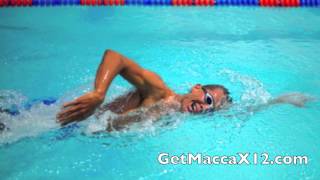
This transcript excerpt records an interview in which Chris McCormack describes his preferred swim session, the "Elevator" set (originally from coach Dick Kane). He explains the set's structure (repeated blocks of fast 50s followed by 200m race-pace efforts, historically longer 400m-based versions), its use as a weekly Monday benchmark, and its role as a form- and fitness-assessment tool for triathletes.
So let's say somebody's listening in and they want to set up basically a skeleton week like you recommend. And they're not a pro, they don't have tons of time and they can't do super long workouts. Can you kind of run through? I want to run through, like your top swim session, your top bike session, your top run session in terms of just like getting the most bang for your buck as far as what you do. Let's start with swim. What would you do for a swim session as far as, like one of your key sessions that you think just gives you a ton of benefit?
You put me on the spot, but a good set. Probably my favorite swim session is a set that we got out of my old swim coach in Australia, Dick Kane. And you know, he's coached Olympic champions, he's coached myself, Craig Alexander, McKeely Jones. Some of the greatest triathletes have come out of Dick's swimming pool in Carrs park, just south of Sydney. And he created a session that over the years we called the Elevator. And the athletes actually called it the Elevator. He used to just give it a simple name. It was basically a set of two hundreds and. But we used to call it the Elevator because it used to climb and just kill us by the end. And it was a set of four hundreds. And we used to do eight by 50, two by four hundreds, two by 400. And you'd repeat that, you know, the first 50 meters would be flat out. Then you do, you know, another eight, seven 50s on a set cycle. And then you do two 400s at race pace, and you would repeat that eight times. So it was a very, very long set. And over the years, we adjusted that for, you know, I got older and I didn't need to swim as much. And I'm thinking I don't need that kind of intensity. When I was young, we. We cut that back to two hundreds. And it's a session I use weekly. Every single Monday, I do a version of the elevator set. And it's, you know, I'll do four 50s, two 200s, and the 50s will be first 50 is flat out, three 50s steady, and then the 200s at race pace. And then it'll be. The next set will be the 250s flat out.
You know, too steady, and then two two hundreds at race pace. And the third set will be the 350s at max effort. And this last set is obviously the 450s at max effort. And that's why we call it the Elevator. You're constantly stepping up the lactate with the hard 50s. But the key is to try and hold those two hundreds at as close to race pace as you possibly can. And it's a good form finder because you get to really see those 200 times drop off towards the end. And you know, if you're finding some good swim form when you can maintain that 200 pace the whole way through the set. And mate, I can tell you right now, I do this session with Crowe in Australia. We do it, you know, we swim in the same squad, and both of us look at that session in particular as a, as a key marker for where we are in our, in our swimming. It's probably one of my favorite sets. It's mentally very, very easy. You knock it out and, you know, there's multiple variations of the elevator set. But that is probably the meat and potato session that we would nail on a Monday.