Obstacle Dominator Episode 16 with Hunter McIntyre And Ben Greenfield
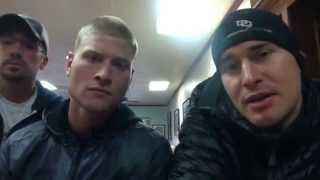
Ben Greenfield and Hunter McIntyre talk through their Spartan Race in Sacramento, covering obstacle techniques and nutrition strategies. They're sitting in a coffee shop near the finish line, breaking down what worked during the race.
Chapters
Yo, yo, what's up?
Hey, guys.
Welcome to Obstacle dominator podcast number 16, a special episode from a coffee shop about already about a mile from the finish line of Sacramento Muddy Buddies. Sacramento Super Spartans raining and sleeping outside. So we came in here.
We drinking coffee because we're wusses and.
We don't like inclement conditions.
I'm drinking chocolate almond. Actually, I'm drinking.
I'm drinking decaf. So I had about 300mg of caffeine before the actual RA.
This is quite exciting. This is our first video edition.
This is our first video. As a matter of fact, if you're listening to the audio version of this, you can actually. Just in case you don't know what Hunter and I actually look like or you want to see all of the hubbub in the coffee shop that's behind us, the ceiling fan, the folks getting their frittatas. Yeah. All the hot chicks from Sacramento hanging out. It's crazy in here. Yes. As you can see right behind us, we've got like 70 year old freaking hotties. It's amazing.
I've been slipping booze in her coffee.
Boom. Anyways, though, this is it. So go over to YouTube and we'll have, we'll have a link over obstacledominator.com if you click on the show notes, we'll link to the YouTube video where you can go watch the video version of this podcast and see us do all our monkey tricks while we're recording. So.
Anyways, though, Hunter just took seconds in the second. I have the spark right now and.
The sprint is tomorrow as well. This is the age group championships for Spartan. How'd the race go, dude?
There were some ups and downs, my friends. You know, this was my first elite Spartan race ever. I did my first race in Malibu in 2000.
You mean last year?
No, it was two years ago.
Two years ago.
This is like my two year anniversary right here.
Wow.
I raced against Hobie. There was another kid who ended up beating me out. And that was two years ago. And we were all just duking out. It's a very kind of like rolling pitch into like flat little like valleys. And every once in a while you'll meet these little cow pies and dirt pits.
Very much a runner's race.
Oh, yeah?
Yeah.
So going up against someone like Cody and Glenn Rats, who are both pretty well trained runners, it was a cool experience. But they had some, some, some old triplets that they put together. The first one that we experienced was the monkey bars to the rope. Climb straight into a traverse and like.
That's awesome. Well, they're like, they're like burpee makers, right? They try and get rid of your grip. And we actually have a special guest here off to our right. We can ask him what he thought about it. But dude, come on in here. Introduce yourself. We always have to have a guest on the show. Jeremy.
This is my road trip buddy.
Jeremy Hunter's road trip buddy. How long did you guys drive? Come down here? It was about five and a half hours. But we stopped and we got Denny's. Had Denny's. Had as you do. Had whole foods twice. Yeah, Denny's mixes well with whole foods.
There's nothing like throwing some kombucha.
On.
Put some organic kale on top of the burgers just to push them out. Yeah, exactly. We got our haircut. So you got a nice yin and the yang. Yeah. Hunter, you have no, Hunter, you have less hair than me. Now we've like come. I'm trying to be more aerodynamic.
Everyone's getting so fast.
That's right, that's right. You gotta shave your legs. Next.
Jeremy's got ice picks. Show me your ice picks. He's got ice picks on the side.
So Jeremy raced today. I have to have those.
Puerto Rican.
Women love ice picks.
Jeremy, race. Hunter raced. I raced. And it was interesting.
So a couple good combinations of strength obstacles we went. There was like a two mile stretch. Horrible. Just fields of dirt and nothingness. And then we went straight into a spear throw run around a hill. We had tire flip, quarter mile down the road. We had tractor pull, quarter mile down the road. We had bucket brigade, quarter mile down the road. We finished. No. Then we had about like a half mile straight into this gauntlet at the finish line. That's where I got Glenn muscles win.
They, they threw like four, four or five obstacles at us at the finish line. A herculean hoist, slippery wall, barbed wire crawl, dunk, a wall dive. So let's talk, let's give the folks listening in some practical tips and tricks here that we took out of the race today. A few things. Probably the first thing that you guys should know if you're listening in is you're gonna see this at more and more races is they're attaching ropes to the end of the spears now. So in the past when you'd run up on a spear throw, you just have. You'd have a bunch of spears there on the ground and you'd pick one up, make sure you grabbed one with it that was straight or whatever. And you had your selection of spears, and you threw. Now there's just one spear at each station safer. Nobody will put out an eye that way. And each spear has a rope attached to it. And when you throw the spear, you're throwing the spear with rope on the end. And I think they're just being lazy.
That's all I have to say about that.
Could be, could be. I get the same thing, but the spears throw a little bit differently. They throw lower. You got to look down before you throw to make sure you're not stepping on the rope.
Aim for the top half of the box. I shot in the middle, and I shot down twice. This has happened to me.
Don't be fooled, because they had the same thing at the rope attached to the end of the spear at the beast. And same thing happened. I know. To you, Hunter. To me. I threw under today. I threw hard, and I aimed for the top, and the beast I threw under.
So be ready for that. Be ready for this new spear thing with the ropes attached to the end of it. And make sure that you look down, make sure you're not stepping on the rope. It's real high. Couple other things I thought were interesting. They had a big, like, moat that you had to, like, wade through, like, a pretty long moat. That was fun.
That was fun.
Yeah.
Tell me your method, and I'll tell you my method.
Okay, so listen carefully when you come up to obstacles that you may not be familiar with, because sometimes the volunteers or the people standing there will give you some clues or some tips. I don't know if that counts as outside assistance or not, but as I ran up, the guy goes deep on the right, shallow on the left. So of course, I moved to the left of the moat.
You didn't tell me that. I stayed to the moat.
It dropped off, though. It dropped off in the middle. Okay. I don't know what happened in the middle because I wasn't in the middle. But basically my approach to these deep moats is if it's basically about above your knees, as far as how high the water is, and you're having to pick your legs up real high and move super slow, you know, if the water is above your knees, that you've got enough room to swim if you need to swim. And frankly, I can swim faster than I can wade through that deep water. So I swim because I know when I get out of the moat, and part of it is because I like to swim. So I know when I get out of the moat, I'll have fresh legs to run. So I waited until the water got so deep that I could swim, and then I swam. And once I could touch bottom, I started wading again. How do you approach it, Hunter?
I call my method the swimming pony. And what I do is.
I'll let myself. Basically, once it gets to about waist deep, I start to then bring my chest into it. And what I do is because the water underneath it has a thick layer of muck. And every single time you put your foot in there, you're putting more muck and dirt into your foot. Now, you can adopt the principle of swimming and getting out of it like that, but for someone who's not as comfortable swimming, like myself, heart rate gets jacked up, then you're screwed. So I do the galloping thing. I keep my head out of the water. I do only allow my feet to kind of get that little kick off the top of the mud. And I do a big breaststroke type pump with my arms.
Right.
So that way I get my legs churning underneath, but they're not actually sinking into the mud rather.
So you're using both your arms and your legs?
Oh, yeah.
Are you making pony sounds?
Yes, I am.
But I caught tons of ground up on that. Now, many people thought that the galloping pony was not the method to use. Very efficient heart rate.
Many people up until this podcast probably don't even know what the galloping pony is.
Amateur.
You just gave away your secret.
That's what we're here for.
We're have galloping ponies all over Spartan races worldwide now once this podcast is released. So the galloping pony for the moats. You can try the swim and walk method or the galloping pony. Either one. That's right. They had a lot. I noticed it seemed like they would get your hands wet in a lot of these moats and the mud crawls and then throw an obstacle at you where you had to use your hands. Oh, yeah, Right. So one thing that you want to do, like, say like in this race, we had a rope climb and then we had a traverse wall right after the rope climb. That was tough. And the way that most rope climbs are is there's water underneath them. So you drop into this moat, your hands get all wet when you drop out of the rope. Now look on the ground for like dry grass that you can rub your hands on. Or if your shorts are dry, you can use your shorts or your shirt. Get your hands dry, though, if there's a back to back obstacle like that where your hands are wet when you're on the second obstacle. That helped a ton.
Yeah.
But Hunter, what's your strategy? This is a common obstacle, obviously. What's your strategy on something like a traverse wall?
Traverse wall. My method is now, first of all, you always want to clear your hands. So it's a huge clap. I try to get about three huge claps in, try to just clear off the back of my hands, hit it this way, then hit it this way and try to get everything off and what the goal is. You always want to make sure that your hands are the basically the most important part about everything. You lead with one foot, you stay tight and then you shift over. So always make sure that you held on as tight as you can up top.
Now the hand's more important because the feet are slippery.
Yeah, always, always, always. So you test out the block. Once you get a little bit of a toe grip on the block, then you can basically, as if you've seen one of those bar star workouts, you basically just stay tight in your lats and you shift over and try to push off the back one, reach to the next one. You know, it's always about having that big thumb kind of gripped onto the block. And I try to stay as tight as possible. The further you are away, the likelihood of that back balance weight dragging you down.
Yeah. By the way, I just noticed you're wearing a Timex.
Yep. This is my rusty, trusty sport.
A rugged Timex watch. And this spot, this podcast is not even sponsored by Timex, but now we're gonna have to write to them and tell them.
This is such a manlier watch.
Two Timex athletes. I think my watch is manlier. No, it's rugged.
This is like a safari band and it's got Velcro for efficiency.
The safari band style, though, holds germs like staff and mrsa. That's true.
And I use that on my enemies like a mace.
Alright, so let's throw a few more tips out. This race, the terrain that we were running across was pitted and it had a lot of like, cracks and pits and holes and stuff in it. If you know you're gonna roll up on a race like this, and I would have done this retrospectively if I would have known 2020 hindsight, I would have either taped up my ankles or worn ankle braces. Did you wind up wearing a brace?
They called me glass ankles. I'm a princess. I tore my ligament not too long ago. And even if you guys have strong ankles, Spartan Race is always gonna pick the ugliest terrain possible. Because if it's not the option, it's going to challenge you. It's the terrain that the obstacles are on and they really take you through some challenging spots. So keep it safe. Put some tape on.
Yeah, I mean, you know, even like this, this rock tape stuff that you see at a lot of races, that's not super supportive. But even if, even if that's all you have your hands on, what that does is it increases what's called your kinesthetic awareness of a joint. So just by having that extra little bit of feel around the ankles, that, that can help you out a little bit. But ultimately you want a brace or you want the full on non stretchy like cotton athletic tape. Either one of those methods, if you can get taped up before race, especially if you got glass ankles like Hunter Glass ankles, Malibu Barbie, Galloping Pony. Are there any other nicknames? No.
I'm hoping to rest for the next podcast. I can't give them that all the way. But another thing you can just do after every single time I'm done running, I either take one of those voodoo bands and wrap my ankles and do the directional movements just to kind of strengthen, go through the range of motions. And I try to really roll out the meat on the outside and the inside of my calves rather than just like the big meat of the calf in the back. And you know, you're not a hot shot. Even if you trail run all the time, you really need to work on that kind of proprioceptive stuff. So what I'll do is I'll take a Bosu ball and two to three times a week I'm doing different kind of shifting motions just to keep yourself, because the terrain is always going to be bouncing around. The faster you go, the more weaknesses that are susceptible to rolling ankles, twisting toes, stubbing them.
Yep, yep, get into it. All right, let's toss a few other tips out there. We had a tire flip and these tires were not super duper light. I know that there were some skinnier folks out there that probably had a little bit of trouble on, on the tires. Jeremy. Tire was tough.
Jeremy.
So this.
Is.
Anyways though, as far as the tires go, I'll throw my tip out there and then I want to hear what you guys have to say. But you know, traditional tire flip, nice clean tire flip, you put your hands under, you clean it up into, into almost like a, like a racked position and then flip it over. But I think in a spartan.
Basically use every body part, shove your knee underneath the tire. If you're having trouble getting it up. And once you toss your knee under there, you've got your full leg support. So you're basically on one leg with your knee thrown under there for just a second. Then you give it a giant push. And by using your knee, that can help you get that tire up and over when you normally wouldn't be able to just using your hands. What are your guys approaching with the tires?
You got the right idea. Look, there's the thing about Spartan race is not all the tires are the same. So take your extra 5 to 10 seconds. Go in eyeball the tires. I try to find a tire more so that is bigger, wider around and has a.
Lower width than some of the bigger ones. The shorter ones for some reason end up being a little bit heavier.
Some of them are deceptively like if you go for the smallest tire. If you look at them, some of the tires are super duper dense and thick.
So the tractor tires have good, good tread on the bottom of them to grab, but they're heavier. They're significantly heavier. So it's a good point that Hunter makes. Yes. Do not be fooled.
Yeah.
When you guys get there, you guys have the pick of it. I, I get there and there's a group of people there already, so I don't get to pick my tire complaining. So what I do is exactly what Ben said. I mean, I lift it up and I sneak my one knee under and then I get a little bit lower of a leverage and then I push it from my chest over.
Get your hips into it.
Pretty much what I do. Yeah. Nice. No galloping pony strategy for the tire. Not even like a grunt or a flick of your tail.
Yeah. You know, a lot of people get a little excited. Just put your glutes into it. That's a thing to protect your back when you're running like that. You're fatigued. And the one thing that happens in obstacle racing is if you look at a really good looking runner, they're very upright. In obstacle racing, the first thing that breaks down is your midline. A bucket brigade bum. A sandbag boom. A tractor pull bum. Everything is moving forward. So what happens is if you come in with a compromised position, you don't want to be that person who ends up tweaking themselves thinking they're a hot rod. So get under it, put your button to it, squeeze up. You know, safety first, treat it just like a deadlift.
You know, it's kind of like rock climbing. There's so many situations where you feel like using your Hands and your arms, but it's much more effective to use your legs. Two other examples of that. And they had both these obstacles in the race. Tire pull and the Herculean hoist, Both of those. You could try and go hand over hand and just muscle it. But honestly, if you get your butt down or you sit down or you get low and you just put one hand over and then pull your lower body, turn the other hand over and pull with your lower body. I'm demonstrating on the video, if you guys go check out the video. The video is awesome, by the way. Hd. See how I'm doing this?
We're all in the same motion here. It's kind of like a big rowboat.
Back in the Trojan days. Yeah, exactly. So it's just like you're rowing a boat or using a concept too, or whatever, but you don't use your arms. Use your hips and your legs, and your arms are just there to hold on for the ride. So any of these obstacles where you're tempted to use your arms, even the rope climb, once you learn how to do that properly, it's all core and legs. But use your legs when you can.
Practice some big things like overhead kettlebell swings, sumo high pulls, or rowing just with high resistance, you'll be able to kind of get that muscle memory when you come to that big tour. You're into it.
Yeah. And by the way, speaking of video, for those of you who want to see video demos, Hunter and I are working on some demos for you guys. We'll have them out in early December if you're listening to this podcast when it comes out. But we're working on shooting some video demos for you, probably up on the Greenfield obstacle course, actually. So we'll shoot some videos and some how to's for you guys very soon. What else? Any other little tips we want to give folks from this race that you guys can think of?
You know what was a cool thing? And this is not a pitch for Clif Bar. So Clif Bar gels. You know how they have that little loop in them? There's that, like, that little thing. And I don't know, it's meant to obviously be tied in I for the first time, instead of carrying a goo pack, because this ended up taking just over an hour.
I mean, like a race belt. Yeah, race belt.
What I did was I took the string from my shorts and I put them tied in underneath my. Right in front of my crotch.
Yeah.
And that was a great spot to hide it. And what I did when I Was ready. I just ripped it out, ate in.
The goo, chucked it, took the pubes out of your teeth and kept running.
No, I put it in the trash can.
Yeah. In a race like this, that takes you under about an hour and a half. That's actually a good tip. Like, you don't have to wear a full on, like, you know, fuel belt or like a backpack or a vest or camelback. Like, you can take gels and shove them up your shorts. And if they're like, like Hunter just described, if they've got like little loop in them, you can even tie them into your short strings. You know, I had a hammer gel out there and I just shoved it up in my adductor of my spandex shorts and, you know, about mile four, took it out, slammed it at a water station and kept going.
We gotta give one other nutrition tip here.
I got one cool one. Okay, this is not from me. Some dude came up to say hi to me after the race today and he had like one of those little shampoo bottles that you travel with. Yeah, he put honey and salt in it and he had it clipped on his shorts. And when he was running, he just pulled it out and sweared in his mouth. I don't know if that's a good thing, but that looks cool.
Yeah. Honey, salt, any of that. And the nice thing is the taste of salt can keep you from cramping. So that's, that's another useful thing. It's just, you know, these super Spartans are. It's kind of a, you know, especially if you're kind of, kind of sort of towards the pointy end and you're going under an hour and a half or so. It's one of those deals where you've got enough carbohydrate on board to make it through the race easily, even if it's under two hours. But you also want to have a little extra sugar out there with you or a little bit of extra whatever salt nutrients. Just because they've done studies that show even the taste of something sweet, sending your brain a message that there are calories present, allows you to tap in and go a little bit faster, even if you don't necessarily need those calories from a physiological standpoint. So, yeah, having just a little bit out there with you, even just a little taste like halfway through, can help tremendously with the water. They had pretty, pretty good water stations.
Here, like over the course of every other one.
Yeah. My strategy with water is like your body can handle about 4 ounces before you kind of risk the diaphragm doing its little contraction, and that's a side stitch when your diaphragm does that. So I actually. Every single water station, I grabbed a cup of water, but it was just, like, one sip, right? Like, I drank, like, a third of what was in the water cup and then tossed it. And for me, that works better than less frequent stops with a. With a full sip. With a full cup of water.
Coach is putting on a mean pace, though. He's putting on a mean paste. I didn't have time to stop.
Yeah. Yeah. Such a bummer. So there's your nutrition, hydration tips. I'm sure that Hunter and I have plenty of other things to say to you guys, but I know Hunter's got a podium to stand on here in about a half hour. There's a bunch of traffic outside, so it's gonna take them, like, two hours to get back to the race for miles.
And what I'm.
You may have to Skype into the podium.
I'm gonna pretend that Jeremy's pregnant. And we need to get to the podium. It's Waterbird.
We need to go anyways, though. So what we'll do for you guys for the video, go to obstacledominator.com. this is. This is episode number 16 that you're listening to, complete with coffee and Southwest frittatas. So if you go over there, tune into episode number 16. It's super easy. Go to obstacledominator.com. there's a link on there that says podcast show notes. Click on the show notes while you're there. You can also leave us a question for any of our Q and A episodes that we do. And when you go to the show notes for today's episode, we'll also have a link for the video right up there for you, so.
Oh, yeah, we can get on YouTube.
Yeah, we'll put it on YouTube. Yep, exactly. YouTube. And maybe we'll talk to NBC. Maybe they'll push this out in one of their quieter times of the evening. They can put it on, like, in place of an infomercial. Yeah, it's perfect. Yeah. There you go. So, see, we're locking the loader.
We're going out into the world now.
Boom. All right, Hunter, you look nice and warm. Go brave the elements. All right, you guys, thanks for watching. And we'll be back next week from obstacledominator.com later.
More from Jeffrey





The Solution to Aging Might Be Closer Than Anyone Realizes - With Ben Goertzel


