The 3 Pillars of Fat Loss with Ben Greenfield and Paul Jaminet
Live webinar by Ben Greenfield (with Paul Jaminet and Damon Young) presenting three pillars for fat loss: (1) identify and train in your fat-burning heart-rate zone (field 20-minute test, lactate/VO2 lab alternatives) and combine with fasting; (2) strength-focused workouts optimized for fat loss (full-body circuits or supersets with short cardio boosts, hypertrophy rep ranges, and the 'rule of three' for load selection) plus 2–3 weekly high-intensity intervals; (3) increase non-exercise movement (standing desks, treadmill desks, weighted vests, greasing-the-groove) and use cold thermogenesis cautiously. Includes sample weekly plan, pre/post workout fueling rules, fasting guidance, and pointers to resources (BenGreenfieldFitness, Perfect Health Diet retreat).
Chapters
Well, hello everybody.
Welcome to today's presentation, which is on the three pillars of fat loss. And my name is Ben Greenfield.
Today, what we're going to be going through are really the most important things, things that you need to know when it comes to specifically what I guess.
I would consider to be kind of my wheelhouse.
The whole movement exercise component of fat loss.
It can be really confusing.
All of the different workouts and gyms.
And circuits and exercises and training programs that are out there.
And while many of them work, what I want to do today is really.
Equip you with the knowledge that you.
Need to make sure that you know what's going to be most efficient when it comes to achieving your goals and what tends to work really, really well for myself and for the clients who.
I work with for fat loss.
Now.
Let me just get forward here. There we go. Just a quick introduction to who I am. I've pretty much been coaching people ever.
Since I was 15 years old when I started coaching, when I was a tennis player and would coach people and teach them how to play tennis.
When I started college and began studying.
Exercise physiology in college, I started off as a personal trainer and managed the local gym in my college hometown and continued to train all the way through my master's degree. My master's degree was in exercise science. So I really am a true exercise nerd.
And about a year after I graduated.
Had a pretty robust personal training program going on in the local gym and.
Began to open up more gyms and.
Training studios around my hometown.
Eventually, I was nominated and voted as.
The top personal trainer in the nation.
And a great deal of that was.
Because of my commitment to research and.
To, to constantly be discovering what's going to work best when it comes to.
Helping people to achieve their goals.
And that's really something that I take.
Quite seriously and take a great deal of pride in, is making sure that everything that I choose to do is really research based and gets you the best results.
Now, the majority of what I do.
Is I write books and I write articles and spend lots of time, I tell people, sitting at home in my boxers. Now doing online consulting and not quite as much running gyms and studios, primarily because I home school my twin boys. And so I kind of had to make the choice to stay more at home.
So I do a little bit of.
Face to face local consulting up here in Spokane, Washington, where I live. But most of what I do now is online. I have a blog at BenGreenfieldFitness.com and a private Q&A forum for my clients at what I call the Inner Circle, the Ben Greenfield Fitness Inner Circle.
And then I also work with personal.
Trainers from around the globe and train them to be able to get better results for their clients. And so I have kind of a mentorship program over@superhumancoach.com so that's what I.
Do, and that's about me. So let's jump into kind of the.
Overarching concept of today.
Before I start to show some of these concepts to you, I want to let you know that I really like to get questions. If you have a question that you think that you'd like to ask, right.
As I'm in the middle of something.
That'S fine, just pipe up and I.
Should be able to hear you if you're attending this presentation live. Of course, if you're watching the recording and you try to ask a question that probably won't work quite as well, you can also save questions that you have for the end of the presentation. Again, if you're watching live. And I'm happy to answer your questions then as well.
So I know that for those of.
You watching the post recording of this, you may not know this, but the live recording is right now live recording for the Albert Oaks Perfect Health Facility. And I'm going to be telling you more about that facility towards the end of this program for those of you who aren't there right now watching.
But that means that Paul Geminet, the.
Author of the Perfect Health Diet, is on this call.
And Damon Young, who is the proprietor.
Of the Albert Oaks facility down there in Austin, Texas, is also on the call.
And those two gentlemen are also going to be dialoguing with me a little.
Bit as we go as well. And you may hear them toss in their two cents every now and again.
So let's jump into this first slide. And what I want to tell you is that in most cases, most of what you think about fat loss is wrong. And it really is. Because what we get shoved at us when it comes to us learning how to lose weight, learning how to burn fat, and learning how to get the bodies that we want is influenced to a great extent by popular media, by.
Men's Health and Women's Health magazines and The Biggest Loser TV show and Dr.
Oz and all of these different media sources that sometimes present some decent information, but also generally seem to make us think that the best way to lose.
Weight is to beat up our bodies every single day with exercise sessions. Exercise sessions that we might do in a gym or in our Backyard exercise sessions that we might do out pounding the pavement or riding a bicycle.
But the whole concept behind fat loss that gets presented to us on a daily basis is that the only way to really lose weight effectively is to somehow beat up your body and go to the pain cave every day and.
Huff and puff and sweat.
And the fact is that up until fairly recently, the whole concept of a gym was pretty much relegated to, you know, like Olympians, like Greek Olympians out.
Training for very serious competition or for the Olympics.
And for the average person, staying lean was more about lifestyle than it was simply about creating these artificial exercise environments.
And these packaged 1 hour or 30 minute or 45 minute or 2 hour marathon esque type of workouts.
The idea that I want to make sure that you're aware of is that even though we're going to be talking about exercise today, the workout is really the least important thing when it comes to you. Losing weight, burning fat, getting the body that you want. And the reason for that is because there are so many other components of your body that you can have in place before you actually introduce a hard exercise session. These components would be things like detoxification and gut healing, balancing your hormones, fixing.
Nutrient deficiencies, eliminating a sedentary life of just for example, sitting in front of a computer at the office all day.
Getting adequate sleep, eliminating stress. All of these components are going to get you much, much better results than.
Simply going to a gym. I like to use the example of my father in law, he's a rancher.
He spends his day out working and.
He eats real food out on the ranch.
And.
He'S lean, he's healthy, he looks great, he's muscular and he fits into.
His clothes and he doesn't ever really worry about losing weight or piling on pounds.
And the fact is that I don't think he's ever stepped into a gym in his life. He wouldn't know how to use a dumbbell if you handed him one. But he has a lot of these other components in place. And so he doesn't even need to.
Work out in the traditional sense that we think of that word.
So I want you to understand that the workout is really the least important thing. And you can beat up your body all day long and either get no results or get results that end up leaving you stressed out and ready to.
Kind of drop off of your exercise program, or you can kind of fix your lifestyle and then use exercise as kind of the, the cherry on top of the cake, so to speak, or the icing on the cake.
And towards the end of this presentation, I'll tell you about how you can really accelerate the learning curve when it comes to all of these other lifestyle.
Components that kind of come before the workout.
Because there are definitely ways that you.
Can learn how to do a lot of these things like detoxification, gut healing, hormone balance, fixing nutrient deficiencies, etc.
And I want to make sure that you're aware of how to take on these sometimes intimidating concepts that I know.
Can kind of be confusing things like hormone balancing and getting rid of insomnia or getting adequate sleep, those type of things.
So I'll tell you more about those.
As we get to the end of the presentation.
But for now, let's jump into the concept of movement and exercise, the concept of what you need to do when.
You actually do workout.
And I'm going to give you three.
Pillars that are going to supply you.
With all the Jedi exercise fat loss.
Tricks you need to know when it comes to actually putting together your workout, the exercise component of your program, now that you understand that that is part of the program, and you need to make sure you have all these other components in place as well.
Well, so pillar number one is that you need to know what is called.
Your fat burning zone.
Now, for about four years, I managed.
What was called an exercise physiology lab.
And in the exercise physiology lab, we.
Would put a mask on people and.
They would walk on a treadmill or.
They'D ride a bicycle.
And this mask would measure the amount of oxygen consumed and the amount of carbon dioxide produced. A really cool test. And what that test will tell you based on the amount of carbon dioxide that you produce is the amount of.
Fat that you're burning as a fuel.
And the amount of carbohydrate that you're burning as a fuel at any given exercise intensity, at any given heart rate. And this was called an indirect calorimetry.
Test, or what you may know or.
You may have heard of as a metabolic rate test. And you could do it resting, you.
Could do it during exercise.
But the idea is, is that if you do it during exercise, there's a certain heart rate that you get to during exercise at which you're burning a maximum amount of fat as a fuel.
Not a maximum amount of calories, necessarily.
But a maximum amount of fat. And the fact is that you don't have to go to an expensive exercise physiology lab necessarily to find out where that zone is, because there are tests that you can do yourself that get really, really close to the value that you're going to get in a lab when it comes to finding this fat burning zone. So here's how you can actually find out what your maximum fat burning zone.
Is and get really close to what you're going to discover in a lab. If you were to go do this.
In a lab, it's about a 20 minute test. It involves about 20 minutes of exercise. What you do is you warm up well first, and I recommend that you.
Use either a treadmill, if you're comfortable.
On a treadmill, or a bicycle for this.
Just like an indoor stationary bicycle is fine. I actually like for these tests to be indoors because it's kind of a controlled environment.
And what you want to do after you've warmed up for about five to 10 minutes and you've broken a little bit of a sweat and you're beginning.
To breathe just a little bit hard.
What you want to do then is you want to begin to exercise at your maximum sustainable pace.
Now, that's very, very different than your maximum pace.
Maximum sustainable pace typically means that you're breathing hard, that your muscles are burning.
So for example, if you're pedaling a.
Bicycle, the muscles in your legs are burning, but your legs aren't getting rubbery.
Your muscles aren't getting rubbery, you're not slowing down, you're not breathing air so hard that you feel as though you're going to pass out.
It's basically a pace that you feel like you could sustain reasonably even though.
It'S a little bit uncomfortable.
Typically, if we were to look at.
On a one to ten scale, one being the easiest, ten being the hardest.
It comes out to about a seven and a half or so, kind of.
Between a seven and an eight on a how hard you're working type of scale.
And what you're going to do is maintain that pace for 20 minutes. And it's not easy. You know, you may want to throw.
On some headphones and get some motivational music on, something that pushes you a little bit.
So it's not easy, but it's also.
Not that red hot intensity where you feel like you're going to fall off the back of the treadmill or collapse off the bike.
It's just kind of pushing you a.
Little bit outside your comfort zone, getting that muscle burn going.
And what you want to do as you're going through those 20 minutes is you need to collect your heart rate. And you can do so by wearing.
A heart rate monitor.
You could do so if you want.
To do it the hard way, by if you're using One of those treadmills or bicycles that will take your heart rate forward. You, you could hold on and you could simply jot it down and record it every minute. You can use the really old school method and put your fingers on the side of your neck or on your wrist. And that's easier to do if you're riding a bike, not quite so easy if you're on a treadmill. And you could take your heart rate that way.
But either way, you want to find out about what your heart rate is over that entire 20 minutes. And if you're doing the test properly, that heart rate shouldn't change a lot.
Over the 20 minutes. It shouldn't start really low and get really high. If it starts really low and gets.
Really high, that means you probably didn't warm up long enough or you're pushing.
Yourself too hard towards the end of the test.
So you want to try and maintain.
The same average pace throughout the test.
Now what you're going to do is.
You'Re going to get a heart rate.
Let'S say you're going to get a heart rate. For me, when I do this test.
My heart rate is about 1/7 when I'm exercising at my maximum sustainable pace for 20 minutes. So let's use 170 as an example. So that'll be easy for me.
Use your average heart rate over 20.
Minutes and for me it'd be 170.
And then you subtract 20 beats from.
Whatever that heart rate is. So for me, If I subtract 20 beats, I get 150, 170 minus 20 is 150.
And then you want to give yourself.
A little bit of a range.
I find that about a three, three.
Beat range is good.
So I add three beats and I.
Subtract three beats from 150, which gives.
Me 147 to 153.
And 147 to 153 would be my maximum fat burning zone. If I were to go into an exercise physiology lab and I were to get that test that I described to you where you're wearing the mask, I.
Would actually come up with a number.
Right around that range where my fat burning was would peak.
Now, once you've found your fat burning zone, it's not like you're going to.
Go out and do every single workout in that fat burning zone.
But what you do need to realize is that exercising in that fat burning zone teaches your body how to tap into its storage fat quite efficiently as a fuel. And it also doesn't beat your body up too much. So I've found that in the folks who I work with, we get the best results when we find this fat burning zone and we use it for a fasted morning workout. Again, because it's not very carbohydrate depleting.
It'S not very stressful, it's tapping into the adipose tissue that you have on board. It's not depleting your muscles carbohydrate levels, it's not really even tapping much into your, into your liver's carbohydrate levels.
And we'll also use this for a.
Longer weekend fasted workout. So what I mean by that is.
For example, once we find the fat.
Burning zone anywhere from four to six days a week, we'll go out for about 20 to 30 minutes in the morning and could be walking the dog or going for a nice easy bike ride or something like that.
But just an easy fasted morning workout.
With the goal to be in your fat burning heart rate zone during that workout. And the fat burning heart rate zone you're going to find is not that difficult. It's a conversational pace. And then typically what we'll do is we'll throw in like some kind of.
A hike or some kind of a.
Longer walk or a longer bike ride.
Or a longer session on the weekend that's closer to anywhere in that kind.
Of one to two hour ish range where it's a little bit longer fasted workout.
And the combination of exercise in the.
Fat burning zone with being in a fasted state works really, really well for allowing you to tap into your body's own storage fat as a fuel.
Now, just as a quick alternative to what I just described to you, as.
Far as that test that you could.
Self administer, there are a couple of other kind of geekier lab based tests.
That you could do if you wanted to go visit your local university's exercise science lab or you wanted to go to a sports performance laboratory or sports performance facility.
One is called a blood lactate test.
During a blood lactate test, you exercise and your lactic acid that you produce in your blood is measured about every three to four minutes.
And what an exercise diagnostician will look.
For is when your blood lactate goes.
About 1 millimolar above what your resting.
Blood lactate would be. And that's typically one good way to identify your maximum fat burning zone. Another way that you can do it is you can do what's called a.
VO2 max test and a VO2 max.
Test is where you're running on a treadmill until you practically fall off the back of it and it's measuring your maximum oxygen capacity.
But there's a point during a VO2.
Max test at which you reach what's called your ventilatory threshold, which is where you begin to breathe hard and you begin to produce a lot of carbon dioxide. That ventilatory threshold, or what's often called a VT during a VO2 max test, is another way that you can identify that maximum sustainable pace and you could subtract 20 beats from that and also find out what your fat burning zone would be. So, kind of a few different ways to skin the cat, but honestly, like 90% of the time I just have folks do the self test because it's easy to administer and it's repeatable because your heart rate might change every few months as you get more fit, for example. So that's the overview of finding your fat burning zone.
And what I like to do is combine that fat burning zone with fasting. And this is something that I know.
That Paul has talked about a little bit in the Perfect Health Diet.
And Paul, if I could interject here and ask you a question down there.
At Albert Oaks, when you guys are doing your 30 day intensive or in the folks you're working with on the.
Perfect Health diet, are you using fasting much as part of that protocol?
Yeah.
It'S one of the core elements in our program.
Not only for fat loss, but for health generally. It's very desirable to do intermittent fasting. And there are some people who, because of their personal health conditions, aren't quite ready to fast, at least not for 16 hours. And what we would recommend for them is a small breakfast that contains some protein and a vegetable like tomatoes to provide potassium, a little salt, some vinegar. So not a lot of calories, but basically providing the core nutrients like protein and electrolytes that you're most likely to become deficient in during a fast if you're not regulating hormones, if you're not able to regulate the body quite as well as you should be able to due to things like adrenal dysfunction.
So just getting a small breakfast, it's sort of.
It'S not a full meal, but it's enough to enable people to get through. And we have two main meals a day within an eight hour feeding window.
And we try to synchronize workouts with feeding so that there's a 15 minute workout before lunch and a 15 minute workout in the late afternoon.
And then we have light work at other times, like yoga or walking.
Excellent, excellent.
Okay, so very, very similar to this.
Slide that you're looking at right now when it comes to some of the things that Paul just described.
What I've found works fairly well.
And this is a strategy that I'll use with the clients that I work with. With a caveat that I'll throw in that's pretty similar to the caveat that Paul gave for some populations is one day per week for the people who actually want to do this. And I always make it optional because it can be mentally difficult.
But we'll do one day per week.
Where we actually do a full 24 hour fast.
Some people will even take that to.
Just one day a month.
And during that one day per week.
Or one day per month, we'll where we go for a full 24 hours. For example, Saturday at lunch till Sunday at lunch we'll just use amino acids. So usually like an essential amino acids or a branch chain amino acid supplement.
We'Ll add in a little bit of.
Greens to get some nutrients. So for example like a greens powder or a greens capsule and then a little bit of caffeine, for example some green tea to enhance fatty acid utilization.
And just one day per week or.
One day per month, we'll do a full 24 hour fast.
And we'll combine that with these fasted.
Fat burning workouts in the fat burning zone. Nothing too stressful, no hard weightlifting or interval training workouts or anything like that.
The other option is that we'll simply.
Do more of an intermittent approach. And this is what I use personally for myself.
And this is just one 12 to.
16 hour period during the day, such as stopping eating at 8pm after you've had dinner and not eating again until 8am the next morning.
And at some point during that 12.
To 16 hour fasting period, we do a little bit of cold thermogenesis which I'll explain to you later, but it's typically like a cold shower or keeping the house a little bit cooler than usual, sleeping with just the sheets, that type of thing, thing. And then one of these fasted workouts in the fat burning zone, like a 20 minute walk with the dog, for example, in the fat burning zone during that 12 to 16 hour fast. And that works really, really well at accelerating fat loss.
Now these fasted workouts are appropriate for.
Easy stuff, meaning if you're in your fat burning zone.
I am not a fan of going.
Out and lifting weight, stressing the body, running from a lion or a bear fighting, basically and doing hard interval training in a fasted state that can be very stressful on the body and you might get short term results, but then long term adrenal fatigue or high cortisol issues.
The other folks for whom I would recommend that you be careful doing fasted.
Workouts, whether they're easy or hard, would be if you have struggled with adrenal fatigue or in a state of adrenal fatigue or overtraining. If you have sleep issues, which can often be indicatory of adrenal fatigue or just severe caloric depletion. A lot of times I'll find that fasted workouts don't jive very well when we're trying to fix sleep issues.
And then if you have a really.
Stressful life, if you're going through a stressful period of time, stressful relationships, stress at work, work, things of that nature.
A lot of times fasted workouts just.
Are a little bit too stressful, too much stress thrown on top of stress.
So you just got to be careful.
When you're using fasting and fasted workouts.
Because it can be a form of mild stress that in some cases you.
Do want to be careful with.
But for the most part, finding out.
Your fat burning zone and doing fasted fat burning workouts works really, really well.
And I want to emphasize that fat.
Burning workouts don't need to be hard. They can involve yoga, they could involve gardening, doing housework. I'll talk a little bit here about ankle weights or weighted vests, but I have some clients who will just do housework wearing ankle weights or wrist weights.
Or wearing a weighted vest to make.
Them burn a few more calories.
And that will actually allow them to.
Get up into the their fat burning zone while they're just vacuuming the house and doing laundry.
An easy swim, and I especially like.
An easy swim if you're able to in like a little bit cooler water.
In a fasted state, that can really.
Help to accelerate fat loss.
An easy bike ride or just walking.
The dog as you can see this person doing on the beach. I guess that would be one way to combine walking the dog with.
An interesting version of a weighted vest.
But a lot of different ways that.
You can do a fat burning workout.
But understand that, and I mentioned this.
Earlier, your fat burning zone is going to be easier than you think. And it really is just a conversational pace. So we'll talk about some of the more difficult variations of working out here in just a second. But that's the idea behind the fat burning workout. And the fat burning zone. Oops, duplicate slide there.
Now just a few other things.
When it comes to the concept of.
Fasting, I've found that a few things.
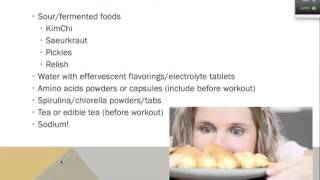
Work well for myself and for some of the clients that I work with. When it comes to not eating calories during that fasted window, I like the concept of using sour or fermented foods. We do a lot of fermentation here at our house, so we make kimchi and sauerkraut and pickle. And I know that's really a core part of Paul's perfect health diet as well.
And a lot of times when you're craving food, simply having a little bit of kimchi or sauerkraut or a pickle.
For example, can really help to shut down appetite cravings when you're in that 12 to 16 hour fasted window where you're doing something like a 24 hour fast.
Paul mentioned electrolytes. I'm also a fan of using water.
For example, I have a sodastream countertop water maker that injects carbon dioxide into the water and kind of makes the water bubbly.
And a lot of times I'll add.
An effervescent electrolyte tablet to that. There are companies such as Noon makes one called EU Hydration, that's a natural stevia flavored electrolyte tablet. There's another company called Goo that makes one called Goo Brew that's again, it doesn't contain sucralose or artificial sweeteners. It's just a naturally flavored electrolyte tablets. Those can really help to quell the appetite. I use those quite a bit when I'm traveling as well. For example, on an airplane I mentioned amino acid powders or amino acid capsules and those can especially work well if you find yourself getting very, very hungry. When you're doing like a fasted fat burning workout, they simply send a message to your brain brain that blood levels of amino acids are a little bit higher and so it doesn't really need to be in quite so much of a catabolic state. I mentioned that I like greens. So like spirulina or chlorella powders or tablets, those can work pretty well at quelling the appetite. When you're in a fasted state, they're typically very low in calories and so they don't really pull you out of that fasted fat burning state.
So much tea or edible tea they.
Make edible green tea or regular green tea for example, works very well.
I'm not quite as much of a.
Fan of Caffeine, it can be a little bit too much of an adrenal stimulant in many cases.
And then sometimes what you'll find is.
That especially when you're launching into a program such as, for example, the Perfect Health diet, where you may not be eating as much carbohydrate as you're used to. You know, if you're used to doing lots of pastries and things of that nature, when you shed carbohydrate, you tend to shed water and shed electrolytes and shed sodium along with that. And sometimes you may need to add a little bit of extra sodium into your diet if you find that you're getting dizzy or getting low blood pressure. Some people think it's because they're bonking from low carbohydrate, when in fact it's just a sodium issue. And you need to add a little bit of, for example, like a Himalayan rock salt to your diet. Or I even know some folks who will do bouillon cubes to add in a little bit of extra sodium, but kind of a few different ways to skin the cat there. But ultimately those are some of the strategies you can use if you do experience appetite cravings during some of these fasted scenarios.
Now, we're going to jump into pillar two here in just a second, but before I do, any questions from anyone about the.
About the fat burning, finding your fat burning zone or kind of how you would use those fat burning workouts.
I.
Think that was great.
Are you familiar with Phil Maffetone and his running advice?
Yes.
And that test that I described, and.
Phil's a friend of mine, is very similar to Phil's math protocol or math test.
Yep.
He has a simple rule for the fat burning zone that works pretty well. Just take your age and subtract it from 180 heartbeats per minute. And that seems to work pretty well.
Yes, that is an even easier way.
To approximate your fat burning zone.
I've found that the testing can pinpoint a little bit better when we're actually.
Comparing to laboratory values. Because when I ran the lab, what I would do is compare some of the values we'd get from field testing versus simple equations versus actual lab testing.
If you're able to do the bike ride or the treadmill for 20 minutes.
You might get a number that's a.
Little bit closer than the 180 minus age.
And that 180 minus age, though, can.
Work pretty well if you just want to get something quick in a pinch or get a ballpark number for sure. Absolutely. And Phil Maffetone has some great programs as well. Good guy.
Right now, I find for my own personal running, I like even simpler cues. And so what I tend to focus on is pace of breathing. And if you can breathe entirely through your nose, that limits the amount of oxygen you can get in. That ensures that you're in a fat burning mode.
Pretty much.
Another cue is while running.
It'S usually a good thing to breathe rhythmically, and it's a good idea to exhale when your left foot is hitting the ground. And the reason is if you exhale when your right foot hits the ground, you'll compress your liver, and that can cause pain. A stitch in the side.
So I find if I'm exhaling every third time my left foot hits the ground, that pretty much matches the fat burning heart rate. And if I exhale every second time my left foot hits the ground, that's more akin to the sustainable aerobic pace.
That's a really good point, and it's kind of funny. Paul and I have never talked about this. I had no clue that he was a fan of either of the two concepts that he just described. But I actually have two books that I recommend to just about every, especially every endurance athlete that I begin to work with. One is called Mind Body Sport by John Douillard. And it goes into that nasal breathing concept quite thoroughly. And there are things that even go above and beyond just being able to maintain your aerobic race, such as lower cortisol when you're breathing nasally. And that's a really interesting book to teach you some of those breathing concepts. And then as far as the rhythmic breathing, there's another book out there called Running on Air. I think it's called by Bud Coates.
Bud B U D D Coates.
C O A T E S. And it teaches you those rhythmic breathing protocols that Paul is talking about. Both those books are excellent books if you want to delve into that a little bit more thoroughly. But that's really cool, Paul, that you're a fan of both those concepts. Those are two things that I rely on quite a bit in my own training as well.
What was the first book called again?
The first book is called Mind Body.
Sports, and it's an interesting book. It goes into concepts above and beyond simply nasal breathing, such as there's things in there like ayurvedic typing for the type of exercise program that works best for you from an ayurvedic body typing type of standpoint, and some concepts that I don't personally use and then others that I do, such as the nasal breathing and the power breathing and some of the other things that he teaches in there. So it's a really good book.
All right, well, cool. Let's jump into pillar two, the Best Workout for Fat Loss so let's say that you actually want to go to.
The gym and you want to lift weights, or you want to lift weights in your home gym or in some type of an exercise setting.
Well, the question is, what kind of.
Workout is going to get you the most bang for your buck when it.
Comes to burning the most fat while.
At the same time building muscle or maintaining muscle? Because of course the last thing that you want to do is burn fat, but at the same time lose muscle and get that kind of gaunt marathoner type of look that really isn't all that healthy. You need to be careful that you actually keep some muscle on your body because muscle is youth. It protects your joints, it protects your ligaments, it helps to maintain your metabolic rate, and it's good to have a little bit of muscle.
There are two different options when it.
Comes to the best workout for fat loss, and both are kind of variations of of a study that was done at the University of California. And I talk about this study in a post that I wrote over at the Huffington Post. I put the URL down there. I just made it into a shortened URL. If you want to go read in more detail, it's@tinyurl.com huffpostfatloss and I have a link there to the original study upon which these other options are based.
But the idea is that you've got a couple of options when it comes to the type of weight training workout.
That'S going to get you really good results when it comes to fat loss, especially your post exercise, metabolic rate, muscle retention, things of that nature.
So the first option is what you can see here. What you do are four to six different full body movements. And you do these in a circuit.
Which means you go from one exercise to the next to the next, next.
To the next, with minimal rest between each exercise and what's called a cardio boost at the end of the circuit. So for example, you can see what.
I have here is you would start off with something like an upper body pushing motion, such as a chest press on a machine. Or a push up would work anything where you're pushing with your upper body. And then you go to an upper body pulling exercise, such as a pull down or a pull up or a row or anything where you're pulling, and then you move on to a lower body pushing exercise, such as a squat or a lunge or a leg press or something of that nature. And then to a lower body pulling exercise. And this would be a deadlift, for example, where you're lifting a weight off the ground, or a leg curl where you're curling your legs on that laying down machine. But some type of a lower body pulling exercise, some type of a core exercise. And I'm a big fan of avoiding crunches and doing core exercises that involve a little bit more of your whole body. One that I like is called a cable torso twist, where you're holding onto a cable and twisting from side to side.
And then you finish off that entire.
Scenario, four to six full body movements.
With a cardio boost.
For example, you go hop on a bicycle and you do two minutes of bicycling on a stationary bicycle as fast as you can. Or you do that on a treadmill or an elliptical trainer or a rowing machine or anything like that. Or you could even just do jumping jacks or jumping rope or running in place. If you don't happen to have a cardiovascular machine handy. Now, you would go through this entire scenario three to four times through. Use about 10 to 15 repetitions for each exercise and use minimal rest. As soon as your breathing is under control and you're able to maintain good form, you simply move on to the next exercise. So you spend very little time sitting around.
Now, one very important thing is that.
You use an appropriate weight. What studies have found is that unless someone is under the supervision of a personal trainer, they tend to choose a weight that is too low for most of their exercises, A weight that's too low to stimulate an actual muscle fiber response, or what is really muscle fiber tearing. When you lift weights, you get a little bit of muscle fiber fiber tearing. And when that repairs, your muscle fibers will grow and you'll develop that strength that you're looking for or that tone that you're looking for. Now, what I recommend that you do to choose the appropriate way is the rule of three.
Now, here's how the rule of three goes. If you can do any more than three repetitions over and above the recommended number of repetitions, then the weight that.
You'Re using is probably too light.
So in this case, If I recommend 10 to 15 repetitions and you're using.
A weight, say for your squat, that allows you to get to 18 repetitions.
And keep on going, you probably need.
To add some weight.
And if you can't even get within.
Three repetitions of the low end of.
That range of 10 repetitions.
So if you choose a weight and.
You can't even get up to seven, then you probably need to lighten the.
Weight a little bit.
It's just a very simple rule.
I call it the rule of three to choose the appropriate weight.
And it lets you get pretty close.
To a ballpark weight for using the correct weight. The way that weight training should feel.
Is that you should feel some fatigue.
And your form should begin to suffer and you should begin to have a little bit hard time completing a repetition. When you're getting close to or at the repetition range. That's right, recommended for the actual workout.
And if you can just keep going.
And going and going, you need to add a little bit of weight.
If you can't even get close to.
The number of repetitions recommended, you need to take away a little bit of weight. So that's option one for the best workout.
For fat loss, option two is kind of similar, but it's just a little bit different. So for option two, you're going to use a combination of what are called supersets with cardio boosts. Now, even though this one can be.
A little bit more confusing at first glance and may seem a little bit.
More advanced for me using this approach.
I prefer it a little bit more when I'm working with my clients. I also find that when I'm doing it for myself, time seems to go by faster during the workout.
It's just fun. So a superset simply means that you.
Do back to back exercises with minimal rest.
Typically, those back to back exercises are.
Working opposite body parts or opposite muscle systems.
So an example for this would be you do a standing overhead press where.
You'Re pressing a couple of dumbbells or a barbell overhead, and then you combine that with pull downs. So first you do your standing overhead press, and then you do your pull downs.
And then immediately after you've finished the.
Set of the standing overhead press and the set of the pull downs, you.
Move on and you do a quick cardiovascular burst. And even though I didn't put, I.
Forgot to write on this slide the length of time for that cardiovascular burst. Typically, it's shorter than what you saw in option one. In option one, I told you at the end of the circuit to go and do like two minutes of riding the bike or something like that for the cardio burst.
In this scenario, option two, typically just.
About 30 seconds, a maximum of 60 seconds is fine. So, for example, you do your overhead Press, you do your pull downs and then you do your set of jumping.
Jacks, quick rest and then you go.
Back and do it again standing overhead, press, pull downs, jumping jacks, then you.
Go back and do it again. You're going to go through that superset with the cardio boost three to four.
Times and then move on to the next superset, which would be for example, like squats with leg curls and then 30 to 60 seconds on the treadmill and you go through that scenario three to four times. Then you go through the next scenario, chest press with seated row to bicycle three to four times. And you use the same number of repetitions as you did for option one. About 10 to 15 repetitions is fine. That's what we call the hypertrophy rep range. And all that means is that it allows for some growth of muscle fibers. You use the same concept of minimal rest. So you always want to maintain good form. You never want to feel like you're going to pass out. But at the same time you aren't using kind of the old school gym method of sitting around reading a magazine between sets or something like that, which is really, really nice for building maximum strength if you're a football player trying to develop power, but isn't all that great for burning lots of fat while you're working out.
And that's basically the scenario for option two. So either option one or option two.
Works really, really well.
It maintains a good post workout metabolic response rate. Don't get me wrong, these are relatively difficult workouts. And in just a second, because I.
Do realize they're difficult workouts, I'll lay out kind of a sample scenario for.
You of what it would look like.
To put these into a typical week, because these definitely aren't the type of things you're going to be doing every day.
But.
Before I do that, before I talk about how to work those into.
A typical week, any questions on those.
Two options that I just went through? Option one or option two for the weight training workouts?
No, I think.
Those are pretty self explanatory. Here at the Perfect Health Retreat we use a lot of body weight type exercises.
So natural type movements like good morning bends, squats.
Pull ups, you might be familiar with the Primal seven movement system which uses straps to support a lot of these movements so that people who are in poor condition or who are disabled in some way can still perform the basic movements. And they're good because they cover a lot of core strength. Nearly everything is done with a straight spine and they move through all of the major joints and the major muscle groups. So deadlift type movements, squat type movements, pushing, pulling type movements.
Yeah, I love suspension straps. The Primal 7 is a good system.
I'll toss another couple of resources at you that you might find fun to explore for some extra movements.
One would be the book Paleo Fitness.
I believe it's called. It's written by Darrell Edwards, who's better known as the Fitness Explorer. He shows up at a lot of kind of like ancestral Paleo type of conferences, like, like the Ancestral Health Symposium and Paleo Effects, and usually teaches some movement sessions at those. And they're typically like outdoor body weight only play type of sessions. He has a book called Paleo Fitness that has some good movements in there. And then there's another really fun thing I've been playing around with with my kids.
It's called the Safari Fit phone app. And it is a.
A bunch of exercises named after animals like the lion and the gibbon and.
The squirrel, the lizard. And basically it simulates these animal movements and lets you create your own circuits or lets you choose from preset workouts that are kind of similar to the circuit type of workouts I just described. Both of those resources are kind of fun if you like the concept of bodyweight workout workouts. And I'm a huge fan of ensuring that you're never limited to necessarily having to go into a gym to work out. Now, the two examples I just gave do indeed use traditional gym equipment, but yeah, you can certainly use body weight as well, and that works quite well. Or suspension straps.
All right, so pillar number three. Pillar number three. Three would be. What you want to do is about two to three times a week you want to toss in a few cardio interval workouts. Now, these are far different than the.
Type of fat burning exercises that I talked about or the fat burning zone workouts.
High intensity cardio intervals are where you're going really, really hard and then recovering and then going hard and then recovering and going back and forth like that for several repetitions.
So for, for example, some of the ones I've written down here would be 30 seconds hard and then 2 minutes easy, 8 times through, or 1 minute hard, 4 minutes easy, 4 times through.
Or 2 minutes hard, 1 minute easy, 5 times through. Now these are something that I find.
People tend to overdo.
You'll feel after you've done cardio intervals.
Like this, like you've just done something like say, like CrossFit workout, which is.
Actually pretty difficult on your nervous system. Now, what research has shown is that.
It takes about 72 hours for your nervous system to fully recover from this fight and flight type of workout, this running from a lion type of cardiovascular interval workout.
So I'm not really a fan of doing these any more than two to.
Three times a week. Some people try to do high intensity interval training every day and they end up burning, burning themselves out.
But if you just toss in two.
To three times a week, some kind.
Of sprinting session, some type of high.
Intensity cardio interval session, whether on a.
Bicycle or on a treadmill or something of that nature, it can really, really.
Accelerate the response when it comes to.
Production of your fat burning hormones as.
Well as your post exercise metabolic rate.
And so I combine those along with the two different kind of best workout.
For fat loss options that I showed to you along with the exercise done in the fat burning zone.
And that's a really really nice scenario. And it looks kind of like this once we put it all together in a sample fat loss week. So for example, here's what a sample.
Week would look like that I would write out for someone for fat loss.
On a Monday we do fasted 15.
To 30 minutes of morning cardio and.
Then in the afternoon or the evening.
We would do a weight session similar to for example what I outlined in option one for the best workout for fat loss. I tend to like to encourage folks to do the harder stuff in the afternoon or the early evening just because not only is your body temperature a little bit higher than but you also tend to have higher post exercise protein synthesis. When you finish up an afternoon or an evening exercise session, all that means is that your body is better able to take the meal that you eat after the workout and use it to help your body to repair and recover.
So I'm a big fan of easy.
Stuff in the morning, harder stuff in the afternoon or the evening. Maybe that's also because I just hate to roll out of bed and go do something hard. I'm a slow riser.
So Tuesday you could do the same thing.
You could do a fasted 15 to 30 minute morning cardio session in your fat burning zone. Again, something easy like walking the dog.
And then 15 to 30 minutes of.
Cardio intervals like those high intensity interval sessions that I just got done showing.
Wednesday you could do the same type of thing as Monday, but you could.
Use something like option two instead of option one when it comes to the best work work out for fat loss. So you could lift weights again on a Wednesday.
Thursday could be the same as Tuesday. An easy morning fat burning session and.
Then an afternoon interval session. But you could do a different kind of cardio interval session. So if you used, for example, one minute intervals on Tuesday, maybe you'd use 30 second intervals on Thursday.
Friday you could repeat Monday's workout.
And for people who are just getting started, I like to include more than one off day. So sometimes Friday might just be yoga or an easy movement session or something very relaxing and restoring. Saturday would be, for example, that longer fasted fat burning session, like a 90 minute hike without having eaten in your fat burning zone, that type of thing.
And then I like to use something.
Like a Sunday as an off day or perhaps as a makeup day if you weren't able to make it in for one of those sessions, one of the other days.
But that's just a sample of how you put together some of the things.
That I just went over in terms of the three different pillars.
As you can see, that week kind.
Of works in each of the different components of fat loss that I just got done explaining.
And so that's what a sample fat.
Loss week would actually look like.
Putting together some of these concepts. Now, I wanted to get into real quick pre and post workout fueling.
And I know.
We'Re.
I think close to an hour for this session. I want to make sure I respect everyone's time.
But any questions about that sample fat.
Loss week or about anything I just talked about in the past couple of slides?
I just mentioned that we don't, we don't have a time limit here.
If you. Okay, cool. All right, great. Then I can just keep on blabbing.
Okay, well, let's jump into pre and.
Post workout nutrition because I know that that can be confusing sometimes when we talk about all these different workouts, how to eat before, how to eat after.
I know that there at Albert Oaks.
And again, for the, those of you who are watching the recording of this and may not be familiar with Elbert Oaks, don't worry. We'll explain more towards the end of this presentation about how you can kind of get plugged into that.
But in terms of how to fuel these workouts, I want to mention to you that often pre and post workout fueling is just overemphasized. A lot of times people are burping.
Up their pre workout meal, launching into.
Their post workout meal and just stuffing their faces in and around their workouts because they're relying on trickle down advice.
From the bodybuilding community or from the marathoning or ironman community or these type.
Of communities or demographics for which eating.
Is important because you're going through a.
Huge amount of calories and really depleting.
Your body and doing these extremely difficult workouts and spending four hours a day in a gym.
But in reality, most of us really.
Don'T need to be focusing as much on pre and post workout fueling as we've been led to believe.
So I just have a few simple.
Rules that I try to follow.
First of all, if you're doing a fasted workout, let's say you're rolling out.
Of bed in the morning and you've gotten that 12 to 16 hour fast.
In and you're doing a fasted workout, I generally recommend you eat within about.
60 minutes after that workout.
And the main reason is because of compensatory eating. And what I mean by that is that a lot of times if you're.
Waiting a really long time after you've.
Done a fasted workout, you end up.
Getting really, really hungry.
And by the time you actually do eat, you often make poor food decisions.
Or you eat more than you actually should or more than would be reasonable.
And so I generally recommend that if you're doing a fasted workout, you eat.
Within about an hour after that workout.
The nice thing is that that also is a window in which you tend.
To be relatively insulin sensitive. And so, for example, carbohydrates that you might consume with that post workout meal.
Are going to be a little less.
Likely to cause a very large release of insulin by your pancreas. You tend to be able to uptake glucose into the muscles a little bit more effectively when you eat within that post workout window.
And so I do recommend that you.
Eat within about 60 minutes after the workout. Now that could simply be your next real meal. So for example, if you're doing a.
Fasted workout, it'd probably be breakfast and it should preferably include some proteins and some carbs. And in many cases, I would caution.
You against using the shake or the smoothie approach.
And the main reason for that is because I run a lot of times.
Into the issue of when people are.
Doing a shake or a smoothie. They're beginning to rely upon what I.
Call engineered Frankenfoods where they make all of these different recovery powders and blends that you might pick up at like a GNC or a health food food store. And if you really look at the label, it's basically just pure sugar, like glucose or maltodextrin or fructose combined with a relatively subpar protein source in many cases, just like kind of a whey protein derived from a commercial cattle source. And you know you want to be careful with these engineered post workout blends that are marketed a lot of times as the perfect post workout recovery shake or the perfect post workout recovery smoothie or the 800 calorie Jamba juice style smoothie you might grab on your way out of the gym if you happen to be a member of a health club with a smoothie bar. So I'm a big, big fan of just kind of timing your fasted workout so that your post workout meal is just your next real meal. You be really careful. If you are going to do a shake or a smoothie, do it like I do it and get some real greens like kale or spinach and mix that up with maybe a handful of nuts or some coconut milk and make sure that your shake is real food and not some engineered blend that you bought at the GNC or wherever.
Rule number two would be that if it's not a fasted workout and you've.
Had breakfast or you've had lunch, you've had dinner and say you're working out at 10am or you're working out at 3pm, you've already got food in your system from your last meal. Don't really worry about eating after your workout.
You don't have to prioritize it that much. You've already got amino acids and sugars.
Floating around in your bloodstream.
You've got what you need to recover. The only reason you'd worry about eating.
After a fasted workout or after a.
Non fasted workout would be a if.
You'Re trying to build muscle, maybe you're just trying to get big. You want to get some big arms or you want to build muscle. Maybe you're skinny and you want to put on some size. That's a case where eating a post workout meal can actually come in handy and help you to achieve those goals.
The other issue would be if you.
Have blood sugar issues.
Maybe you haven't had a really good.
Diet for a while and your body is not very insulin sensitive and you tend to have a lot of blood sugar fluctuations. You tend to you tend to get hypoglycemic really easily.
You might be going through a period.
Of time in your life for which a post workout meal would actually make sense. Maybe you need a banana and a handful of almonds or something like that. After your workout you'll know you'd be that type of person who gets dizzy. Or maybe if you measure blood glucose, it drops really low after workout, or you have some other blood sugar fluctuation.
Issues, and sometimes those go away after.
You'Ve kind of gotten your diet under control. But in the short term.
Sometimes you.
Do have to eat after a workout.
Even if it's not a fasted workout per se. So you might have lunch at noon, workout at 3pm and find that rather than waiting until eating dinner at 6pm, you need to eat right after that workout at 4pm and.
That just might be the case for you based off of blood sugar fluctuations.
Now, finally, if the workout is really.
Long, let's say you're training for a marathon or an Ironman triathlon or something like that, so you're going out and you're doing workouts that are two plus hours in duration, then you want to.
Actually eat during that workout.
The reason for that is because if you get into the period of time.
During a workout for which you've completely.
Exhausted your muscle glycogen storage and often.
Your liver's glycogen stores, and this would for most folks be about two hours.
Or two plus hours, it can get.
Really stressful on your body to continue to work out past that point in a fasted state.
And so in that case, you know.
You might have a Ziploc bag full of some raw seeds and nuts, or you might have some chia seeds mixed up and soaked in a water bottle, or you might have some dried fruit.
Or something like that that you take.
Out there with you, you if you are on a really long hike or a really long bike ride or a long run or something of that nature. So if you happen to be one of those few people who is doing very long workouts like this, then eat during the workout.
And again, I don't recommend that you.
Eat engineered franken foods like sports gels and sports drinks and Gatorade and things of that nature.
I'm a bigger fan of just getting real food.
It tends to be more nutrient dense.
It tends to be a little less.
Prone to cause things like advanced glycation end products and reactive oxygen species and a lot of the other issues with pure sugar intake.
And you can just eat real food during those type of hikes and long workouts.
I even have some clients who will do things like pemmican and beef jerky and things of that nature when they're out there just stuffed in the back of their bike jerseys, etc. You know, I should emphasize that I'm not a huge fan of super duper long workouts unless you really are training for a Marathon or an Ironman or something along those lines.
But in those cases, once you exceed.
Two hours, it's a good idea to have some food out there with you, some nutrients out there with you because it can be stressful to your body otherwise. Or you might find that you just bonk and you have a hard time getting home unless you do have something to eat with you.
Questions about pre and post workout fueling.
Now, can you go back to the previous slide? There were a couple of bits of it that I missed copying down that.
Part about the sample fat loss week. The week?
Yeah, that one.
Yeah, certainly.
And you know, the other thing that.
I should emphasize is that since we're recording this, I'll of course, for anybody watching this, we'll make sure that we've got the slides available up on SlideShare and, and you can go back and take notes more if you'd like.
But any specific questions about that week?
A way that helps me learn as well. So even if I'm going to see it again.
Yeah, sure.
So yeah, that's what a sample fat.
Loss week would look like.
And.
We talked a little about the.
Pre and post workout fueling. Am I okay to move off of this slide?
Yes, go ahead.
Okay, so.
I did have a few sample meals.
So for example, if you were going to do a really, really hard workout and you were going to eat prior, I'm a fan of doing something like amino acids and a little bit of fruit. Sometimes I'll do something like that before a very hard workout or an easy to digest carbs such as a sweet potato or a yam, 20 to 30 minutes beforehand or a real meal like two hours prior to the workout. Now after a very hard workout, a lot of times I'll do a real food source such as a protein shake that's actually from a very, very good source with nuts or fats, coconut milk, things of that nature. Or again, a real meal. And then as far as sources during the workouts.
Like I mentioned, I'm a big fan of real food like trail mixes and things of that nature, avoiding sugary engineered foods. And I also will sometimes use, if I'm going to use carbohydrates during a long workout, a really slow release fuel.
Such as Superstarch or something along those lines. Now.
I know that for example, at the Perfect Health Retreat, you guys are really learning a ton about nutrition down there. And so I don't want to deemphasize some of my slides on nutrition, but I know that you're very steeped in it there.
You'Re going to get a.
Lot of education there as far as eating and things of that nature. And I want to make sure that I really focus more more on the movement protocols and things of that nature in this particular presentation. So.
Let'S go ahead and.
Oh, we're going to go on to.
I apologize. I did have one other pillar here that I wanted to focus on. So pillar number three.
Sorry to confuse the issue, but I.
Didn'T know my own slides right there. Pillar number three is actually the concept of moving.
The other pillars. The first pillar was finding out your fat burning zone and doing fat burning workouts. The second pillar was doing the combination of weight training along with use of cardiovascular intervals. And then this final pillar is going to be basically moving and this one is going to be really straightforward and intuitive.
I don't think we're going to need.
To spend a ton of time on it.
But basically the concept is that rather.
Than you simply thinking of exercise as I started off this presentation by explaining, rather than you simply thinking of exercise as, you know, canned exercise sessions such as what I've just described to you, in these brief periods of running from a lion or stepping into a gym or something of that nature, you want.
To make sure that you really kind of simulate that whole kind of hunter gatherer, constantly moving type of approach if you want to get the most bang for your buck and the fastest results.
When it comes to fat loss and keeping your metabolic rate elevated.
So there are some strategies that I.
Personally use and that I recommend that all my clients use when it comes.
To incorporating movement throughout the day without.
Necessarily engaging in structured exercise sessions.
So for example, I've been standing the.
Entire time I've been giving you this presentation because I have a standing workstation.
And I stand when I'm at the.
Doctor'S office, I stand when I'm waiting in line anywhere. I stand a lot of times during almost the entire flight on airplanes, I.
Stand because when you stand you up.
Regulate the activity of fat burning enzymes.
Such as lipase, and you keep your.
Body more metabolically active and burn more calories.
So whenever you're able to, I do recommend that as long as you're able.
To maintain good posture, you stand.
So I'm a huge fan of standing.
Workstations and spending lots of time on your feet.
Now I also have some clients who have actually set up treadmills and there are special types of treadmills.
There's one called a Trek desk, for.
Example, that allow you, if you have.
For example, an office job or a desk job or a writing job or.
A computer job to walk. And I literally have some folks I.
Work with who by the end of.
The day will have walked anywhere from four to seven miles during their work day at a very slow pace. And they end up kind of burning calories almost effortlessly throughout the day, simply with that little bit of time that they spend standing and moving, literally walking. I know that for some people, a.
Treadmill workstation might not be a reality, but if you're able to get one of these, they can work really well. Also some type of a treadmill workstation. Trek Desk is one company that makes these.
And then for just standing desks in.
General, there's another company called Up Desks.
That makes a good one, the Lotus One workstation.
Lotus. Lotus Workstation is another good one. I'm personally just standing at a big cupboard, just an old cupboard that's in the corner of my office. And I don't have anything fancy, but I just have my computer perched on top of it and my microphone perched.
On top of it.
And that works fine for me. So kind of more than one way to go there, but moving.
Another thing that you can do that.
I hinted at was wearing a weight vest or wearing ankle weights during the day.
And you got to be careful because.
These can get a little bit stinky, a little sweaty, a little gamey. If you're not careful. You can use a little bit of baking powder, for example, or something along those lines underneath to make sure that they're not getting too sweaty and clammy.
But wearing these type of things throughout.
The day, or while you're out on.
Walks, or while you're gardening, or while you're working around your house, anytime that you make yourself weigh more, you're going.
To burn more calories. And these can work very, very well for that.
Be careful running, bicycling, doing things like that.
Wearing weighted vest or weighted ankle weights because they can affect your biomechanics. They may increase your risk of developing, like a chronic repetitive motion injury if you're not careful.
But as long as you're able to maintain good form, and especially when you're just working around your house, these can.
Actually come in really handy as a little bit of a biohack, so to speak, for accelerating weight loss and burning extra calories. So weight vests and ankle weights very easy to find at a sporting goods store or online, and they make them anywhere from 20 all the way up to 60 plus pounds, especially for the weighted vests.
I mentioned. Briefly that I'm a fan of. When you're in a fasted state doing some form of cold thermogenesis, on the.
Upper left there you can see what's called a cool fat burner vest. I actually wear one of those several mornings a week. Many of my clients use this as well. It's simply a vest that allows you to place cold ice packs over areas where you would have high amounts of metabolically active what is called brown adipose.
Tissue or bat, and that burns calories to generate heat.
And it's another kind of hack that you can use to help your body to burn more calories. I personally take an icy cold shower for five minutes in the morning and.
Five minutes in the evening.
And as a matter of fact, alternating.
Hot water with cold water can accelerate.
The results of a cold shower even more when it comes to fat loss.
Because of the the quick back and.
Forth with blood circulation that occurs when you do that.
You can even go outside in the cold weather.
There is a friend of mine named Ray Cronice and he's a big, big fan of using cold thermogenesis for fat loss.
And he does shiver walks where he.
Walks a mile and you could do this in your fat burning zone.
And he simply ensures that he's walking in a cold, cold environment and shivering.
A little bit as he's walking.
I personally, even in the winter will go out on my back porch and do yoga and just expose my body to some fluctuations in temperature. Sleep with just the sheets, keep the.
House a little bit cooler than 70 degrees.
Do things that cause your body to have to burn calories to generate heat. And this can be another way to help you to burn a few extra calories.
It's just a form of movement shivering and the generation of body heat, the burning of calories to generate heat.
I mentioned that fasted workouts you should.
Be careful with if you are adrenally fatigued.
I'd say the same for this type of thing.
If you're in a state of adrenal fatigue and you know that you're really stressed out and beat up, sometimes cold exposure can be a little bit tough on your body.
But as long as you're not in.
That state, this can be another really, really, really good tool that you can use to burn a few extra calories.
I'm a fan of also what I call greasing the groove.
So I rarely drive my car. I'm in my car about once a week. I take my bicycle or I also have a stand up elliptical trainer Everywhere to the grocery store, to the library, to the gym, anywhere I go, I have a pull up bar as the one you can see shown here in the door of my office. And my rule is that every time I walk underneath it, I need to do five pull ups. I have another rule that every time I go and use the restroom, I need to do 20 body weight squats.
These little rules thrown throughout the day, what I call greasing the groove, can really help you again, burn extra calories and keep your muscles stimulated throughout the day without you necessarily doing a structured workout session. And it's very important that you try and get certain periods of time during the day where you're just moving. And for me, the way that I.
Do it is I just have rules set up. Like if I go to the grocery.
Store, I just have to ride my.
Bike or take my elliptical trainer to the grocery store. And I have a big backpack that I can put all my groceries in. I actually don't use panniers like you can see pictured here. That's not my bicycle, but that'd be another option if you wanted to do that. And I have that rule that I have to do 20 squats every time I go to the bathroom. I have the rule that when I walk underneath the pull up bar in my office, I have to do my five pull ups.
If you have little rules like this that you can work into your day.
It can really help you to burn some extra calories and to again, kind of simulate that whole kind of hunter gatherer type of approach throughout the day where you're constantly moving. Kind of like my father in law I was talking about, who just ranches all day but never actually steps foot into a gym.
So those are some of the ways that you can engage in pillar three.
And move a lot.
So before I jump into some final.
Resources that I wanted to give you guys, any questions about that whole concept of movement. I know it's pretty straightforward, but I want to make sure I pause here and let you ask questions. Or if Paul or Damon want to throw anything in, they can. Go ahead.
All right, so I just thought I'd comment quickly a little bit about.
The cold. Thermogenesis might be a point of a few differences in our protocols. So for us.
The strongest emphasis is on circadian rhythm entrainment. And ambient temperature is actually a circadian zeitgeber, meaning it's a time giver to the body. And what's desirable is to have warmer ambient temperatures during the day and colder ambient temperatures at night.
So ideally, most of the day you'd be exposed to temperatures of like 75 degrees or above and most of the night to temperatures below 65 degrees. And.
You know, so I would say time of day that you do those types of things is important. Any kind of cold thermogenesis should be done late at night, early in the morning, you know, just before or after bed.
And in general, in the middle of the day, you should see warm temperatures, more heat exposure on short timescales, quickly alternating between heat and cold is very well attested. So, for instance, moving back and forth between a sauna and a quick shower can be beneficial with just a minute in the cold shower and four minutes in the sauna and back and forth.
Or to a hot tub or something like that.
And I strongly endorse, you know, all that you said about those simple movement cues, you know, so we've been trying, while we've been listening to your talk, to do little yoga stretches and, you know, keep moving. So if you're doing an activity like reading, there's no need to be sitting in a chair the whole time, especially if you have a laptop. You can get on the floor, do simple floor exercises, stretching, mobility, work while you're reading.
And even if you're just squatting, so it's like being seated, but as long as your weight is not on your butt, it's on your feet, then you're going to be activating those lipoprotein, those lipases that Ben mentioned, and you'll be burning fat, so you don't even have to be standing. You can be in bent, folded postures, but just be activating your muscles to maintain balance.
So if you're squatted down on your feet and you've got your laptop on the floor in front of you and you're reading and you just rock a little bit.
You'Ll be getting just as much good, and I think it's good. Divvy up the day and try to spend as much time in highly folded postures as you do in extended postures like standing and get in a diversity of positions through the day.
That's all really fantastic. And actually what Paul mentioned about cold thermogenesis, I'm really excited about that because that's new information for me. I love to hear about new things that I'm not familiar with yet. And so that's really, really interesting. Paul, thanks for sharing that about cold thermal. I'm going to have to now go and look into that a little bit more and maybe I might be picking Your brain after this presentation about that. So excellent information.
Let me, the innkeeper, speak here a moment. We try to do a lifestyle that people can continue when they leave. And in Texas, getting us down below 65 in the evening is going to be very economically challenging here or away. So I'm thinking maybe cold showers at night might help.
Yeah, that can definitely accelerate things. Also, if you blow a fan, if you sleep without blankets and you have a little fan blowing some air over you, that gives you a sensation that's cooler than it is.
I have a personal difficulty falling asleep when it's colder than 65, even colder than 70. I just. I sit there and shiver in bed and cannot fall asleep.
So.
Yeah, right. Well, you want to find the right temperature that works for you, and you may be a little bit hypothyroid or nutrient depressed. So we'll work on that.
Actually, most people find it easiest if you're in good health. Most people find it easiest to sleep between about 60 and 65 degrees. And high temperatures actually prevent sleep. So if you've ever been in sweltering conditions without air conditioning, then you'll know it's very hard to fall asleep in those conditions.
My sweet spot is somewhere between 70 and 73. If it's warmer than that, then I have a hard time, but it's colder than that. I wouldn't mind sleeping under 65 if I would fall asleep first and then the timer would make all the temperature go down. So my body was colder once I'm asleep. But I can't actually fall asleep while I'm trying to generate our energy.
So this is exciting and stuff that you just didn't hear about a couple of years ago. So we'll be anxious to hear what you learn more and we'll share what we learn more on these new concepts as we go along.
Yeah, I love it. And I know that we have some.
People listening who may not know who.
Damon or Paul are or who may not be familiar with some of the other folks listening in and where they're at as you're hearing this live conversation.
And so I want to make sure for those of you, both those of you watching live, as well as those.
Of you listening to the recording, kind of get filled in on some other resources and also learn more about the Albert Oaks Perfect Health kind of immersion.
Down there in Austin. So let's go through a few additional.
Resources here to wrap things up.
So, first of all, in an act.
Of shameless self promotion, I of course have to make you aware that I Have a podcast and a free newsletter, articles, videos, things of that nature. Some people think it's just for elite athletes and triathletes. It's. It's not. I try and keep stuff palatable to the, to the general population, too.
But that's over@bengreenfieldfitness.com and the podcast is on itunes. I also have another podcast as well as a book that you can tune.
Into@Getfitguy.Com and that's just a really short 5 to 10 minute podcast that I put out weekly. For example, this week's podcast is about.
How to recognize the difference between all the types of different gyms and health clubs and exercise facilities in your area if you're trying to join one. And you know what might be a good choice for you? I just try and put out some really practical tips like that and then also have that book there@getfitguy.com I also.
Like I mentioned, have an inner circle.
And this is just a place where my wife and I teach cooking videos and interactive online webinars and also have.
A forum where we take questions 24.
7 from people who have questions and want a little bit more personal advice. And that's@BenGreenfieldFitness.com innercircle that we do that.
That one does cost.
It's $10 a month. But it's kind of just like a little bit of an extra resource that I put out there for folks who, who want to ask some extra questions.
Now, I also wanted to talk especially to those of you who are watching.
The recording of this, because those of you watching live are at the Perfect Health retreat right now.
But I wanted to mention this Perfect Health Retreat, and I talked earlier in this presentation at the beginning about how you could accelerate the learning curve when it comes to learning how to detox and how to adjust your lifestyle and how to lower stress and how to get better sleep and how to get all of these other big, big wins that even go above and beyond just exercise. Now, many of you watching may be.
Familiar that I personally adhere to.
What'S called the Perfect Health Diet, which is.
A book that's written by Paul Geminet. And I'm relatively immersed in everything from Paleo concepts to low carb to ketogenesis.
The diet that comes closest to what.
I personally follow and my family and my children follow and that I implement in the lives of my clients who.
I work with is the Perfect Health Diet. And so I was very, very excited when I found out that for people who want to really get immersed in the Perfect Health diet. And really not just the diet, but the lifestyle itself.
And this whole idea of living in.
A way that is ideally designed for the makeup of the human machine.
They now do a Perfect Health retreat down there in Austin, Texas.
Wonderful town.
Elbertoaks.com is where you can go to learn more about this 30 day immersion. But it would be a wonderful opportunity for any, any of you listening in who just want to get away and really learn how to make changes that.
Are going to affect you for the.
Rest of your life in a very positive way to be able to just accelerate the learning curve and drop in and join up and they have options.
Where you could just go for the.
Weekend, you could just show up and.
Do a lot of the 30 day immersion kind of, kind of in more of a satellite format where you join in online and then just go here and there during the 30 days.
But the perfect health retreat in Austin, Texas is something I would highly, highly encourage to any of you watching or listening who want to make some lifestyle.
Changes and you're ready to kind of just put your foot down and learn how to do it all, how to cook, how to live, how to basically set up your entire life in a way that allows you to live a long time, burn fat, be healthy and.
Kind of just implement and do everything.
You'Ve always wanted to do when it comes to health, but maybe didn't know exactly where to start or how to do.
So that's@albertoaks.com go to elbertoaks.com and actually going to be down there at Albert Oaks.
March. I believe the exact dates are March 3rd through the 6th. So for the February through March retreat that they're doing, if you're interested in working a little bit more with me, I'll certainly be around then and we'll be there physically in person in that first week of March.
But you can see here that everything.
You'Ll learn there include, you know, dietary principles for each plate that you prepare, what it should and should not include, how to read labels to avoid toxic food, how to order at restaurants, healthy movement techniques, a lot of the things that we just talked about and you know, like the primal seven that Paul was talking about, personal training sessions and.
A local gym membership, learning appropriate lighting.
And activities to do during daytime and.
Nighttime to encourage adequate sleep, a ton of stuff. So I am definitely getting behind this.
Whole Perfect health retreat, extremely excited that they're doing it. So check out elbertoaks.com to learn more about that.
And that about wraps up the presentation for the three pillars of fat loss. Anything else that you guys wanted to add in, Paul or Damon?
Well, I just say one more resource is our website, perfecthealthbiet.com and so there's a lot of resources on diet, on lifestyle and recipes and things like that that people can find. Also an active community of commenters and.
People.
We have a question and answer thread and so, so we welcome any of you who are curious about diet. Come visit us there.
Yeah, that's another great resource. And Paul may have broken up a little bit when he was saying that URL. He broke up on my end. But it's perfecthealthdiet.com where you can learn more about that. And of course, if you don't yet own the Perfect Health diet book, head over to Amazon or head over to Paul's website and grab that. Highly recommend you have that on hand.
Well, Paul, Damon, all of you there at Elbert Oaks, thank you for joining me live today.
Yeah, thank you very much.
And for those of you watching the replay of this, go ahead and head over to Elbert Oaks and you'll also be able to find the slides for this over at SlideShare. And of course you can always email supportengreenfieldfitness.com if you run into any tech issues or you have further questions. Thank you everybody for watching. Best of luck in your fat loss pursuits. Have a wonderful healthy week.
More from Jeffrey





The Solution to Aging Might Be Closer Than Anyone Realizes - With Ben Goertzel


