The Best Way To Test How Healthy Your Heart Is: Carotid Duplex Scan
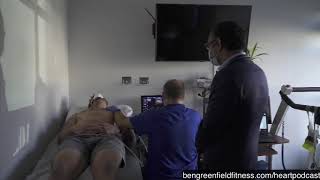
A carotid duplex scan uses ultrasound to spot plaque buildup in your neck arteries before you have a stroke. The discussion covers how ketogenic, carnivore, vegan, and paleo diets affect your cholesterol and inflammation, and why most doctors get almost no nutrition training.
Chapters
Great.
So what we're going to be doing here is called a carotid duplex. This is an ultrasound. The two large arteries in your neck taking blood flow up to the brain.
I don't have a lot of blood flow to my brain.
You'll find out.
What's great about this test is the carotid artery is extremely superficial, so it's easy to see.
And we're able to really get an early look of any buildup on the arterial walls.
And then again, same type of parameters. With the echocardiogram that we did, we have the color, so we can see the blood flow actually going through the artery. And then we have the Doppler, so we're gonna actually get to hear blood flow.
Going through.
So what we see here is.
Actually the artery.
I have a carotid.
And a heart.
So far, I'm two for two.
Two for two.
Are there certain populations that you found to either be surprisingly healthy from a cardiovascular standpoint or unhealthier than would be expected from a cardiovascular standpoint? Dr.
It's a good question. You know, I think what's nice about being in LA is that we see such a diverse population of folks. What's interesting is that some of the folks that have family history that come in and we deep dive and look at some of these parameters, we find that truly there is a significant genetic component with some of the lab work that we see. And so, and then we start to do some of the tests, the ultrasounds and so forth, and we can start to see early disease. So that is somewhere where we can definitely alter the trajectory. If we can get to the disease, you know, five, 10 years earlier, we could make a huge downstream difference.
Yeah.
But, you know, it's interesting. I do see certain folks that have done very hardcore for ketogenic diets, which I know is your area of expertise for you. And interestingly, their lipids can be very alarming. So there's a balance on that that we should certainly.
And the people who I've worked with and helped out with their lab panels who are following a ketogenic diet, I'll often see pretty rampant triglycerides, some amount of inflammation.
With high ldl, which I don't think is.
Sufficient for heart disease, but definitely a necessary component. And a lot of times I'll find that these are the people who are not necessarily achieving ketosis via, say, carbohydrate mitigation, some amount of fasting, good plant intake, and not an appreciable intake of saturated fat. But Instead, people who are doing, you know, the coconut oil bombs and the half a stick of butter on their coffee and just rampant amounts of particularly saturated fats with the absence of much plant matter. And I think there's kind of two flavors of a ketogenic diet. One that is favorable for heart health potentially and one that seems to accumulate a lot of risk factors for heart disease.
Yeah, I tend to agree. I think there's a certain diet type that is optimized to the individual and interplay between gut microbiome and TMAO as.
An emerging risk factor.
So I think it's really fascinating and I think.
There'S still a lot of unknowns.
Yeah, you can fast, you can eat fish, you can have eggs, you can drench some of your vegetables and extra virgin olive oil and still maintain low blood glucose, low glycemic variability and somewhat high levels of circulating ketones, have good health. And then you can also, you know, like I mentioned, just dip a giant spoon in nut butter and coconut oil and butter all day and do it that way. And I think you'll see two different outcomes.
Do you have any opinions on this new trendy carnivore diet a lot of people are following now?
Well, you know, I try to take a balanced viewpoint on all these issues, but I do see some problems that run into again, I see, you know, people are able to keep their inflammation levels down and keep their lipids under control and certain things. I, you know, I suppose they've adapted. You know, like we talked about, there's some adaptation to that type of a diet, but my personal feeling is that.
It'S a little bit extreme. But again, there's really hasn't been.
Controlled data on that and these studies are obviously hard to do.
Yeah.
Again I kind of tend to see the same thing. It could be done right or done wrong. I think there's people eating ribeye steaks from Costco for breakfast, lunch and dinner. And then there's people consuming bone, broth and liver and lots of glycine rich organ meats and kind of taking an entirely different approach. I think the latter is if you are going to use that type of approach just from a nutrient density standpoint.
And you're also limiting the massive amounts of methionine intake you get from just eating muscle meat all day long. And there's some definite linkages between methionine and constant MTOR activation to the extent where you might be.
Limiting longevity to a certain extent.
Yeah. So I think for that diet, more of a, so called nose to tail approach seems to be favorable. It's a very socially limiting diet. No plants at all. It's as difficult to follow.
I see it being of some utility for someone who just wants to eliminate all problematic plant compounds from an autoimmune standpoint short term, but I don't see it being a long term.
At least a strategy that I personally could sustain just because I love our vegetable garden and plant foraging and.
Having a little bit more, more expansive diet.
You know, the same could be said of like a, like a vegan approach too. Right. You could be vegan and have granola and bread all day long or you could, you know, be fermenting and soaking and sprouting and doing greens and shoots and sprouts.
And I mean we always say, listen, you know, potato chips are vegan and a lot of trouble with vegan diets. Oh yeah, it's between the nutritional deficiencies we've talked about, but certainly having that base of whole food plant based eating is, you know, is good. I think everyone agrees on that.
Yeah, nearly everyone. Yeah. Except the, except the, the carnivore population. And I didn't think to a certain extent the paleo diet crowd eschews a lot of things that we know could be metabolically favorable like legumes or.
Grains.
Certain things that I don't necessarily have a problem with if they've been prepared properly.
How do you recommend young folks that are interested in nutrition? What is, what is a way to start? Because it's, it's very confusing and there's a lot of choices out there.
Yeah.
How do, how do people find their, their pathway on this?
That's confusing as dogmatic. If someone were interested in it as a career, then I think the very best thing to do is to, you know, tackle it from a standpoint of.
If you look at the education rather than focusing on nutrition courses or dietetics courses, which are always going to be biased, what you do is you instead take chem biochem, o Chem microbiology and you essentially equip yourself to be able to understand the underlying building blocks of, of what it is you're talking about.
If you start there, even physics to a certain extent, just to understand some of the energetic equations, then you're able to step back and look at any diet. Especially if you pair that with some type of education, anatomy and physiology, rather than simply.
Learning about whatever carbs, protein, fat and the Mediterranean versus the Paleo versus the vegan. I think instead a deep underlying knowledge of the science is going to set you up to foundationally understand any diet if it's something you want to pursue from a professional standpoint.
I think that's the key missing component is a lot of people just don't understand the science behind the actual molecules we're talking about.
That's the issue with nutrition is no matter which route you go from a, from an educational standpoint, there is going to be a certain amount of bias.
And I think in medical school, just thinking back, you know, we had maybe a handful of lectures on nutrition, but it was more geared towards nutritional deficiencies, scurvies and things like that that we don't really encounter, you know, in just modern society. But the true practical nutrition training was really not there.
Yeah, yeah, there's a few organizations. I think the Institute for Integrative Nutrition is one that does a decent job. The iin, they have a good certification that seems to be a little bit more well rounded and holistic.
And there are, there are places like the.
Okay, little break here.
Okay, good, good.
So far so good.
Awesome.
The Institute for Functional Medicine, they put out some good resources and there are guys like Chris Kresser who have good training programs. You know, Paul Check, who's a little bit more of a fitness trainer, he has some really good programs as well.
Based on an education that's more addressing each person individually, you know, and also looking, looking at things from a more ancestral standpoint. Right. And you know, but a lot of the, a lot of the university courses, they're steeped in, you know, essentially the same food philosophy that is sparked from, you know, government subsidy of grain, corn and soy, monocropping of agriculture, you know, this idea that.
Gets echo.
Fats are largely vilified, just all lumped into one category and.
Still very kind of like old school food pyramidesque. A lot of the education, shockingly enough.
More from Jeffrey





The Solution to Aging Might Be Closer Than Anyone Realizes - With Ben Goertzel


