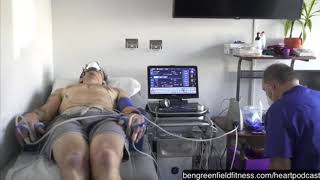
A clinic-demo transcript from a YouTube video showing Ben Greenfield undergoing an EndoPAT (Endo‑PAT) test. The EndoPAT measures endothelial (arterial) function by recording peripheral arterial tone via fingertip sensors and quantifying reactive hyperemia to infer nitric oxide–mediated vasodilation. The procedure is ~15 minutes total split into three 5‑minute phases (baseline, occlusion using a cuff on the non‑dominant arm, then dilation upon release), produces a rapid RHI score normalized to a database, and yields real‑time results in clinic.
Questions this video answers
Approximately 15 minutes total, broken into three 5‑minute segments (baseline, occlusion, dilation).
The non‑dominant arm (they specifically state the left arm for this right‑handed subject).
The RHI (Reactive Hyperemia Index) number, normalized to the device's database.
Chapters
So this next test is called an endopath. So it looks like I've heard you already say it three or four times at least, arterial stiffening. So this is looking at nitric oxide.
Okay.
So it's funny you talk about, you know, cialis. Yeah. Sialis is a heavy nitric oxide. We all know, you know, exercise products and stuff like that always boost nitric oxide. So we're actually able to measure it. It's actually a medically award winning formula. As you probably know, there's a Nobel prize behind the diagnosis of nitric oxide.
So very important.
Cool test.
And this one's called the endopath.
This is called the endopath.
Endopat.
Endo. Pat.
Okay. Not the endopath, the endopat.
Correct.
Pat.
Endo standing for endothelial lining and the PAT standing for peripheral arterial tone.
Got it.
And that's going to be these guys right here. So very cool little device has a pneumatics inside. So that's what your finger will go in your sensors inside there. And are you right handed or left handed?
I'm right handed.
Okay.
All right, so we're going to do is this guy here and this guy here.
Okay. Index finger goes in and there just like that. Yeah. Looks like a little finger condom.
Okay. This keeps that thumb from bumping into that sensor.
Okay. That's what those are for.
The bumper pads.
All right. This keeps the stability of the test.
Finger from shaking. So this is kind of a cool and unique test in the respect that we actually put your arm to sleep for this guy.
So you put my arm to sleep.
Put your arm to sleep.
So for our lovely viewers, they're gonna get to miss out on the boring component of the test is also conducted over 15 minutes where the patient is not allowed to move.
Okay.
Not allowed to speak.
Okay.
So.
We'Ll have a couple portions of some control in the test. I'll be doing some talking, but again, you're gonna be a good boy.
That's fine. I can go to LA la. Great.
Add checker as well.
All right.
If you would have warned me, I would have put headphones and an audiobook in. But.
Now I'll just have to go inside my head.
Yes.
Kind of like an audiobook. I'm sure it's a little. I'll try to be like one since I do about three a month.
That's right. Tell me, tell me stories.
I don't know. You'd like the one I'm listening to now. I meant Ben's head's like an audiobook.
That's right.
What's funny, sometimes you listen to them, you can't remember if they're a movie or if it was an audiobook. Like something will pop in your head like, oh my God, I remember that great scene. You're like, that wasn't a scene, that was an audiobook. Especially the really good ones. All right, perfect. So fingers go all the way down. You're gonna stay just like that. And I'm gonna take the air out of those in just a second.
Okay, it.
And we said six two, right. And did I hear 185?
About 180 actually. Okay.
I quit eating as many ribeyes.
Okay, perfect. Okay, good. All right, so fingers should all the way be down. Don't move. Hold nice and still.
Perfect. Okay, so we're going to go ahead and put you into the testing position which is exactly like that and exactly, exactly like that.
All right.
So we have good signals, good strength.
You ready to go?
All right, here we go.
So 15 minutes, no moving, no talking. Alright, so we have begun As I said, 15 minutes, no talking, no moving. The test is broken up into three five minute segments. The first five minutes is called the baseline. And that's why the two probes on your fingertips there are capturing your pulse data which we see represented over here on this screen. And we're going to maintain this measure for five minutes. And then we'll enter into the second stage which is called the occlusion. And that's going to be where I pump up the blood pressure cuff and put that left arm to sleep. Through the science, they found out that is the non dominant arm that we like to test. And so again we'll maintain that for five minutes. And then the last five minutes is called the dilation. And that's where we're going to watch as the blood is returned back into the artery and kind of that revascularization process. So since we're looking at pulse in terms of amplitude, the higher the amplitude, so we should be watching that amplitude increase after we release the blood pressure cuff. And they're proprietary software, they're able to give us the measure of nitric oxide through how the voltage, so how tall it is and how long it lasted. And so based off of those parameters, we'll be able to get that score for you today.
So 3 minutes 25 seconds left of the baseline.
It.
Great.
So 2 minutes, 30 seconds.
How's it going here?
Hey there. I'm just filming with these guys. I should be finishing up in a Little bit. So. Oh, yeah.
She can go after that.
Good.
3 minutes, 47 seconds left.
I will definitely give you a lot more updates on.
This page, just so.
You know when we're going to get rid of that error.
Three thirty. Doing good.
It.
Left on the clock.
Okay.
240.
Doing good.
So when you release the blood pressure cuff in 2 minutes and 25 seconds, you'll just feel a normal rush of the blood going back down your arm. No discomfort.
Coming up on 10 minutes.
Two minutes. Doing good.
It.
And 45 seconds. Doing good.
24 seconds.
10 seconds. 10 seconds. We'll let that air out.
All right, so five minutes. Still no moving, no talking.
We're watching here.
You guys are going to use some video or some screenshots, you think?
Yeah, yeah. Because you can actually see the response. Sorry, I should have gave you a heads up. It's all good. So do you remember how it was? Nice and small like this.
So do a little narration to go with the video.
All right, so docus down close.
Yeah. Also a little closer. I got the mic.
Oh, perfect. Yeah, great. So what we're seeing here is a response in the artery. So as we reintroduce the blood flow black, we see that the pulsatility on our screen is actually higher than it was when we began, which is exactly what we expect to see happen.
This is the reactive hyperemia we're talking about.
Absolutely. Absolutely. What's so great about this test is we can actually see it in the form of the high amplitude port pulse.
And the machine will take this data and apply calculations and normalize it to its database. Correct. And then we'll get the RHI number, which is the key number that we're looking at.
To get an indicator of arterial health and endothelial function.
And what I love about this test specifically is that we get the results. Now, you know, some of the tests that we talk about, even our favorite tests that we like, sometimes we have to send that out. Sometimes we're dependent on getting those test results back. Sometimes that could be a day. So that comes be a couple days. You know what's great about this in the practice is that rapid results. It's a real time number.
2 minutes, 20 seconds left.
Still one of my favorites.
Doing good.
And coming up on two minutes. Two minutes left.
And then we'll be done with this test. And then we'll go ahead and transition over to the stress echo.
Too bad this isn't live. We could have taken bets on how long he went on the treadmill at a winner.
That's right.
You still can.
Doing great. Home stretch. 120.
50 seconds. Doing good.
It.
All right. So in 50 seconds we'll go ahead and stop all of our recordings. I'll let you know when you're safe to talk and safe to move.
And then we'll initiate the program to go ahead and give us those rapid results.
You can talk, you can move.
How'd you do?
I don't know. I was in La La land.
I could hear your voice droning in the background. But I was so deep into meditation. Good on the planet. Got some good data here.
I have to admit I'll probably need to take a leak then before I get on the treadmill.
For sure.
We'll.
Pause for station identification.
All right. Did you just unhooked here Station identification? I know that a long time.
Yourself.
I'm glad that at least one person in the room got it.
Somebody's heard the radio before.
That is an interesting test.
I really wanted to see what you thought about it. Yeah, Very cool.
It fell asleep then.
Yeah.
You know I've done a lot of blood flow restriction training before where I'm pretty used to having the arteries occluded.
Even while training. So that wasn't too crazy of a sensation for.