The Best Way To Test How Healthy Your Heart Is: Heart Ultrasound
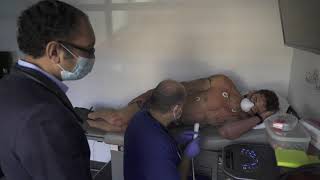
Ben Greenfield gets an echocardiogram with Dr. Dandelayers and sonographer Michael Crowley to check his heart muscle, valves, and arteries. They explain how ultrasound spots athletic heart changes versus dangerous enlargement, and why pairing imaging with lipid tests and calcium scoring gives the clearest picture of cardiovascular health.
Chapters
Well, I think we're gonna get started with getting your ultrasound done. So we'll have you come on here. I wanted to introduce Michael.
Okay.
All right.
So this is going to be basically an imaging of the. Of the actual musculature or the.
Heart muscle. We're also going to look at your carotid arteries, which is a great place to visualize the buildup of plaque, atherosclerotic plaque. And then we'll also take a look at your. Your abdominal aorta, which is another place.
Great.
And then your arteries. Lower legs.
Okay.
Absolutely.
Great. So how you doing? My name is Michael Crowley.
Good to meet you, Michael.
Cardiovision. So we're going to be doing your ultrasound today.
Okay.
So it will require you to remove your shirt for me if you.
I think I should be able to do that. I'm wearing. I'm wearing a M. But we can get creative here. And there are plenty of places I can attach this, including my beautiful mask.
And as we progress through the rest of the testing, which will include going to the treadmill where we'll hook you up and all of that stuff, so.
Okay. And, Brandon, I'm attaching this. This lab mic to my mask now. You should still be able to hear. Okay.
Check, check, 1, 2, 3. Mic, check. Mic check, 1, 2, 3. All right, cool. All right, excellent.
So we'll go ahead and have you lie on back with your head on the pillow there.
Now, one thing that I know many healthy, active people will find on a ultrasound like this is enlarged heart ventricle, also known as athlete's heart, or correct me if I'm wrong, doc. Acromegaly or cardiomegaly? Cardiomegaly. Cardiomegaly, yeah.
We see this not infrequently with our athletes. And I think part of this is that we take some very specific measures on the ultrasound, some physiologic parameters to assess whether this is creating an impact on cardiac performance or it's sort of part of that athletic heart pattern. So some of this is a little technical, but we can walk through it. But it wouldn't be surprising to see some thickening of the walls, what we call hypertrophy, concentric hypertrophy. But as I mentioned, there will be some patterns that we can tell to see if this is abnormal or not.
Yeah, great.
We're gonna go ahead and roll it over. You over a little bit on your left side so that you're facing toward me, please. Okay.
Like so.
Like so.
Great.
We're gonna get that left arm up we're gonna get you into a nice, comfortable position.
Okay.
Best Titanic position for me.
All right, Got it. Perfect.
And if we don't mind production, if we could kill the lights just behind you there.
Awesome.
Thank you.
Now, of course, my mom always told me I had a big heart. We'll find out it.
And how.
How far away we'll put that in because all of the measurements will be normalized to your body mass index and so forth. And we can get the body surface area calculation.
I'm 6 foot 2 and 181 pounds.
Okay, got it.
All right, so this is an ultrasound. So just like when they look at a baby, we're going to be actually looking at your heart. And all the mechanics within the heart, the valves, the walls, the chambers. We even have the ability to turn on something that we call color flow, which is a Doppler. So just like they use some sonar, etcetera, so we can actually watch the blood flow going through the heart. So we can look at those leaky valves or things that would cause that heart to enlarge. And then the best part is we can take those visions that we see with the color. We can actually measure that so we can actually see the velocities that are going through the valves.
Wow. Amazing. Yep. So here we go.
It's gonna be a little cold.
Not too bad.
Well, for all those viewers out there that did wonder, he does have a heart.
I have a heart.
You have a heart.
Great images.
Reminds me of when my wife was pregnant. We went in and she said, you have a baby. Although in her case, there were two.
Now, is it common, Doc, when you. When you bring in healthy people, athletes, exercising individuals, that you do indeed find things they may have been unaware of, or you do indeed find issues that would have surprised, you know, the average person for a healthy, you know, quote, healthy, unquote active person to have, I.
Think it's about 50. 50, you know, and I think what's really important is to look at family history, because you can be totally healthy, have normal cholesterol, and then you actually have. When we do some of the scanning and so forth, we do a calcium score, we find out that there is atherosclerotic plaque developing. And that's. That's something where it's early enough for those folks that are younger that they can really alter the trajectory of the disease.
Yeah, I think it's interesting. I believe it was James o' Keefe who I listened to lecture at the Ancestral Health Symposium, I believe, and he was speaking to arterial stiffness in athletes, particularly endurance athletes. And he was finding, when it comes to cardiovascular mortality, a law of diminishing returns in terms of heart health. Once someone was exceeding about 60 minutes of intense, moderately high physical activity per day and about 90 minutes of aerobic activity. And he was actually finding markers of inflammation, atherosclerosis, and arterial stiffness and people who were overdoing it.
Yeah, I think that's absolutely true. And there's increasing data that those folks can have accelerated atherosclerosis. Their calcium scores can start to be elevated out of proportion, someone in their age. And just so we do see that. And I think it's a certain type of inflammation depending on, you know, I think there's an exercise type for everybody that's. That's really optimum. Find that out and figure that out is going to be key. And, you know.
Yeah, and there are confining variables too, like that that's also a population who's eating oodles of pasta and scones. And, you know, and in many cases, you know, very active person is also someone who is inducing a certain amount of insulin insensitivity and, you know, rampant levels of blood glucose and other issues just related to the training to eat and eating to train phenomenon.
Right.
Yeah. And I think it's interesting your take, you know, when people train for marathons, they do a huge amount of carb loading. What kind of stress that puts on the. On your system and your liver and so forth. They're trying to load up on glycogen.
Yeah. I know many cyclists who pretty much live on, you know, three glasses of wine at night after they've ridden and, you know, a bunch of bread and pasta during the day. And, you know, they're consuming 70 to 80% carbohydrates, which in many cases I don't think does you many favors from a. From a. From a lipid oxidation standpoint. Correct, correct.
That or a very, very high intake of PUFAs, which.
I was recently over in India, where they're seeing a lot of obesity and cardiovascular disease, even though the carbohydrate intake has not appreciably risen. A lot of the natural cooking oils like ghee and coconut and extra virgin olive oil have been replaced by vegetable oils.
So that could be the.
Yeah, yep.
As a matter of fact, I personally, from the data I've seen, think that polyunsaturated fats and some of these linoleic acids and other sources of vegetable oil are just as big a culprit for Things like diabetes and insulin resistance as carbohydrates.
You know, I think you raise a good point. You know, we've always advocate, and the cardiology community, plant based Mediterranean diet and olive oil, that type of thing. Now there's certain purists, Caldwell Esselstyn and his group and Cleveland, that really suggest no cooking oil because concern about when you cook things in oil, so forth, there's damage to endothelium that can occur. And so, and we can see that with some of the testing that we can do, but it's hard because these are not the most accessible tests to sort of a general population. Yeah, but it's there and it's, there's some really good validated data sets coming out of that.
Yeah, yeah. You know, I certainly opt for heat stability, but that's always crossed my mind is, you know, would, would less oil in general be better, you know, even if the, even if the oil are stable? And I think a large part of that can be genetic too. I think populations that have subsisted on whatever whale blubber, like the Inuit, or high amounts of marbly fat or milk and blood, like the Maasai warriors, they might be more genetically adapted to those type of, those type of fats.
I think anytime you're dumping a bunch of oil into a hot skillet and cooking something, it's, you're increasing risk, no matter the smoke point.
Although it's hard to have a good pork belly though, that hasn't been cooked in a little bit of fat to get it crispy.
And so as you go through this ultrasound, you're simply identifying different areas, taking a photo, listening.
Exactly. So what we do is we have a specific protocol that we follow that Dr. Dandelayers use too. So it's a series of images and then we take each chamber in each valve and then do a set of diagnostics. So we use the color and watch the blood flow.
Right.
And then the sound that you've been hearing is the Doppler. So that's taking, you know, actual measurements of the velocity through the, the valve. And so remember, we're checking the valve for two things. We're checking for function, so making sure that it's opening and closing correctly. It's not prolapsing, it's not stenotic, meaning heavy calcification when that valve can't open and close, or sometimes they just get a little piece of calcium on it and the valve leaks. Kind of like a faucet in the house.
Right.
So, you know, routinely we do the echocardiograms to monitor chamber size sizes, valve regurgitations, and then the progressing of those abnormalities.
Fascinating.
And then you're also pairing some of these parameters with, with actual blood work as well.
Yes.
Yeah, yeah.
And we'll do a, an advanced lipid panel which goes beyond our traditional lipid panel, which has really been there for decades.
Right. So you're actually looking at lipid particle size, particle count.
Yeah, I'd like to do that for you because, you know, we've seen that observation that just standard lipids alone can underestimate risk.
Yeah.
This is where we pair it with things like the calcium score, endothelial function, and we can get a great composite of. Of risk above. And there's some fascinating things in the advanced lipid panel, things like lpmao.
Yeah.
Particles that we can, we can deep dive when we get your results.
Yeah.
What's your training regimen in general these days?
A lot of walking. I probably walk anywhere from five to seven miles a day just while talking on the phone or consulting with people or recording.
Typically.
Sauna four or five times a week.
Some kind of a cold soak after for anywhere from two to five minutes. Often another cold shower, jump into a cold river cold tub later on in the day. And then about four times a week, I'll do.
Around a 45 minute long, kind of like kettlebell or strength training session or high intensity interval training session or something that's a little bit more of a difficult workout. And then aside from that, some tennis with the family, usually a hike on the weekends. And.
I'd say the hardest thing I do is those, you know, four sessions a week where like a Monday, Tuesday, Thursday, Friday, I'll go to the garage and crush the kettlebells or do a lot of sandbags, unwieldy objects, carries. I quit racing professionally last year, and so I do a lot less of the extremely hard, voluminous, intense training.
There was a time when I was probably getting close to about 16 to 18 hours a week though, you know, when I was racing triathlon, for example.
But yeah, no, now it's primarily walking. Some kettlebells, some sauna, some cold, and then just a little bit of sports here and there in between. Tennis, paddleboarding, hiking, things like that.
Take a deep breath in for me. Good. And blow it out.
Good.
Okay.
All right, so that is test one, complete.
Before I do more testing, I'm gonna mute.
Oh, yeah. Do you have that?
Yes.
Your date of birth again? 12:20, 1981.
Okay.
I'm at 12:5, December 5th. Oh, nice.
Yeah.
One thing that I thought might be cool, you know, once we've done all of this and, you know, whether it's a week from now or, you know, whenever we've kind of got all the, all the results ending, we're ready for a summary, is I was thinking I'll do a lot of, like, recorded podcasts where I can Skype you or call you and we can do like a 15, 20 minute debrief. It's kind of like, you know, tack on the audio at the end. Okay, cool. Put a little bow on everything for people.
Yeah, that would be great. So there'll be a lot to unpack.
Go ahead and lay on your back.
Okay.
And if you're getting any photos at all, Vanessa, you can feel free to.
Send them at some point. And maybe I'll post a couple to Instagram.
Chin up for me.
And over this way, just like that.
More from Jeffrey





The Solution to Aging Might Be Closer Than Anyone Realizes - With Ben Goertzel


