The FOURTH Macronutrient No One Is Talking About! Talking Ketones With Rob Rogers & Gary Millet
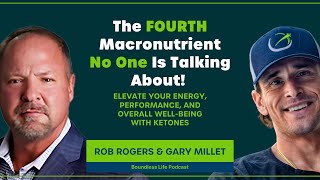
Rob Rogers and Gary Millet discuss exogenous ketones as a fourth macronutrient, explaining how BHB salts work differently than ketone esters and why both D and L enantiomers are metabolically active. They cover radioisotope studies showing both forms work, custom formulations for sports and longevity, and AI-derived ratio recommendations for different uses.
Questions this video answers
December 5, 2024
Over 75 patents (claimed by guests Rob Rogers and Gary Millet)
2019
Approximately 60–70% BHB (the rest is 1,3‑butanediol)
About 20 grams or less of BHB salts for the average person
Chapters
The world didn't know what BHB could do with all the things we've been saying on this podcast. Brain longevity, performance, et cetera. So we've totally gotten away from the keto diet, and now we're into all these incredible things that BHB can do over and above that.
This is really the first time we've talked about it publicly. We decided to save that for this podcast.
My guests on today's show show are not to call them old, but they're OGs of the ketone industry. These guys know, like, more about ketones than I think about anybody I've ever emailed with or talked to, probably besides, I don't know, guys like Dominique d'. Agostino, you know, I've interviewed him, but it's rare to find somebody who kind of talks about ketones in a scientific way that goes beyond something like, oh, they're the fourth macronutrient. They can help you go a long period of time without eating, whatever. These guys know a lot more about ketones than just that. So I know you guys have like over 75 different patents. And as you're, if you're listening, probably already also realize I've got more than one guest on today's podcast, Gary Millet and Rob Rogers. All the shownotes are going to be@BenGreenfieldLife.com BHB podcast because BHB is a very special form of ketone. We'll talk about today. So go to BenGreenfieldLife.com/BHB podcast for the show notes Rob and Gary. I really don't care who goes first unless you guys have a specific order of priority and pecking order. But can you guys talk to me a little bit about how you got into this whole industry of ketones in the first place?
Yeah, you just brought up one of the guys, dom, you know, D'. Agostino. So back in 20.
God, it's been about 12 years. I got introduced to Dom, Gary and I. And so we, we talked to Dom. I think we went down to Florida and met with them, if I remember right. Anyways, you know, my background is I'm a former pro athlete. Gary is, was an incredible and still is incredible tennis player. So we met with Dom. This predated the keto diet. So there was, you know, everything about that had the word keto and it was ketoacidosis negative. And Dom was working with the military on a project. Some Navy SEALs were having trouble with the rebreathers where they were having Seizures. And they had done seen some work that Dom did with, you know, kids with epilepsy putting them on a ketogenic diet. Seizures were going to. And so they thought there might be some correlation there, but they said to Dom, look, you can't put them on a keto diet. These seals aren't going to go on a ketogenic diet. Can you create some type of supplement? So Dom was able to come up with something, gave the, the Navy seals this product and Caesars were gone. So that was intriguing. And then he said he was also working with NASA on their mission to go to Mars, trying to get the astronauts maybe on a ketogenic diet. But again, same thing, they would need supplements. So I knew nothing about keto. I said, dom, I know nothing. So what the hell is a ketone? He said, well let me make it simple. When you were being born in your mom's wound, when your heart, brain and all the major organs are being developed, that's a ketone. He said, were you breastfed? I said yes. He goes, those were ketones. He goes, look, you won't know this Rob, because as a pro athlete you were probably taught glucose is a preferred fuel. I said, yeah, I was. He goes actually it's ketones. So we met with them for a couple hours. We went back and I said Gary, what do you think? And Gary's got a, you know, numerous degrees in chemistry. And he goes, rob, I think there's something here. We should do something with Dom. So, so we ended up doing a deal with Dom in the University of South Florida. And that was our entree into getting into this whole field.
Very interesting. You know, it is kind of funny. I think it was probably for myself maybe 10 or 11 years ago when I met Dom at the Ancestral Health symposium where he was presenting a paper on these drinkable ketones which at the time were a prohibitively expensive. I think it was, you know, a few thousand dollars to get your hands on a shot of these drinkable ketones. And B, they tasted just like horrific jet fuel. But Dom was presenting a paper about, I think it was cycling time to exhaustion. It was funny, the subject on the photo on his paper presentation was, was Dr. Peter Attia. And so I wound up, I think it was at the next year's Ancestral Health symposium picking Peter's brain because he was out doing these long like 24 hour fast fasted bike rides. And I believe he was using ketones and branch chain amino acids. And Peter later convinced me to adopt that strategy for Ironman because I was competing with Ironman at the time, so I started doing that and then like two years later found myself at Jeff Volek's lab at University of Connecticut following that faster study where I had to follow like a 12 month strict ketogenic diet leading up to that study. And all that to say at the time I couldn't afford the actual ketones, I was just eating a high fat, low carb diet. Well now these things are like marketable and they're no longer kind of like research laboratory chemicals that you gotta trade your first child or your Ferrari to get your hands on. So I kind of wanna get into this whole world of ketones and how they've kind of developed over the years. Cause you guys have been a part of all that.
Yeah, I'll, I'll let Gary jump in, but I wanna address that. So yeah, it's so funny because 12 years ago we meet Dom and then we meet Peter. You know, we did a, we did. God, we talked to Peter a lot. And then Jeff Volic. So those are all three people that have been in our, you know, our world. But back then what was being taken, what was called a ester, you know, that's before the BHP salts were invented. And.
The hard part was even to today was being able to drink it because you know, Peter said it would. I think he was the one that called it jet fuel. And he took it and I think he, if I remember right, even threw up.
Yeah, jet fuel was a very kind term and I actually wound up getting my hands on some later on.
Yeah.
And tried adding it to my Iron man bottle and it was just, it was unpalatable.
Yeah, and it still is. They're very tough to drink. But you know, to Dom's credit, and then certainly Gary had a huge part in this. The, the ability to create BHP salts and now the ability to one, make them so they're palatable. But number two, to your point of affordability. Yeah. When Gary and I first started, I think we were paying a thousand or $2,000 a keto or a kilo for PHB, which nobody could afford that.
Right. That's. Yeah, it's like just like the ketone cartel.
Yeah, 100%. But now you have it down to, you know, a $50 or $2, you know, a serving where it's now definitely affordable. But even in addition to that, Ben, they're even more efficacious, you know, than they were, you know, 10, 12 years ago.
And what I'd like to clarify by the way is you Know, as we talk about this, you know, you mentioned esters. Then we have, you know, products like ketone IQ, right, which is a 1:3 butane dial. And then we have these BHBs that you're talking about. And we got time for you guys to lay this out, but can you, can you go into the difference between each of those?
So let's go into real quick. Yeah, the. So what happened is Karen Clark and this guy Dr. Veach with NIH came. You're the. They're basically the ones that came up with the first ester a million years ago. And they. So those predated dramatically the BHP salts. So what an ester is, it's BHP on the backbone of what's called 13 butane dial. 13 butane dial is an alcohol. Most people don't know that. So.
You have what's called a diester and a mono ester. Both of them are roughly between 60 to 70% BHP, and then the rest is 13 butane dial. The drink you're talking about with Ketone IQ is 100% 13 butane dial.
Okay, so, so to pause you right there, just real quick, we've got two different forms of esters, a monoester in which I assume a 13 butane Diol is linked to beta hydroxybutyrate via a single ester bond and a Diester via which 13 Butanediol is bound to beta hydroxybutyrate via a diester bond. And in either case, we could theoretically cleave that bond and have 13 butane diol or beta hydroxybutyrate. And what you were just getting into was how, you know, some of These products are 13 butane dial and alcohol.
That's. You're. You nailed it. And then when. Yes. So then when the bhp, we call them salts, but they're actually electrolytes, but let's just call them salts. It's 100% BHP. And the, the. The difference is when you, when you look at the 13 betane dial, unlike the BHP, when you ingest, the BHP goes right into your blood. When you take the 13 butane dial, it's got to go down to the liver and then be converted into bhp. So it can be very toxic. And the thing with a lot of people don't understand, again, is that one three butane dial is actually an alcohol. So it can be. It can have some effects of drinking, like you're drinking alcohol. And a lot of people in the marketplace don't know that. That's why we're excited. You know, we're glad to have this conversation to let people know once and for all what's, you know, what's the difference between these, these products?
Okay. And with one, three Butane dial, you know, and obviously, you know, this, this is something that we should come around and say. You guys sell products that have BHB, so obviously 1,3 butane dial is going to be a competitor to your product. Well, when you say it's toxic, I mean, is somebody going to jump into the comments section here on the podcast and say, well, you know, that's not actually true. Nobody's shown elevated liver enzyme. There's no evidence of toxicity. I mean, you know, it's a, it's a claim to say that it's toxic. But can you back that up?
I think the question is how much and how often. And I think that as you continue to take any alcohol, it has its effect on the liver. Raising, raising ultimately over time, enzymes in the liver. But I think more importantly from our perspective and from the way we look at it, is why would you want to spend ATP converting it? So however we're seeing the big drop off is that when you take 1, 3 butane dial, it's not a free pass. It doesn't go instantaneously into bhp. It goes through about an eight step process in your liver to convert to bhp. All of that requires ATP. So essentially you're having an energy deficit before you get BHP into your bloodstream using one three butane dial.
Okay. And with one, three butane dial, I guess the, the advantage I've spoken about before regarding it is that it is less expensive. Right? Like you could go to like, I think sprouts right now and get a bottle of Ketone IQ for like five bucks.
I.
And I've used bhb, I've used one, three butane dial. I don't feel drunk or notice deleterious effects with 1,3 butane dial. I will admit, however, that BHB seems to elevate energy levels and maintain blood ketone values for a longer period of time. But is the, is the difference like, are you kind of like paying for that? There's a significant cost difference between the two. Right.
You know, actually the BHB salts are now less expensive than 1,3 butane dial. So they've actually the price down dramatically. Yeah.
Okay, got it. And then the other thing, and I realize I'm throwing a lot of tough questions at you guys right off the bat is I've heard also Some people say that the amount of salt necessary in a BHB salt to elevate blood ketones is such that many people will experience gastric distress from that concentration of salts. Because unlike 1, 3 butane dial, the BHB is bound to assault.
That's a great question. So if you look at.
Let'S say the diester or mono ester, the grams they, they put in that product is anywhere from 25 to 35 grams of BHP. So if you were to do that much in salt. Yeah, that's probably too much. That's true. If you look at the keto IQ, what 3B stain dial, it's only 10 grams. So if you're going to go with BHP and you stay at let's say 20 grams or less for the, for the average person, you're not going to have any GI discomfort. But what's really cool Ben, is Gary has now come out for the first time with liquid BHP which is pure acid. So it's not bound to assault.
Oh trust me, I know because I've got some bottles of sparkling water out in my garage and you sent me that concentrate and you, you definitely want to water it down a little bit. Yes.
So but it's now pure BHP and so now you know, when you get into the higher doses if you want, you don't have to have the electrolytes anymore.
Okay, okay, got it. So technically you wouldn't have to have it bound to assault in this newer form that you guys are doing it as a concentrate.
You know, I think the other thing Robert is very interesting here is when it comes to, let's say take sodium bhp. Well actually it's interesting how sodium can actually accelerate absorption of BHP as, as well as potassium. But I think one of the things that's overlooked is that you can build maybe the best hydration product in the world utilizing the combination of BHB salts properly. So if you use a great ratio of sodium, potassium, calcium, magnesium, and they're all attached to bhb, you've just created a hydration product.
With.
No errant anion to it. The anion becomes the BHB of self.
Yeah, that's a really good point. It's a really good point. I'm glad you bring that up because my last three years of racing Ironman in my fuel bottle was essential amino acids, ketones, very small amount of a potato based dextrin which is very digestible and then electrolytes. And theoretically if I was using a BHB salt in the proper ratios, I Could go with three instead of four things in the bottle. Leave out the electrolytes because the BHP salts would already be covering those bases. So for somebody listening who's doing like a long hike, long bike ride, triathlon, marathon, et cetera, you could do a strategy like that. Like essential amino acids, BHB salts, and a little bit of carbohydrates if there are glycolytic elements of the event.
Yeah, exactly. And you don't need that much chloride. So if you really think about it, right. So if you're using sodium chloride as your, as your key, you need the sodium more than need the chloride. So by being able to use BHP as the anion and the, and the sodium as the cation, you really have a great combination with no waste to that. But it's so easy to combine them in any ratio you want.
Yeah. So the advantage you have, you know, let's say with the salt as opposed to the Ketone IQ product is.
You know, one is now taste, right? And so it's something now you can, you can drink without.
You know, with 1 3B 10 dial, it's not a knock on ketone IQ. It's just almost impossible to flavor. It's just tough. So you don't have to deal with that anymore. And now the advantage is you're getting 100% BHB as opposed to the 1,3 butane dial that has to be converted to BHP. And then if you're looking, if you're doing an Avid Meter or Mojo, you're going to be dramatically higher on your ketones, you know, in your blood, as opposed to 1, 3 betane dial.
Right. For those of you not familiar with Abbot Meter or Ketone Mojo, those are two ways that you can actually, using a tool very similar to a blood glucose stick, measure your ketone levels. Rob, would you be comfortable speaking to the difference of the configuration of the ketones? You hear a lot about D isomers versus L isomers and I'm sure anybody listening right now on their commuter at the gym is just rubbing their hands together in glee at the idea of getting back into, you know, chem 101 from freshman level college courses. But are you familiar with the, with the D versus the L isomer?
Yeah, 100%. So for those listening, if you just look at fresh from an Isomer, if you look at your right hand and your left hand and you put them up, they're almost 100% identical.
Right?
But they do different things. And that's totally the same thing with Beta, you know, We BHP beta hydroxybutyrate. So you have a right, we call it D, and you have the left, or we'll call it L isomer. And when you measure what's in your blood, that's the D isomer. So for years, everybody thought the L, or we also call it the S didn't do anything because you couldn't measure it with an Abbott or Mojo meter. So everybody hypothesized that it didn't do anything. To Gary's credit, I would say eight years ago, he said, no, I'm telling you, there's something here. So I said, well, we got to do something and measure it. We got to do a test. And then Gary did a test, and I'll let you. He can elaborate on that. But what we're finding out to keep it real simple is the D and the L do opposite things, and it leads to what's cool is going to be the day here pretty soon where you're doing customized ketones. So depending on what you want to do, performance, weight loss, longevity, inflammation, that would require a different amount of D and L, so becomes customizable to the. To the person. Gary, do you want to elaborate on that great L study you did?
Yeah, let's. Let's go back to 2019, if we could.
In 2019, one of the things that we decided to do, Ben, was do a radioisotope study on L and on.
The L. On the L isomer of the ketone.
Yes. And the reason is that if you, if you looked at the research probably before that, everybody basically said the L and isomer was inertia, didn't do anything. Veach was so, I think, blindsided by his. His work in the D area that he, he even said as much as, oh, it could be dangerous. Okay. So the question is really, what was it? What did it do? And was it metabolically active? So we decided to do a radioisotope study back in 2019 and track it. Okay. So what we wanted to figure out is whether or not, in fact, you got cellular respiration from the L enantiomer. So what we did is we radioisotope the L. And then what we did is we collected tissue sample. We also collected feces. We also collected urine. And we decided, okay, well, here's the group that says, well, you take the L or you'll kiss it out. Here's the other. You'll poop it out. The other is it doesn't do anything. Okay, so you got all those. You got all those possibilities and Then there's the last one. It comes out, dries a carbon dioxide, which means now it is cellular respiration. It's been used for energy. And sure enough, guess what? The isotope ended up on the carbon dioxide.
And so you're basically tracking, for people unfamiliar with radioisotope tracing or tracking the actual carbon. You labeled the carbon, You've. You've ingested the carbon. And that labeled carbon is a portion of either the D or the L isomer of the beta hydroxybutyrate. And then you're able to track that carbon and where it is excreted. And you guys found that. That carbon on the. I don't. You'll probably tell me if it was the D or the L isomer is excreted via carbon dioxide.
That's correct.
So we knew at that point we had cellular metabolism of L. And now the exact pathway of L metabolism is still widely unknown. Lots of speculation onto that. There's some speculation that it converts to D. There's not really been anything traceable to that effect. A lot of speculation that it converts to acetoacetate and is converted, consumed that way. Also speculation has its own metabolic pathway, so that is something to be discovered. I think the study Rob is talking about, which is also pretty exciting, is we did two years ago, and this has kind of led us to where we are today with the L and Anthem is what we did is we decided to do a neurotransmitter study.
So what we did is we took three groups. We took a control group, we took a group with D enantiomer only, and another group with L enantiomer only.
And we decided, okay, what's the impact on neurotransmitters of control D, L? And so we did. Oh, gosh, I had to remember.
We probably did about 26 different neurotransmitters that, as I recall. And what we really found is that the L in antima behaved differently than the D enantumr. And of course, they both behave differently, the control group. And so there was some overlap and then there was some coincidental effect of both of them. But what was so unique is that L and D had. It had their own distinct characteristic impacts on neurotransmitters. We thought that was a pretty interesting breakthrough right there. And so one of the things that had been cited in the literature a long time ago.
Was, hey, maybe the Allen antiviral is really a signaling molecule. Maybe the reason it occurs in small amounts in mitochondria is because it's being used for mitochondrial signaling. And so as we continue to pursue that, well, okay, let's test that. And that's why we did the neurotransmitter study on L to start with. And then what we did is we applied an AI model to that information that we got. That's, that's how we got to the conclusion that there is such differences between the Allen antiomer and the D enantiomer.
Now, knowing what you know now, based on what you learned about the neurotransmitter effects or other effects of the D versus the L enantiomer, is there one that is better? I mean, you know, if I was going to use ketones, is there a form of it that would be superior?
Yeah, depending on what you want to do.
Yeah.
So, for example, if you were going to want to lose weight and you'd want to probably do a combination of 50, 50 D and L if you were looking to do. And Gary, you can get into this, but each depending on, again, performance, brain longevity, it's going to be a different ratio of, of D to L. So, for example, on the brain, it might. If you're looking to just do executive function for the day, you know, you're reading a bunch of stuff, it's probably going to be 75% L, 25% D. And that's where this thing is going. As I mentioned earlier, which is really incredible, this is what Gary and I, you know, started thinking of about four years ago was this custom ketones. Based off the individual and what you're trying to do, you would take a different amount of D and a different amount of L, and it would have a dramatic impact on what you're doing.
Okay, interesting. So let's say for the sake of mnemonics, I'm going to say the D isomer. Let's call it the drop set isomer. Right. Maybe better for performance. The L Isomer. Let's call it the Lengua isomer. Maybe better for cognitive performance. I come up with silly ways to keep track of stuff in my head here, but then based on that, if, like, how do I know if I'm grabbing a product off the shelf? Does it actually say on the label when you're, when you're buying a BHP product, whether it's the D or the L or a mix thereof?
Yes, it does. Yeah. We'll say on the label if it's DL, if it's D or if it's L. Yeah, interesting.
And, and so is when you say that, when you say that or Though about the product label is that products that you guys produce or like every product has that, every ketone product, every.
Product will say that. And where this is going is one day there'll be a bot. You know, I think what we ship to, there'll be a bottle of D or a, or a canister of D powder, and then there'll be a bottle of liquid or canister of L powder. And then depending on what you do, you have your glass of water and you put in a proportion of each, mix it up, and then there you go.
Interesting. So I could theoretically, like, if I'm doing like a morning workout, I could say, okay, I'm gonna D Isomer heavy morning workout, 10, 11am When I'm really jumping into podcasts, articles, writing, etc, maybe second dose with the L Isomer, something like that.
I do that. Just what you said is what I do. Every, every day I'm up, so I get up early. I, you know, I'm at the gym by 4. So by at 3:30, 3, 45, I'm. I'm taking a dose of D. And then just like you said, about 12:30, I'm taking a dose of L.
Interesting. What were you saying, Gary?
Here, here's. Let me just kind of run down. This is kind of fun. This was our, this is the results using a trained AI model in looking at all of the data that we had accumulated during that neurotransmitter study.
So we had created a AI model for that, kind of trained it up on bhb, and then we turned it loose on all of the individual effects or all the individual data that we had received in that neurotransmitter study. And this is. These are some preliminary things. I wouldn't say, hey, these are verbatim because they've not been really truly clinically tested. But let me give you kind of a rundown on this discussion because it's kind of fun. But back to your first comment, Ben, you said, hey, what's the deal with physical athletic performance? The AI model came back and said, you know what? If you really want to have peak performance on your athletic performance, use a ratio of 80% R.
In the case we're using D, but 80% D, 20% L. And then the next question was, okay, how about cognitive and memory use? 70% D, 30% L. Mood disorders, 40% D, 60% L.
Mad disease, 50% D, 50% L. Weight loss. Rob just mentioned that. 90% D, 10% L.
Parkinson's, 30% D, 70% L.
ALS, 20% D, 80% L. So what is interesting and interesting, we ask it, what about heart failure? Kid came back and said, to be determined. So it's fascinating how we've entered a brand new era of ketone therapies. Ketone regimens, being able to ratio between D and L gives you different outcomes.
Yeah, that is, that is fascinating. That is, by the way, is MAD disease, macular degeneration?
No, MAD disease is a disease where the person is unable to assimilate proteins and fats into their system as macronutrients.
Oh, so what's a sample? Like muscular atrophy, something?
Yeah.
It'S a disease of digestion where they're not able to break down proteins or break down carbohydrates into energy.
Let's give you a real life story on that. So about six months ago, Gary and I got a call from a hospital, Mount Sinai in New York. And they said, rob and Gary, we understand you guys own all the IP around, you know, bhp. And we said, yes. And they said, you probably don't know this, but you guys are saving babies lives. And we said, can you elaborate? And they said, as we were talking about, they said, these young babies get this mad disease where they can metabolize fat or protein and they die. And they said, we're putting them on your BHB and the kids are living. And as we talked to them more and more, we found out when they were putting them on pure D bhb, the kids would not survive. But when they were putting them on DL, the kids would live.
Isn't that interesting?
That is super interesting. Wow.
Then they, we said, well, know how many of these poor kids get this? And they said, it's about 5,000 kids in the United States, but they said it's more prolific in Europe and China. And they said, unfortunately, it's going up in the U.S. you know, as all of our health problems in the US are increasing. And then 30 days later, we had hospitals from Michigan and all over calling us with the same problem. So Gary and I created this DL formula and shipped it to him for free. And fortunately, these kids are living because of this.
Wow. Nice job, you guys. That's.
Yeah, thank you.
Incredible. You know, speaking of like, you know, creating and shipping this stuff, everything you've described to me seems very ripe. You know, just for me, my, my entrepreneurial mind is thinking, well, you know, why not create a drinkable or powdered ketone product specific for specific goals or purposes. I, I do know that having too many SK also, you know, shoot yourself in the foot. From a business standpoint. What are you guys doing now based on this knowledge?
Well, you know the story of the company we started. We, you know, when we originally started this, Gary and I are serial entrepreneurs and we really didn't know where that, where this was going. Right. We, we were into it three years. Gary and I had probably put two or three million dollars into it. We hadn't figured out how to flavor it, we didn't, we hadn't figured out how to manufacture it. And then when we finally did, we said, you know, let's just license the technology. So we licensed it to a big multi level marketing or new multi level marketing company, a company called Prove It.
I got, I got about 8 billion emails from them.
Yeah. So to their credit they killed it in 30 days. Just nailed it. And then they, they got up to hundreds of millions of dollars. They'll probably get up to $1 billion once we get into Europe. And then it was like, now what do you do with it? And we really didn't have any interest in starting a brand. So we started Ketone Labs to sell the, you know, the BHP to a bunch of brands doing business on Amazon. The big guys weren't interested yet because it wasn't validated. And so the brands on Amazon, same thing, 30 days, they all became top sellers on Amazon. But at that time it was all based off the ketogenic diet. You know, the keto diet was starting to explode. They put keto on the box, you know, and does it help with the keto diet? Of course it does. It works with any diet because it has incredible appetite suppression. Plus it gives you energy. And then right about that time, because of Gary and I's relationship with Walmart, they reached out to us and said, hey, can you start a brand for us? And Gary and I were hesitant. We said no because we didn't want to get into a brand again. But we finally acquiesced and that was a brand called Real Ketones. And at its heyday we got up to probably 15 SKUs in every major retailer. Way too many.
You guys are, you guys are a supplier to a lot of these brands people might recognize, like Prove It, Real Ketones, etc.
Yeah, that's Ketone Labs. We, we, we supplied them. But the negative thing at that point, Ben, was Gary, you know, Gary and I both knew what BHP could do over and above the keto diet. Now we built huge companies based off keto. That's great. But the world didn't know what BHP could do with all the Things we've been saying on this podcast, brain, longevity, performance, etc. And you know, about a year ago Gary and I just said, you know what, we're done. We're going to start telling the world what BHP can do in all these other areas. And we actually had one brand win pre workout of the year with BHB in it. And now we're getting brands to put BHB in their products for everything we've talked about. So we've totally gotten away from the keto diet and now we're into all these incredible things that BHB can do over and above that.
And are companies, when they order from you selecting whether they're getting the D or the L isomeric configuration in certain.
Ratios, what we're talking about first time. You're the first one we've, we've actually talked about this.
This is really the first time we've talked about it publicly. So we, we decided to save that for this podcast.
Oh, gee, thanks. I'm honored. So, so, so what's that mean exactly? Like, like now companies can come to you and, and tell you their ratios. Yep. That they want.
So if they come to us and they say hey, we want to do a hydration product, we want to do a longevity product, they can now will tell them exactly what the percentages are and they can formulate accordingly.
Not that everybody on that listening owns a supplement company or nutrition company, but if they wanted to do that, how do they do that? Where do they go?
Well, they would go, they would buy, they'd come to Ketone Labs, the our ingredient company and we, and they would say hey, we want to again do a longevity product. And we'd say great, that formula should be X amount of D, X amount of L. And we would sell it to em accordingly and then they could formulate around that.
So, so our top selling product at Kion is our essential amino acids. So we could theoretically do a product like, I don't know, Caminos with a K and. Yes, and you guys could tell us because people usually take that one for muscle gain, muscle maintenance and satiety. Those are probably the top three reasons. So you guys could tell me, hey, this is the DNL configuration that's going to work best if we wanted to add this to aminos and then you could work with us from a flavoring standpoint to make sure that tastes all right.
Yeah, we have a, we have an incredible formulator on staff that, God, I mean the words gotten out. So we're, the business is exploding because again, people now know it's, it's all above keto.
But I'm going to talk to our CEO about that because every time I take aminos I almost always take ketones with it. We just have it all in one bottle.
Well, what the cool thing is these new technologies that Gary has made.
More referring to L now when you take it, you feel it. So in the supplement space the whole key is can you literally create something that somebody feels? Because if you don't feel it, you just assume it's working, but you really don't know. So when we go to meetings with brands, we give them some of the, you know, before the meeting starts, we'll give them a sample of the product in about 15 minutes into the meeting they're going, what the hell is this stuff? Because they've never felt that before. You know, this incredible energy that's not caffeine and it goes straight to your brain. And so to have something now that people can feel it gives us a huge leg up.
Hey Rob, that's something I wanted to ask you actually. So you seem to be implying that crosses the blood brain barrier, the both BHB and 1, 3 and butane dial cross the blood brain barrier or just BHB.
Well, one three butane dial never crosses the blood brain barrier. It's processed in the liver into BHBs.
Oh yeah, it's converted and then those.
BHBs, it's never, it's never crosses that barrier. I think the other thing that's kind of interesting here that we have not really talked about that is going to be really important to I think people who are explorers like you are Ben, and that is.
In the past people could get into ketosis vis a vis diet. That was mainly the avenue to do that. So when they were in the ketone diet then they were generating ketones and mostly D ketones, some, some L ketones, but mostly mostly D. I think what, what really.
Comes comes striking to us is that for the first time we're now all pioneering, including yourself, the use of ketones in a glucose fed state.
So there isn't any reason that you can't utilize now three fuels, glucose, db, H, B and L, bhp. And so being able to experiment how you blend those three fuels together into a super fuel is really an avenue that we really are going down in a big way. Because you've never been able to do that before. You can't do that in a keto diet.
So you could theoretically create like a post workout meal replenishment drink or a pre workout for people. I know that doing like morning fasted workouts and you know, carbs are the devil is kind of a thing these days. But yeah, the studies back up the glycolytic performance and anaerobic performance is improved with some throughput of glucose. And what you're saying is that you could simultaneously elevate glucose and ketone levels and see a greater improvement in performance than elevating either alone?
Yes.
Has that been re, has that been, has that actually been fleshed out in research? Are you just saying that?
No, I'm just saying that because we're, you know, right now that's just, that's fledgling research. So that's, that's the, we're, we're on the cusp of. Okay, now that we have all three fuels now, what can you do with them? So you've got. First of all, would it be great if you could keep your glucose stores intact until you absolutely needed them? When your body can regulate, and it body does a great job by the way of regulating between when it needs to ketone or when it needs to glucose.
So by being able to allow the body to modulate its utilization of those three fuels, you've now got yourself a situation where, how, how improved could your performance really be? So that's a pretty exciting territory for us.
Yeah, there's a glycogen conservation mechanism that's baked in. I don't think I told you guys this, but you know, it's not a study. But I won my first toughest mudder, I think it was in Vegas. It wasn't a 24 hour one, it was like the five mile one or whatever. And you know, I don't know if he uses your stuff, but the guy who's worked with Frank Veach in the past. Frank, Frank Losa, you know him?
Yeah, yeah.
He had sent me some of his, he had sent me some of his esters and I took one of those and two of the, two of the sports gels, like the mouth reduction fructose gels. So two different carbs that hit two different upregulation pathways and I felt like I was on freaking like strapped to a rocket engine for that entire race.
Yeah. Now if you take this, these new forms of the BHB would be even more bent. It would be, you would go to an even higher level.
You, you mean a mix of the L and the D configuration plus you add in a glucose source?
Yep.
I'm, I'm not. You know, my big thing now is a Little bit of pickleball on tennis and some walking kettlebells. But if anybody's listening in, you're a serious athlete. I mean, I would love to see somebody who's actually competing at a pretty top notch level now try something like that. Or maybe somebody has that you guys know of. I don't know.
Yeah, you're starting to see it a lot. I think you're starting to see forms of it in France with the Tour de France cyclists. And what's really interesting with them is not only are they taking BHP for performance, but they're taking it for recovery. So they take it right before they go to bed and they wake up in the morning and it has a, you know, BHP has a dramatic impact on inflammation. So you got, you probably have 70 to 80% of the cyclists and for the Tour de France that are taking some form of bhb.
Yeah, I get a lot of people complain about the liquid aspects of, you know, canned shots, etc, getting through tsa, blah, blah, blah. You guys sent me like a powder packet. Is that a decent amount of BHB in one of those little powder packets?
Yeah, so we, we were basically the first ones that started that put BHB in a stick pack. And you can have, you can get up to 20 grams of BHB in one of those stick packs. But some of the versions I think we sent you have 5 or they even go up to 8 grams of BHB in them.
Yeah, those things saved me a lot of volume space in my suitcase.
Yeah.
Because I travel with Keith, I use them on airplanes. Because it keeps you from eating airplane food and airport food. Right. But yeah, that, that's an incredible idea. What about the drink that you do? You said, I still have some in my mini fridge. It tastes pretty good. It's called Vault. Tell me about that one.
Yeah, we, we had an influencer that we, we did that drink with. We, Gary and I never really wanted to get into the RTD space because it's so crowded. And one was, we knew the potential was for it to become very big. And then we were like, do we really want to be in, you know, the RTD world? But anyways, we created a BHB acid RTD that has about 6 net grams of BHB in it. And the really cool thing about it is it has no sugar, no caffeine. So the vast majority of RTD's, as you know out there, have caffeine in them. And what Gary and I found out as we studied the market was how many People have. They're either allergic to caffeine or they have some type of problem when they take caffeine. We had no idea about that. And what we've been able to see is the drink is blowing up for those two major reasons. No sugar and no caffeine in it. So literally, we've created the healthiest RTD drink ever made.
What's the actual impact of something like that? Because I think you had carnitine in there, which I know is helpful for mitochondrial health. But I'm more curious about, like, BHB's impact on the mitochondria. Is there any research on anything like proliferation, biogenesis, mitophagy, anything like that with elevated ketone levels and mitochondrial health?
Okay, so now we're getting into my favorite topic called longevity.
So if you, if you want to talk about that a little bit, we can. Yeah, so if you take a look at just some, you know, basic statistical data.
The mitochondrial loss in terms of the actual number of mitochondria themselves between somebody who's 25 and somebody who's 65 is about 40%, maybe 50%, depending on, you know, how they live their life, if you will. And the other problem that you run into is that you got a decrease in the efficiency, the actual cellular respiration of cells.
At that age difference between the age of 25 and the age of 65 as well. So between the loss of mitochondria and the loss of efficiency in mitochondria, it's pretty much about a 60 to 70% total loss in mitochondrial output in total between somebody who is 25 and somebody who is 65. Does that make sense?
Yeah. Is it significant?
Very significant. So I, I do a lot of reading, do a lot of studying on longevity.
And at. At the end, at the end play of that. My question is, my hypothesis has always been in order to either stabilize longevity or reverse longevity, it's not ever going to happen unless we can do two things. Okay.
And the two things are we actually are able to create a situation where we have proliferation of new mitochondria, where we start to add back to the mitochondria loss, or we increase the efficiency of mitochondria.
That you presently have. Without that, I don't think there's a longevity endgame. So.
It just makes complete sense that if your powerhouse is down 60%.
How.
Further down the road are you going to get? I think the other thing that has been discovered in the last four or five years that was pretty exciting to me is how much talking the mitochondria do between themselves and the nucleus of the cell. And it wasn't really quite understood that there was a really interesting computer or communication protocol between those two things. But the best way I can say is this, is that the.
Where it's like, I'm a big Star Trek fan because I grew up in Star Trek.
Area, right? But it's more or less like this where Captain Kerr calls down and says, hey, Scotty, I need more and more power, right?
And Scotty transmits up, I don't have any more power.
So what that communication does, Ben, is it allows the nucleus as the control center to decide what stays on and what turns off.
And the body is absolutely brilliant in knowing what to keep on and what to turn off.
And so as, as we start to take a look at this, we always talk about, we always talk about genetic switching.
What I think is happening epigenetically is the nucleus is deciding what to shut down based on the amount of power the mitochondria are telling it it can produce.
And I think this is really significant for aging. So if we, if we really think through that process of aging, we've got really a really tight knit argument that without proliferation and without efficiency improvement, where's the aging game going to go? What are you going to do?
And so are you implying that BHB salts could improve both the cellular signaling processing and the efficiency? That's something that's been studied as well.
As we believe, the proliferation increase in mitochondrial growth.
Oh, so you're kind of hitting the holy trilogy because you're getting the proliferation, the efficiency and the cell signaling.
Yes. So bhb, exogenous, BHB is one of those things that allow that to start happening.
Because one of the things that happens in, in mitochondria, as you know, is you get ros, right? You process fuel, especially glucose, you create reactive oxygen species.
And that is a pretty big waste product. And autophagy is designed to get rid of ROS and other junk particles out of that. And the more you clean that mitochondria, if you will use cleaning.
The more opportunity you have to produce energy from that. What BHB does, it's such a pure fuel. It allows you to decrease the amount of ros. It allows the cell to do a better, much better job of autophagy and at that point start to improve its own efficiency. Once the efficiency we believe of the cell takes place, what ends up happening is now it's wide open to cellular proliferation.
Yeah, and it's interesting too, because since reactive oxygen species are used as a cell signaling molecule, theoretically, by introducing an alternate cell signaling processes, you could reduce the need for ROS formation in addition to the reduced formation of it from usually lower amounts of glucose being consumed with the BHP approach.
So 100%.
Yeah. That's super interesting. You know, you guys, we are almost out of time and I know you guys have a host of different. We've hinted at many of them. You drink, you have a pouty, you have that freaking liquid for people who, who have a strong palate. And I'll, I'll put more information if folks go to BenGreenfieldLife.com BHBpodcast and then I assume like you guys said, if somebody's in the supplement industry and they're listening in, you guys are ready for people to start approaching you about custom DL configurations based on needs.
A hundred percent. Yeah. If they just go to ketonelabs.com, they'll see, you know, they, they can just, they'll see our phone number there and they can just reach out.
Got it, Got it. Well, you guys, this has been fascinating. I, I got to answer or ask all my dumb questions about ketones. I usually get job. And for those of you listening in, I have a lot of other ketogenic episodes. I mean, way back to interviewing Dom like a decade ago and a few times since. So I'll put all those@bengreenfieldlife.com BHBpodcast check out the stuff Rob and Gary are doing. Products are very interesting, very efficacious. If you want to feel what rapidly elevating your ketone levels feels like, look into their stuff. So, you guys, thank you so much for coming on the show.
Thanks, Ben.
Thanks, Ben.
All right, folks, I'm Ben Greenfield along with Gary Millet and Rob Rogers from Ketone Labs, signing out from BenGreenfieldLife.com BHBpodcast have an incredible week. Hit subscribe, leave a ranking, leave a review. If you got a little extra time, it means way more than you might think. Thank you so much.
More from Jeffrey





The Solution to Aging Might Be Closer Than Anyone Realizes - With Ben Goertzel


