Why Sleeping on the Floor Could Change Your Life?
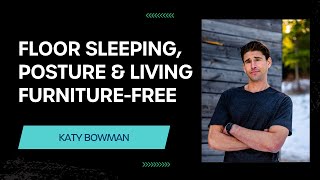
Podcast interview (Ben Greenfield with biomechanist Katie Bowman) discussing furniture-free/flexible seating homes, floor-sitting and ground-sleeping, how environments shape movement habits, child movement development, and practical steps to transition to firmer sleeping surfaces and more varied daily positions. Covers mobility/pressure-related work, minimal footwear parallels, device (tech-neck) impacts, glute–pelvic-floor relationships, and ideas for engineering homes and family routines to encourage movement.
Chapters
Sleep surfaces are surfaces, right? So the pressures that you're going to get on them are going to be whole body, different joints are going to feel different. So get on the floor more often before you transition to floor sleeping.
All right, folks, I have as a 3P guest today, somebody I'm pretty excited about. She's a biomechanist. My son's asked me today, hey, are you interviewing that lady who doesn't have furniture in her house today? I'm like, yes, I'm interviewing that lady today. But beyond being furniture free, which I'm sure she can share with you more about in today's podcast. My guest, Katie Bowman, is an absolute wizard when it comes to all things movement, biomechanics, posture, position, reshaping your body, and a lot more from a very, I would say, unique and holistic yet scientific perspective. She, like I mentioned, has been on the show before she was on way back in the day. We were talking before we started recording. I think it's been like five years since I've had her on, but she was on the show called Making Biomechanics Fun, how to fix your body, align your posture and look like a million bucks from head to toe. She was on my episode why youy Shouldn't Suck in youn Stomach, which was an interesting one, as well as why standing all day is bad for you and how Kegels are killing your core. Fantastic show as well. And I'll link to both of those in today's show, which you can find@bengreenfieldlife.com Nutritious Movement that's BenGreenfieldLife.com Nutritious Movement Katie Bowman has written nine books, as a matter of fact, just a couple of which I've talked about on the show. Two that I'm holding here. If you see the video, rethink your position. Fantastic. I read both of these last month and then also Grow Wild. Rethink your Position is obviously, as the name implies, about posture. Grow Wild is more like a guide to family and children and household. And we're going to touch on a little bit of both today. You can read more about Katie and access her website, all of her socials, everything that she does, as well as her books. If you go to BenGreenfieldLife.com nutritious movement but Katie, welcome back to the show. It's been too long.
I know. Thanks for having me. Three times.
Yeah. So I guess we should just cut straight to the chase since my kids asked me this morning. But do you actually still not have Any furniture in your home?
Yeah, we are. I guess I'm notorious at this point.
Yeah, I am still on the low furniture or what we should call it flexible seating.
Flexible.
Flexible seating home. But. But now for different reasons. I mean, same reasons. But now I live. We've been living in a tiny house for almost the last year and so there's just not a lot of space. And so luckily it allowed us to make a transition to a 500 square foot house. And it's not a permanent thing for our family, but it's what we needed to do for. For housing temporarily while we got some other things sorted out. So. Yeah, still have different. Yeah, like if you have cushions for seating, you can build them up into different things to relax upon, sit upon. They can double as higher proper seat, you know, like a conventional seat if you need to belly up to a table. But they're also great for draping over backwards when you want to, you know, practice back bends or if you want to read a book, but you don't want to sit in a conventional position.
You mean the, the cush. The cushions are good for that.
Yeah, Puff. Like. We've got these. I just happen to find them. They're just. They're cubes almost. Yeah, cubes. But we can, we can layer them or, or put them in series so they sort of function in the same way like a backless couch would, or you can sit on the ground and lean back against them. But I just, I've got so many pictures of how we've used them over the last years. And it's really what I'm all about is using your body in a diverse number of ways. So not having heavy static furniture that can really be used in a single way tends to result in a lot of spontaneous movement. And then the other thing that we still have when the kids were little. So my kids now for context, I think I might have had toddlers the first time we talked about.
Yeah, you did.
And. And now I've got preteens, you know, I've got a 12 and a 13 year. Oh no, sorry, 11 and a 12 year old. And so their needs change and you know what they're into changes. But when they're little, we had monkey bars, indoor monkey bars that we had is, you know, the official word is like a breaking ladder, you know, for younger kids, a breakeation ladder. It's just a glorified term for monkey bars. And we designed one that could operate like at different heights and we just would always set that up and Move it. Depending on where we were living, into different rooms, sometimes it was in the living room. A lot of times, most of the time it was just in a bedroom with a mattress underneath so kids could sort of play on it. Mostly for upper body strength, which indoor play doesn't really promote. And then now we've got. Cause I said we're in the smaller space rock holds, you know, for rock climbing walls. And just those are across a beam, so you still get that upper body experience. And man, when the kids come over, other kids come over, they're just lining up to go on to them what feels like a ride. It feels like a. Like they're at a carnival or something. And it's just our. Our single living room and they go up the stairs and then they jump onto them and like walk across and then drop down to the floor. So, yeah, our house still more or less looks. Has that same thoughtfulness behind it. Even though what the actual things are has changed. They need to change. They need to change as we all move through the stages of life.
Yeah, it is so interesting. Maybe it's because either I read a lot of your books or we both have a history in biomechanics. That was my degree at University of Idaho. So I think a lot about the world, way the human body moves and how we're positioned during the day. I think in the same way that you do. And it's so funny as you describe your home, because when you walk into our house, you almost smack your nose right into a yoga trapeze that's hanging by the front door from all the railings in our home. My children have the option of taking the stairs to get up to our upstairs bedroom or scrambling up the railings and the slats that we have that you can technically kind of like hack your way up to get upstairs. There's no seats in my office. As you can see. I'm walking on kind of like a soft surface treadmill right now. And I have this rule in my own life that I sit to eat and I sit when I'm commuting, like on a plane or in a car. And besides that, I really don't embrace that parasympathetic state quite as much as you get when you're seating. That's why I sit to eat, for example. But sometimes I'll sit on the floor like you do. And so I've learned a lot from you. And I think that. I think posturally, to a certain extent. So our homes are kind of engineered in this fashion. Which is one reason I want to do this podcast, because I wish more people would kind of do that. But can you explain the reasoning behind the idea of something like a furniture free concept for a home, or at least engineering a home to cause someone to need to sit on the floor more or less, or sit on, say, like a hard surface more?
Sure. I mean, I think the overarching philosophy for me is.
The environments that we're in are a big part of why we behave the way that we do. And that just goes across the board. You can only make a certain amount of choices within a particular environment. And after just working with so many people, trying to figure out how to move more, and then from a more biomechanical perspective, try to figure out why their low back was causing them so many issues, or why their joints or particular parts of their body or areas of their body weren't feeling great and coming up with corrective exercises that they now needed to fit into their day, I really started looking at, well, let's. Instead of just trying to add to solve your issue, what if we looked at subtracting? What if we looked at taking away some of the behaviors that was reinforcing why your body parts were having this particular experience.
Or. Another way I like to think about it is we all have a movement diet that is made up of the shapes and the ways that we move our body throughout the day. For most people, people living a conventional life.
They have this one particular shape of their body that just shows up again and again and again and again. And we call it sitting. And sitting is often associated with inactivity. Right. Just the whole body state of your heart rate, you know, or just the fact that you're not, like, metabolically, you're not doing very much when you're sitting. Your respiration rate is low, and rightly so, because you're not doing anything mechanically.
It's kind of like the position of royalty, right? Like throne rooms where kings and queens would just, like, sit for long periods of time. And, you know, it's a very comfortable and coddled position, you know, but biomechanically might not be the most favorable. Or metabolically, as you were just saying.
Well, metabolically, Right. So I think we think of being still as a problem. And being still, I mean, being still is great. To be able to be still is a skill. But if we talk about it, like diet, like an abundance of stillness is a problem. And then biomechanically, an abundance of a single repetitive position is a separate problem than just metabolic stillness, there's an adaptation that starts to happen within the joints and the muscular, like the musculoskeletal system, that ends up affecting you when you do get up out of that position. And so I was looking for ways to break up not only sitting still, which does need to be broken up, but breaking up the way you consume your stillness, because that's a really good entry point for people to be able to move more. Because for so many people, their jobs, for example, or certain things that they're doing in life require that they be in a place, eyes on a computer or hands on a keyboard. But it doesn't necessarily dictate what all the other joints are doing. And so flexible seating, for example, allows you to still be still. Say you want to read a book, say my kids need to do homework. It does not have to be taken in the same shape shape that their other stillness was taken. And so it's one promoting a variety of positions, some of them much more active. Because even our sitting, like, yes, our whole body is inactive when we're sitting, but part by part, a lot of us will lean back in a chair. So even if you're sitting, you could be more active. Like, there's more active ways of sitting than other ways. So by removing the back of a chair, scooting forward to the front of the chair, that's a more active, more metabolically active way of sitting, then completely outsourcing support to some external structure, like.
A piece of structure. There's actually a. There's a training, a postural device someone sent to me about a month ago. It's called a back belt. And you, you place it around the back, and then there's two straps that go around the knees. Then you strap the legs together so you're kind of like internally hip rotated, sitting straight up when you're in a chair. It's a cool little device. And I've actually been putting it on occasionally when I do sit to, for example, eat lunch. It's impossible to have a bad posture. Kind of like pulls your shoulders back and pulls your back upright and kind of internally rotates the hips again. So it's a fantastic device for kind of training the posture to be correct when you're a seated position, if you want to call, you know, any given position correct. Well, seated. But I. I don't recall if it was in one of your books or not, Katie. It might have been. I don't know if this rings any bells, but there's like, this chart. I think you can find it online. It's kind of like the Kama Sutra of seated positions. It's like at least a few dozen different ways that one can sit that goes beyond the standard, like hunched over in a chair type of position. Was that something that you made? I. I forget. Or are you familiar with that one?
Yeah, that's in my book, movie or DNA. And then we made a poster of it. We made a separate poster of it. Yeah, because people found it inspiring because it just again, because we're so influenced by our environment and that includes how other people behave in a particular environment. Like that becomes, that becomes your, you know, your construct of how you are to operate as a person. Right. Like, so we have so many cultural cues that promote not only being still, but being still in a particular shape that I. There. It's a. That poster is based on research done by an anthropologist decades ago named Gordon Hughes, who was interested, he was interested too in people not moving and seeing that trend towards less movement. And this was in the 50s and the 60s and he was showing how many other cultures of the world take rest, you know, So I know there's a lot of talk in the, in sort of the movement, interested community about squatting. And if you've traveled in a lot of different places, you'll see that the squat for many people is the preferred way of taking rest. It's an active position. But for joints that have not grown up doing it, it's very difficult to hold a squat for an hour, you know, or to sit on the side of the road or wait for a train, or hang out and have your lunch in this active squat position. And that's just one of them. Lots of them are just still resting on the ground. But when you look at it, it looks like a handful of stretches that you would be given in an exercise class to do. Which was my point. My point is we're trying to recreate through exercise what we could be getting during non exercise time by just positioning ourselves differently. So I just modified my house to not promote so much. Just have a seat, Just, just relax in this one particular position. So by not having that option. And the analogy I like to make is if you're trying to eat better, you don't stock your house with the foods that you don't want to eat. You, you stock them with the foods that you do want to eat. And it's the same for the way that I want to use my body. I just put out things that.
Signal and some environmental cue to use me because I am here and it's Easier to use me than not, right?
It's almost like chairs are the chocolate covered almonds from Trader Joe's that are in bowls around the house when you're trying to get on a better diet. It makes perfect sense. And it's kind of funny because you talk about subtraction and obviously many people are probably familiar with the idea of subtracting shoes. I know that. I think you've talked a little bit about minimalist footwear and strengthening of the feet. That's one perfect example of something that might go beyond a chair free or a minimalist chair home would be minimalist footwear or at least taking the option to go barefoot or less shod on a regular basis. Another example that I was thinking about is you were talking about the idea of being in the same position biomechanically for long periods of time. And the potentially deleterious aspects of that was the same thing for the eyes. Right. You talked about sitting and looking at screens, and I think some people might notice if they were to watch the video version of this podcast. Sometimes I'm looking at the camera looking at you, but I'm often, as I'm listening to you and your answers, I'm gazing out this big picture window that's in front of my office. There's a mountain. There's trees far off in the distance. There's trees on another hill that's slightly closer. There's trees right in my backyard. And then there's you on the camera. So often when I'm recording a podcast, I'm shifting my eye and my focus on a variety of different distances so the eyes aren't in that same static position throughout the day as well. And then this is kind of related to something I also wanted to ask you about. Obviously, there's sleep too, right? We're in that position arguably for around a third of our lives or so. And I'm just curious how you arrange the sleeping environment. Like, if you're also just like sleeping on the floor with these cushions propped under your head or what does it look like in terms of your bedroom or your sleeping environment?
Yeah, same. So I am a ground sleeper, just like I'm a ground sitter. And I am happy to use chairs when they're out and about. Like, I don't make it a point to only do that, but I'm just. I want to make sure that I'm always comfortable to be able to sleep.
You don't. You mean you don't stand on the airplane the entire time?
No, no. Although I Will get up and try to walk around just a little bit. Sometimes I do. I. Sometimes I will squat in my seat, though, just to stretch out, you know, for a longer flight. So I have been known to do that only when, you know, people I know are sitting by the side. But for. Yeah, I sleep on the ground. So we have sheepskins, and so we roll them out and, you know, make our bed on top of that and then sleep on.
What would be. So it's. It's not. It's firm. It's much firmer than any mattress or futon. But it still is comfortable because it's got some. It's got some warmth. You know that if you're worried about sleeping on a cold floor and you've got your cush, I find it to be nice and comfortable, but I'm able to.
Get out of my position better. The way I try to explain it is, let's say that your particular body, because of its being in repetitive shapes, it has a hard time getting out of essentially, what is a chair shape.
Even though you can stand up, if we really broke down what's happening in your joints, for many people, their hips really don't come out of flexion. Their pelvis. People deal with what's called an anterior tilt forward tilt of their pelvis. That is a hip that's not standing up all of the way. The hip is still sort of in a chair. Even if you get your legs straight, the pelvis is coming forward. So there's like just this little bit of chair residue. Chair baggage, I've called it. Different things that's left over in your body. And for many people, when they get into bed, they're not even. Even if you lay out on your back, I guess that you lie out on your. Lie down on your back.
Because of the cushion, you're still sort of able to keep some of those flexions in your body. That they are being coddled is not the word that I want, but. But the cushion is sort of supporting you where your body is right now, where the ground is a much, much more of a taskmaster. And it makes those parts stretch out, which is why it's really uncomfortable for people when they first start, because you can't continue to stay tense in certain areas. So I sleep on the ground in that way. And then I don't have a big, heavy pillow, you know, like, I. Oh, really? Yeah, I've gone down. I mean, and I took 18 months to go from. My neck was really stiff all the time. And I was like, why is my neck so stiff? And then, you know, as you said, our sleep environment is a third of, you know, on the best days, it's a third of your day. And so I was just realizing like, oh, I am sort of propping myself up in a single position and keeping my neck from moving. So in the same way, if you've been in a car ride for a long time, the hips are stiff. Like my, my neck was stiff and I, it just didn't make sense to me. And then I just was looking around at like, well, how, how do human, like what are, what are other cultures doing? And I just realized like, oh, of course, like, like.
I need more movement even during my sleep time. I need more, what I call pressure related movements. I need, my joints need to be able to go to a broader range of motion than what my bedding will allow. And that goes for my neck too. I need to be able to be more. It's like tenderizing a piece of meat. I need to be more supple. I need to be able to fold myself up and.
And that's why I sleep the way I do. And that's why a lot of my training that I would do is really just making my tissues more supple in general. Not only stronger, but more supple too. Like, that's so important piece because then you can really adapt to whatever surface you're being given as a human.
Yeah. I'm building a new home in Idaho right now and I've been thinking about doing one of those wooden slatted beds as a slightly, a harder, more biomechanically favorable sleep surface. I guess there's like one guy, liver king, Brian Johnson, you know, he, I think he caught some social media.
Attention for claiming that he also sleeps on some kind of a wooden slatted bed. And it kind of makes sense. It does. It does seem kind of uncomfortable to just like toss out the. I'm on like this super fancy, you know, organic, you know, eco friendly mattress right now. And it's nice and it's cushy, but sometimes I do think, gosh, this is too cushy, especially when I go camping now or I go hunting. And it takes me at least three or four days sleeping on the ground in the tents where my body finally feels comfortable in that environment. For you switching from not using a pillow to kind of going lower and lower and lower in terms of your pillow height, how long do you think that adaptation would actually take for somebody who wants to go pillow free or even for somebody who Wants to maybe ditch the bed or start to sleep on a harder surface. Is there like a certain period of months because they talk about minimalist footwear not to kick that horse to death. And sometimes it's like three, four, five months, sometimes up to a year before somebody's feet are adapted to not using big, built up, cushiony shoes. Is there kind of a way that someone can ease into this adaptation period or something? They should expect as far as adaptation period to go pillow free or cushion free in the beds?
Yeah, I mean, I think that the thing to remember is it's always stepwise, and it's exactly like transitioning from conventional to less supportive footwear.
So much of that time period really depends on you and where you're starting and then what you're doing to help you with transitioning. So the same thing was for minimal footwear. Like, you wouldn't put on just minimal shoes and go running. Right. That would be the equivalent of just like just jumping out of your bed and sleeping on the floor all night. And I think a lot of people have done that in camping where they go even to someone else's house and sleep on a different bed and they're like, oh, my back's wrecked, or I'm.
Never gonna camp again. That sucks.
Yeah, that's right. And that just shows, like, that's too big of a leap. You know, we. You are essentially moving all of the time. It's a misnomer to think you're in a sedentary or an exercise category. That's a helpful way of sorting it on the big scale. But on a cellular level, you're always under the effects of some load due to gravity and your position. Like you're creating the load to your cells. So you're about to engage in eight hours of some form of loading your body in a novel way. So the things that I recommend would be to start sleeping. Like, if you are so adapted to a particular mattress, even sleeping on the other side of it is going to cause your loads to be different. Especially if your mattress has been shaped by a different body. You know, like if you're swapping sides with somebody, or if you have a guest bedroom that you don't really like that bed that often cause it's kind of uncomfortable spending a couple nights there. That would be another way of.
Hopefully not because you've had a fight with your spouse. Hopefully by choice.
Right? I mean, whatever. At least you could reframe it. You could reframe it. It's like, well, at least I. I Will work on my loads.
This is a biomechanically favorable argument.
Yeah, you could go together, you know, you could go together. You could. I suggest to people that like I transitioned where I went from a bed to a single mattress low. I'm in the Pacific Northwest, where I think you are as well too. So we had to really watch for mold. Sleeping on the ground can be really a mold issue depending on where you live. So slept lower on the ground and then went to a futon. So I just slowly got closer to the ground and I played around with different surfaces. And then as far as the training part, you really want to be working on mobility and then like nooks and cranny mobility, because there's mobility in the general sense of like your hamstrings and your hips and your shoulders. What we don't get a ton of are what I categorize as pressure related movements. For a lot of other people, they might categorize it by the tissue they think they're working on when they do them. So that would be like foam rolling, fascia rolling on fascia balls, like tune up fitness balls or things like that, where you're applying pressure into the nooks and crannies of your body that don't often deal with having to change their position due to pressure being applied. Bodywork is also something that fits into that category. So sleep surfaces are surfaces. Right. So the pressures that you're going to get on them are going to be whole body. Different joints are going to feel different. So get on the floor more often before you transition to floor sleeping. Like I used to do a before I go to bed tenderizing, practice where you roll all of your parts all over the.
By the way, that's me in the morning. I do morning tenderizing. 15 minutes every morning. The hardest foam rollers I can find, the most uncomfortable massage balls. And I interviewed this guy named Joel Green who calls it maintaining young muscle where you're reducing a lot of those fascial adhesions and getting the body used to a little bit of that discomfort of being against hard objects. I swear by that protocol every morning, 15 minutes. Basically it's just self meat tenderizing.
Yeah, I swear by that too. But I feel a lot of it comes while I'm sleeping. Yeah, and so it's the same thing like we. When you think about bodies, human bodies have been interacting with high amounts of pressure through interacting with the ground. So take everything that you think about minimal footwear and what your foot needs to like stretch out its parts like, that goes for your whole body on the ground too. Vitamin texture, as I call it. Like, it's the same thing, only it's not as easy as just swapping out a new pair of shoes. Like, you have to take yourself down physically and you have to get used to these parts being able to spread out. Like, we just don't. Those movements aren't listed in a book of movements that you need, but I categorize them in a particular way. We definitely need pressure related movements throughout our body and it comes through interaction with surfaces. And you can make it in a supplement format right. Where you're approaching it with an exercise mindset and supplement that way. But it's also something that comes with more floor living. It's also something that comes with more floor city. And then bonus, when you sleep on the floor in the way that we do now, it always allowed us to be in smaller homes more comfortably when we had younger kids. Because think of all the square footage of a house that's allotted to sleep time only just the footprint that is under most people's sleep time equipment. So for us, we hang it up every day and it gave like a room for cartwheels, an exercise room and off, like what office?
So that's really such a good point. Yeah, I mean, you're making a good case here for saving a lot of money in Airbnb so you can get the zero bedroom Airbnb and just travel with your sheepskin and use the garage. It is kind of. It's interesting though, because it is important for that one third, or I guess if you're one of those Silicon Valley execs who has a biologically inferior need for sleep, apparently 1/4 or 1/5 of your life is spent in that position. So it's something to think about. It's also unfortunately, probably a good way for me to lose any mattress sponsors ever for this podcast for all time. But regardless, it really makes me think a little bit more about my sleeping surface and at least giving an attempt to expose my body to a little bit more of a hard, possibly even slightly uncomfortable surface during sleep. The mold in the cockroach issue is kind of funny though, because it's mold in the Pacific Northwest, but it might be cockroaches if you're down in, I don't know, Miami or Southeast Asia or something like that. But these are things I suppose people can get used to. And then, you know, this is kind of interesting because you talk about, like you mentioned, the furniture free aspect, the bedroom and some of the Rock climbing holds on the wall. In the book you even talk about how you had, I think when your kids were young, just like a pool ladder right out in the middle of the living room or something like that. Beyond that, are there other things you have just scattered around the house or that you did when your kids were young for these type of movement snacks?
Yeah. I mean again, like if you look at how complex the way you can move outside is, the way we move inside really pales to what's available. And so I was looking, I wanted a way for my kids to be able to explore more complex movement. But in the modern environment where, you know, parents have to work more or.
The weather just didn't feel as supportive to be able to go outside for, you know, like in the wintertime. So I found a pool lab ladder. So a pool ladder just for people listening. It's for the, the backyard pools that are these pop up rings and the way the ladders for them are these triangle, a frame ladders that set over where there's a ladder going up one side and when you go down the other side, you're in the pool now. So I found one for five bucks at a garage sale. And it became. Because again, if you have an emerging walker and you don't have a lot of furniture, they need something to pull themselves up on. Right There's.
Yeah, it's a good point.
Nature shapes are really good for facilitating. I wanted self led movement development kids, they have a natural program for layering on their movement milestones, but they live in environments that don't really foster the emergence of many of those skills. So I wanted to create an environment that did that. So I found that ladder and so my kids were able to pull themselves up and then they were able to climb when they were.
Ready to take that next step, you know, and they, and they could play with the in between space. The in between space of where you have a skill now and the skill that you want to have, that's what we're all tackling all the time. That, that strength gap, that mobility gap, that skill gap, however you like to think about it. And often things aren't structured, especially for kids that allow them that like just smidge over where they are right now so they can get to the next step. And so I wanted things where, you know, they can't make their foot, can't get up to the next step yet, but they can pull their arms against it. And so they're developing this.
I mean it's really just a skill. But in smaller stages. So that was one and then.
And by the way, I'm not convinced your home would survive a modern day litigious environment. I think I tweeted it was either this morning or last night. A picture of a playground. This is increasingly common amongst playgrounds. There's a no loitering sign and violators will be prosecuted near the bottom of the slide. You know, we have these. I talk about that too in my little book, Raising Tiny Superhumans, about the idea of playgrounds becoming very safe and protected spaces with cushiony, you know, floors and none of the gravel or the rocks we used to find. None of the hard, hot metal slides or the, the swing sets that give you splinters. Like it's very safe. Yeah, exactly. God forbid. But it is kind of funny too, because I think about what you're saying and I'm like, gosh, this is not just for kids. Like, there is no reason that, for example, an adult can't have like the same type of ladder you'd use to, to access higher shelves on a bookshelf and have that thing in your office behind you. And every time you walk out your door, you got to go up one side of the ladder and down the other side of the ladder. It sounds silly, but you can engineer your home to do this and kind of like turn your entire home into a spartan esque playground.
Well, and that style of ladder, I mean, we use that ladder. The kids were done with it pretty quickly. And then we use it to go over a fence that was separating our chickens from our house. And so we loaded up and learned how to go up and down. Yeah, that's right. And then also when we were, we were in England doing hiking Hadrian's Wall with the kids over like a week. And that is the way, that is the way people move their through paths of the countryside, which is so the animals can roam and people have access. So there's not open and closing ladders or just these stairwells that go up and over pasture walls. And I was like, wow, we've been practicing this. This movement's functional and woven in more to society. And so we just, we have a society that doesn't weave a lot of movement into our primary. It's not a global society, it's just a society. You know, like, I'm mostly speaking of North America perhaps, or maybe just the United States and Canada. Like, I haven't been everywhere, but I've just seen a dearth of, of movement. So we add that in and just.
Part of it by the way is just due to this lack of need for it. Like, my legs are sore right now because I just two nights ago got out of three days in the Eastern Washington wilderness where my sons and I were hunting, moving at a very slow pace throughout the day. And I looked at my aura ring data at the end of one day of being out there, like, six hours, and it's. That's like 9,000 steps. I thought, gosh, there's no way I was out there for six hours. But you're stepping and you're weaving and you're crawling under logs and then stepping over another log. It's like one giant playground for six hours when you're hunting. And you can imagine that human beings hunting for thousands of years, then gardening and engaged in agricultural activities for many thousands of years afterwards, have been largely removed from those type of protocols or primal movements. But it's interesting. You just go hunting for a day and you realize, oh, gosh, I'm walking, lunging, I'm stepping, I'm ducking, I'm weaving, I'm crawling, I'm on my stomach, that I'm sleeping on my back on the hard ground. You know, a lot of this stuff is so natural, yet we're pretty far removed from it.
Yeah, I mean, they're just. They're the shapes that formed us. And I don't. I mean, our bodies aren't really that different. It's. It's just the context that they are in. So I'm always looking for ways to modify some of that context and then helping people modify it no matter where they live. You know, like, if you can't go hunting for six hours, like, is there some sort of equivalent or, you know, even camping? Like, we're a big fan of bringing the outdoors in, which is a lot of what Grow Wild is about. So it was always really special. I remember when we were younger, like, we did a camp out at school, and it was inside our classroom when I was in third grade. And you were sleeping on the ground in sleeping bags. But that felt. Because it was just not so conventional. Some of my best memories are those sorts of things. So when I became a parent, I was just thinking, like, what was it about those things? And some of it was novelty and a break from convention. But I think a lot of it was. I physically felt better. I physically felt better just being asked to move in more challenging ways. So I've just tried to weave that into parenting and help other people do that too, so that there is some element that they can fit into their lives no matter where they live.
Yeah, yeah, it makes really good sense. You know, I have to ask you, I'm sure this is a burning question for many people because I think about a lot during the day myself. The idea of devices and smartphones are obviously super handy and they make life much, much easier in many ways. But there has to be a biomechanical impact of either the thumbs or the neck craning or the way that the eyes are directed downwards. Have you ever thought about that? And do you have any kind of. Kind of like movement snacks or fixes for something like smartphone use in either kids or adults?
Yeah, I think about it all the time.
So one thing I like to. I mean I'm sort of a nitpicker with details. So one of the things I like to just really point out from the beginning is your device doesn't require any particular position to be used in. Right. Like, but we have adopted sort of a mindless.
Stereotypical position now at this point for how we use our devices when we're not thinking about it, when we're not mindful, it's really easy to be so engaged with what we're seeing or doing on our device that we're no longer remembering how to use our physical body. So once you realize that you can use a device can be used in different shapes. Shapes, it opens up just like sitting. It opens up a different menu for thinking about it. So one just to know like you might not remember 100% of the time. Like I have these technic decals that I put on my computer that they just stick to the corner of a screen and they're there to remind you how to what we call ramp your head. Like the forward head, the tech neck, like that. Your device doesn't power off when you fix your head.
What'd you call them? Tech nex stickers?
They're tech nex stickers. I'll send you some. So you have them. But yeah, they're just. And they're just. They're a cue that you put on and it's again, it's an environmental reminder. You know, it's like putting a post it note of things that you don't want to forget. You know, you have that on your desk, you have it on your computer. Maybe you have it on your mirror at home. It's something simple and low profile that is just. It has a head and a couple arrows to remind you to. You could hold your head differently right now.
Oh, I like that. So, and by, by the way Is this something that you created? These technique stickers? Okay, cool. I'm, I'm going to hunt those down. And again, you guys, if you want links, go to BenGreenfieldLife.com Nutritious Movement and I'll put them in there. Okay, so keep going.
So there, so there's that. And then I do think the gripping of the hands, like obviously the spine. I just wrote something not too long ago where I actually took a picture of my body holding the phone doing a standing back bend. Not all the way to the ground, but where I was so arched all the way back and my head was craned all the way back. My arms were overhead and I had my phone and I was like, if people were walking around like this tomorrow, we would sort of freak out. It would cause everyone to be like, what are you doing with your back? Why are you doing that? But because this forward with the tech position has creeped on. You know, first it was, you know, maybe.
Middle age, like millennial, middle aged people with their BlackBerry, you know, looking at, doing work on their phone. And then it crept over into younger children and now it's the full gamut. Now you have ager, like the goldener population. And everyone's like folded forward and it doesn't even cause alarm in anyone anymore of just this extreme folded forward scream inches from the face of the.
Trust me, I know you walk through a mall or an airport and you wonder like, everybody's got their head thrust forward. There's gotta be a biomechanical impact on that with the weight of the head. And I mean, you know, the concept of lever arms and the fact that what's the headway? I forget. It's like £30, something like that.
It just depends on the head. But.
Yeah.
Yeah, how big your ears are. It's a heavy, it's a heavy load. And I always just say, if you're carrying a bowling ball, you want to carry that bowling ball close to your body, not with your arms way out in front of your body.
Pumpkin impaled on a broomstick. Carry that around, then shift it just a few inches forward and feel how much it pulls you forward.
It's a lot of torque that's created. And then now it's like it's made its way. It's not just a, it's not just the neck though. It's like now it's the upper back and the lower back too because they have to accommodate this forward position. And the reason I wrote Grow Wild is because the juvenile period of any Animal is really where you're, you're setting your adult shape. It's not, you're not just like passing through that period of time until you become an adult. You are. Right, you're setting your adult shape. And, and that, like, you're. I don't think a lot of people understand that your bone potential is done being set by the time, you know, between 17 and 19, you're never going to have any more bone than that. And so even if you become a heavy exerciser later on, you can't go back and play with what you set during your juvenile period.
Such a good point.
And so that's a bank account, right? Like, you're set, like if you told people, like, you could never have any more money or any more accomplishment or however you want to think about it. Like, there's a potential account limit that's being set with bone and we are not really optimizing the juvenile period any longer. And so I think about things like that. Like, I think about, yes, obvious mechanical things like the thumbs and the neck and the spine. But I think about it also in a broader way where when you're on the phone, you're not doing something else, and the doing of the other things is part of what your future self depended on you doing. And so when the time is filled, so not just the structural thing, but when the time is being filled with things that aren't loading you in a way that you can respond to and like, set, you know how well your ligaments are going to be able to respond. You know, all these tissues that are mechanically sensitive and here to be like, what are you going to do with your body for a lifetime? Because you're doing it as vigorous as you're going to do it when you're younger and it's going to slow down from there and you give them to a younger population and your body's like, sensing, okay, what are you going to do for your lifetime? You're going to sit and do this and it's only going to decline from there. That's not the bank account that we want to set people up with. So that's how I think about devices mechanically. Is, is. Is how. Is how they are filling the space, not just, not just curling the spine.
But they're feeling, to mention like, like the thumbs. I don't know about you, but like, I have found myself, especially when I travel and I seem to use my phone more when I'm traveling just because I'm not around my computer and sometimes have a little Bit more time, you know, on an airplane or in an Uber or whatever. On my phone, I'll get, like, almost like a golfer elbow medial epicondylitis type of issue on both arms, using the thumbs, at least for the longest time. And then I thought, gosh, I got to figure out a way around this. So now I use dictation. I'm a dictation ninja on my phone in terms of Siri and add a note and that little iPhone dictation microphone button. So I'm constantly talking my thoughts on the phone, not using the thumb very much, which mostly is just for scrolling, which you shouldn't be doing that much of on your phone anyways, if you have a life. And so I think dictation is super important. That comes in super handy on both the computer and on the phone. But are there, like, positions that you can be holding your phone in for more friendly wrist and finger alignment or elimination of tennis elbow or golfer's elbow or anything like that? Have you ever thought about that?
Yeah, my solution's been like, I just try not to. I try not to put very much on a phone, so it's not my main device. Like, I am still a person with a. Yeah, like, I'm still the person with a notebook and a pencil, because that just works better. And really, truly what hurts me most with the phone is my eyes. And I haven't really talked about that, but I think that, I mean, if you're really digging into literature and even just reading kind of mainstream health articles, the Globe's eyes are not doing very well. Like, the myopia, the rise in myopia from, again, not necessarily only the closeness, but the indoorness and the fact that you're just everything you want just sort of inside sitting down. That, like, there's precursors for eye health. That's not just vision, which you can correct pretty easily with contacts or glasses or surgery. It's the health of the eye later on and, like, the loss of a broader vision that can't be corrected. That's.
Yeah, I'm a big fan of, like, Bates Method esque divergent convergent training. My sons and I, like I mentioned, we're like, shoot the bow quite a bit. So almost every day I'm shooting 12 to 20 arrows and focusing the eyes and different movement patterns along with, like I mentioned, looking out the big picture window in my office, then back to the camera. And so, you know, I think that goes all the way back to. What's it called, the Bates Method, you know, that old school Eye muscle ocular training method to get people off of contact lenses and glasses that nobody does because it feels like exercise and everybody wants to pop the pill of contact lenses or spectacles.
Well, I mean, and just like I, I have contact lenses, like I have such myopia and I've, I do exercises and train my eyes, but at a certain point like so much of that was set in by the time I was 12 or 13. My eyes, eyes haven't really gotten worse since I was. Since I became aware that there was something to do with my eyes. But like I haven't found anything that reverses.
You can extreme myopia, you slow the acceleration or at least halt the progress of it. But kind of like you were talking about with bone formation and posture, once you set up a certain pattern early in life, sometimes you're stuck with that.
Yeah, I mean you can always. I always. You can work with whatever you have. And what's good for the eyes is good for the entire body. Right. Like anything that you do to take care of your body is going to also be taking care of your eyes. Your eyes are in there as well too. So. But to your earlier question about hands, I do think that I've seen these white things that people put on the back of their phones and I think it's so they can let the phone rest inside their hands so they don't have to grip to hold it. I never knew what those were, but I think it's so you don't have to actually grip.
Yeah, that kind of makes sense because you're getting a little bit less of like the. What's it called? The, the. Is it the flexor Halicus. You know that like a lot of thumb flexion. Yeah, that makes sense.
And the whole hand, right. Just gripping the hand so that, that's, that's there and then.
Yeah, be mindful of use and not just like there's a way. I think what happens is.
Everything as everyone goes to apps because it's easier or you know, you go to school and everyone needs to be on all these softwares because it's easier. But everyone making this like so called easier solution requires that everyone be on a phone now to make their way through life. And so like is that really easier when you look outside of what a single choice a company or institution is making to when everyone's making the same choice like you're the. The reps of you doing phone is starting to escalate more and more. Like people are on their phone more and yes, they're doing more entertainment things. But I would say that people would probably also say they're doing more have to things that they didn't have to do five years ago because everyone went to a complete online way of accessing everything. So how are you supposed to decrease your screen time if everyone has made it a requirement?
Yeah, exactly. And back to the concept of doing reps. I think that a few of the things that we've talked about here, being in a forward position, as far as your neck is concerned, seated with the hip flexors tightened and the glutes often deactivated, it kind of raises the question of the butt. And I have this book by this guy named Brett Contreras. I don't know if you've heard of him before, but he has a fantastic book called the Glute Lab. And he's even gone deep into EMG analysis of the glutes and looked at hip thrusters versus squats, et cetera. But very gym driven, very go to the health club and do this to turn the butt back on types of advice for you. And I know you talk about this a little bit in your book. You're cognizant of the glutes and the butt. And I'm curious what your movement snacking protocol would look like throughout the day to kind of keep the glutes turned on and to kind of give yourself a better butt biomechanically well.
So for me.
The reason glutes came onto my radar as being, to me, such a key, important thing, a part of your body that you want to keep strong is because of the way they work in opposition with the pelvic floor. Right. So even if you didn't do very much movement at all, your pelvic floor is always under the load or the weight of what's on top of it. Pelvic organs, abdominals, et cetera. But what balances, like, if you think of, like the lever, if you think of lever systems, your pelvic floor is pulling on your sacrum in one way. The only thing that can counterbalance that is the glutes that pulls on your sacrum in the opposite way. So there's a, a very important relationship between the pelvic floor and the glutes that you want to have in balance. And for a lot of people, it's out of balance. And so glutes, for me, it's not so much just, I mean, there are going to be some snacks. But the way that I try this is from Rethink youk Position where I'M trying to break down the mechanics of different parts because glutes are so important, they fire. They would be firing quite naturally every time you get up and walk around. Because when you take a step, you're walking right now.
You'Ve got a leg swinging back behind you.
And by the way, I should note, I'm walking on a manual treadmill. And I have seen some of those EMG analysis studies that show that walking on a manual versus a motorized treadmill based on ground reaction forces and that kind of tilt of the pelvis can allow for better glute activation when walking. Now that's one reason I chose a manual treadmill. Besides, kind of like the, the dirty, electricity free nature of it compared to a big manual treadmill or a big electronic motorized treadmill with the wi fi. But yeah, but keep going.
Yeah. Well, I mean, anytime you're pushing off on the ground, anytime you have to do the back push off, that's going to be a glute contraction if your hips are mobile enough to extend. If your hips don't extend, which means your leg doesn't go back behind you very well, then a lot of people get their leg to go back behind them at the lower back. So their lower back is extending and flexing instead of the hip joint just below it. And so for many people, those tight hip flexors, those high reps in sitting.
Lead themselves to glute weakness, not simply because of the time spent sitting, but because when you do get up, your steps are not hip extension created, which means that glutes, those glutes aren't firing. So that's why mobility work and making sure that you have one pelvic stability so that you can have hip extension are so important. So in that way, those snacks aren't even necessarily about doing butt exercises. They're more about making sure your body is getting the glute action with just you walking around, that you're getting rid of some of that chair baggage in your body. That's really important. And then of course there are some concrete stat like exercises that I like that are just for the glutes. My favorite one is just, I call it, it's an arabesque. If you do yoga, it's like a warrior 3. It's standing on a single leg.
Yeah. By the way, describe it. And I'm actually, I'm flipping open to the book as you're describing it. So if people want to watch the video, I'm going to, I think. Is it this one? The butt builder?
Yeah. Yeah, right.
Okay, so watch the video.
So your. Your arms are way out in front of your legs, back behind you, and you're holding all of that weight on the single standing leg. But then of course, you have to drill it in where your floating hip has to drop down to the same height. We've got all these little tricks to avoid using our glutes. And, and form is so key when it comes to glutes, because for what a lot of people think they're the exercises they're doing, the form's not drilled in well enough to like, deeply target some of those glutes. And so it's that. And then I like carrying, but carrying things uphill, you know, those are also good glute rear leg type things.
Yeah, that's fantastic. Rucking. Rucking around a hilly neighborhood with a backpack on or with a child. I'm chuckling because I was holding your book up to show the exercise. I was looking at the back of the book and your media contact is Christina Butt on the back of the book. So there's that too.
I like to stay on brand. I like to stay on brand for everything.
Didn't even plan that. Well, the one other thing that I wanted to ask you while I had you on was. And we don't have a ton of time left, but I'd love to hear just a little bit because there are a lot of people who are interested in re engaging their children with natural movement patterns while they're in the home and the whole concept of snack activities and movement snacks that you weave throughout the book. But do your kids still go to an actual alternative school, like a nature school or something like that?
I mean, I definitely have a hodgepodge. It's been different throughout the years, but they still spend a day in a nature program. So it's so important to me that it's important to us as a family that the relationship between ourselves and the larger support system that we're on the earth is appropriate. That there is a knowledge, a respect.
And learning that goes in between us and the earth. And it's not to say that other learning systems aren't also important things that take being in society, you know, that society requires or that allow for success in society. But I think that a lot of times we've pivoted to mostly educating for society and aren't educating. That kind of foundational relationship of everything you're going to consume is going to come from this bigger relationship that you're in and how do you manage this natural relationship. So it's for that reason. And then of course it's also because it's outside and it puts them in good relationship with their physical body. So it's not.
All the days. The rest of the time they go. They're pretty much in conventional schooling at this point, although where we live. And people could always check too, what.
In Washington. And I'm not sure if it's a state or a district thing because I'm not from Washington originally. But you can go into conventional schooling, but you can pick the number of periods of middle school that you want to go to.
For example, I believe, because I had looked into this a while back when we opted to unschool. As long as you have demonstrable progress and record keeping for the 12 core subjects like math, reading, writing, social studies, history, etc. As long as you're able to demonstrate records by the end of the year that your child has completed a certain number of hours in each of those activities. And most of that would honestly just be for a high school diploma or for a collegiate entrance exam or for the ability to be able to go to a higher education institution. You can kind of mix and match the two. I'm looking at your book in the show and tell section of the chapter entitled Learning Container. I love your picture of the classroom here with floor tables and wobble stools and floor pillows and exercise balls and rocker chairs. With my sons, they each have a room in the house where they spend most of their time. And it's the same thing. They each have a stool, each have a ball, they've got a cushion, they have a stand up desk that'll go up and down and then they've got a couple of little mobility ball exercise type of devices. So they can just jam at school all day and be in a lot of these primal movement patterns.
Yeah, I mean, school, while it feels.
Like it is so big, it really is more like 20%. And so we just really focus on. We walk to school and we walk home from school and we spend a lot of time together as a family doing, I think, what happens in unschooling, like exploring the things that people are interested in. We have chickens and we produce and cook a lot of what we consume and we make that our family. And also part, I mean, it's family time, but it is also part of the education container. It's how we get sort of that nature education to fill more broadly the day. Even if, even if their class time, their core class time is not that.
Making sure that you use the More malleable parts of your day has made, you know, like, we're always out in some sort of wilderness once a week for an extended period of time for immersion, you know, on some weekend. And my kids will still play soccer, but we will hold special a day for getting into the Olympic mountains, getting into the forest, camping year round, sleeping in the backyard, like, so that's such. That's an important value for us. And so we make sure to center it.
Yeah, you're speaking my language. In a lot of cities and areas will have wilderness schools or nature immersion camps. You know, shout out over here to Tim Corcoran, who's also been on the podcast, and his wife, Jeanine Tidwell, because they have twin eagles Wilderness school. So my kids go to that every summer. And then they're engaged or enrolled in the Kamana instructional program that Tim introduced us to, which involves several times per week of them being out in nature, plant foraging, doing sit spots, learning bird calls and animal patterns. So it's kind of organically woven into the entire year. But I think that everybody has something like that somewhat near them, or many people do, and you just have to be aware of it, find it, Google it, look it up. And you can often find these type of camps and immersions that if you don't have the ability to be able to kind of fabricate that in your own backyard, you can outsource or mix and match.
In summertime. Like, they always go to nature school in the summertime, some nature camp. And then we've also done a lot of DIY stuff, you know, where we kind of make our own and then invite other kids. You know, if parents are working in the summer, try to be supportive of, like, hey, can we go somewhere for three days and take big groups of people and just have fun so it doesn't have to always be structured. Structure definitely helps when you're like, unlimited time. You're trying to find a budget or a schedule that works, but a lot of things can be done. There's so many books now about how to bring nature education into your own life. Doesn't matter if you live in the most urban setting. It can be done, and there are people there who will help you figure it out, and you can find resources for that.
This book, by the way, grow Wild, I'm holding it up. Go to BenGreenfieldLife.com nutritious movement and I'll link to my other conversations with Katie. But also, this book is fantastic for what we were just talking about. Katie. And then this other book with the publicist Christina Butt, Rethink youk Position. Also fantastic for a lot of the stuff we were talking about your hips and your psoas muscles and the way you walk and the way you carry yourself. So, Katie, these two books are fantastic. Thank you for writing them and for being gracious enough to come on the show yet again and geek out on this stuff with me.
I love it. Thanks for having me.
All right, folks. Well, I'm Ben Graham Greenfield, along with Katie Bowman, signing out from bengreenfieldlife. Com Nutritious Movement Bengreenfieldlife. Com Nutritiousmovement. If you can't spell that, Google it. Have a fantastic.
More from Jeffrey





The Solution to Aging Might Be Closer Than Anyone Realizes - With Ben Goertzel


