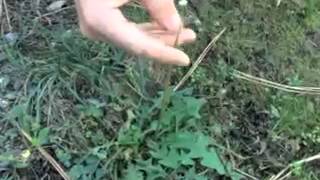
Tim Corcoran shows how to identify dandelions and eat them. The whole plant is edible: leaves go in salads, flowers make fritters, and roasted roots taste like coffee. Dandelions are packed with vitamins and minerals.
Questions this video answers
From French 'dent de lion' meaning 'lion's tooth'.
They were introduced to North America from Europe.
Vitamins A, C, E, and minerals phosphorus and calcium.
Leaves eaten raw or cooked like spinach; flower heads dipped in pancake batter and fried as dandelion fritters; yellow petals sprinkled on salads; roots slow-roasted and used as a coffee substitute.
Chapters
Okay, now what do you see right here? You guys know it. Good job. Give me five. Dandelion. Okay, so how do you know it's a dandelion?
Because it has this.
It has this. And what are those little things, guys?
They're kind of like fur. If you look really close here, I'm going to pick one. If you look really close, it's got the little furry stuff here. And what's that?
A seed?
It's a seed, exactly. This is called. This is the dandelion seed. And the whole thing, like many people have seen. There's the big seed hedge. And so this, of course, is where the flower was that went to seed. And it's got the big. The leaves with big teeth on there. Now, you boys, your dad says you're just learning Spanish. Oh, here's a flower bud right here. And you can see the little bit of yellow. It's growing. It's growing. That's right. So this plant was actually named after the teeth in here. Dandelion is a take on the French word dent de lion, which is teeth of lion.
It's amarillo.
And can you guys imagine? A lion's tooth is kind of like the teeth on that leaf. That's why it's called dandelion. Now, this is an amazing, amazing plant. It's perfect. This is our first one. They call it the supermarket of the lawn. And they're super common in everybody's lawns, the dandelion. And you can literally use every part of this plant for food. And they're not originally from North America. They came over from Europe. And actually, our ancestors brought this plant with them. And back even just a couple hundred years ago, our ancestors depended on this plant for food. And so, to start with, the leaves right here, the leaves are edible. You can eat them. You can just pick them and eat them. If you want to try one right now, you can.
I want to try one now.
I'm gonna warn you, it's a little bitter. It's not bad for you. But if you pick the small ones, the littler ones are gonna be less bitter. Okay? Dandelion is packed with vitamins. Let's see. A, C, E. Phosphorus, calcium. This is an amazing plant. You can cook these as well, like a potter. Kind of like you would cook spinach, right?
It tastes like spinach.
Yep. You can.
Guys, look.
You can use the flour as well. The flower is an amazing wild food. You can take the flowers and. Do you guys ever eat pancakes?
Yeah.
Do you mind when they give you pancakes? Okay, check this out. You can take the flower heads, dip them in the pancake batter and fry them up to make dandelion fritters. And they're super, super yummy.
I had those in second grade. Did you really remember doing that?
Yeah. Like with your mom or something?
No, our teacher.
Oh, with your teacher. That's so awesome. Yeah. Okay. And then there's a root in here. I don't know if you guys. Should we try digging it up? Sure. Should we try? Okay, I need you guys. Can you guys find two kind of like strong sticks, but not too big? Just some sticks we can use to dig them up.
We'll check that out in a second.
The roots are. Yeah. This is an amazing, amazing plant. The bitterness sometimes throws people off. Some people, they taste the bitterness of the leaves and they don't like it. But, you know, there's an old saying that goes, bitter to the tongue, sweet to the stomach. Sweet to the tongue, bitter to the stomach. In other words, like, too much candy is not good for us, is it? But we actually need some bitters in our diet and. And there's ways to reduce it. Like I said, if you find the small leaves, they have less bitterness. And also, dandelion that grows in the sun like this has got some pretty good southern exposure here. It's gonna be a pretty bitter plant. But if you find. Have you ever seen a dandelion that was really big with really big leaves? Wow. Yeah. Okay. They get really big when they grow in the shade. And those plants are gonna have been much less bare. Okay. You got your sticks? Yeah. All right, now here's what we gotta do. You guys help me out. I'm just gonna get us started. We're gonna dig up your mom and dad's brand new lawn a little bit. Okay. We'll put it back. So there's. There's a big root.
Down in here. We're gonna see if we can get out. And it's right on the edge of the driveway here.
And right next to. Right on the edge of the lawn. So you guys help me out here. Can you pull some of that dirt out of the way? Just the dirt? Don't. Don't pull the plant quite yet. River. No, that's not River. That's Terran.
Okay, now, so we're getting down. Can you put your. Get your fingers around that? And there's gonna be a root down in there.
I can pull it out.
Okay, we gotta do a little more digging.
The heads like to pop off.
Yeah. Okay. Now don't break the root. It's gonna be kind of fragile, so we have to be careful and dig around it.
Okay. And then we'll do a little digging and then use our fingers a little.
Bit and pull it out and we're gonna.
Oh, I can start to feel it. Can you guys see it? Yeah, There it is. Okay, now let's see if we can. Okay. It's a little. A little tight still. Okay. I want you guys to keep digging. I'll protect the root. Don't bonk my fingers. Don't scratch up my fingers. And you dig around it right up close to my fingers. Can you get close in there?
You're doing good. Keep going. Can you get it really close to my fingers? There you go. There you go, buddy. Okay. Give it a break.
I'm a professional dandelion puller.
I am.
I did our whole front yard.
Did you? Can I try?
Because I didn't want to fertilize it.
Yeah, well, and that brings up a good point, which is so many people are way anti dandelion in our world today, and we've got this kind of crazy quest for the perfect lawn, right? People want like. Like an astro turf lawn. They want a lawn that only has grass and nothing else. And for some reason.
What about flowers?
I know. What about flowers? Like yellow dandelion flowers? Well, for some reason people have this idea that, you know, it's bad to have other species in their lawn. And I understand, you know, it's not as soft and stuff, but. Why do dandelions grow in people's yards? They grow there because, like all natural systems, a yard is actually an ecosystem. And the dandelion is doing what any other species would do, which is growing in its ecological niche. Every plant has a place, just like every person has a place. And the dandelion is coming into balance the yard out, ecologically speaking. Okay, here we go. We lost the bottom of it, but that's okay.
Here's those roots. Now this has got a double. Look at this, guys. And here's a whole plant. Okay? It's kind of like you guys. This has got twin roots. Okay? Now this root is amazing. For any coffee drinkers out there, this root makes an amazing coffee substitute. So what you can do is gather up these roots and you cut it right here and then you wash them off and clean them off really good. And from there, you do us. You do a slow roast in the oven, like the lowest setting on your oven and with. Even with the door open, and do a slow roast until it's roasted all the way through, chop it up, and then use it as a coffee substitute. And instead of having all the negative impacts of caffeine and everything, it's gonna have a big, healthy impact. Okay. Can you see that little white stuff? It's got that little. The little milky SAP in there.
Yeah. So all parts of the plant are edible. It's really cool. So you got the. You can do the coffee substitute with the root. The leaves you can use again as a salad green or a pot herb. And the flower heads, you can dip them in that batter and make amazing dandelion fruiters. Or you can even take the little yellow petals and just sprinkle them on top of your salad. Really, really cool. Should we hold on to this one? Yeah. Okay. Do you want to hold it? R.