Your Magnesium Supplements Are Probably Useless. Here's Why.
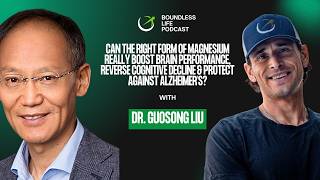
Neuroscientist Guosong Liu spent 25 years developing magnesium L-threonate, the only magnesium compound that crosses the blood-brain barrier. A 2015 clinical trial found 2 grams daily reversed up to nine years of cognitive decline and improved memory and attention within days. Most other magnesium supplements don't reach the brain.
Chapters
So, then finally we found out, hey, actually magnesium citrate among all the magnesium compounds tested is only one who can effectively elevate the brain magnesium.
Today's podcast is with Dr. Liu, um, Guosong, I believe it's how you pronounce his first name. Dr. Liu is what I'm going to call him. He is a boatload of, or has a boatload of knowledge on magnesium, specifically magnesium L-threonate. A little bit of a deep scientific dive today. I took 140 milligrams of magnesium L-threonate approximately before this podcast, so you'll see how I perform. Go to BenGreenfieldLife.com/MagteinPodcast. That's M-A-G-T-E-I-N, Magtein Podcast, if you want the show notes. So, here we go. My guest on today's show, Dr. Lew, and I'm cracking up because I just gave him a fantastic introduction and I forgot to press record. So, you guys get this again. He's actually a neuroscientist, world-renowned neuroscientist who studies magnesium. And magnesium specifically in terms of its impact on the brain, on things like cognitive function and synaptic plasticity. He's got over 25 years of experience doing this. And studies up on learning, on memory, on neurological function, all related to this mineral. So, Dr. Liu, welcome to the show.
Thank you for invite me. I'd be happy to share with you about our journey.
Yeah. I'm very interested in what got you started into studying magnesium's impact on the brain because these days it seems like everybody's talking about it as a relaxing and stress-relieving mineral. But, that's kind of, I would say, 90% of what I hear about magnesium. And, I don't hear about it as kind of like a, I guess, something you would use to enhance cognitive performance or something like that. So, what got you started into magnesium in general and then its impact on the brain?
Yeah. The whole thing is, I have to say, it's like a serendipity, by accident. Like, you know, about 25 years ago, when I was a faculty at MIT in the first Center for Learning and Memory, we were actually a scientist trying to study the synapse, right, which is a building block of the entire brain. At that time, we're interested in say, how do we make more synapse, right? We have simple idea of At that time, you know, the synaptic plasticity is an extremely hot topic. The idea is how do you find some compound which can increase synapse density?
Before you keep going, how do you define synaptic plasticity for people who might not be familiar with that term?
Okay. I think that in this case, it's interesting, right? If you think about the AI right now, right, AI is essentially neural networks, right? And artificial neural networks are just connections between the nodes, right? Many connections. What the difference about the brain is that each connection actually can be modified, right? The connection strands are modifiable. So this modification of synaptic strand, a connection strands, is called synaptic plasticity.
Okay, got it. So basically, synaptic plasticity is an increase in the connection strength with the connection being between neurons in the brain, right?
It may not be increased, it could be decreased too.
Oh yeah, I guess so, because plasticity would mean it could go either way.
Exactly.
Yeah, okay, got it.
So it's always a hot topic. I think if, you know, our brain can learn, I mean, fundamental about a human is, or in fact, the animal, right, is learn to adapt the changing of environment, right? The key to learn is really, you know, what is the foundation to be able to learn is actually changing the connection strengths between the synapse. So that's why if you are able to modify ability of brain to change its connection strengths, but in this case, synaptic plasticity, you will make a brain a better learning machine.
[Speaker:BEN] Now, a quick question about that before we get into how magnesium might influence that. I think increasing the strength of the connection would make sense to people, but would decreasing the connection be something that might be related to decreasing the appearance of a negative pattern or a negative thought or habit? Or, what would be a situation which you would want to decrease the strength between neurons?
Excellent. That's exactly the point. For example, you know, for people who have PTSD, right, then that's a strong memory of negative memory and you want to get rid of, right? Then, you need to reduce the strength of connection. Right? And a lot of bad memory, and you prefer not think about it all the time. Then you talk to the doctor, right? And then they have extinction therapy, is try to reduce that negative memory. So, it's not everything you're supposed to remember. In fact, many bad stuff you probably prefer to forgot.
Yeah. Yeah. Okay. And I might be putting the cart before the horse here. But, when we're talking about something one could take as a supplement to strengthen or weaken a neural connection, does something like that have to be paired with an actual activity? And, I'll give you the example of a popular wakefulness drug that many people are using for focus, modafinil or Provigil. What a lot of people report is that it doesn't work that well unless you take it and then you combine it with a very intense cognitively demanding activity. Or, in the case of something like ginkgo biloba for memory, you'd actually need to pair that with learning a musical instrument or memorizing a speech or series of words or numbers or something like that. So, when you take a supplement, does it automatically strengthen or weaken a neural connection or does it need to be paired with some type of activity that actually causes that connection to occur and the supplement's just making that activity work better?
That is another— you should be a scientist. I mean, the question asked is really a great question. And that's actually touched upon our research. That is, there are two types of sandwich, right? And, you know, for example, brain have a lot of inhibitor synapse, right? They call GABA, right? GABA type of synapse. You could actually bring everything down by stagehammer. Let's say increase the GABA, right? And, or even taking anesthesia, right? And you can lock people down. That is not learning-dependent. So that's one type of, you just increase the brain inhibition and you can actually bring down the neuroactivity in the brain. But alternative is exactly what you're talking about it, is whether you have something to lose. In fact, by original classic definition of plasticity, it's actually enable the the synapse to learn. So, in that case, it's exactly what you talk about is the, when you're taking certain compound who promote the plasticity, they just allow you to be able to learn better. So, taking one example, in fact, that's one of the experiment we have done. If you want to use the extinction therapy, for example, for treating PTSD, right? Very bad memory. You know, you go to talk to the psychiatrist, right? They say, calm down. You know, right now you're in a safe environment. That bad thing were not going to happen again. During this session, you actually contemporarily forgot the negative stuff. Okay. Ideal situation is you probably will remember that's not harmful. And when you go home, you still that way. But if your synapse It's not plastic. It's only transiently that the negative stuff is gone. You go home, they'll come back again. In fact, the compound we developed, Magnesium Suanli, in animal study is exactly like that. If you couple with the, let's call it, behavioral therapy, and with our compound, it will enhance the learning In this case, enhance your ability to forget the negative memory.
Yeah, yeah. Okay, okay. I understand. So, in the case of something like magnesium threonate or magnesium L-threonate, it's simply enhancing the ability of an activity that you engage in when magnesium L-threonate levels are elevated to allow that activity to, for lack of a better term, work better?
To modify, right? For example, if your intention is stronger, let's say learning, you want to remember something, in the presence of Magnesium L-threonate, your ability to strengthen the synapse during learning is increased. But if your intention is weakening, the synapse by try to forget some negative stuff during psychotherapy. This also help you to remove that synapse.
Yeah, yeah. Okay, okay. So, magnesium L-threonate. Now, for those of you who are unfamiliar with that term, I know it sounds like the number 3 and the number 8, but I'm not saying magnesium L-3-and-8. It's actually T-H-R-E-O. N-A-T-E, a magnesium L-threonate. So, Dr. Lew, when did magnesium L-threonate enter the picture for you in your research as a form of magnesium that was of interest? And, as you're explaining that to me and the audience, also, can you clarify what what all the letters and funky words are. Like, what's the L mean and what's the threonate mean after the word magnesium?
Okay. So, this actually getting back to your original question about the journey, right, how we found the magnesium serum, why we actually study magnesium from beginning. It's interesting in ivory tower, the place like MIT, we supposed to do some extremely fancy, nobody know what's going on kind of high-tech. And a Magnesium is considered to be too low for an MIT professor to study. So, my original interest is a synaptic plasticity, right? How to make the brain better. So, originally we have experiment system to look these synapse, like, you know, study their plasticity, right? And we actually done a lot of molecule. And looking which one molecule we can actually— nanomolecule will increase synapses. So, that was 25 years ago. So, after screening many, many compounds, we found something extremely simple. That is just the magnesium ion, which is readily available anywhere, is a powerful molecule that can increase the synapse number. And also a plasticity of each synapse. So that work was finished and published in 2002. So that's almost like 25, 23, 24 years ago. So that obviously leading to extremely interesting study. A lot of people get excited about it. I mean, for most of the professor, Game is over, right? Okay. You publish a nice paper and you show magnesium is important. I will believe, you know, the people say, well, we know the magnesium is important anyway. Here is a problem. The, during that period of time, I found something very interesting. That is the brain magnesium level in the large animal up to human. The smarter the animal, the higher the brain magnesium. Because, for example, take an example of rats. The blood magnesium and the brain magnesium is about equal. But, when you get a dog, the brain magnesium getting bigger.
The brain magnesium is getting bigger relative to the body magnesium as the size of the animal increases. Yes.
And, particularly, the brain getting bigger, the higher their brain magnetism. Okay. So, that's a very surprising, just observation to me. And, in fact, our early animal experiment, when we found we could increase the synapse number and the plasticity, is we actually humanize the concentration of magnesium in rats, which means originally they are very low. We actually artificially elevated rats' brain magnesium level to human level. Suddenly we found, oh my God, there's a lot more synapse and each synapse are more plastic. So, that actually is the initial early trigger for me say, wait a minute, this is exciting, right? And at 25 years old, I think that's Although my other colleagues think the magnesium is not exciting, for me, I say that must be important. But here is the next step. Okay. If you have to elevate the brain magnesium to making this whole thing work, so I increase the brain function, then you have to basically bring magnesium to the brain. Remember, there's a— At that time, there's a lot of magnesium compounds, right? Magnesium chloride, magnesium oxide, magnesium glycinate, many, many magnesium compounds already available. But there's nothing for us to do until we realize most of the magnesium compounds cannot bring magnesium to the brain. So that's at the time I built a biotech company. In the Silicon Valley, we dedicate our effort to screening the magnesium compound that can increase the brain magnesium.
Quick question with the rats that you were amplifying the magnesium levels up to human-level magnesium levels in, at that time, were you doing this via oral supplementation or using a different method to get it into the rat's brains?
No, that's a very good question because at the time the experiment was done in culture, we basically taking the animal brain.
Oh, yeah. Okay.
Culture in the neuron in a dish, we can increase whatever they want to increase.
When you take a rat neuron and you put it in a Petri dish, obviously you can easily add magnesium to that, but that's nothing like actually getting it across the blood-brain barrier in the intact brain in the actual mammal.
That's exactly the point. So, so that at that time we say, okay, now we have some task to do, right? The task is, can one find a, can we find a new magnesium compound, right? And that actually can effectively elevate the brain magnesium. So we actually looked at the molecular structure of a magnesium compound. Here bring my colleague Fei Mao. Who is, you know, one of the top chemists. And he actually synthesized a bunch of magnesium compounds. So, the magnesium L-cyanate is one of them. So then, it's time to go to animal and say, "Okay, let's see which one actually works." So then, finally, we found out, hey, actually magnesium cyanate, among all the magnesium compounds, tested is only one who can effectively elevate the brain magnesium. So, that's where the journey began. The work was actually published in 2010.
Okay. So, the name of magnesium L-threonate, for those of you who may remember a little bit of high school chemistry, you might recall that certain molecules have a left and right-handedness, and sometimes terms like L and D or R and S are used to describe which configuration that we're looking at. So, with magnesium L-threonate, what is the L and what is the threonate? How do you explain that to somebody who might not be as familiar with molecular terms?
But, so they, I think the relation, I think that maybe the right angle to think about it is ironically, when we discover this molecule, right, we think we found something new, totally new. Ironically, later on we realize we did not find anything new. Our body actually contain the sirtuin. So, because selen is a metabolic byproduct of vitamin C, so when the vitamin C is used, it will be converting into selen. Okay. So, we basically artificially increase the metabolic byproducts of the vitamin C.
So, does that mean that you're getting threonate from an ascorbic acid or vitamin C source and then somehow binding that to magnesium?
Yes. So, that's still mystery right now. Yes. So, because the magnesium is anion, right? They need a negative charge molecule to combine to stabilize them. So, that's really you have a magnesium side, you have an L-threonate, and when they combine together, it's basically magnesium in threonate salt.
Okay. Yeah, it's a threonate salt that you're binding it to. So, when people see something like magnesium citrate or magnesium glycinate, or in this case magnesium threonate, it's simply the magnesium ion that's bound to another molecule. And, when it's bound, it would have different effects on different areas of the body. And, what you guys found was that when binding magnesium to L-threonate, you were able to actually create a form of magnesium that could cross the blood-brain barrier and enhance synaptic plasticity.
Excellent.
Right.
So, I think I want to add one more point. So, this compound also increase the bioavailability to get inside our body too. So, the bioavailability not only— before they can increase the brain mechanism, they can also increase the body mechanism in terms of absorption rate. They are way higher than ordinary magnesium compound. So, that's probably explain why— I mean, of course, later on we can touch to the dosage. Our recommended dosage right now is 2 grams, which is only 140 milligrams of magnesium, elemental magnesium, which is way lower than other magnesium compound.
Did you say 40 milligrams?
140 milligrams.
140. Okay, got it.
For example, if you look in most of the magnesium products sold in the market, right? And they are basically 200mg elemental magnesium, sometimes they're 400mg. And our is the lowest, right? I don't want consumer to feel bad about it. It's our lowest because our bioavailability, which means let the magnesium get into your body, is highest. You don't need take that much. It's not a motivator, you just take the right amount.
Yeah. Okay. I was at a health conference last year when I met someone who was with a company called Magtein and then he later introduced me to you. And, Magtein is M-A-G-T-E-I-N. And, from what I understand, Magtein is a company that owns the rights to use magnesium L-threonate in supplements. Is that right?
Yes. So, essentially, we are the one who invent this compound. So, we obviously got the US global patent for use this compound for both develop as a drug and also use sell as a supplement. Dietary supplement for promoting health. So, Magtein is a trademark of Magnesium L-Threonate. So, Magnesium L-Threonate is chemical name. Magtein is a brand name of this. It's the same thing.
Okay. Can you get magnesium L-threonate in other brand names or has Magtein pretty much like own the global rights to magnesium L-threonate?
No, the 20% of the distributor use the brand Emagene, but there are 80% of them have their own name. For example, Life Station is one of the early distributor. They are probably also biggest distributor, and they sold the magnesilinate under their brand name of Neuromag.
Okay, got it. Neuromag. So, if there's these different forms of magnesium L-threonate, are they all pretty similar or is there a difference between something like Magtein and Neuromag in terms of, I don't know, purity or the way that it's created or anything like that?
They're very similar because if you think about from a science point of view and when you develop a molecule, In the drug development called API, right? You have a molecule which is effective. The only modification you can have with that molecule is release profile. They call formulation development. For example, you can control the speed of that molecule get into your body, right? You know, you can put into gummy and you can put a drinking water. And so, you can improve, modify the rate how fast that molecule get into your body.
Okay, okay. Got it. So, with magnesium L-threonate in the form of Magtein or otherwise, this idea that it increases synaptic plasticity in vitro in a dish is one thing that you established. And then, you established that you could achieve high levels of magnesium L-threonate in the body by binding magnesium to L-threonate. But then, from there, did you guys do any actual trials, human or otherwise, on what happens in the brain, to the brain, or to things like cognitive performance once you take magnesium L-threonate?
Absolutely. Actually, the I mean, it's interesting about the, you know, for, you know, general audience. In terms of the translation from animal study to human study and whatever benefit you got, animal study and transfer to human study. Remember, every day if you look at the news, some scientists found, you know, almost like big effects of some molecule for certain disease. Breakthrough. Actually, there's two areas of the research that translation from animal research to human, you know, results is poor. One is cancer. Other one is neurology. That's in neuroscientists, many, many molecules work beautifully in animal model. And you go to human, it doesn't work. So it's our duty right, to show this compound, you know, works in human. So first human clinical trial was conducted actually 2 years after we got beautiful animal experiment. So we begin the first human trial in 2012 at Miami. So we got the patient, you know, people who have a mild cognitive impairment. And then we give this compound and we look in their cognitive function. We look their sleep. We look their mood. Okay. So that's the first human clinical trial. Results is positive on the cognition. So we actually, to make that understandable, the cognitive improvement quantified we ask the self is how much we can rejuvenate your brain. Like, if your brain are, you know, decline, function decline faster than your biologic age, are we able to reverse your age-dependent cognitive decline? In that clinical trial, we found we can reverse 9 years of cognitive decline. Okay. So, that's the first human study and published in 2015. Since that, we have conducted in the nutraceutical side about 3 more clinical trial. Oh, in fact, more than 3. 2 more clinical trial focus on cognition, right? Can we improve your cognitive? We got a trial in Australia. We have another clinical trial in China. Both trial results is positive to demonstrate the, when you're giving this as a supplement to the healthy human being, the compound can improve cognitive ability. So, just slightly outside this whole thing, If they have a clear regulation, right, you sell the supplement, then you actually have to test whether compound can improve the function of normal human being.
Yeah.
Right now, I'm leading a drug company. We actually also testing, can we use this compound to treat neurological disorder? In this case, actually, originally my main work, is testing whether this compound can be used to prevent, reduce the, you know, the chance of developing Alzheimer's. That actually is the main work I'm doing today.
Yeah.
But in this case, just separate, right? It's a huge— one is the supplement for normal human being. The other side is for prevent the disease. Right. So that prevent the disease is drug development.
Yeah, yeah. Some people might be wondering, well, is this something that you feel right away when you consume magnesium L-threonate? I noticed you guys actually did do a study on how effectively different forms of magnesium could cross the blood-brain barrier. And magnesium L-threonate appeared to be the only compound tested that significantly raised the concentration of magnesium in the brain. I think this is the one where you you measured magnesium concentration in cerebrospinal fluid and penetrate neural cells better than other forms of magnesium. But, there was a number of days of supplementation, I believe, in that study. It wasn't right away. Was it a number of days, weeks, months? How soon does it really start to take effect based on what you've seen?
[Speaker:BEN] Right. So, it depends. And, for cognitive function, we found it takes longer. For cognitive function, we found actually you got pretty nice results about 6 weeks. The maximum benefit for cognition, it need about 3 months.
Was that at 140 milligrams daily?
Yeah.
Okay.
Yes. However, I mean, there is an unpublished study. You know, we have not published, when you actually try to change the moon, the effects of improving your— in fact, you're talking about stress reduction, reduce anxiety, that is a moon direction, like emotion control, that's about 3 days. So, you can have a positive feeling of a moon improvement in 3 days, but improve your ability to do math, do the work, And, you know, and that takes longer.
Yeah. Okay. So, 3 days. Yeah, that's pretty quick. When you're talking about cognitive function, I think a lot of people kind of throw that word around. But, just a little rabbit hole here for people, when you hear Dr. Lew and I talking about improving cognitive ability, typically there's kind of 4 different areas that are studied: executive function, working memory, episodic memory, and attention. Did I get those, Dr. Liu?
Yes.
Okay.
Absolutely. When you define cognitive function, it's really primarily, you know, two domains. One is executive function, planning, then attention, and episodic memory, right? So, those are major domains of cognitive function. So, that also is something we tested in human clinical trial.
Yeah. Okay. So, executive function, the ability to plan, focus, remember instructions, juggle tasks. And then, you have working memory. That's basically how you can, I guess, I would say retain— Phone number.
For example, phone number, right?
Yeah, exactly. Retain and manipulate pieces of information like a phone number over short periods usually. Then, episodic memory. Episodic is just a fancy term for long-term memory. Like what did I eat last Sunday night for dinner or where did I go last Friday afternoon. Then, attention is exactly what it sounds like, your ability to remain focused. Maybe there were a few times so far in this podcast where you kind of tuned out and then you tune back in, that would be a disattention and attention. The reason I'm bringing these four areas up is have you seen that magnesium L-threonate kind of works globally across all 4, or does it seem to target any of those specific 4 areas more than others?
That's another great question. I think so far the biggest improvement is a prefrontal cortex function. So, they are more closer to executive function improvement is highest. And, episodic memory improvement is less. So, the biggest improvement is executive function. Like planning better and focus better. One of the interesting components is prevent you to be distracted by, I mean, particularly like a rumination. Oh, one of them actually, my people talk about a brain fog, right? Like you feel just not clean, like a tranquility. I mean, after you're taking this kung fu, I think that one is pretty clear. It's like you feel clean, almost like have a meditation, like your just brain is clean.
Yeah, yeah. A little windshield wiper for the brain. And, by the way, I don't regularly take magnesium L-threonate right now. Sometimes I kind of wait until I do the podcast with somebody to decide if it's something I really want to bring into the protocol. But, I took about 200 milligrams this morning about, oh, let's see, yeah, it was about 4 hours ago and certainly feel as though attention is remarkable in terms of executive function. And, I don't know if different people respond differently. This is what I wanted to ask you. Is there a way to actually test for a deficiency? Can you get a blood test that tests specifically for L-threonate or would you just get a a blood test for red blood cell magnesium, for example, to just look at a global magnesium deficiency?
The interesting part is one of the major discovery found is the— which we actually just published last year, is for magnesium to work, the magnesium has to get inside of cell. So, there really is intracellular magnesium. We actually published it last year. And that paper took me 10 years to finish and publish. We show it just has to be inside of cell, the magnesium, to perform all those miracle function. Okay. So that's why it's very difficult to quantify intracellular magnesium. Actually, you're absolutely right. It would be nicer given this is a mineral, right? If we have a diagnostic technique, to determine your level of the interest in Magnesium, you say, well, you definitely have to take it, right? So no excuse, right? And otherwise you say, well, I just heard this, um, you know, uh, ad commercial, you know, and say broadcasting. But in this case, if you have evidence you definitely need it, will be much better for consumer, right, to make a decision. Problem. The biggest problem here is it's easy to take the red blood cell, right? And for measurement, unfortunately, there's a lot of magnesium inside of cell. They actually binding with the molecule. Then what really matter is ionized magnesium inside of cell, which is extremely difficult to quantify with conventional technique. So it's very difficult to develop a simple clinical assay for us to introduce to consumer to determine their intracellular magnesium, free intracellular magnesium level. So that's our problem. That's problem number one. The problem number two is it's very difficult to quantify the brain magnesium. In human. You don't want to actually tap, you know, getting the CSF is a pain.
Yeah. You don't wander into your doctor and have them tap your cerebrospinal fluid for magnesium levels.
Exactly. So, that's— so, then you can also go opposite direction, right? If you have certain symptoms, right, like a brain fog and bad sleep, right? And anxiety. It's clearly when you're taking this compound, it will definitely reduce anxiety.
Yeah, yeah. And, that's actually something that I meant to ask you. So, even though the testing is difficult, especially because you're trying to look at intracellular levels, which presents an issue when you're doing a standard blood panel for say RBC magnesium, symptomatic evaluation is important. You mentioned brain fog. We've talked about cognition in the form of episodic and working memory and executive function, et cetera. But, back to kind of earlier in the podcast, I mentioned that magnesium is usually championed as a sleep enhancement tool. Does magnesium L-threonate have an effect on sleep architecture? Has it been studied in terms of how it affects sleep cycling or anything else related to sleep?
Yeah, that's another interesting thing. Actually, before us, right, if you look the internet, right, and for whatever reason, the magnesium was popular as almost like supposed to be promote the sleep, right? So, rather than, you know, even before us, rather than, you know, think about magnesium improve the cognition, and improve your mood. But actually, most people's major motivation for people to take magnesium actually is that people think magnesium help them sleep. So, at least their original intent, their motivation to buy this supplement is for sleep. So, we actually thinking— so then we obviously conduct clinical trial, And then, we found out actually it's funny. So, we did not make people sleep longer, okay? In fact, the amount of time they sleep after taking magnesium serine is slightly shorter. However, the major change is changing sleep architecture, which actually has never happened before in history. We live, you know, there's no drug, nothing change the sleep architecture. In this case, you know, sleep have a multiple stage, right? You have a light sleep, deep sleep, REM sleep. Okay. First of all is that most people who take magnesium, surely the first they tell, they'll say, hey, I see this work. You know why? They say they got a vivid dream. They can remember dream better. A lot of people tell me at the very beginning when this was a— I gave to my friends like 15 years ago, they always say, I can have a better dream. I can remember the contents of dream better. And my dream go from black and white into colorful, something like that. So those are just verbal observation, right? The people's response. I think a few years ago, we have done the first study actually by Jennifer Gu. And she obviously worked with a company and where she used Oura Ring to monitor sleep architecture. Yeah, Oura Ring. So, she found actually there is a reduction of light sleep. But increase of the deep sleep. Okay. And also increase of the REM sleep. So, which means the total sleep time is about the same, but improve the sleep quality in terms of those good sleep time, like deep sleep and REM sleep, which are both important stage of sleep. Those duration is improved. Light sleep time is reduced. But will not unfortunately make you sleep longer.
Yeah, yeah, that's interesting. I suppose that might have something to do with its effects on the cognitive function kind of like when you use a popular nootropic or smart drug, you can perform just as good on less sleep. I don't necessarily endorse, for those of you listening, taking a supplement then shorting yourself on sleep and kind of robbing Peter to pay Paul. I think back to something like the Oura Ring, watch your heart rate variability, watch your recovery scores, make sure that if you're sleeping less, those are not being deleteriously affected. But, that's very interesting on the sleep architecture impact of magnesium L-threonate. I noticed that you guys had one study where self-reported stress was reduced by over 160% versus baseline. After about 6 weeks of supplementation. So, I'm sure that just being less anxious at night might help a little bit with sleep latency also. When it comes to the delivery mechanism, we have capsules, we have powders, you can snort it like cocaine, you can use it as a suppository. I mean, pick your poison. With magnesium L-threonate, is there a specific form that you've found to be superior as far as the delivery? Mechanism?
Well, there is two type of delivery mechanism. You know, it's interesting, animal experiment, we actually provide the magnesium serum in the water. And so, they're just like a slow release, right? And we think the slow release is better. Okay. However, slow release is extreme. It's very difficult to make a slow-release tablet for methylene serine. And we've, after many years, we actually developed a version. Right now, are reserved for drug development. It's under drug development. It's a slow-release version. We're testing for the chance of reduced chance of developing Alzheimer's disease.
When you say a slow-release version, some people might be wondering, how do you get it to do that? I'd like to release more slowly.
Right. So, there are many ways, right? For example, you can put a certain matrix, right? Certain molecule prevent the molecule magnesium to get out of tablets, right? So, that it's just blocking, let them just get it out slowly, right? Rather than just, like, if you take a capsule, the whole thing just dumped to your stomach immediately. Okay. So, typically, we prefer slower release, right? So then, of course, nobody making back his serenade tea, right? You can take it like animal study. You just take it one by one. And right now, all the nutraceuticals are basically instant release magnesium.
Okay. Okay, got it. I noticed Meg Teen after that event, they sent me, I believe, some capsules. Those are the ones I took this morning. I think they might have sent gummies too. Do they have a gummy version?
Yeah. Yeah, they do have a gummy version, but even gummy, I think you're not going to chew in gummy for hours. So, that's still considered to be a fast release.
Somewhat similar to capsule just following closely behind. Yeah. Yeah, interesting. Well, this is all fascinating. Is there anything about magnesium L-threonate or Magtein that I haven't asked that you want to share?
I think they pretty much— I mean, you probably almost asked everything I can think about it. I mean, at least for people on the street, I mean, you obviously represent the consumer, right? From consumer's angle. Obviously, there are certain— oh, there's only one thing which is really science. That is the, we think we invent this whole thing, we didn't. And later on, only other thing I want to add is the selenium is naturally present in high concentration in the brain. Okay. So, that is a total surprise. We thought we— you know, by chance found something new. Later on, we found the human brain have high concentration of serine. And, it's serine what matters because serine promote the magnesium into the synaptic terminal, the neuron, and to make neuron big. So, serine is the key, you know, a molecule. So, the, you know, my joke is the You know, magnesium is a bullet, but the sironate is the gun to shooting the magnesium to the right target. So, that's why it's harder to replace magnesium sironate by other magnesium form because you need the sironate to bring the whole thing into right place.
Yeah, yeah. It kind of makes you think about possibly the Better Living Through Science piece through Magtein. And then, if you happen to have a garden, and you're able to enrich the soil with minerals like magnesium and grow some vitamin C-rich foods like, I don't know, acerola cherry or sea buckthorn or just some great oranges, there might be something to that as well because you might get some natural threonate and magnesium. What's that?
Right. No, no, no, I'm just saying originally one of the argument people have is, "Okay, why don't we just take a lot of vitamin C, right? For example, Nina's Pony was proposed many years ago we should take 2 grams of vitamin C, right, every day for a variety of reasons. You know, the question is, so can you get magnesium citrate by taking vitamin C? Here's another interesting experiment we have done is it turned out you have to take magnesium swirling. For example, we actually tested if you just give a swirling alone without giving magnesium, it doesn't work that well. So, there still has to be a compound.
Yeah, yeah, yeah. So, you still have to combine the two. Well, there's a lot of companies. I mean, I know Life Extension has it, many others, I think Jarrow Formulas. But, magtein.com, you can kind of see which supplement companies, there's probably one on there that you already shop from, actually have this form of magnesium L-threonate in their products. It's very simple. It's M-A-G-T-E-I-N, like Magtein. So, you go to magtein.com or you just look for that form. If you turn over the label, kind of like with creatine, you might see that they're using CreaPure or with ashwagandha, they might be using KSM-66 with Magtein or with magnesium L-threonate, you look for Magtein. And then, I will also put together some helpful show notes for everybody listening. And, if you go to BenGreenfieldLife.com/MagteinPodcast, that's BenGreenfieldLife.com/MagteinPodcast. Dr. Lew, thank you so much. This has been fascinating and I'll probably take some more magnesium L-threonate tomorrow morning. Based on this.
Thank you very much. Yeah, you should. I think it will be benefit.
All right, well, thanks for doing this. All right, folks, thanks for watching, thanks for listening. Until next time, I'm Ben Greenfield with Dr. Liu, signing out from bengreenfieldlife.com/magteampodcast. Have a great week. Hit subscribe, leave a ranking, leave a review if you got a little extra time. It means way more than you might think. Thank you Thank you so much.
More from Jeffrey





The Solution to Aging Might Be Closer Than Anyone Realizes - With Ben Goertzel


