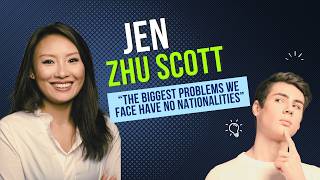
In a Davos‑side interview, Jennifer Zhu Scott, founder of Radiant Blockchain Ventures, explains how blockchain can be leveraged beyond cryptocurrency to address global challenges. She describes Radiant Carbon, a project that distributes free high‑efficiency cooking stoves and clean‑water filters to the poorest households in Rwanda. The intervention reduces indoor air pollution and water‑borne disease, lowering child mortality, and generates UNFCCC‑certified carbon credits. Those credits are tokenized on a blockchain, turning traditionally bilateral, paper‑based, illiquid carbon‑credit trades into multilateral, liquid digital assets that can be accessed by a broader set of investors, provided regulations allow. Zhu Scott also discusses the under‑explored use of blockchain for immutable digital identity, arguing that refugees could retain a permanent, portable record of who they are and their assets, empowering them to access services and funds across borders. Throughout, she critiques the media’s narrow focus on cryptocurrency price speculation, urging a shift toward real‑world impact applications of blockchain technology.
Chapters
I'm Edie Lush and I'm here inside the Hub Culture Davos Pavilion. Jen Zhu Scott has just come through the door.
Welcome. Thank you, Edie.
So you are the founder of Radiant Blockchain Ventures. I want to talk to you about the what blockchain can do to achieve the global goals?
That's a great question. In fact, I think the majority of media today actually got it wrong because they're so focused on cryptocurrency and the pricing. We don't have enough discussion in terms of what blockchain can do and do good. So one of the projects we just launched in the last week called Radiant Carbon, we basically generate carbon credits by distributing free high-efficiency cooking stoves and clean water filter to the poorest households in Rwanda, and using that generate carbon credit and sell the carbon credit to the European organizations and companies that need to offtake their carbon credit, carbon emission. And traditionally—
Let's just break that down. So there's stoves in Rwanda.
Yeah.
And what are you doing then? So the—
So in Rwanda, the child mortality rate is actually very high. The leading cause is— leading cause is two things. One is pneumonia. Another one is diarrhea. So for children under 5 years old, they're very vulnerable to in-house cooking pollution. They use a three-stone stove, biomass cooking. And indoor, you can imagine for, you know, young children breathing that particle into the young lung, they ended up getting pneumonia. And diarrhea is from drinking dirty water. So by deploying this, distributing this, you know, free devices, very simple project, and yet you can change people's lives.
So these are biomass stoves, is that right?
So those are high-efficiency cooking stoves.
High-efficiency cooking stoves, okay.
And then clean water filter. And so through this project we generate carbon credit and certified by UNFCCC. FCC, and if we sell those credits to European off-takers, you know, organization, they probably pollute and then they want to buy the credits in order to offset their emissions. Exactly. But in the traditional carbon credit trading flow, this is nothing new, right? It's been around for a while. But in this traditional trading is bilateral paper trail, which is highly inefficient. Unless you have contractual relationship into either side, for any individual or institution, if they want to participate in this flow, it's almost impossible. So we use blockchain to tokenize the interest of the cash flow. And then, you know, it's through this process we basically turn bilateral illiquid investment to multilateral liquid investment. And made very profitable business but also doing good to even more attractive investment. In this way, we are able to invite a lot more individuals and institutions to participate in this, as long as regulation allows them to.
Okay. Tell me also the possibility to use blockchain with digital identity and refugees.
Right now in the world, this is a topic that bothers me quite a lot. Most people— I actually think this is underdiscussed because Right now in the world, we have more individuals in terms of number displaced from their home because of the war, because of failed government, etc. The number of population displaced from home more than during World War II. And a lot of those individuals, you know, refugees, they're going to another country. They probably don't have a passport. They probably have to give up everything they have, you know, in their home. So with blockchain, when you put an individual's identity into blockchain, one of the features of blockchain is that the data is immutable, which means it will be permanent. So once on blockchain, as long as you can access the internet, it doesn't matter where you go, it doesn't matter if you have your passport or not, nobody can deny who you are, where you're from, who are your parents. None of the really I think, you know, quite promising nature that blockchain can provide is digital asset, right? So right now I think there's a lot of debate in terms of what is Bitcoin, what is other cryptocurrency. Of course, I think the entire cryptocurrency space is very manic and it's very unhealthy right now. However, it does give us hope because imagine if the refugees They have to drop everything in their home and go to other country and all their assets, basically all they need to do to access their assets is to remember that password in their head. So I think that's very powerful and very empowering for refugees.
Jennifer, thank you so much for stopping by. I really enjoyed this conversation.