If You Can't Do This, You're Not Fit (Even If You Look It)

Jeremy Ethier puts six people through seven fitness tests that measure real functional capacity: explosive power, lower-body strength, pulling strength, cardio, mobility, core endurance, and sit-to-stand performance. A 60-year-old non-lifter scores 3 out of 14; an experienced lifter scores 12. The sit-to-stand test alone predicts mortality risk 5 to 6 times over.
Chapters
This is Mariana. She's almost 60 years old, pulling herself up with just 3 fingers. And this is my aunt Melinda, who just turned 61 yet has never touched a weight. Today I'm putting lifters and non-lifters, young and old, through 7 science-backed fitness tests that you can try yourself, measuring strength, power, mobility, and conditioning. Every test is worth points, and we'll reveal the final scores at the end to find out how age and lifestyle actually impacts what your body can do. Because even if you look fit or you're strong in the gym, if you fail these tests, it'll reveal weaknesses that seriously affect how well your body holds up as you age. Starting with power. You've probably seen this before. Bodybuilders look big and strong, but the second they try to sprint or jump, something looks off. I noticed this myself after years of soccer and sprinting growing up. I switched to bodybuilding style training and I lost my explosiveness. And the reason for this is muscle power. It's what helps you move explosively, react quickly, and stay athletic. And if you don't train it, it's the first thing your body starts to lose, often as early as your 30s. And research has shown that it actually matters more than strength or size when it comes to how well your body and even your brain holds up as you age. So how do you know if your power is actually holding up? So the test we're doing is a broad jump, and that's going to measure your explosive power. If you can jump your own height you pass the baseline test. And for those 55 and older, you pass if you can jump at least half your height, whereas for the advanced test, you'll need to clear 2 meters as a woman or 2.5 meters as a man. And if you can't even jump half your height, that is a clear warning sign that your power needs some work. We're taking the best of 3 attempts, starting off with Robin. Even though he failed his first attempts, his next attempts were way better than I expected. Let's go, Robin! Wow, that was very good. Yeah, Ravan pushed past his second attempt, landing right at his own height to pass the baseline mark, which is impressive, especially considering he sits most of the day and doesn't exercise at all. But let's also not forget, Ravan at 29 is just reaching the age where he'll begin losing a lot of his natural muscle power. Yash is also 29, but he has been lifting weights for several years and actually plays volleyball recreationally. Wow! Josh easily passed the baseline test by clearing his own height. He didn't quite reach the advanced tier, but it was still a great jump. Solid. Sticks it. Yeah, these are clean. These are clean. Both Josh and Ravin earn 1 point for passing the baseline, and you can follow along too. 1 point for baseline, 2 for advanced, and I'll show you how you rank at the end. Next up is my Aunt Melinda. She's 61 and has a very similar lifestyle to Ravin. Because she's over 55, she only has to jump half her height to pass the baseline. She barely made the cut, but she kept her spirits high and had a lot of fun with it. Oh! Nice! Hey! Woo! But Mariana is the complete opposite. Always moving and lifting weights 4 to 5 times a week, she jumped nearly as far as the guys on her first 2 tries, but couldn't stick the landing. She finally found her footing on the last attempt. The jump had slightly less power, but she still walked away with an outstanding score for her age group. Now, compared to the younger guys, the main difference in Melinda and Maryana's muscle power has to do with their Type 2 muscle fibers. These are the fast-twitch fibers responsible for explosive movements. And when researchers examined muscle samples from people in their 20s all the way to their 80s, they found a huge drop in these Type 2 muscle fibers. So for Maryana and Melinda, compared to the younger guys, they're already starting with fewer of these power-producing fibers, which explains why my aunt just barely jumped half her height. Now here's a detailed breakdown of how your jump ranks compared to young, healthy adults. So to actually train it, all you really need to do is move weight quickly, whether that's your own body weight through jumping and sprinting, or in the gym with one of my personal favorite exercises, the kettlebell swing. Now, unlike a deadlift where you're controlling the weight slowly, these train your hips to produce force quickly. Make sure to use a lighter weight and add a few sets as a warm-up or finisher on your leg days. But for someone like Robin or my Aunt Melinda, you don't start here. First, you got to build a foundation learning how to squat properly with something like a goblet squat. So everyone earns 1 point for clearing the baseline, but nobody was able to hit the advanced mark. By the end of the video, we'll total up all 7 tests to see how well they're actually aging. So while the broad jump measured your explosive power, lower body strength and stability is just as important. And to test that, we are going to use the reverse lunge. The general benchmark is going to be 25% of your body weight in each hand with dumbbells, and you're going to aim for 8 reps each leg. Melinda is out in less than a rep. However, Robin does last a tiny bit longer by using some questionable form. Unfortunately, that doesn't take him far, and he fails after 4 reps, leaving both him and Melinda with a zero for the baseline test. Now, as we wait to see how like Mariana and Josh do, there's a few things I really like about this test. First, if you can't handle the required weight, it's a clear sign your lower body needs more strength or more stability to stay balanced. Second, both sides have to pass, which exposes strength imbalances between your legs, and that's way more common than you might think. Most people, they naturally favor one side, and with something like a squat, your stronger leg can quietly do more work and you'll still finish the rep. In my experience, for lifters, this can create all sorts of problems in your hips, your knees, and for me it was my groin. And this only gets worse as you age. Research tends to show younger adults have a 5 to 15% difference between sides, but in older adults that often grows to 15 to 20% or more. And when you trip or you lose balance, one side has to take over. And so if that side just isn't strong enough, that's when falls are much more likely. Now, both Mariana and Yash actually do this exercise regularly, so passing the baseline test for them was a piece piece of cake. Was that easy?
That was good.
But the advanced test, it takes us to another level. 8 reps of the dreaded Bulgarian split squat using 50% of body weight in each hand for men and 30% for women. For Yash, that meant holding 100-pound dumbbells in each hand. But there was just one problem. You don't have, uh, 100 pounds. I don't have hundreds. To make up for the lighter weight, we bumped Yash's target up to 10 reps. 1, 2, come on, 3, 4, you're halfway there, you got it, 5, 3 more, 6, 7, last one, go all the way down, there, good, 9, come on, last one, Oh no, it doesn't want you to win. The stability. No.
Okay.
No. Okay. Damn. Come on, you got it, you got it. Oh, so close. You were so close. Oh my gosh. I'm not going to lie, that advanced test is no joke. So if you try it, let me know how it goes in the comments. But if you had trouble with just the basic test, then start with a stationary split squat to build strength and control. Then progress to the reverse lunge until you can handle 25% of your body weight in each hand before moving on to the final boss, Bulgarian split squats. And for most lifters, keeping at least 2 to 3 single leg exercises in your routine is one of the simplest ways to prevent imbalances as you get stronger. But with test 2 finished, here's what the scores are currently at. We still got 5 more tests to go, and the last one might look like a piece of cake, but it's actually the one that most people struggle with. The next question is simple. Can your upper body actually pull its own weight? This test measures the strength of your lats, your upper back, and your biceps. And if you can't even pass the baseline, it's a sign that your upper body strength and muscle mass aren't keeping up with your body weight. Okay, so for this test, we're going to use an underhand grip. You're going to start from a dead hang, and then you're going to pull until your chin crosses the bar. So one bodyweight chin-up is the standard general benchmark. And then if you can pass that, we have some advanced benchmarks where we're going to add weight. Hang. All right. Oh, oh, oh, nice try, nice try. Next up is Yash. The baseline test was a piece of cake for him, locking in this point while Robin takes zero. So we're moving him on to the advanced test, 3 or more reps with an additional 40% of your body weight. And for women, we're bringing the requirement down to just 5 or more clean bodyweight reps. The Gym Bros will be looking up to you. Lightweight. 1. Up. Up. Up. Yeah, that's good. That's good. Come on, one more. Drive the elbows down. No, so close. As for the senior group, ready? Are you hanging? This is like when I was a kid. This is the opposite now, monkey bars. All right, pull. Hold on, hold on. I can't pull! Now, unlike the power test, Melinda wasn't able to get a single rep, and that's because going from 0 to 1 rep, no matter your age, is a massive jump. Later, I'm going to show you how to bridge that gap, but first— whoa, that's clean! Nice! 3, easy. Wow, Dennis, you gotta get a shot of these back muscles. Holy crap. Holy— Oh wow, easy. Was that 5? I'm just in awe. Mariana easily placed herself in the advanced category, but that's not the end. She's about to show us something I have never seen before. That's crazy. I don't even know if I can hang with 3 fingers. Yeah, that's pretty wild. Oh my God. Honestly, this is way harder than it looks, and I was genuinely shocked how strong Mariana actually is. How'd you get so strong with pulling? You're a climber, right? Yeah. Oh yeah, I saw you earlier. I was like, damn, like Her forearms. Yeah, more muscular than my forearms, I feel. Holy crap. When you go to the gym, how often are you practicing chin-ups, pull-ups?
I try to do a minimum of 5, so I stress my body because when I go climbing, I need to make sure I climb and not fall. So I rely on every body part.
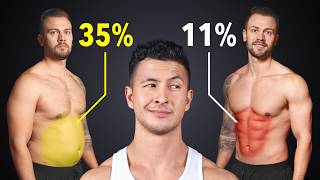
Now climbing is just one of the secrets behind how Mariana manages to stay in such incredible shape. But she's not just strong, she's also insanely lean as well. In fact, based on her DEXA scan, she clocked in at under 17% body fat. That's top 1% of the population lean and the equivalent of sub-10% body fat on a man. And later I'm going to show you exactly how she does it. But if you can't bang out chin-ups like Mariana, you'll want to start with the inverted row to build your back strength and then move on to band-assisted chin-ups, which even someone like Robin with zero exercise could already do. And then over time you use smaller bands until you can do unassisted chin-ups, which is when you want to start adding more weight every time you can do 8 reps pretty easily. For our next 4 tests, we're actually moving away from strength, and I know a lot of you are definitely neglecting this next one, which is testing your cardiovascular fitness. Now, when people say being out of shape is worse than smoking, they're not just being dramatic. A massive study on more than 120,000 patients who perform treadmill testing found that low fitness carried a risk comparable to things like diabetes, high blood pressure, and yes, even smoking. In fact, many researchers are now suggesting that being fit is far more important for your health than what you eat. Today we're gonna do a 1-mile run. Melinda, do you do any form of cardio? Never. Never? I just only walk every single day.
I bike. I do cardio, yes.
I used to be like, run the Sun Run back in high school.
Yes.
I was in like a running club. I love walking, tried running sometimes, but no, I'm not good at running. 3, 2, 1, go! And right out the gate, Yash and Robin are taking off in the lead, while Mariana is sticking to a manageable pace, while I'm personally helping my aunt set her pace for lap 1. The first lap, it'll like raise your breathing.
Oh yeah.
It'll feel harder, but then your body will get used to it. Now typically, researchers test your cardio fitness with the VO2 max test. You run as hard and as long as possible until you give up, and afterwards you get a score that represents your fitness level. But the good news is a simple 1-mile run test is a pretty good way to gauge your cardio fitness on your own. For the baseline score, you should be able to run a mile in under 10 minutes if you're younger, or under 12 minutes if you're over 55. For me personally, I'm currently under 6 minutes, placing me at an advanced level, which is under 7 minutes. Whereas if you're over 55, you 9 minutes or less is the advanced benchmark. And you can also easily do these tests on the treadmill. Just set the treadmill to these speeds in miles per hour for the designated time. But just half a mile in, Robin burned out from his early sprint out the gate. While to my surprise, Josh is actually on target to beat the advanced time if he can hold this pace. Now, even though Josh doesn't do any formal cardio anymore, he has built a solid base from his early years of running and playing sports. Which he seems to have been able to maintain just from doing big lifts in the gym that get his heart rate up. But he's also got his age on his side, because after your mid-20s is when your cardio fitness starts to silently decline by about 1% per year. It doesn't sound like much, but this can eventually reach a point where climbing a set of stairs or keeping up with your friends on a hike becomes very difficult. I'm noticing this firsthand with my aunt. This is good. I got no breath now. She is trying her best. I can hear the wheezing in her breathing, and she was nowhere near Mariana's pace, who seemed to also be on track to beating the advance time. When it came to the finish line, Josh actually crossed first, but he missed the advance time by a few seconds. 7:16! Wow! Mariana followed behind him, officially clocking in at 9 minutes, beating the advance time for her age. And after a few minutes, Ravn who burned out early, finally crossed the line. Wow! 12! 12 minutes! And as for my aunt— Almost there! You got it! You got it! You got it! So close! Let's go! Almost there! Almost there! Yes! Wow! Thanks, thanks! Grandpa, are you okay? I would rather have less life expectancy than running. Mariana was the only one able to beat the advanced time, putting her in the top tier of cardio fitness for her age. But perhaps an even bigger benefit of cardio is what it does to your belly fat, specifically the dangerous visceral belly fat deep in your organs that's linked to disease and death. Now, if you don't exercise much and you eat a lot of sugar and fatty foods and you notice that your belly is full and firm to the touch, you probably have a high amount of this fat. In fact, both Melinda and Robin had alarmingly high levels based on their DEXA reports. But the good news is cardio is the most effective form of exercise to burn off this visceral fat, even without losing weight, which is why we added cardio exercises to our Built With Science+ app. And this is actually where Mariana stands out. She not only has extremely low body fat, but her visceral fat is virtually nonexistent. And from just one day together, it's clear to me why that is. Rather than driving, she actually biked over to meet us for the 1-mile run test, and she regularly goes for hikes and just finds ways to stay active no matter what time of year it is. She is the only one who came prepared with a full day's worth of food: Greek yogurt oats for breakfast, a smoked salmon bagel for lunch, plenty of healthy protein and complex carbs to fuel her activity. And this is actually what researchers call a high energy flux lifestyle. She eats more, but she also moves more, and that combination has been shown to be one of the best long-term strategies to lose fat and keep it off for good. The good news is when it comes to cardio, just walking more is a great place to start, but it needs to be challenging. So try alternating between faster and easier walking for about 30 minutes, and then over time you'll want to include more demanding cardio that actually gets your heart rate up a few times a week. Running, cycling, swimming, or sports. It doesn't matter what you choose as long as it feels challenging and is something you can actually stick to. And if you want more ideas, I'll link a video in the description box down below where we scientifically measured the calorie and fat burn of almost every cardio exercise you can think of. So this next test is going to test your upper body mobility. Over 90% of people actually fail this simple test. Usually it's because of poor posture, sitting all day on the computer, or They're lifting weights in the gym, but a lot of what they're doing is just imbalance. All you need is a wall. Stand roughly a foot back from the wall and rest your glutes and upper back against it. Then bring your arms up into a goalpost position with your arms at 90 degrees while making sure the back of your head is still touching the wall. Now, if you can't get your arms to 90 degrees with the back of your hands touching the wall, or you can only get there by sticking your head forward or arching the lower back, That's a fail. And then advanced is can you slide all the way up while keeping everything intact? This seems easy. It looks easy, but that does not feel easy. Okay, Robin, Robin, Mr. Looks Easy, let's go. Touching the wall, slide up all the way up, all the way up. Ah, his back, his back, his back, his back, his back. I don't know. My back is— No, it's just your— it's because you don't have the mobility that you're going like this, right? No, it's because I sit all day, so my back is curved. I know, but that's what— that's the point of this test. All right, get out of here. Can you lift your hands up at all? I mean, my elbows come up. Yeah, come on. This is not something you can force your way through. Yeah, right. It's okay, nice try, nice try. Now you'll often see strong lifters who do a lot of pressing really struggle with this test. Their bigger muscles tend to overpower key muscles like the mid and lower traps that help open you up and control proper shoulder movement. It's probably why when I tested 3 other guys at the gym, they all failed, whereas both Mariana and Melinda passed with flying colors. Keep this flat and go down. Yes!
You did it!
You did it! If you struggle with this, the fix is actually really straightforward. You want to start with a band or towel and do over and backs for 3 sets of 10 to 20 reps to open up your shoulders and chest, and then follow it with a set of wall slides to actually strengthen some of these back muscles. For me, I do this like 10 times every morning. Oh really? Yeah, okay, every single morning. This really helps with a lot of my, like, shoulder issues, tightness in my upper traps and my neck all went away once I started doing this. Okay, so we just have 2 tests left, and this next one, if this muscle is weak, it's going to negatively affect everything that you do. Most people train their abs for how they look, but that's not what they're most important for. Your core, which includes your six-pack, are all the muscles around your waist, and they're what keep you stable and strong, whether you're catching yourself from a fall or doing heavy squats and deadlifts. But when your core gets weak, Your lifts in the gym not only start suffering, but your posture and your balance can break down, and you can even become more prone to back injury, the leading cause of disability worldwide, which can affect you at any age, whether your goal is to lift pain-free, play with your kids in your 40s, or just stay active and mobile through your 70s and 80s. And to test it, the baseline test is 25 controlled rolldowns and 50 for advanced. You're going to start up here. And your hands in front of you. You're gonna come down very slowly, flatten your back, then reverse by slowly flexing your spine in a C-shape. No momentum and no leading with your neck. And go. Just go slow. There you go. Good job, guys. Melinda is out. Now you can train your abs all you want, but they're not going to show unless you do this. To make them pop, you want to get down to at least 15% for men and around 25% for women, and that's mainly driven by your diet. Let's go, Robin! Come on, you got it, you got it! That's exactly why we created the Built with Science app. It takes care of both your training and nutrition for you and has helped members of all starting points and ages lose fat, build muscle, and get into the the best shape of their lives. You can try 2 weeks for free over at builtwithscience.com or by scanning this QR code. And oh my God, I cannot believe Mariana is still going. That is insane. Let's go! 48, 49, 50. Wow, she can go all day. That is insane core strength. And with Mariana easily hitting the advanced score, I had to know how she was training.
So there are a couple of things I do. Then I launch that. Sweep.
Nice. That's really nice. Wow! What? Close to the mat. And while I'm definitely going to try Mariana's core training myself, if you're already lifting weights, especially with free weight compound exercises, you're probably training your core more than you think. But you can always benefit from training it directly, especially if you struggle with this test. For beginners, use the rolldowns as both your test and your training tool, starting with partial reps and then gradually build up to full controlled ones over time. Whereas as you get more advanced, some of my personal go-tos are RKC planks, ab rollouts, and weighted crunches. And if you do want to mix it up and take it to another level, this is what Mariana does every week. I also added some of her ab exercises into our Bitly Science+ app so that you too can become Mariana. Okay, so for the next test, if you do this test poorly, your risk of dying actually increases by up to 5 to 6 times. All you have to do is sit down and stand up. Back in 2012, a group of researchers had 2,000 adults between the ages of 51 to 80 do this exact test. Now you get 5 points for sitting down and 5 for standing up, but you lose points each time you use a support, like with your hands or your knees. Now, after the test, the researchers followed these individuals for over 6 years to see how well this test predicted survival. And during that time, 159 of them passed away. And what they found was striking. Those who scored poorly were 5 to 6 times more likely to die than those who scored well. So out of all the tests today, this is the one I'm most interested in, especially for our older participants. And for our baseline test, we're keeping it simple. No support, you pass. Any support, you fail. Okay.
Oh, nice, nice, nice.
Do it together, do it together. So no hands, no support. Okay. Oh, geez. Okay. Whenever you're ready. You did it! What happened? No, I don't think I can do it. This is where things get interesting. Josh is way stronger than Robin but still couldn't pass this test because this isn't just about your lower body strength. You also need enough mobility in your hips and your legs. And even though Robin doesn't lift at all, the one thing he does do is a 10-minute yoga routine every morning, explaining why he actually outperformed Yash in both our mobility tests. You can do it. You got it, you got it, you got it. Okay, one hand. Good job, good job. We got to work on your leg strength. Yeah, yeah. Easy, easy, easy. Now the advanced. I don't think I can do the advanced. Uh-oh, uh-oh. Does that count? We need a demo from—
whoa, the other leg!
Whoa, wow, wow, Dennis! Dennis mentioned it might be due to his background. Growing up in Taiwan, they sat on the floor a lot during school assemblies, so he's essentially been practicing this movement ever since he was a kid. And even now at home, he still sits on the floor more than on the couch, which explains why his mobility is naturally better than everyone else here. And if you want Denis's level of mobility, start with a 90-90 stretch to open up your hips. Hold each side and use your arms for support. Then gradually work towards doing it without your hands and windshield wiping your legs, and then finally progressing into a getup. I personally do just 5 reps of these every single morning, which has been just enough for me to keep my hips doing well. Here's everything we tested, and here is every exercise we covered to improve each test. Focus on your weakest areas, and honestly guys, just don't overthink it. Out of all the tests we did, you could have scored a total of 14 points. Melinda, you got 3 points. Robin, you scored 3 points. Josh, you scored 5 points. Mariana, 12 out of 14 points. Wow! Yes!
Vote for me, I'll be the next prime minister.
Thank you. We found the different areas that you guys need to work on. I think like Robin and Melinda, it's very clear that you just need to start something. I would highly recommend one of those things be strength training. It's never too late to start. When you're 70, when you're 80, when you're 90, I want you to still be healthy and still be around. And the same way that you took care of me, I want to start taking care of you. Thank you. Okay. Okay. What a good guy. Do you have any advice for people watching who want to stay in shape as they're getting older?
So start as soon as you can in anything. Just find anything you like. Those days that you don't feel good, just do something. Stretching, yoga, something. Just push a little bit. Push yourself a little bit. That's it. If I inspire anybody, I'm super happy about that.
Give this video a watch next and give a like and show your support for all these amazing people for joining us today. All right. Peace.