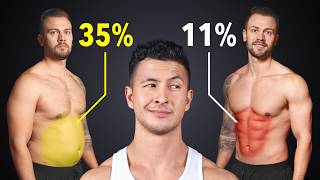
Targeting Belly Fat Is POSSIBLE?! (60-Day MRI Experiment)

Jeremy Ethier tests whether you can target belly fat with a 60-day MRI experiment on two people at 31.8% body fat. Phase 1's cardio plus ab work barely moved belly fat despite growing abs 15-20%. Phase 2 switched to calorie control and strength training, dropping Vicky's body fat from 31.5% to 27.5% and cutting belly fat by 30%.
Chapters
While everyone says you can't pick and choose where you lose fat from, some new studies are proving the opposite. They found not only can you target specific areas like your stubborn belly fat, but all it takes is a simple workout that you can even do at home. But while these new studies are actually very well designed, I don't fully trust the results quite yet. So I'm testing it myself. For 30 days, we're following the exact spot reduction plan that was scientifically proven to work, followed by another 30 days of regular fat loss, measuring everything using the most accurate device in the world. MRI. And let me just say, even as a coach and published researcher myself, I was genuinely shocked by the results.
Oh, oh, whoa, it's really hard. There's almost 8.
But before diving into the plan, meet my guinea pigs. This is Dennis, our creative director, who has been struggling with his belly fat ever since he was a kid. And abs is something he's always admired.
When I look at someone, I look at their face first, and I look at their abs. I don't look at anything else.
I don't care about this, I don't care about that. The first time Dennis came to work, he just said, Jeremy, the only thing I want is abs. Although he works out 4 days a week and doesn't eat much junk food, he's never been able to get rid of the fat around his belly. And based on his MRI scan, he's got some serious potential. So you actually do have nice looking abs. Yours are pretty thick. You're not the first person to say I'm pretty thick. Yeah, yeah, yeah. And this is Vicky, who is pretty active as well, but is also struggling with losing that last layer of belly fat covering her ab definition. Your total body fat is Dennis, 31.8%. Oh, now keep in mind, keep in mind, for, for girls compared to guys, you usually want to add like 10% to get the equivalent just because you have more essential fat. When you look at your belly specifically, that's at 24.7%. You actually store the least fat in your belly compared to anywhere else.
Oh, interesting.
And for Dennis, his total body fat came in at 17.5%. With his belly clocking in at 16%. Now, if this new research holds up, the plan they'll be doing should be the perfect way to destroy the belly fat they've been struggling with. We're going off a, a study where they found this actually works super well. And the idea is that if you train your abs really hard, you're kind of mobilizing the fat in that area. So it's very interesting. The study I'm talking about was published in 2023. Where the researchers came up with a pretty smart plan. They knew that before your body can actually burn fat, it first has to release it from the fat cell, a process called mobilization. If that doesn't happen, the fat just stays stored. And now here's where it gets really interesting, because when you train a specific muscle, blood flow increases to that area, and so does fat mobilization. So in theory, training your abs should increase blood flow to your belly, helping release more fat from that area. And that's exactly why so many people try to target belly fat with crunches and sit-ups. In fact, one study had participants do over 5,000 sit-ups in just 27 days to test this. But it didn't make a difference. Because unlocking fat is actually just one half of the equation. If you release fat from storage but don't actually burn it, your body just stores it again. And so now you're probably wondering, so how do you burn it? And it's actually quite simple. Cardio. but at a low to moderate intensity to maximize fat burn. And that is exactly what this new group of researchers tested. They had one group simply jog for 45 minutes, whereas the spot reduction group, the researchers designed it so that their workout burned the exact same amount of calories, but their workout consisted of jogging for only 27 minutes and then immediately followed it with ab training. And this time it worked. After 10 weeks, even though they didn't make any changes to the participants' diets, both groups lost a similar amount of total body fat. But the spot reduction group, they lost around 2.5 times more fat around their belly. And this isn't the only study to find this. A 2017 study tested a similar protocol but on arm and leg fat, and they too found clear proof of spot reduction. Now, as a published researcher myself, I can tell you that these studies are actually quite well designed, but I did notice one big problem. They measured everything using DEXA scans, which is great for measuring total body fat over time, but it's just not precise enough to measure small changes in specific areas. That is why we're using MRI. It is by far the most precise way to measure fat and muscle changes, and it's rarely used in studies because it's extremely expensive and hard to get access to. But in experiments like this, it really is the only way to be confident with the results. We scanned Dennis and Vicky's bodies and identified 3 points along their spine to track the fat thickness across their upper, middle, and lower belly, as well as the thickness of their abs, just to see how they respond to their training. Now we're coming back in 30 days to see if the plan actually works. You're gonna start here. Yeah. And all I want you to do is lift your tailbone off the bench. Slow, slow, slow, slow, slow, slow, slow. Now the plan Dennis and Vicky are following is almost identical to the study I mentioned earlier. Just with a small upgrade to the ab training. They're doing 4 sets of weighted crunches for their upper abs and 4 sets of reverse crunches for the lower abs, trying to increase the weighted reps every single workout. The key here is you're not using your legs to get it up. Good job. Ah, burning!
I'm got a fucking cramp.
There you go! Enemy out of this. Now if you've seen my previous abs video, you'll probably recognize both of these exercises. They're two of the most effective movements that you can use. And as you'll see later on, worked incredibly well. But immediately before their ab training, they'll do 25 minutes of moderate intensity cardio, just like the study did. And they're gonna do this workout every other day. But there is one key difference between Denis and Vicky's plans. Vicky does not lift weights. So for her, it's just the cardio and ab work. Denis, on the other hand, is sticking with his usual 3-day lifting routine alongside it. And as you'll see, that difference actually ends up having a huge impact on the results. But as someone who doesn't do cardio and abs at all, Dennis was off to a rough start.
I changed my cardio to StairMaster. I think it's a little bit more fun. I climbed 123 floors, and you can't say I broke Alex Holland's record.
Whereas Vicky went with incline walking for her cardio, but trying to juggle it with work has been hectic.
So it is, um, 1 AM right now, and I'm driving to the gym on a Monday morning, and it's It's all my fault. I had a presentation due tomorrow for work and I, I honestly procrastinated.
But so far both of them haven't missed a single workout, which is great because belly fat can honestly feel like a nightmare you can't escape no matter how hard you try, especially for men. And there's a reason for that. After my team and I analyzed over 8 years of DEXA scans from nearly 18,000 people, we noticed a clear pattern. Women tend to store most of their fat around their hips, their legs, and their arms, whereas men always tend to store more of their fat in their belly. And this actually just becomes much worse once your body fat gets above 25-30%. But it's not just where fat is stored, it's also how it comes off. Cuz when we looked at fat loss across different body parts, the belly was consistently one of the slowest areas to change, while areas like the arms and legs tended to lean out first. So it makes sense why so many people try to target it directly. Dennis actually saw this growing up, At his parents' house in Taiwan, there's a horse riding machine and even a belly reduction machine his dad has been using for years. Yet his belly hasn't changed. But if our experiment works, this could finally give a real solution to his problem. And so far, the early results look promising. We're just a week and a half in, and Dennis is convinced his abs are more visible, especially under some good lighting.
Looks pretty good. But I do still feel like there's still a lot of fat covering it.
Meanwhile, Vicky was consistently getting stronger with her weighted crunches and also sticking to a rigorous schedule. But in week 2, both Dennis and Vicky noticed something interesting.
I will say I do feel like I can kind of see like upper ab definition. I don't know if I'm seeing as much improvement in my lower region, but for sure in the upper ab region. You can kind of see some abs coming in here.
There's actually a reason the lower belly is the hardest area to burn off. There's two receptor types inside fat cells: alpha-2 receptors, which slow fat release, and beta receptors, which accelerate it. Your lower belly fat is thought to have a much higher ratio of alpha-2 receptors, making it slower to burn off. But that's not the only issue. Visible abs, they come from two things: low enough body fat and abs that actually pop through. Now, the upper abs tend to be thick and pop through easily, whereas the lower abs are often thinner. And depending on your ab genetics, you might not really even have any. And this is actually why we're tracking Dennis and Vicky's ab growth with the MRI scans, to see if the ab training grows their upper abs as well as their lower abs, and if it does, how much that actually helps them pop through. Now, we're just 20 days in, and Vicky isn't the only one feeling like the belly fat is coming off. Denis has seen some great improvements on his ab strength and the appearance.
I'm going to do an ab progression.
So sore. Which also means he's spending more time checking himself out in the gym, admiring the abs he used to only see on influencers. In fact, he was sending me photos almost every single night. But take a look at this. These are two photos Denis took on the exact same day. Just with different lighting. Influencers use this lighting trick all the time to look better, and honestly, I do too. But it can set the wrong expectations if you're not aware of it, because even when you're super lean, you're not going to have that six-pack shredded look all the time in every environment, and you're going to drive yourself crazy trying to chase that. And this also matters for our experiment too, because small differences in lighting could easily make it look like the protocol is working even if nothing has actually changed, which is again why we're relying on precise measurements. So we're not guessing based just on how things look. After a total of 375 minutes of cardio and 15 ab sessions in 30 days, it's time to see whether all this work actually made a difference in belly fat.
Well, have you noticed anything?
Okay, maybe a little bit. Like, I can see like the line in the middle.
Let's start with Dennis. After 30 days, Denis actually gained half a pound, but he ended up going through a small body recomposition. As a result, your body fat percentage went from 17.5% down to 17%. But how much of that fat loss came from his belly? Well, and based on his MRI, barely any. Most of his fat loss actually came from his arms and hips. His belly fat only dropped by about 0.3%. So for Dennis, more muscle, but no sign that spot reduction actually worked. But maybe it's because he wasn't in a big enough calorie deficit.
This is how you get abs.
And we weren't controlling for his diet. Same protocol as the previous spot reduction study. And that is where Vicky's results come in handy. You actually lost 5 lbs in the month.
Yes, that was kind of crazy. I feel like I was eating the same, and then I went on vacation, and then I think with work stress and school stress, like If I don't sleep well, I don't eat a lot.
But Vicky's cardio-only approach took a toll. Despite losing 5 pounds on the scale, 60% of that weight came from lean mass, and only 40% was actual fat. As a result, your body fat percentage went from 31.8% down to 31.5%.
Okay, okay.
I would put my money that if you did weights on top of that, then probably 5 out of those 5 pounds would be fat. Oh. Now researchers have actually tested this. While cardio plus a diet can lead to more overall weight loss, lifting weights ensures more of that weight comes from fat, not muscle. So it ends up being the more effective way to get leaner. But Vicky still ended up losing a good amount of fat. Vicky saw clear belly fat reductions, especially in her upper belly. But don't get too excited just yet. When we zoom out and look at her entire body, the amount of fat that she lost from her belly was proportionate to her arms, shoulder, and legs, with some of these other areas actually seeing greater reductions. That said, the MRI scan of their ab muscles did reveal something promising. Denis's abs showed a crazy amount of growth, even more than I was personally expecting, with every single one of his abs growing on average about 20% bigger. Which might explain why in the right lighting, both of them noticed their abs bulging out more. As for Vicky, because she wasn't weight training, she lost size in every single muscle of her body except for her abs, which actually ended up growing about 15% bigger. So for losing belly fat, it does seem like your diet, as well as if you're lifting weights, will determine how much fat you lose, and factors beyond your control will dictate where that fat gets taken from. Which brings us to phase 2. Now is where it gets interesting because the first 30 days we tested this spot reduction theory. Yeah. Now for the next 30 days we are just going to throw that shit in the trash. No more cardio? No more cardio. At all? Fuck cardio, I hate it so much.
I kind of liked it.
So no more cardio, no more ab training. At all? No way. Zero. Zero. Oh, really? I'm gonna lose some muscle here though. You might. We'll see. For the next 30 days, what we're gonna do instead is we are gonna do diet and we're gonna focus on weight training. We'll compare the results from this 30-day phase to the previous 30 days of spot reduction. And let's just say the results blew us away. Whoa, what you looking at? Whoa!
Yeah. What is this?
Now going into phase 2, I'm expecting Vicky and Dennis to each lose about 4 to 5 pounds of pure fat in 30 days. While maintaining all of their muscle. And their plan has two simple rules designed to help them lose fat as fast as possible. Rule one: track everything you eat to hit your daily calorie target. Now, if you take your body weight in pounds and you multiply it by 12, that is roughly what Dennis and Vicky are following at their respective body weights. But if you want a more personalized number, you can use our calorie calculator at builtwithscience.com, which I'll also link down below. But how they hit their calorie target is just as important. They're building each meal around these core foods and including a fist size of lean protein in each meal to protect their muscle. But the second part of their plan is where we fix what went wrong, especially for Vicky, who in phase 1 lost muscle everywhere except for her abs.
That's a hit! Bravo! It's a little embarrassing.
That was pretty good. That's not bad. What?
I barely moved.
Oh, Vicky will be following a a 3-day full body workout to hit every major muscle group, while Denis is sticking to a 4-day upper/lower split.
I honestly don't know if I can do it. I now go and watch them drink and eat, like, I get so hungry around 4 and 5 PM, but I have to save it for later because I don't want to go to bed hungry.
Now even though Denis is no longer climbing Mount Everest every other day, cutting food is equally as painful for him. He's a huge foodie. Eating out almost every day. And living downtown means temptation is everywhere. Just like Dennis, Vicky didn't exactly start off strong.
I ate 1,000 calories of dim sum. We only got 1,500 a day. So I went into the party being like, okay, like I got 500 calories left. I was doing pretty good at first. I just got some spaghetti, some like Chinese noodles as well, like cucumber rolls, sushi rolls. Took a picture with Build a Science app. It was 500 calories. I'm like, okay, perfect. Then I had a beer and, you know, a few slices of pizza, and so that added up real quick.
Oh, and she forgot to mention that she ate a cake during her workout on the same day. But despite that rough start, both of them quickly adapted and got on track with their food prep.
I pre-weigh everything, so when I cook a meal, I know exactly how much quota I have left in the day.
We're 10 days into Phase 2. Dennis is still eating out, but he's set on proving that dieting does not have to be torture.
I'll always ask for the sauce on the side instead of having it poured on the top.
Sauces are actually one of the most overlooked sources when dining out. For example, having hollandaise sauce poured all over your Eggs Benedict can easily add 400 extra calories. But if you keep it on the side and dip with control, you can easily bring that down to under 100.
Had the itch and I got a matcha self-serve. So I logged into the app. This thing's like 300 calories or something. Oh my God, like, how do I burn this off? And it's like 10:00 PM.
This is where most people get it wrong during fat loss. It is incredibly hard to outburn a bad diet. 300 liquid calories can be consumed in a matter of minutes, but to burn off the equivalent, Vicky would be looking at an hour of incline walking or 30 minutes of running. Plus in phase 2, we completely got rid of cardio because it's actually not the best tool for fat loss. Because after doing cardio, people tend to subconsciously eat more or move less throughout the rest of the day. It's why in general, people often lose less than half the weight they were supposed to lose when cardio is a primary fat loss tool. And again, even if you do lose weight like Vicky did, if you're not strength training, then most of that weight loss will be from muscle rather than fat. Now, to be clear, I am not anti-cardio. It has real health benefits and it can definitely help speed up fat loss when you use it correctly. But for the sake of this experiment, I am curious to see the results Dennis and Vicky can get without it. And already we are seeing a much bigger difference than in phase 1. This is their first 2 weeks in phase 1 versus their first 2 weeks in phase 2. I mean, it's pretty clear to me that they are losing belly fat much faster, but there is something I'm worried about. In this phase, they're doing zero direct ab training. Now, yes, research shows your abs are actually highly activated during heavy lifts like squats and deadlifts, which both of them are doing, but it's still unclear if that's enough to actually build or even maintain your ab size. And so at this point, I am genuinely curious. If Dennis and Vicky's abs start shrinking, could that completely change how they look, even though they seem to be losing more belly fat than in phase 1? We'll find out what actually happens at the end of the experiment, but 20 days in, both of their weight is dropping just like we predicted. And more importantly, they've seemed to finally found a diet that actually fits their lifestyle.
This is my new favorite snack, tuna and toasted Rice cake. I like to scoop out some oil. You know, every calorie count.
I also noticed Dennis made a simple but smart change. He swapped a lot of his fatty meat protein to lean fish. Lower in calories, yet packs in more protein. Vicky tried to do something similar, but ran into an issue.
I was going over my calories a little bit. I've been eating basically salmon, broccoli, and rice 5 out of 7 days.
Now salmon is great for omega-3s. It actually packs a ton of calories from all the fat. Now that's not a bad thing, but for Vicky, it was causing her to overeat. Whereas when you compare what 30 grams of protein looks like from other sources like white fish or shrimp, you can get a lot more for less.
So that's only around, well, plus seasoning and like, um, olive oil and stuff, like 500 calories or so, 40 grams of protein. So this is really good.
On top of that, Dennis made another subtle change at parties. He secretly swapped his usual whiskey for tea.
So this is my little trick. The color is pretty much the same, and you won't make it weird at parties.
He even came up with a bunch of creative, tasty, low-calorie meals. And if you're a member of our Built With Science Plus app, all you have to do is scan this QR code, and it's going to upload that recipe directly to your food log. And with just a few days left, it seems like all these tips and tricks were working incredibly well.
This is kind of crazy. They're definitely supposed to be like nice and tight to the waist, but they're so loose.
Now we'll get to the final results in a second, but by this point I think it's pretty clear which 30-day approach worked best. So even if targeting your belly fat isn't actually possible, the good news is you can get rid of it no matter your genetics and no matter how big your belly has gotten over the years. And if you do it right, you can see results really quickly. And if you want a step-by-step plan that'll guide you every step of the way, showing you exactly how to work out and what to eat every single week, then try out our Built With Science+ app for 2 weeks free by scanning this QR code or heading to builtwithscience.com. And now it's time to see their final results in person. You have like 4 coming in, holy crap.
Yeah! There you go.
Wow, would you look at that!
Oh, oh, whoa, it's really hard!
If I jump, look at it, look at it.
Whoa!
Jump like here.
I like when you jump.
See here. Wow!
But there's a downside having ass. I found myself like looking down a lot, just like touching myself. I do want to feel them every day just to make sure they are still there.
Okay, results. Let's start with the abs. Okay, so in the first part of the experiment, your abs actually grew by about 15%. Okay, your upper abs, middle abs, lower abs, they all grew.
Okay.
And then the second part of the experiment, we cut out all ab exercises, but you did start strength training. Maybe the squats, he just deadlifts. So what happened to your abs? Well, they did not grow, but they didn't really shrink. They pretty much maintained.
Okay, good, good. That's good to hear.
As for Dennis, your abs actually got about 16% smaller. Oh my God, that's a lot.
Wait, how does that work?
So you, you almost pretty much got back to the point where you were before So doing any ab exercises. So my theory here is Vicky, a complete beginner who just started strength training, got enough indirect ab stimulus to maintain her new ab size. Which for someone like Dennis, who's been lifting weights for a while, he would need to train his abs directly, and so would I. But how much has his ab shrinkage actually affected how his midsection now looks? Well, let's now dive into their fat loss results. So in phase 1, Vicky lost 5 pounds, but only 2 of those 5 pounds were from fat. Taking her body fat from 31.8% to just 31.5%. This time you're down to 27.5%. Really? Yes.
What?
Whoa, that is a huge drop.
Wow.
And that was a, that was a combination of fat loss, which we'll get to from the MRI of your belly. But what really brought your body fat percentage down was the muscle gain. This time you gained almost 3 pounds of lean mass. Wow. Not only that, but during our spot reduction experiment in phase 1, her belly fat dropped by just 3%. But this time, your belly fat dropped on average by 30%.
30%?
Yes. Dennis's result is just as crazy. In phase 1, Dennis gained half a pound and his body fat went down by 0.5%. But this time, after 30 days of only dieting and strength training, He not only lost 5 pounds on the scale, but his body fat went down to 14.4%.
Wow! Hey, that's so good!
That's 3%? That's a lot in one month. You locked in!
Yeah, I, I was tracking everything, including even just a spoon of like peanut butter.
See, that's the difference, guys. People say they track, but they don't. As for his belly fat, The spot reduction protocol in phase 1 led to pretty much no change in his belly, just a 0.3% drop. But this time, your belly fat dropped on average by 26.3%. Oh my God, diet is everything. Now, Denis was actually so motivated from this experiment, he's decided to combine everything— diet, strength training, plus ab exercises— to get to 12% body fat. So make sure to subscribe so you don't miss that. And give this video a watch next if you want to learn the 2 exercises that both Vicky and Dennis did that made their abs pop.