Anatomy of a Patent for Executives and Entrepreneurs
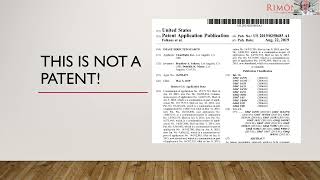
In this hour‑long webinar, US patent attorney Stephen Kolbe (partner at Ramon Law) walks executives and entrepreneurs through the fundamentals of patents, focusing on the United States. He begins with a disclaimer about attorney‑client relationships and then explains what is patentable, the distinction between patent‑eligible subject matter (machines, compositions, processes) and excluded categories (laws of nature, abstract ideas, algorithms, business methods). Using concrete examples such as a historic sewing‑machine needle, LED traffic‑signal patents, and software image‑tagging patents, Kolbe illustrates how obviousness and prior art affect patentability. He then dissects the anatomy of a patent document – data section, specification, drawings, and especially the claims, describing independent versus dependent claims, claim breadth, and the “one‑hand” test for claim narrowness. The webinar covers the lifecycle of a patent family (continuations, priority dates, expiration after 20 years, maintenance fees) and the difference between published applications and issued patents. Kolbe offers strategic guidance: when startups should file provisional applications, how public disclosure impacts US versus foreign filing, how to conduct patent searches, freedom‑to‑operate analysis, and the role of patents in valuation, licensing, and enforcement for both early‑stage companies and large incumbents. He also discusses practical matters such as filing costs, attorney time, conflict‑check procedures, and the importance of aligning patent drafting with business goals. The session ends with a Q&A covering topics like software patents, provisional misnomer, patent fees, and how to leverage patents for fundraising or exit strategies.
Chapters
Hello folks, and welcome to Anatomy of a Patent for Executives and Entrepreneurs. I'm Stephen Kolbe, and I will be your presenter today. Before we get started, a couple of details. First of all, a disclaimer. Listening to the seminar does not create automatically an attorney-client relationship between us. That does require more agreements and documentation. I am a patent attorney in the United States, not anywhere else in the world. So what I'm talking about today applies to the US. I'm also a California attorney. And I am a partner at Ramon Law. I will talk a little bit about Ramon at the end of this presentation. If you have any questions, please put them in the question and answer tab. I'm going to talk roughly about an hour, and then I'm going to take questions, and I will start by going through the Q&A tab. I might have time to go and look at the chat a little bit, but best thing to do if you have specific questions is please put them in the Q&A tab. This seminar will be made available online. There will be a recording, which has now started. So if you want to share it with somebody else or you have to leave early, everybody who's attending should get that in their email relatively shortly. I want to say a little bit about why I chose to do this webinar. As a patent attorney, I work with a lot of clients and executives and people who are doing startups and even bigger companies. And one of the things I find is very often they don't really understand how to read and look at a patent. And while this is a niche, something much more narrow than the usual seminar that I give, I I think it's important and it's an important resource that if you're somebody who has to make decisions about patents, when it lands on your desk, I want to give you and empower you the ability to at least get a basic understanding of what it is and what it isn't. Right? There are sometimes I have people coming to me going, oh my gosh, look at this. And they haven't really understood what the document means or what it does. So we're going to go through a relatively technical example here. I'm going to actually show you some patents and we're going to go in detail how to interpret them and what they mean. My hope is that by listening to this webinar, you will have a much better handle on patents and understanding of what they're good for, how to read them, and what they're not good for, right? So let's start off with the first thing, which is kind of important here, like what is patentable? All right. And that was supposed to click. Good. There we go. So this again applies mainly to the United States, right? The statute says that patentable things are anything that's new or useful, a machine or manufacture, composition of matter. All right. It's actually pretty easy to look at what's patentable by looking at the other side of the question, what's not? Okay, so things that have been done before are not patentable. Okay, and obvious combinations, if you take a bunch of elements and put them together and that's obvious, that shouldn't be patentable, right? Of course, that's a huge gray line. What is and what isn't obvious changes with time, right? I'm going to give you an example here. Let's talk about the sewing machine. Right. 150 years ago, probably. Right. It's— there was a great idea about the bobbin, and then there was the gears and the trundle and the thing you put your foot on to make the thing go. But there was also the needle with the hole at the pointed end. It's obvious to us now, but at the time, nobody would put the hole at the pointed end of a needle. You put it at the back end. It was fatter. Okay, so it's arguable that that little tiny change in engineering wasn't obvious at the time the sewing machine was first invented, right? So obviousness can change. Sometimes a good part of inventorship is realizing what the problem is. Okay, I need to have that thread at the tip of the needle, so I'm going to put the hole there, right? And so you know, in my practice, in my experience, a lot of the time people come up with cool ideas is because they're the first people to realize the problem and nobody had realized the problem before. And that means that their invention, while once you look at it, you might say, oh, that was obvious, that's now obvious. It wasn't obvious before the problem was realized. So obviousness is a place in the patent office where we do lots of arguing and it's an area where getting a patent through often depends on whether something is obvious or not. Straight algorithms and abstract ideas are not patentable. A great example here is an algorithm for calculating risk on a financial instrument, right? You put some numbers in and you get a number out. That is almost certainly not patentable. Okay. Laws of nature aren't patentable. Gravity, not patentable. Scattering light through a prism, not patentable. Those are things that are not patentable. The gray areas, right, are things like business methods, ways of developing business processes. And with business methods, obviousness comes in to a really big degree. Was this approach to doing, to, to managing your data or, or executing some business process obvious or not? And it's hard to argue the obviousness in business methods, so it can be hard to get patents there. There's actually a special review board in the Patent Office that looks specifically at business methods. And while it's possible to get patents there, it's a gray area and difficult. Software is the next question. People come to me and say, oh, software is not patentable. Well, you know, 70 to 80% of the patents I do are software, right? So software, a computer with executable code of some sort, can be very patentable. And a lot of what I do is especially in areas like AI or, you know, client-server systems, IoT, all of that involves software. In Europe, the criteria is that the software has to result in some technical result. And I like that requirement, and I write my patents in that direction, because that seems to solve a lot of the problems both in Europe and the United States. If you're going to do software, you have to have the software do something, whether it's fire the airbag or sort your data or create a tag describing a, a, a photograph. That's a technical result. And if you really focus on the technical result of what's the thought, the stuff software is doing, I find it's much easier to get patents out. Okay, so again, software is— I still have it under gray areas here because if I write something that just analyzes the nutrition facts on the label of a can of food, that's not really going to get me very far. But if I can show that the software actually does something technical result, That's good. There's an area that's gray in diagnostic tests, right? In Europe, for instance, there's, you know, methods of treatment are not supposed to be patentable, but a device that's used for method of treatment might be. Okay, again, this is a gray area and it depends on the jurisdiction you're in, right? A test for a specific DNA sequence may or may not be patentable. That's something you have to go to a patent attorney who specializes in that particular type of subject matter, and they'll be able to give you a much better opinion. So that's it. Okay, what's patentable in the US? A lot of stuff is patentable. The thing to do is go and talk to your patent attorney. Okay, so what does the patent give you? This is very an area where I see a lot of clients get confused. The patent gives you the right to exclude, and only in jurisdiction where the patent applies. So a U.S. patent gives you rights in the United States. It doesn't give you rights in Belgium or in South Africa. It's the right to exclude people from importing, manufacturing, or using. Right. It's on a per-country basis. So if you really want to get patents in a wide group of markets, that means you need to get a US patent, a German patent, a Chinese patent, a South African patent, etc., right? Which can be very expensive. Generally, it's— most of my clients will only look at getting patents in a handful of countries at most. Otherwise, the only people that try to get patents in dozens of countries are pharmaceutical companies with billion-dollar drugs, right? Okay. The patent does not give you the right to practice, right? You could have a patent on something, but that patent would cover a product that might be subject to other people's patents. Okay, so a product, a complicated product, let's say a cell phone, could have hundreds or thousands of patents that cover it. And the fact that you have the right to exclude other people from importing, manufacturing, and using doesn't necessarily mean you have the right to do it yourself without infringing other people's patents. Okay, so patents give you the right to exclude. All right. Now I'm going to now dive into the main subject of what we're going to be talking about today, the anatomy of a patent. And hopefully when we're done with the next 7 or 8 slides, you'll be able to take a patent when it shows up in your computer, your inbox, or on your desk and go, okay, I know how to analyze this and take a look at it, at least at the first level. All right, so The patent application has a bunch of different parts to it, right? There's— starts off, and I'm going to show you actually a patent in a minute, so bear with me. First of all, there's a data section that has information about the patent. When was it filed? What's its patent number? What's its title? OK, there's a specification, and the specification is the written description, all the text that describes information about what the invention is. There's drawings, which are supposed to illustrate more about the invention. And finally, there are the claims. And arguably, the claims are the most important part of the patent, right? They're the part that say what somebody thinks is their invention. The specification can be 100 pages, it could be 200 pages, it could be huge and have lots of stuff in it. But the claims can be really narrow, right? And it's only the claims that express the rights over the invention of what somebody has the right to exclude others on. Okay, it's not the specification. It's just that. So let's go dive in. But before I show you a patent, let me show you a non-patent. This is not a patent. Okay. People come to me, panic. Oh my gosh, look at this. So-and-so, our competitor got this patent. And I have a client who's freaking out. This is not a patent. It says on the very top up there in the corner, patent application publishing. Okay. So this is a published patent application. It is not necessarily issued as a patent, right? On the top line, it also gives a publication number. This is a US publication. It starts with US and then it has the year 2019. Okay. This is a pending application, right? And it may or may not issue as a patent. And when it does issue a patent, the claims may have substantially changed, be much narrower and different. Right. So this— when you get a document that looks like this, the first thing you want to look for is does it say patent application on it or does it say United States Patent? Okay. So hopefully this one slide has relieved several of you of some great anxiety. This is only a publication. Once a patent publishes, you can go to the Patent Office and look up the actual application and see the correspondence between the examiner and the applicant and see if the claims have been rejected once or twice, if the applicant has amended the claims and so on. You can watch the progress of a patent application in the Patent Office once it's published. All the details of what's going on with the application become available to you. Okay, now this is patent. Yay! Okay, this is actually one of mine. Quite a while ago. It starts off in the title, United States Patent. Yes, clearly this is a patent. Okay. And this is the data section of the patent application, right? Usually most of the time that fits on the first page. We have a patent number. This is 7,006,011. All right. The B1 only talks, indicates the version of publication. So this means it's since it's B, the original application to publish first. All right. It has a title, Traffic Signal. Very simple. Okay. That's what it's about. It has the inventor, me. Okay. I have like 3 dozen patents. And then it has the application number. That's what the number you would have looked at up if you wanted to look it up before it actually issued as a patent, the date it was filed. Right. And the next section is very important. I want you to understand that there's a section called Related U.S. Application Data, and it says this is a continuation of another patent. Application that's now issued as a patent, 6,809,655. So patents can be members of families, right? I can file a patent application, let's say back at this time, this was filed in 2004. Okay. If I had paid the maintenance fees on this, And if there was nothing special about it, it would have filed, it would have expired 20 years after that filing date. Now, I haven't paid the maintenance fees on this because it turned out not to be very useful. But you can look at the filing date and then the continuation date. All right. Oh, no, wait, this is a continuation. Of something that was filed in 2002, that means the expiration of this patent would have been 20 years from that 2002 date. So this would have expired a couple of years ago if I had paid the maintenance fees. And again, I didn't, so it probably expired before that. So a patent family can— you can file one application and then you can file a daughter of that. And each member of the patent family can have a, has to have a different set of claims. So if I have a really complicated invention, I can have one patent that addresses one part of the innovation and another patent, let's say a, that have a bunch of system claims that actually claim the device. And then I could have another patent that has a bunch of method claims that claims a method of using the device. And I might still have— if you look at somebody's patent, they may still have further applications pending, right? So this application claimed priority to a non-provisional application, serial number 10,206,871. And that in turn claimed priority to a provisional application that was filed way back in 2001. Right? So that is the information data. Now there's a little bit more data. There's what the examiner looked at and so on. And there's the abstract here on the first sheet. But that's the— this is the typical information you see on the first page of a patent application. You want to— the things to remember here is, are you looking at a patent published application or an actual patent? If you're looking at, you look at the filing date, okay, and you look at the related U.S. applications, unless there's been some delay in the Patent Office or nonpayment of fees or something, a patent will expire 20 years after the earliest priority date of a nonprovisional application. So in this case, This patent would have expired July 26th, 2022. Okay. If there's a big delay at the Patent Office, this section up here that says notice, is there an extension to the term? In this case, it's 0 days, right? There was no delay. And so there's no extra time on this patent application. Okay, let's go and look. Let's have another slide that looks a little more detailed here in case you guys couldn't read that. So this is the data section of a patent application, right? Ta-da! All right, let's now go on to the next section. This is, this is a patent for a traffic signal. Okay. And again, this was, I didn't pay the issue fee on this. It was abandoned. I know I paid this fee. I didn't pay the maintenance fees on this. It was abandoned because I found that it was a product, an idea that was pretty much impossible to get into the market. And the idea behind this was a traffic signal, LED traffic signal, where you could turn on different groups of LEDs in order to represent different symbols. Pretty simple, right? Okay, so the idea was instead of having to have a 4-lamp traffic signal, I could have a 3-lamp traffic signal and one of the lamps could either do a left arrow or right arrow or a forward arrow, so on, right? That was the basic idea. So this is what the figures— this is an example of the figures from this patent application. It was a pretty simple device, something we're all familiar with, traffic signals. It turns out I have a whole bunch of LED patents, some of which are related to traffic signals, others which are much more interesting and are more successful. But this is it. We have the drawings. The drawings are discussed in detail in the specification. We'll get to specification in a minute. This example is a simple device. We are turning on different groups of LEDs to get different patterns within one lamp. That was the innovation. I could save the cost and weight of a traffic signal by using this technology. Unfortunately, in traffic signals, there's a lot of state and federal regulations on exactly how they have to work. And I really couldn't get anybody to bite on this. Okay, so that's a simple— that I'm going to give you now, example of some drawings from a software application, a software patent. This is a typical example for software, and this is from a patent that I wrote for a client, and it's about image processing. Okay, so there's an image here, a white Starbucks cup, and the technology, which was, you know, many years ago, was about taking an image and tagging it, creating a description of the image, which people do quite a bit, right? So in this case here, if you look at the center image, the description for this image came out, came back as white Starbucks coffee cup. Which is pretty good back then. Still pretty good because it actually identified the Starbucks logo and, and said more than just cup, right? For software patents, the figures will often be block diagrams. So in the first figure here in Figure 1, it's a straight up block diagram with a network, various clients that communicate through the network. And a block diagram of a processing system that includes all these different logic elements, right? And the logic could be hardware, firmware, software stored on some memory device. And in the description for the software application, I describe in detail what each of those logic components is going to be, and those logic components show up in the claims, right? So if we're going to do software, typically what you have is a system diagram like shown right here that has logic elements. Often you'll have a picture like this cup, something other than a cup maybe, but something that shows, you know, how the, the processing works, that gives an illustration of what the software does. Might be a screenshot, for instance. In the third slide here, I have a flowchart. And again, I might have system claims that describe— that claim the software, the server, the— in this case, an image processing system. And I might have claims directed at a method. And the methods are shown in the figures as flowcharts. So I have a method here that starts receiving an image, and the next step is receiving an identification of some subset of the image, and so on. There's a whole process that it goes through, and we managed to patent that case, that method, right? So moving on, let's go look a little bit more at the specification. This is back to my traffic signal application. This is a specification, part of the first couple of few, two of the first few pages of the specification of that traffic signal patent. And it starts again with a cross-reference section. I don't know if I can highlight this for you. Okay, the first thing it does is says cross-reference to related applications, and it lists the related applications from which I've claimed priority. This means that I've said this patent application, this patent gets priority meaning credit for the filing date of those earlier filings. All right, so if you're comparing, you know, your product line or your own patents with something that's public, that's a published application like this, it could be that you have to look at the filing date of this application, but then also the priority dates that are claimed. And keep in mind that, you know, one of the things that lists here is a provisional application. That's a number that starts here with 60308229. The provisional application could have a lot less disclosure in it, right? You only get credit and priority for the date when something actually is submitted to the Patent Office. So if I have a 3-page provisional application that had very little in it, that might not be enough to support the claims of this patent application, which really control what the effective date of the claims could be, right? So all this, these priorities and what's in each of those prior applications can really matter in the strength. In this application, there's a background section. This is— I would consider this a relatively long background section. Background sections are useful for pointing out specific deficiencies in the prior art or suggesting them. They should be short. They can be used against you. They very often don't help you. So background, I wrote this over 20 years ago, right? So right now I'd probably reduce this to 1 or 2 paragraphs at most, right? But I kind of wanted to just, the purpose of this background was to describe the deficiency or the prior art, okay? Without saying too much. Backgrounds. I have had cases where I've described too much of the prior art and had that used against me. Right. The next section is a summary of the drawings. Right. Each of the drawings that are included in the application should have a figure number and should be briefly mentioned in what's called the brief description of the various views of the drawings. The next section is the I skipped a page here. There's a summary that goes in between. The summary and the next section here called the detailed description is a description that should include the invention. It can have a lot more than the invention. So the description could go on for page after page after page, and it could be that in that pages there's 3 or 4 paragraphs that really matter the most. Right? Something where the, the magic, the magic sauce is, right? People often come to me and say, oh my God, look at this description. They've got 50 pages here and basically they're describing everything that people have been doing for years. And yet it could be that way, but they're, they are probably taking elements, you know, combining elements from that in specific ways that are new. Or there's a couple of pairs. There's some disclosure in this description that if it's an issued patent, the Patent Office at least has found to be patentable, right? And what's covered by the patent isn't what's in the description. This description, and let's bring this message home. The purpose of the description is to support and explain the claims. The claims are the part that describe what rights the patent owner has. There are what rights they have to exclude people. Okay, so when you look at a patent, look at the title, the abstract, maybe the summary, kind of glance through the figures and then jump to the claims. And the claims, we're going to, the next slide we have has some examples of claims on it. I'm going to explain claims in detail in a minute. But it's the claims that really matter. And when you read the claims, if you see terms there and you're not quite sure what they mean, you have to go back to the detailed description and see how those terms are described. And that is how the detailed description supports and clarifies the claims. Okay, let's, let's actually go do that. Let's go forward here. Click. OK, here's this— still the traffic signal patent application. All right, this is the section starting in column 10. There's a section of the application that starts, I claim, or we claim, depending on the number of inventors, right? And this turns out to be a method claim. So as I pointed out, this patent was a member of a family. The patent that issued prior to it had system claims that actually claimed the actual lamp of traffic signal itself. Okay. And here now I got that patent and I got that allowed and ready to issue. And before it actually issued, I filed this daughter application going after the invention that was related to the method of using this traffic signal, right? And What I've got here in this slide is an image showing the actual claims. There's 21 of them, right? And then I've expanded Claim 1. So we're going to go through that in detail. Looking first on the, on the left side, there's 21 claims. Claim 1 and Claim 9 are what we call independent claims. They are self-contained. They don't refer to another claim. So they stand all on their own. And Claim 1 starts off a method of operating a traffic signal. Okay, so that's a method claim. Claim 9 starts off a traffic signal comprising, and it recites system elements. So it's a system claim. Okay. And these claims have to be somewhat different than any claims I had in the original patent application filing. So if you were to go back and look at the parent or the parent of this patent, the previous application, the claims there that issued as a patent would have to be somewhat different. You can't have the same claims appear in more than one patent. Okay, so the other claims, Claims 2 to 8, 10 to 21 are called dependent claims. So let's look here at, at Claim 2 a little bit. It says the method of Claim 1 wherein blah blah blah. So Claim 2 is said to depend on Claim 1. So it's taking Claim 1 and adding more limitations to it. Each of these sections of the claim are called a limitation, right? The more limitations you have, the narrower your claim is. I'm going to say that again. The more limitations you have in your claim, the more words, the narrower it is. So this is sometimes a problem. I'll have somebody come to me and say, you know, I got this fantastic patent. It's, you know, I want to start going and enforcing it. It's got, you know, people are doing my stuff all over the place. And I look at their claim, their Claim 1, their first independent claim, and it's a column and a half long. It is, it fails the hand test. You can, you can't cover it with your hand on the piece of paper. It has so many details. It has, and I say, this has like too many details. And the person coming to me says, yeah, it has everything I do in it. Right? So to infringe that claim, right, to enforce that claim against somebody else, they have to do every single thing in that claim, every limitation. And if you have a column and a half of words, all they need to do is find some phrase and say, we clearly don't do that. And they're off the hook. Your claim has so many— every limitation makes the claim narrower. OK, so the more words you have, the narrower the claim. A really, really broad claim can have just, you know, 40 words, 30 words in it, right? So that is a sign. So keep that in mind. If somebody shows you a patent and you are concerned about whether you infringe that patent, start looking at the independent claims. Look at every line. Okay, so the first line after the preamble of this, of this claim 1, is supporting a traffic signal having a plurality of lamps. That means more than one lamp. Okay, you look at that line and you say to yourself, does my traffic signal have more than one lamp. Yeah. Okay. Then you go to the next phrase and you say, a first lamp of the plurality of lamps, including two or more separately controllable bulb groups. Right now you have this phrase bulb groups. What does that mean? Okay, well, now you've got some term that you're not quite sure about. You've got to go back and look at the specification, look at the detailed description. And in that detailed description, it should explain what a bulb group is. It should define that. It's a group of bulbs that can be turned on and off independent of the other groups, right? For example, right? So this is an example of you look at the claim, and if you see a phrase in the claim, you refer back to the specification. That's the point of the specification, to explain what that phrase means. So a separately controllable bulb group is a phrase that's defined— that should be defined in the specification. If the specification doesn't say anything about that, there's a problem with this claim because it's not— it wouldn't be very clear. OK, so now you're looking at your product and say, OK, I've got a traffic signal. It has a bunch of lamps in it, but do I have a lamp that has Do I have one lamp that has at least two separately controllable groups of bulbs? No, I don't. Okay, I don't infringe this claim. Go on, look at the next independent claim, right? You're in good shape if you get through the independent claim and it looks like you have— your system or your method does have every element that's discussed in that claim. Then you should go talk to your patent attorney. Okay, there's a chance, not certain, there's a chance that you might infringe that, that patent claim. Okay, Claim 2 adds further limitations to Claim 1. Claim 2 is all of Claim 1 plus something else, right? That means Claim 2 is narrower than Claim 1 because I've added a limitation, right? Claim 2 It says where I'm looking past my camera here, this, the, the separate controllable bulb groups each include at least 2 LEDs, right? That's putting in a new limitation, new characteristic, a new requirement on what's in the separate controllable bulb groups. And claim 3 and claim 4. And if you look at detail at any patent, you'll see each of the dependent claims And again, the dependent claims are the ones that depend on another claim. And usually like the method or the system of claim 1, for example, those are dependent claims and they further narrow the scope of the, of what's being claimed. The reason that somebody has multiple claims is if this patent were ever to have been litigated, it might be that there's some prior art and that the defendant, right, the person who's accused of litigation, gets to kill, manages to kill Claim 1. They convince court that Claim 1 is no good, but they might have, but they have to do that with all the claims. So because Claim 2 is narrower than Claim 1, it's harder to knock out Claim 2 by finding some piece of prior art that challenges it. Now, I've said that The claim is the more words in the claim, the narrower it is, the more limitations, right? Without regard to what the actual words are. The thing that somebody has to do to get the claim is convince the Patent Office that there's something, some limitations in the claim that are either original or non-obvious, right? Okay, so if I have a really broad claim, that should make it easier for the patent examiner to find prior art that invalidates my claim, right? Or if I'm going to enforce the claim against somebody, they're going to hire people and they're going to do big massive searches and try to find prior art that invalidates my claim. If they can find some piece of prior art that is for example, a publication that occurred prior to my filing of this patent application that, you know, one piece of prior art or multiple pieces of prior art that are obvious to put together that include all of the limitations of my claim, then my claim can be invalidated. So there's two forces here that are opposed, right? The more limitations you have in a claim, in a patent claim, the narrower it is. But if it's broad, that makes it easier to challenge your claim and harder to get it through the Patent Office in the first place. So these are two forces that are pushing against each other, right? And what you want in a patent when it finally issues is somewhat broad independent claims, right? And then dependent claims that narrow that further making it harder to challenge. All right. So, and again, you might have gotten one patent issued and have daughter applications pending where you're trying for broader claims or claims directed at some specific area. I'm going to circle back to my example of the sewing machine with the needle in the hole at the point of that. Right. I could write a claim if I, with great hindsight, if somebody back at the time the sewing machine was invented had written a claim, a sewing machine with a mechanism for moving a needle up and down and the needle having the hole at the pointed end, period. That's a very broad claim because there's not a lot of detail. The whole point is the needle with a hole at the pointed end. And again, we talk about, was it obvious before you built the sewing machine to put the hole at the pointed end? No. So that's an example of a claim with few words. And to still today, that would cover most sewing machines as far as I've seen, as I know. So when you are trying to patent something, if you can find something that's really specific but blocking, right? You could, to build a sewing machine, you have to have the hole at the pointed end, I think. Right? So if you can find some feature like that, that's kind of, that was non-obvious and you can write a broad claim all around that feature, that's a really powerful claim. Because you're blocking a pinch point. Without that feature, other people can't do a sewing machine. Okay? And the putting the hole there wasn't obvious until you were actually looking at the sewing machine saying, oh, I got to put the hole here, right? Until you realize the problem. All right. So let's see, what else do I want to say about this before I go on? Let's see. Covered that. Yeah, when you look at a patent and somebody hands you a patent, again, look at the abstract, look at some of the figures briefly, jump to the claims. If claim— if the independent claims are half a column or a full column long, they're probably really narrow, and your process of deciding if you would, if something, you or somebody else infringes that claim, is to look through the claim in detail and compare each phrase in the claim with either a system or a method. Does that method satisfy, you know, have that feature or not? Okay, let's see, any other? Okay, that's it. Let's go on. We got one more slide and then I'm going to start on questions here. We're moving pretty fast. Okay. All right. This is not about the patent again, but this is a little bit about strategy because this is important. Why do you get patents? And the question is, it depends on who you are. If you're an early stage startup or a giant company, right? If you're a big giant company, you, get patents to potentially enforce them against competitors, right? So that the inventions, the investment you make in inventions and your engineering gets retained by you. And if you're Apple and Samsung, you can fight about it in the courts, right? And pay each other and block products. Or let's say you're a company that's made a glucose or a, an oxygen monitor in, into a watch, right? And you try to go to Apple and say to them, hey, I've got this great technology you could put in the, the Apple Watch and people could look at their, their O2 saturation in their blood. That would be a great product, right? And you spend 6 months working with them and, you know, working on the engineering and kind of optimizing your product, and then one day Apple stops talking to you, and the next day you learn that 4 of your engineers have just been hired away by Apple, right? True story. Okay, uh, years later, uh, that small company nails you in court. They win, right? And all of a sudden you're going to spend hundreds of millions of dollars, uh, pulling some You're going to first of all pay for infringement, maybe multiple times damages because you've intentionally infringed. You are going to pay, you're going to have to pull either pay into the future or pull this feature out of your product, which is painful and expensive, right? So if you're the little guy, if you're the company, you are going to file patent applications Not because you're like, you don't really want to be in the position when you're fighting Apple, right? For a startup, if you're a Silicon Valley type startup that's taking investment and wants to have an exit, the reason that you do patent applications is to increase your valuation, right? A patent litigation against a big company costs millions of dollars. And so if that happens, you turn from a tech startup to a patent enforcement entity overnight, right? You end up spending all your time, money, and effort on enforcing some patents where your goal had been to start a new company and eventually maybe sell it to Apple. Okay, that's what you were expecting. And the bean counters at Apple decided, oh, let's just rip these guys off. Instead of paying, you know, buying their company, we could reproduce this all and walk away, right? And it didn't work out right. They did the calculation wrong. But if they'd bought the company, the patent portfolio should have made a big difference in the value that they paid for it. And I have seen cases where the patent portfolio made the difference between a company being acquired and not being acquired, or at least a principal part of that. And that meant literally hundreds of millions of dollars to the founders and so on. So if you're an early-stage startup, the reason you're doing patents is not to pound on the competition. The reason you're doing patents is to increase your valuation and the price you get at an exit. That's an important lesson. If you're a large company and you can afford to easily enforce patents, you get patents in order to push around your competition and maybe push around early-stage startups that are trying to copy you. Okay? So that's why you want to do this. Keep that in mind. And that should be an important part if you're a startup. Most of the clients that I work with are early-stage startups. If you're a startup, the goal is every patent application you file, you and your patent attorney should be working together to make sure that it's written and the coverage and the focus of the patent application is towards increasing your valuation. And a good patent attorney will have that discussion with you. Okay. Why are you patenting this? Oh, engineering thinks it's really cool, but marketing and sales don't care. I don't like that patent, right? I want to patent the thing that really makes the sales guys and the marketing guys happy. They can say, we're the only ones who have this, buy us, right? That is the thing that you want to patent. Not what the engineering thinks. And of course, if you're a 3-person startup, you just have to put your, your marketing hat on and say, you know, why am I— is my product going to sell? Okay, that's what I'm going to patent. Okay, so that's it. I'm going to answer questions in a few minutes. Um, this is my Ramon slide. I'm a partner at Ramon Law. We are one of the largest semi-virtual law firms. We've always been semi-virtual. I joined just before COVID It was Perfect timing. By semi-virtual, it means that we have offices. So I'm associated with our North Lake Tahoe office. Nice place. Yes. I often also meet with clients in our Menlo Park office or our San Francisco office. Our offices are relatively small. Admin and a bunch of conference rooms. Some of them actually have offices used by attorneys, but most of us work remotely at home or wherever we like, on cruise ships. You know, that's how it is. It's a good life. Um, Ramone is very different than most law firms. It is a flat structure, not a pyramid, which means most of the attorneys here have 20 or 25 years plus experience. We have many more partners than associates, uh, and in a traditional law firm, it's a pyramid with lots of first and second-year associates and you know, a whole food chain that goes up. Ramon attorneys get a much better percentage of their billings because we don't have to pay for real estate. So that's really good. We are a worldwide— I think we're down to like 12 countries right now since the slide was last used. Russia is gone and somebody else is gone, but we do have quite a few offices and we are worldwide. There are about 20 patent attorneys who do patent prosecution, which means writing patents at Ramone. We have also a litigation team for patents, but we also do just about everything else you could want. International trade, airline leasing, oil and gas, white-collar crime, investigations into foreign transactions, CFIUS, FDA compliance, pipelines. There's— we have a, a really broad background. This is my email. If you have any follow-up questions, please send me a note. I'm going to dive into the Q&A in a minute, and then I will maybe look at the chat to see if there's anything interesting there. Feel free to connect with me on LinkedIn. I'm really easy to find there. And it's just my name as my LinkedIn address. So that's it. Now let's go on to the questions and answers, folks. Okay, Sarah. Yeah. Okay. So Sarah says, do you generally recommend aspiring business owners to pursue a patent if their invention is novel? Is there a time when you don't recommend someone get a patent? So it really depends a lot on the business, and there are definitely times when I recommend not getting a patent. The clients that I usually work with, not exclusively, are early-stage startups. Sometimes I work with big companies. Facebook is a great example, right? I also occasionally work with individual inventors, and these are people who have invented a new garlic shredding device, a, a cool bed sheet, a dog collar, right? Those people who are professional inventors, there's a business model here. Patents are expensive. We haven't really talked— if you go to one of my other webinars, often I talk about the cost, but you're getting a patent out issued over a number of years might cost you $20,000, $30,000, right? And if you're making a garlic shredding device and I've, it, it's probably not worth the investment. I work with somebody occasionally who specializes, his name is Stephen Key spelled with a PH, last name K-E-Y. And he has an organization called InventRight. And I've known Stephen for almost 20, 25 years. And he was in the toy business and now he helps coach individual inventors. And his business model is that you file a provisional patent application, which is really relatively inexpensive. And then you see if you get traction, right? You go and you try to license your idea. And he will coach you on getting into Walmart, you know, how to pitch Bed Bath and Beyond, or let's pick a company that's— how to pitch Home Depot, right, with your new product, or Black+Decker, and license it. And if you don't get it licensed in that year, then you don't put the money into a full patent application, right? And he'll give you advice on how to do that. That's a lot different than the company that's going to be, okay, we're a Silicon Valley type startup. We are, we have a little money from friends and family and we're now going to do a seed round of $300,000. And we hope that in 6, 5, 5 or 6 years, we get bought by Cisco and we're going to all be rich, right? That's different strategy. If you're the garlic guy, and I have literally had this happen to me, where the inventor comes to me and says, you know, I have this patent and I went to a trade show and there's a guy down the row who has the exact same product. Right? And it's like, okay, well, to just get started in patent litigation, you know, budget maybe $50,000. If you get out of it for under a quarter million, you're really lucky. Yeah, but it might, might cost a million bucks. And the guy's response is, well, I, I sell 70,000 of this a year. There's, there's not, you know, that's my gross sales. There's no, no sense in trying to enforce the patent. Right. And so I try to avoid situations where people are going to get a patent and I don't like, it's just expensive wallpaper. That's the answer to your question, Sarah. You've got, there has to be an economic reason to spend the money on a patent. There's a good business model. As I said, start with a provisional, see if you get traction. Even if you're a startup, file a bunch of provisionals, spend just a few thousand, but get you, then see if you can raise money. If you can't raise money and you spend a year of your life trying to pitch this, that, you know, idea of a business, and you haven't raised the money, start on a new idea. It's a whole year of your life you spent, which is worth a lot. Okay, so it depends on who you are. If you're a business owner, if you're a plumbing shop, get trademark, don't do patents unless you invent some cool plumbing idea, right? But that's that. It really depends on the situation. I have had people come to me and I've said no, because I realized that the product isn't going to be defendable, right? Even if they got a patent, it's not going to be useful, right? So next question, Jim, what's the difference between software algorithm or abstract idea? Okay. A software algorithm, a simple algorithm, could be if this is the price of the underlying equity and I have an option, what should the price of the option be? And I have an equation somebody came up with years ago that says here's the volatility number, here's the strike price, Here's the price of the underlying stock. Boom, this is what my option price should be. Okay, that is a straightforward algorithm. An abstract idea— you stumped me. An abstract idea. Sorting pictures by color. Okay. Um, that's an abstract idea. Something that's just, uh, charging older people more for health insurance. Abstract idea. Okay. Um, so that's it. Can you patent a device that defies gravity? I don't know. As an attorney, I'm going to say, what does it mean to defy gravity? You could patent a device that had a superconductor in it where something levitated. Let's say a levitation— if you found a new way to build a maglev train, that flew 4 millimeters above the track at 300 kilometers an hour. Yeah, that's patent. I don't know if that's defying gravity. If let's say you invented a device that, that defied the rule of gravity where the law of gravity didn't apply anymore, it would probably be based on a law of nature. Okay, so here's a good example, my favorite example, the Star Trek transporter. Okay, I could write a patent application on the Star Trek transporter and it would talk about the little noise that it makes, the little sprinkling lights appearing, disappearing in one place, appearing somewhere else, hopefully not in solid rock or a star, worrying about the relative speed of everything to make sure that even though you are moving much faster relative to the object or whatever. But there would be this hole called, you know, there would be the, oh, the data buffer where your, all your, your matrix gets stored, right? But there'd be this little gap, like something special happens. A patent application has to have enough information in it to enable the invention. Which means you can't have the, oh, and then some magic happens step, right? You have to explain in enough detail how the Star Trek transporter is going to work in order for an engineer, you know, expert in the field to reproduce your invention. If you do not explain enough in your disclosure how to reproduce the invention, then that can make any resulting patent invalid. Right? So I don't expect anybody anytime soon to see a Star Trek transporter patent application issued as a patent because there's technical details that are lacking. So you have to have enough to explain it. Okay? No, there's a great Far Side where a guy's got a lot of equations on the board and his little bubble that says a miracle happens. And then the, the equations continue and the other scientist points to that and says, you have to explain this part a little bit more. Okay, so that's it. You have to explain everything. You don't have to explain— well, you have to explain enough to be able to reproduce the invention. If you, for example, give 50 different chemical compositions, you don't have to say which is your preferred. Your patent attorney can talk to you about exactly what you need to include and what you don't. So for example, I do lots of AI patents. And we have AIs to do, trained to do certain things. And in some cases, we often describe the training process because that's part of what's being patented. But we don't have to show the weighting of the nodes in the neural network, right? That can be a trade secret. We don't have to explain in detail exactly how the trained how the machine learning system turned out. We just say it's trained to do this, and it could be well trained or poorly trained. You know, that's a function of how well the product's actually going to work, but we don't need to give that detail. All right, so that's the question about defying gravity. Next is from anonymous. When you're doing a patent search, if you type the word fix, for example, it will show Will it show fixed, fixes, fixed, etc.? Well, it depends on where you're searching. You— the two best places to do searching are the Patent Office and Google Patents, right? Google Patents, I think, will do fixed and fixes and so on. The other thing to keep in mind is that just like in the old, right, Dewey Decimal System, remember back in high school? Patents are classified by subject matter. So very often you'll find one or two patents using keywords, and then you'll drill down on those companies. You'll search for your— by your competitors' names or the names of the inventors, of employees of your competitor. You'll search, you'll find one patent, and you'll see what the examiner cited in the examination of that patent. Then you'll search those patents that were cited and then see other patents that cited the same ones. There's lots of ways of approaching the search process. There's actually a book on patent searching by Nolo Press, N-O-L-O Press. They have some, a good book on how to do patent searches. I very rarely end up doing patent searches for myself, but Occasionally my clients will hire a company to do it. The cost for doing a patent search can vary from about $600 to maybe $7,000 or $8,000 depending on the quality of the search. At the high end, you are hiring an international team to go look in every language you can conceive of all over the world. And you do that because you're, you're just, you're you're about to be sued over, or you've just been sued on a patent, and you want to find invalidating prior art. You want to knock out, you want to find some Egyptian magazine of biology that happens to mention your journal of biology that happens to mention some prior art that's going to nail the patent for you. That's when you spend thousands of dollars on a search. If you're somebody who's applying for a patent, you might file your provisional, and before you do the more expensive non-provisional, you could spend $500 or $600 on a search, usually done by a team of engineers overseas or scientists overseas. That's relatively inexpensive, and sometimes it's worth the money. Okay, but if you're an early-stage startup, I suggest just monitoring. Number one, monitor what your competitors are doing. Do your own searches and read in the patent literature. Keep a record of what you found, right? The advantage of doing this when you're an early-stage startup, if you find a patent that's on exactly what you're planning to do, you might try to license it, or you've only invested a few months into this project and hopefully not so much money. You can engineer around it. You can do a 90-degree turn and do something else, right? If the, if the patent owner is not going to work well with you. But if you're an established company, you really don't want to know about patents that you might infringe, because if you're Intel and you see a patent that's covering some technology that's fundamental to your chips, then you're in trouble. You really don't want that. Okay. But if you're an early-stage startup, you really want to, you know, as a scientist, I advise my startups to read the literature, know what the competition's doing. You might read somebody else's patent and go, oh, they're doing this, but they're not doing it the best way. If they knew about my technology, they'd do something even better. And boom, you're now going to take that even better and file a patent application on it, blocking their improvement. Okay. So that someday they may want to buy you for a lot of money. Because you've got patents on their product plus your added invention. Okay, so that's a little detail of the patent strategy. All right, Sarah asks again, if I apply for a provisional application and then publicly disclose my invention, does this disqualify me from applying for a patent in the EU? No, it doesn't. It saves you. Okay, so we talked— we haven't talked much about this in the seminar, but there are issues with public disclosure or offers for sale, even if the offer for sale is private, right? In the US, you have 1 year after a public disclosure or offer to file a patent application. In the rest of the world, you don't have that grace period. So if you present your ideas at a pitch in front of a group of investors, there's no expectation of confidentiality, and that public disclosure can be used against you in Europe, right? So what you want to do is you want to file a provisional application, a cheap, inexpensive provisional that covers everything you're going to talk about in your presentation, at least before you do the presentation, and that covers your backside. Okay. Inexpensive to do, easy. And that's— that gives you some protection. Typically, that type of provisional doesn't have enough detail to really support a later non-provisional. So eventually, once you have money, you're going to want to file a provisional application with a lot more meat to it. But, you know, submitting a— taking a white paper or requirements definition or a slide deck or all three and putting them together and putting a cover sheet on it for a provisional application, Filing that before you start talking to investors is a good idea. Okay, hopefully then within a year you've got the money to write a full non-provisional application. The non-provisional application is what's actually going to turn into a patent. Okay, Jim has a question. How do patents affect commerce in multinational app stores? They do. Yeah, so somebody can go after Apple for having something in an app store. A patent in Denmark or Belgium, Luxembourg has a lot of servers. There are times when patents focused on specific apps, they don't care so much about Italy as they do Luxembourg or The Netherlands, places where Google and Apple have server farms are actually thought about when people strategize where to file a patent application, right? It used to be that Rotterdam was popular because of the port. It was a huge port. Singapore is a great example. It's a small city-state, but a lot of stuff goes through Singapore, right? Import and export, right? So, you know, If you are an app, right, having a US patent that hits Google Play and the Apple App Store pretty much gives you power over the whole world. I mean, it gives you a huge part of the market. Okay. Having something in Europe adds to that. But it really, you know, it depends on the specific app. I have seen some cases where, you know, early on in my career, it wasn't my client, but it was one of my firm's clients. It was a money, it was a company that was doing money transactions. This is, you know, pre-dot-com, early dot-com periods, right? 2000. And they were trying to patent in countries all over the world because they were like, okay, we're going to get a patent in Egypt and one in Taiwan and one in New Zealand because we're doing foreign exchange, right? They didn't pass the dot-com bubble. But, you know, that's really expensive. Only people who really do that type of stuff these days are pharmaceutical companies. Okay, Anonymous is asking me, how do we get the right to use our invention then, if not through a patent? Okay, well, you can do something called a freedom to operate search, which of course is not 100% insured. And that you can check to see what is out there, what other people's patents cover. It could be though that somebody filed an application that hasn't been published yet, right? So there, even if you do the perfect search, it might be that, you know, a year later a patent issues that's a problem to you. Okay, you license it from somebody, you have your own patent portfolio, right? You know, this is like poker. You have a set of cards, and if there's you and a competitor, they're both startups, and you have a set of patents and they only have one, right? You're going to sit down at the table and negotiate something out. It's going to be the more cards you have in your hand, the better off you're going to be, right? But you can't be sure. You use your product, and if 3 years after first using it, Nothing's popped up. You can be pretty confident that nobody else has filed a patent application. Well, maybe your confidence goes way up because now your first use is priority against any application that was filed, you know, the day after your use. Okay, so a good example is IBM used to have their own journal where they would publish ideas instead of patenting them. They'd just publish it. And that created a lot of prior art so that nobody else would come and, and pound on IBM's product lines, right? So they, they either IBM in the old days, they either patented it or published it, one or the other. Okay. Mostly in that way, their publication, the IBM publication, it was basically a journal, would be a place that patent examiners would look for prior art. Okay. Yes, Jim says, is provisional patent a misnomer? Yes, it is. Okay. There's only provisional patent applications and a provisional application does not issue into a patent. It gets claimed, the priority of a provisional gets claimed in a non-provisional. And if allowed by the Patent Office and all the fees paid, a non-provisional will eventually turn into a patent application. There is no such thing as a provisional patent. Good. People say it all the time. Yeah. Once you file provisional, you can say patent pending, but you can't say patented. Sarah, next question. Great. She got good questions there. Let's say you have certain content in the patent application description, but it is not in the claims section. Okay, so your question is if you have content in the description but not in the claims. Can you use that to prevent other people from getting a patent? Yes. Your, the filing date of your application, not the issue date, but the date you filed your application is the priority date for that content. And if somebody a week later, right, you're, when you first file an application, it's confidential. In the US, you could actually choose not to have it published until it actually issues, which could be 4 years later, right? You get credit for your early filing date, and that date is what somebody else has to beat. Okay, so if you describe somebody else's invention in your application and then they file 3 weeks later, and they might even get an issued patent because your application is confidential, the day your patent issues and it publishes as a patent their patent is now subject to being declared invalid easily, right? And there's processes within the Patent Office of killing a patent like that. Okay. The other thing is that if you keep your family alive, right, you file a daughter and you have to file the daughter while the parent is pending. You file a daughter application, you can have a different set of claims. That go after the part of the, a part that was described in the specification, but not claimed in the first set of claims. So a big, you know, I filed recently an application in the music space, music technology. I filed an application that was probably 80 pages long. There's at least a dozen patents in there. Yeah. And, you know, we're going to, Because it's a startup, we're not going to go for 20 patent or dozen patents at once. We're going to do those one at a time. And as they raise money, maybe 2 at a time or 3 at a time. But I would expect in 3 years that to be a family of 10 to 20 patent applications, some of which have already issued, right? Based on that mammoth spec, because it had so many cool ideas in it. And a great client. So yeah, part of the business management of the patent process is get as early as filing date as possible, keep things alive. And then, I mean, literally, I had a patent, one of my own patent applications allowed yesterday. It has— there's got to be 60 to 70 patent applications in the family. It's huge, but it goes all the way back like 2006. So the patent that's going to be allowed is going to have less than 2 years life because it's going to expire 20 years from the first non-provisional priority date. But it's, you know, it's valuable because it's something that's hopefully I'll be able to show is really infringed a lot, right? It's going to be— that patent is likely to go into litigation and, you know, somebody's going to get money out of it. But there were so many ideas in those earlier, in those early disclosures that we're still milking it, right? If you get a great specification, it's good for, you know, longer than your company will be around, right? So yeah, yeah. Keep, put everything you can in there and start by focusing on one invention and get a patent on that. And then once that's, those claims are allowed, but before it issues, you have like 6 weeks to say, okay, let's now go after this other invention here that turns out this detail, which we didn't include in the first set of claims, it's turned out that's really important. Our customers love it. So now we're going to file a patent application because our sales guys say this is the thing that's selling the product. Our investors are so excited because we're being successful because of this feature. Parts of that feature were described in our original disclosure. We're now going to expressly have claims directed at those features because those are the ones it turns out are making our company really valuable. And when Microsoft or Samsung or Cisco buys us, they're going to pay us more because we have that patent. Okay, so that's part of the strategy. Yeah, it's fine. Okay, okay, I think I answered your question. Anonymous asks, if patent fees are not paid, can anyone then use what is in the patent? Yes, the patent expires. Okay. And that means that that patent has expired. If there is a daughter or sister or parent, right, that where the fees were paid, then that might still be enforceable. But that particular patent is no longer enforceable once the fees aren't paid and all the grace periods have passed. You can look at the Patent Office and say, okay, It's now been abandoned due to non-payment of fees. I'm going to go forward and start selling my product. Okay, and you should be clear on there with regard to that specific patent. If there's other patents, whether it's owned by the same person or somebody different, that's a different question. Okay, Sarah's asking great questions here. If we want to make a patent with intention of selling licensing, how would you find potential investors, or would it be recommended to start a business first? Okay, it really depends on the idea. But that said, this business model of inventing things, and then— so I have one, I'm mainly a patent prosecutor, which means I enforce— or I don't enforce, I mean, I write patents. I have spent most of the '90s as a CTO of a chemical instrument company, right? My— where my PhD is. And, um, so I built hardware, electronics equipment, sold it at trade shows. So I, at heart, am a product, product guy. Um, uh, so I have somewhere between 35 and 40 patents. I don't— haven't counted lately. But, um, the, the model of inventing something and then enforcing it. Let's say you get a patent and a patent really hits its prime like 7 to 10 years after the filing date, which means you were first and other people were after you, but it turned out to be something important. The whole marketplace, everybody's doing this now. Okay. You're really happy. It's expensive. You, I mean, Part of the reason I became a patent attorney was to learn to write patents because I couldn't afford patent attorneys. It's a hard model. It's much better from a business standpoint. This is not legal advice. This is a business thing. It's much better to be going forward with a product or startup in terms of the odds of making money, right? I do have one patent litigation case right now, and that case, was that litigation, you know, the cost of it, it's going to be in the millions. The litigation started in 2016. Okay. So this is year, it'll be 8 years in December. Yeah, it's, it's not, it's, it's a tough road to hoe. So the idea of just coming up with a bunch of ideas and then people are going to come to your door and start sending you checks, that's not, not usually a viable way of doing stuff. Okay. It's better to, your odds of financial success are better if you're going to start a business or actually make and sell the product yourself. Okay. But, you know, it really depends on a case-by-case basis. Okay. If I were to invent a new system for doing, you know, fusion and getting basically free energy, I'd just write the patents. People would then come to me. But, you know, it's got— that's the exception, right? Okay. Why you ask, Sarah, if would you recommend start the business first as proof of concept? What I would recommend is file a provisional and then try, you know, the day after you file the provisional, start the business and see if you can sell the product or service. And give yourself a year. And if it doesn't work, I mean, most inventors I deal with, they have a lot more invent inventions than they're ever going to patent. And so many, I mean, creative people just, they can, they can write one a day down if they really work at it, right? So it's the art of work being a professional inventor is to figuring out which ones are actually going to work. I showed you the, we, the example we gave here was the traffic light. Cool. Okay, wouldn't it be nice if you didn't have to have like a thing with 5 bulbs in it or lamps because one lamp could do arrows of different directions? Okay, that didn't make me any money. It probably, even though I wrote those myself, I'm sure that there was 3, there's 3 patents in that family. I'm sure it cost me at least $10,000 or $15,000 to all the filing fees and stuff like that. And then I didn't pay the maintenance fees because I realized I'm not going to sell this to anybody. So that's an example of me putting probably 100 hours plus of time into it, which is, you know, expensive. I was a patent attorney back then, so, plus the actual fees and so on, and I didn't get anything out of it. So other portfolios have done better, but that that one didn't. So it really depends on the particular situation. And if you go and you look up Stephen Key on LinkedIn, if you're somebody who's doing a small device, there's a lot of people that have gone through his organization. I go up to Home Depot and I see products on the shelf that I know he helped people with. And he's a, he was a professional toy inventor before he started what he's doing now. He's, you And he's a really nice guy, so he's one person I can recommend. But again, his approach is do a provisional with or without an attorney, do some sort of provisional, and then see if it has legs. OK, Jim, is your patent of little value if it's difficult to determine whether someone else's product or service uses your patent? Yeah. So the question is, is it patenting something that really is hard to detect from another person's product. Yeah, that makes the patent less valuable. If infringement is clear, that's good. It makes the idea of enforcing, you know, it makes an enforcement threat more credible. If you can't tell if somebody else is doing it, you're not really in a position to have a serious letter to them saying, you're infringing my patent, pay me money. Right. That will just drag you, they'll drag you into court and you'll be spending, you know, tens of thousands of dollars right away defending your patent and they may not even infringe. So yeah, it's nice. And on both sides, this is if you're a startup, the question, remember you're writing patents to increase your valuation. And so you might look at, I'm looking around my, looking around HP, I have an HP printer over here. Okay, you might go to HP. And you might be in the printer space, you have a new ink, or new toner material, let's say. And you're going to write patents that include the toner material and some special tweak to the toner cartridge that HP would want to use if they were using a toner material like those. So that when you go to HP and say, hey, I've got a great product here, they look at your claims and go, oh, not only do you cover the toner material, you're covering this new little blade on our ink, our, our toner cartridge that was required to use your toner material. Yeah, that's a good example of where it might be hard to detect right away, but they know what they're doing, right? So they'll maybe pay more for your patent at that point. Sarah's asked, do you mean that one claim should be able to be covered with your hand or all claims? So The shorter you want to have some, at least some relatively broad claims. So if the, if you put your hand over the claim and part of it sticks out, that means that's just, you know, this is a silly rule, but that means it fails the one-hand rule. It's got to have a lot. You have to then really dive into the limitations. The litmus test is people make charts, they'll put a column with one column that has every limitation of the claim, and then the next column has the corresponding feature in the method or system that you're analyzing. Does— is every, you know, one-to-one, is every limitation satisfied? And if there's a gap, that means there's a limitation that's not satisfied by your product. You're in good shape. Okay, and so again, I see people who, who go to patent attorneys who are, who just, they really don't understand. They're not writing patents for a business purpose. They're just writing patents and they will put everything into the first claim, make it huge. The client will be happy because, oh, it's got everything I do in it, but it's a worthless patent. I mean, you, somebody would have to go to extreme measures to actually do everything in that claim. And because it's so narrow, it went through the Patent Office right away and got allowed right away because, you know, there's no prior art, obvious combination of prior art that would've put that together. And that the client's happy. Oh yeah, my examiner, my patent attorney was great. He got this for me for nothing. You know, it was, it only cost me this much money and, and the Patent Office approved it right away. Now, What? It's like, well, do you have a, do you have daughter applications that you filed while this application was still pending? And the inventor says, no, nobody told me I need to do that. I said, well, your patent claim is unbelievably narrow, and because you don't have a daughter pending, I can't now go after broader claims, right? If you'd filed a daughter when during the time you were allowed to, you could now go for much broader claims and, you know, build a portfolio out of it. So yeah, okay, that's the question about the hand. It's not a strict rule, it's just right. Great overview discussion. So it's best to narrow down a patent-specific feature or components? Yeah, so Mike's asking, is it best to narrow down a specific feature or component? A specific feature or component versus a system level. Both. So this is why we have dependent claims. Ideally, you start off with a broad independent claim and then you have some really good key dependent claims that further narrow it, that are much easier to defend. Okay. And even better yet, you have— you filed a patent application with the Patent Office and the examiner allowed out of your 20 or so claims, they allowed 10 of them. You said, okay, I'm taking those in the first patent. They're kind of narrow, but I want to have a patent, you know, look good for my investors, so on. And they filed a daughter going after the ones that weren't allowed right away, and they added some broader claims to them. So again, I just mentioned that the, you know, I I had a patent allowed just yesterday that is a member of a huge family. The scope— some of those patents that are issued have very narrow claims and some of them have very broad claims. Okay, so the idea is to get a whole web of— and eventually, you know, to have a dozen patents. If you're a startup and you're going to sell to a big company, you want to have, you know, a dozen or two dozen patents and patent applications that have big variations in scope and looks at your inventions from what I call orthogonal directions. So that if, if this approach to describing the invention gets knocked out, this one's still good, right? That a competitor who was challenging your patent, you, you go after somebody with 5 patents and they're not, that closely. They all cover the person's product, but they're doing it from different viewpoints, you know, based on different limitations. So if they manage to knock out maybe 2 of those 5, they've still got the other 3 to, uh, uh, fight over, right? So you want to have a range in scope. You want to have narrow claims. And if you can do a narrow claim on a pinch point, meaning like having the hole at the pointed end of the needle, it's narrow but critical. That's great. I love narrow but critical because you can get that through the patent office good and it really can be valuable. It's hard to— something that's hard to engineer around. So yeah, you want even in one patent, the patent I showed had 3 independent claims, right? And then it had a bunch of dependents that narrowed those further away. And you got to pick your dependents so that you get broad set of limitations that are expressed in your claims. Okay. Anonymous: What's general thought about engineers other than employees looking at patent apps and issued patents on that? So the question is, do you want to have a look at your patents? Do you want to have your engineers and employees look at patents? It depends on your situation. If you are a big multi— if you're Intel, you don't, because if Intel learns about a patent that they infringe, it can increase the damages. So the policies of most big companies are don't go reading the patents, don't tell us what's out there. And that's because of liability, right? Because they can't change their product path that easily. If you're an early-stage startup, the— it's the reverse. You want to know what's out there because you are nimble enough. Hopefully you can still change what you're doing, right? Startups do this all the time to avoid somebody's patent. You could say, okay, let's not put this feature in, let's do this other thing instead because of this. Or, oh, this patent belongs to a university, let's license it. Good, right? Or I read this patent and it gave me a whole bunch of other new ideas, right? It triggered, you know, just like a, again, a scientist, right? Reading literature gives you ideas, right? Reading other people's patents. I tell my clients who are early-stage startups to read the literature, you know, check your competitors' white papers and their, their websites periodically. Do, do that type of stuff so that you know what's going on and you might get more and more ideas. And again, if you see, I'm going to pick on Apple again, sorry Apple. If you see a new product announcement by Apple and you say, boy, that looks really interesting, but if they added our feature, it would be even better. Boom. And it's not obvious combination, right? Or you have a family You know, you've, you've already got some patent applications pending. You now file another daughter that has claims, if, as long as they're supported by the specification, that have your original ideas plus the way Apple would use them. Now that is a patent application that's going to be targeted at Apple so that when Apple comes around and starts talking to you, they're going to pay you more for your company. Okay, so you can your patent attorney should ask you what your exit plan is and who your competitors are and why you're going to be successful as a company so that they file patent applications that build your value. Okay. So if you're a startup, read the literature, keep track of what you find because there's a duty to tell the Patent Office-related things. So if you find a bunch of patents that are kind of in your area, write those numbers down and eventually give them to your patent attorney. But that's fine. Okay, Alexander, all patents cost the same or depends on the invention or depends on the state, country? The cost of a patent, getting it on file, depends on the, the attorney. How much they charge, how big it is, right? An 80-page patent application takes a lot longer than a 40-page patent application, right? And it can cost a lot. You're paying somebody who's charging many hundreds of dollars an hour to write, and it takes about an hour to write. For me, it takes about an hour to write one double-spaced page of a patent application, including figures. So if you see a 40-page application, That means it's— the patent attorney probably spent about 40 hours. A good patent attorney will spend about 40 hours writing that application and maybe another 45 minutes getting it on file, plus filing fees. If it's really big, like over 100 pages, then there's a size fee, but that's— we don't hit that very often. Different countries have different rates. Outside the US, you pay an annual annuity to keep an application alive before it even issues. In the US, after your patent issues, you pay maintenance fees every few years. But yeah, the difference in cost— the other difference in cost is how much arguing and how much fight you do with the Patent Office. And I can see I'm over time, so I'm going to wrap I wrapped this up just now. If you fight a lot with the Patent Office, that's a lot more back and forth between your attorney and the Patent Office. Each back and forth might be $5,000 or $6,000. So if it's a really important patent, you fight tooth and nail, okay? And you might spend $50,000 before it's done. If it's not so important, you tell your patent attorney, accept the narrower claims, let's get this done with. I don't want to invest a lot, right? This is a communication. Your attorney has to know the business purpose of the patent. Okay, I see I'm way over. What if I have two clients who compete with each other? That's not good. We do conflicts checks. We work on— patent attorneys have to worry about that. We also have to worry about subject matter. Issues. So if I have two clients, they're not direct competitors, but they end up filing patents that are close, that's a concern. We can do some things about it. So we have about 20 patent attorneys, patent prosecutors at Ramon, and we have systems for isolating people. So the files that I work on can't be seen by other patent attorneys. If both clients are in the same space, let's say CRM, you know, call centers. I've had times where I've had several clients in that space. I assign them to different patent attorneys and all the clients are made, you know, put on notice, you know, here's, we also work on these other companies. And if they say okay, that's good. If they say no, then we refer them to a different patent law firm, a different law firm. I've had clients buy each other. Like, what? Like, okay. I can't really contribute to the analysis of the patent portfolio, but here it is. And it was a surprise. But generally that, that shouldn't be the case. Every law firm has a conflicts check system in it, which is a, you know, computerized system where when you become a client, we write down, we note you're the subject matter of what you're going anybody writing about, and so on. So I definitely now have clients who are looking to work with each other, but the focus of their patent applications are very different. But then again, I can't advise them on a contract where I'm representing both of them. I have to send both of them to other independent attorneys. But we work on that. Okay, Jay, And that's it. I've got— can you discuss more about the design patent examination process? Okay, write me about that. I'll tell you. Anonymous says first to invent versus first. It's for quite a few years now it's been first to file. So you want to file often and early. Provisionals are great for that. Okay, so an individual who will help with an invention startup, I will. My email is right there on the screen. If it's a garlic press, I will refer you to somebody who will help you licensing it. And that, that person's name was Stephen Key, spelled with a P-H-K-E-Y, and he can be found on LinkedIn. His organization is InventRight, And then he is a reputable, good, good guy. That's it, folks. I'm going to end this. I will put this available online. I'm glad to see there's actually more people on. Wait, yeah, hold on. How many people? Yeah. Oh my gosh, we got a lot more people in. So thanks. The email and the LinkedIn are there. Please reach out and contact me. I will— anybody who reaches out will get a recording of this, and I'll send you the link to the recording. It'll probably also end up somewhere on the Ramon website or on YouTube. There's a bunch of channels, people who will use this. But thank you very much and have a good day. Bye-bye.
More from Jessie

Non-Competes and Confidentiality Agreements & What to Consider When Closing a Merger or Acquisition





Strategies to Minimize Duty Liability in the U.S. Heightened Tariffs Environment


Coffee Talk: Navigating Leave Laws: Ensuring Compliance and Managing Employee Absences Effectively



New Year, New Laws: Significant Employment Law Developments in 2024 and What to Expect in 2025