Using IP to Build Value in Early-Stage Cannabis Companies
In this one‑hour recorded webinar, Jason Klein (partner at Ramon) hosts Dr. Steve Kolbe, a patent attorney with a scientific background, to explain how early‑stage cannabis companies can use intellectual property (IP) to increase valuation, attract investors, and protect competitive advantage. The discussion covers the four main IP categories—copyright, trademark, trade secrets, and patents—detailing how each applies to cannabis businesses and what practical steps founders should take. Kolbe explains patent fundamentals, including provisional versus non‑provisional applications, design patents, the novelty and non‑obviousness requirements, claim drafting, and the cost/benefit trade‑offs of enforcement. Real‑world cannabis examples illustrate patentable inventions such as pre‑roll designs, co‑extraction of olives and cannabis, anti‑graffiti coatings for bongs, vaping heating coils, and chemistry that boosts potency in extracts. The presenters also outline common pitfalls for startups: failing to assign IP ownership in founder, employee, contractor, and advisor agreements; neglecting trade‑secret safeguards; public‑use disclosures that destroy patent rights; and mistimed filing. Strategic advice emphasizes aligning IP with the company’s exit plan, using trademarks (state filings now, federal later), maintaining detailed invention records, and considering international filing strategies. The webinar ends with a Q&A, reminders about upcoming sessions on cultivation operations, and contact information for further legal counsel.
Chapters
Now, hello. Let's see, we've got the room filling up here. All right, great. Well, hello and welcome to the latest installment of the Cannabusiness Key. I'm your host, Jason Klein. I am a partner with Ramone. I am based out of the Washington, D.C. office and I work in the cannabis practice group. I'm very excited today to share this platform with one of my esteemed colleagues, Dr. Steve Kolbe, who is in the IP group here at Ramone. And we'll be talking about Using your IP in smart ways in an early-stage cannabis startup. So this is going to be a topic that I am particularly interested to hear about because as I was just chatting with Steve about, you know, intellectual property is a complicated topic, but obviously a very, very important one for early-stage cannabis companies. It can be a topic that's complicated and confusing even for other lawyers. So, you know, getting good straightforward advice on what to do and more importantly, what not to do when it comes to making some early decisions on your cannabis IP will be really invaluable for you. So I'm really looking forward to hearing from, from Steve today. Thank you everybody who's joining us live and in person. We'd like to have you on in person. So that you can ask Steve questions. If you haven't joined us for one of these webinars in the past, welcome to your first one. We do want this to be an interactive experience for you. We want you to use that chat and Q&A bar that you've got there on your control panel liberally. All right, so that's a great way for you to write down some questions or comments. I'll be monitoring that throughout this, the next hour, and I'll share some of these questions with Steve as they come up in the context of the conversation. So we're not going to hold all these questions for the very end. We're going to try to make it a little bit more conversational. So if you've got specific questions for Steve, you know, or for me, obviously, this is an educational event. We are not creating an attorney-client relationship during the course of this 1-hour presentation. We're trying to give you some useful, actionable, general information. But, you know, very specific questions, probably best for you not to write that into the Q&A and chat. But if you have very specific kind of stuff, go ahead and send me and/or Steve an email. Our contact information is there below. And, you know, we'd be happy to reach back out to you and have a conversation about your needs. So just, you know, as we get into this slide a little bit— I'm sorry, get into this presentation a little bit. That was a little too fast.
Just a little bit about Ramon.
Steve's been here a little bit longer than I have. So he may have a few things to say about, about Ramon Law. But obviously Ramon's a fantastic platform for lawyers to practice from and for clients to work with their lawyers out of Ramon. It's a very nimble, technologically oriented type firm. We are growing very quickly. We have a lot of fantastic attorneys and obviously highlighting Steve here today is just one of the many great colleagues that we have. So if you don't know much about Ramon or you haven't been to Ramon's website, go check it out and see what you think. So yeah, you can see here just how quickly Ramon is growing around the country and around the world. One of the faster growing law firms of its size. So let's see here. There's a few more housekeeping things I want to mention before we jump in back into the presentation. The first is that we're going to have the next webinar event. That's going to be November 19th on a Friday, noon Eastern time. We're going to be talking about cultivation operations. Not cultivation specifically, but cultivation operations. Setting up, operating, expanding your cultivation operations. Everything about cultivation operations, not directly related to growing the plant. So all those ancillary things around the building, around expansion of your cultivation operation, we're going to be talking to Ryan Douglas, who is a very experienced cultivation operator and has been through a number of small and large expansions and startups on cultivation. So that's November 19th. I'd encourage you to go over to the Cannabis Business Executive or to Ramon's website and click through and, and for that one, uh, it should be a good one. Also, uh, Just like all the webinars in the past and the next one, we're gonna be recording this webinar here today. It's already being recorded. So if you can't stay on for the entire time, you just wanna watch it later or share it with a friend, which we really appreciate, you know, you'll be able to go to YouTube and do that. And you can do that with past webinars, so if there's ones that you missed. All right, and you know, just one more time there, the chat and the Q&A button. Go ahead and type in your questions for Steve. Let me give you a little introduction to Dr. Steve Kolbe, who received his PhD from Indiana University— go Hoosiers— Bloomington, where he focused on the development and design of scientific instruments. He has over 40 published scientific papers and abstracts and holds several patents. Prior to becoming a patent attorney, director of product development for a scientific instrument company, his preferred hardware development, website development, mobile apps, manufacturing management, medical devices, electronics, sensors, security, measurement devices, control systems, lasers, mass spectrometry, chromatography, and bioanalysis. I think I got all those words right.
One more. Cannabis.
Oh, excuse me, one more. Cannabis, of course, I couldn't, I couldn't miss it. Dr. Kolbe, it's wonderful to have you here today. Thank you for joining me.
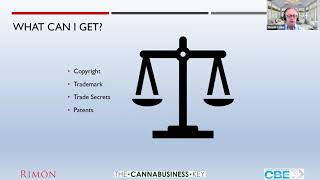
Thank you, it's great, it's my pleasure. Um, yeah, it's— I've been wanting to be on this, uh, webinar series for a while now, and it's, it's great to have the opportunity. Let's step into the slides right away. So Jason's controlling slides, so I'm going to do like New slide, please. Yes, okay. So I'm going to talk about intellectual property and focusing on cannabis, right? I'm assuming my audience is people who do have cannabis business of some sort or another. My personal practice is very much focused on early-stage startups, so small companies, many of whom are going to get investment from investors, and so the IP plays into that. One of the things that people don't realize is that what the point, you know, what the points really are for having IP when you have an early-stage company. And it really depends a lot on what your exit plan is, right? If you are a startup that expects to sell to some big player in, you know, 5 years, then you do intellectual property to increase the value of your company. If you're taking money from investors, every time you take money and give away some equity, you want that to be at the best price you can. You want the highest valuation for your company you can. So for that type of company, the point of getting intellectual property is valuation, right? So what can you get? You can get— these are the— on the slide here, I've listed 4 of the most common types of intellectual property, and today I'm going to talk a little bit about each one of them, but mostly about patents, right? Copyright is something you would do for a picture or a website or perhaps a fancy logo of some sort. It is the type of thing you can do to secure your rights on text or graphics or video, that type of content, right? You can copyright a book or a movie or the text on a website. So it's very likely if you have a website, you're going to have somewhere on the bottom it's going to say copyright 2021 and then the name of your company, right? Copyright applies automatically. So it's owned by the person who does— produces the work. And that means that if you are a company and your employee produces it, or if you're a founder and you produce it, you have to make sure you transfer it to your company, right? So there should be an employment agreement, a founder's agreement, a contractor's agreement, or advisor's agreement, or depending on who— whatever the role that person is. And they need to make sure that they transfer the copyright to the company, right? If you hire somebody on Fiverr or Upwork in order to do some graphics for you, there's a little box to check that says include the copyright or the intellectual property provisions in my agreement. If you don't check that box, the person who did your logo or your graphics or your website might actually own the rights to the layout, not you and your company. Which can be quite a shock when later that person comes back and says, by the way, I'd like more money. Trademarks are probably the type of intellectual property that's talked most about in the cannabis space because the Patent and Trademark Office doesn't let you get federal trademarks directly on things that are clearly cannabis because it's not legal federally. And so what people do— this doesn't mean you don't work on your trademark program, right? What you do is you get state trademarks, right? You use the little TM signal, a symbol next to you, what you think is going to be your mark, okay? You make sure you document when you first used it, all those kinds of things, because someday when they legalize it in the federal level, all those trademarks come available, and then it's gonna be a big battle who first used this, who had the first state registration, who first used it in interstate commerce, etc., etc. So you still need to be talking to your trademark attorney, and a good trademark attorney who specializes, who has lots of experience in cannabis, could probably get you some sort of protection on your existing marks, um, one way or the other. So that's an important thing to have, because if you don't have it and somebody else beats you to it, you could get in trouble. Trade secrets. Yeah, jump in.
Just jump, just jump in here. You know, through the history of this Cannabis Business Key webinar, which is on our 50th year now, I think we've done maybe 2 or 3 trademark-oriented webinars. So we have those in our archive. If you have trouble finding them, just send me an email and I'll make sure you get a link to it, because that in and of itself is a whole nother ball of wax. There's a whole other side of You know, there's the USPTO, which is the Patent and Trademark Office, and the trademark is, you know, half of that. There's a whole other side which we're not going to be touching on very much in this presentation, but if you have questions about trademark, we can talk about that as well and encourage you to go back and watch some of those old webinars.
Yeah, so the next thing is trade secrets. Trade secrets is a type of intellectual property that can be really valuable. I have clients that literally have secret formulas, right? In the cannabis space, you might have a, a set of conditions you do growing under. You might have some magic fertilizer you use. You might have some processing steps that you're not telling anybody in the outside world because it makes— gives you a better product. Those are all considered trade secrets. In order to protect trade secrets, you actually have to take steps to do it. You have to treat it like a trade secret. In other words, if people come in and out of your company and every employee gets to— your recipe for all your secret sauce is posted on the inside door of the men's room or the women's room or in the bathroom, so people are learning it, then you're not treating it like a trade secret. Trade secret, you have to take steps to protect it. You have to make sure that all employees in writing know that what's a trade secret when only special people who have to have access to it get to know the trade secret. If you treat a trade secret like a trade secret, it actually can become much more valuable and become an asset, an IP asset of the company. And there are companies that get bought for their trade secrets, right? The final thing that we're gonna talk about today is patents. And patents is, of course, I'm being a patent attorney, this is what I'm gonna talk about most today. There are two types of patent attorneys. There's the type who's called a patent prosecutor, and those are the guys or gals who go and get you your patent. We write it up, we go in front of the Patent and Trademark Office, argue about it. And then there's the litigation attorneys who fight over patents, right? And I'm the first type, a patent prosecutor. I do a little bit of litigation, but it's usually like 5, you know, less than 5% of my practice. So patents is what we're going to talk about today. Let's go ahead and do the next slide, Jason.
All right.
Trade secrets, you don't have to register. You just keep it. What you do is you keep the paperwork, right? You have a document that says this is our trade secret and these are the limits. These are the only people who are allowed to see it. And you keep that with the rest of your important corporate papers locked away in your safe, right? That's how you manage a trade secret, right? There's nothing quote unquote registering it.
Um, let's see, just so everybody can see there— I'm sorry to interrupt there, Steve, but just so everybody can see, Steve was actually just responding to a question in the chat raised from William. So he specifically asked you, registered trade secrets, great question, uh, and Steve was just responding to that. So if you have questions, uh, you know, I may or may not— we may or may not, but I'll jump into, uh, we're going to try to keep it conversational, so, you know, as this stuff comes up, feel free to type it in there.
Yeah, if it's right about what I'm talking about, then I'll try to grab it. Okay, there's a bunch of different types of patents, all right. There's something called a provisional patent application, which is really informal. It only lasts for 1 year. It's basically a stake in the ground saying, hey, I had this on this date, okay. So it's quick and easy. It's great for early-stage startups who don't have a lot of money. You can do it yourself, or you can spend— you can work with an attorney to do it, and, you know, a couple thousand dollars and you've got a patent pending status. And if it's done well and you work with an attorney, you can, you know, it might actually be really valuable later on. After one year, within a year, the provisional patent application has to be converted into a non-provisional. Now this is where it costs much more money, okay, not just a couple thousand, but $10,000 to $20,000 maybe, right? The non-provisional patent application is what will actually turn into a patent. The provisional, it just sits there in the file and establishes your priority filing date, all right? The non-provisional application will eventually, after some back and forth, expensive back and forth with the Patent Office, that's what can become a patent, right? Occasionally we have people, and I have had this in the In the cannabis space, we have design applications, and that's for how something looks, like the shape and color, the interface of an iPhone or a really cool hubcap for your car. One of the best examples of a design application that was really valuable that a lot of people are gonna be familiar with is the Polycom phone, that speakerphone that sits on the conference table with a kind of triangular shape. Well, that was Polycom's design patent application, and they actually enforced that application against a bunch of competitors, and it turned out to be one of their most valuable pieces of IP in the early days because they were, you know, that triangular shape was really cool. Big round phones looked ugly, or square phones didn't look anywhere as cool. So that's an example of a design application. I have one design application right now in the cannabis space, but it has to do with the shape and look of a smoking apparatus. Hey Steve, so we have a question here. Oh yeah, this is more basic. Yeah, well, I've got two questions.
I'm not sure, but yeah, I mean, they're sort of related. So, you know, I'm the sort of highest level here, $50,000 fee, I think a lot of people may be under the impression that if something is because of illegality on the federal level and the Controlled Substances Act, you know, it's related to cannabis, directly related to cannabis certainly, or even, you know, you know, ancillary related to cannabis, then it's it's not patentable. The Patent Office is going to be rejecting a provisional, non-provisional design, any type of attempt to get some recognition from the USPTO on this. If it's related to cannabis, it's going to be denied. That obviously, the way you're talking about this, seems to be a misimpression. It's not correct. Can you just sort of—
Yeah. So this is fun. Unlike trademarks, we can do the patent and trademark— the Patent Office is accepting everything. There's no limit that has to do with whether something is illegal or not. Now, I'm going to go— I'm going to— I'm a storyteller, so I'm going to tell you stories. It turns out this wasn't always the case. It used to be the Patent Office was a real stickler. And when I first started, you know, about 20 years ago, when I first went from industry and being a CTO to becoming— working for a law firm, I had a book and it was called The History of Sex Through the Patent Office, right? And it turns out in the early 1900s, this was what we call the Comstock era. The guy who made all his money on silver was a big morality person, and the rules in the US about morality were really strict in practice, you know, at the federal level. And you weren't allowed to patent a vending machine change thing where you put your nickel in or your penny in, right, or your dime in, and have a Coke come out of it because it could be used for gambling. All right, and you weren't allowed to patent anything that was related to any, anything of an adult nature. So what would happen is people would put through these patents, uh, that they'd call it something else, but it was really very clearly what the device was meant for. So one of the places where, you know, you could never publish anything of an adult nature back in those days. You know, freedom of speech was very different from what we see now. And, but in the patent office, you would see devices that were quote-unquote medical devices, which wouldn't be allowed to be published in a magazine or paper. It would have been considered pornographic and illegal. So there's some really funny patents from like the 1890s and, you know, 1910s period. That's fine. So that still applies today. I have had a case where I had a patent application that had decryption code that violated the Digital Millennium Copyright Act, and the Patent Office asked to redact that part of the publication of the application. But of course, all the records of that is publicly available on the Patent Office. If you go into the Patent Office, you can— and know what to look for— you can find this illegal stuff that's illegal in the US to publish right now. So we don't have the problem with cannabis. We do cannabis all the time. We do smoking app. I'm going to give some examples in a few minutes of the, of actual patent application stuff that I'm working on right now. So, and then design applications is, is the example I just gave is a good example. It's a smoking device, right? Clearly a smoking device. So we have— we write patents on that all the time. Okay, let's move on. Next slide. Okay, what do patents do? They don't give you— people say this to me all the time, oh, I've got a patent, so I have the right to do this. No, it gives you the right to stop other people from doing this, right? So you might have a patent on something, an improvement, but there might be an overlapping patent that somebody else has on some underlying technology. So a patent only gives you the right to exclude. It gives you the right to stop importation or manufacture or use, right, or practicing a method or making a device, and it's country-specific. So there's no worldwide patent. There's some organizations like the European Patent Office that help you get patents. You know, you can get a patent for many countries in Europe through one process, but in the end, It's always per country. So if you have a US patent, that's good in the US pretty much, and if you have a Canadian patent, that's for Canada or Australia or Korea or and so on. I haven't seen much of this in the cannabis space, filing outside the country. So for most of the people listening to this, if you are in Northern Europe or or somewhere else in the world, you will have a completely different set of laws that may apply. And I am of course only a US attorney. So let's move on.
You know, Steve, this is a really interesting distinction that you make here. Really important for people to keep in mind. Some people, you know, I'm here in Las Vegas this week at the MJ Biz Conference, and I had a really interesting conversation with a with an operator, a US domestic operator, uh, who is setting up an operation in Panama, uh, which has just recently created a medical marijuana program. And, uh, I was just talking to them about their intention of how do they intend to, um, set up that operation. Where are they bringing in the equipment? What kind of, uh, you know, um, What kind of experience do they need? What kind of equipment are they going to do? Are they going to try to replicate what they do here in the States? Are they doing something completely different? But this would be an important idea for you to keep in mind if you do have any designs on going international. You do have to appreciate what happens and what your IP rights are or may not be.
Yeah, so there's a question posted about taxation and IP, and I am not a tax attorney, so I have a friend who is one, and if you have specific advice like that, it's best to— specific questions about taxes, that's not going to be something I'm going to be able to answer, so contact one of us and we'll refer you to an expert.
Right. So yeah, that question about, you know, excluding, uh, you know, application of 280E to, uh, licensing revenue, generally not. 280E does not apply to, uh, revenue from, from licensing deals. But that's a pretty broad type of question and a whole bigger conversation. I've also had I don't know, numerous webinars on 280E specifically. So that would be another good thing to look back through the archives on. But specifically on how your, you know, how a certain stream of revenue from IP may be taxed would be a specific question you should talk to a tax attorney or CPA about.
All right.
You ready to move on to the next slide?
Yeah, let's go. Let's go on. Yeah. Otherwise, we're going to have an hour and a half or 2 hours. Okay, I'm going to give some actual examples of cannabis stuff that I'm working on right now. And I see a question from indoor cultivation that says, you know, one of the— how do you manage aggregating, taking a bunch of different stuff and putting it together to make something new, right? When does that become patentable and— or not patentable? So there's 2 things that have to happen in order for you to get a patent. It has to be new, right? So it's got to be either a method or some system, some device that hasn't been made before. That's step— the first barrier. The second thing that you have to look at is, was it obvious? In other words, did I take part A and part B and just put them together and part A was meant to go with part B, so it's no, you know, it's not— it's a It was an obvious thing, right? So it has to be non-obvious and original. Those are the requirements for patenting something. And if you— pretty much everything we do in the world, right? A lot of what I do is software, okay? The previous firm I worked for had one of the cannabis distribution companies as a client, and we were working on software for their delivery service, right? So Software, of course, is a classic case of taking a set of commands that existed before and putting them together to do something new. And that the threshold is you got to figure out it's obvious. And so a good patent attorney will sit down and work with you and say, okay, you took part A and part B and you put them together, but did they work exactly? Did you have to tweak A a little bit to make it work with B, or did people not realize that A and B would be a better solution than A plus C or something, right? And so often you'll get things that seem obvious once you have realized what the problem is. And so here's my another story. I'm going to tell you a story. It was one of my favorite analogies of patenting cool, how patenting can sort of be obvious but not, right? And so it's the sewing machine. And you've all heard about the bobbin, which is a big invention, and how it catches the thread on each side of the sewing machine. And there was probably patents on the treadle and all this all this other stuff, but the needle had the hole on the pointed end instead of the back end. Before the sewing machine, nobody would do that. Why would you put the needle on the pointed end, right? That's not obvious at all, but once you've got a sewing machine in front of you, you go, oh, well, it has to go here, okay. So that's a case where the problem wasn't obvious, right, and if the problem wasn't realized beforehand and you very often when you're building something, right, you're whether it's a a growing system or a chemical extraction system or some new transport or chemical analysis system for cannabis, you build something and you run into problems and you go, oh, I can fix that by doing this and this and this. So that's the type of thing where, oh, that's patentable, that solution to the problem that nobody realized was a problem before. And so if you're the leader in technology in your space, that means you're trying to solve new problems first, and that's going to give you fodder for patentable technology. Okay, let's talk about some— because I do want to sort of connect this with cannabis, right? So I actually have a bunch of cannabis clients right now, and they're all pretty fun. I just, I have a brand new one, and it's actually on a joint. It's a pre-roll, and the client— I can't talk too much about this one because it's really early stage, but it's about the manufacturer and how the technology quote-unquote wrapped around the weed and how you make this pre-roll, okay? And it's got some unique features that are gonna make it better and more enjoyable to use and hopefully some pretty cool stuff. That company also has a really interesting design patent coming up on how their joint looks. It's pretty cool. Yeah, I look at it and I go, oh, that's awesome. Cool, right? So the next company— so that's number 1. The next company I've had for quite a while, and this is a company that does extraction. One of the unique things about this company— I worked for this guy for almost 20 years now. His first company he founded, he was a CTO of a company called Genentech, all right? And he is a chemist. He was the guy who built the first genetically engineered organism ever, right? So he's He's now in the cannabis space, and he has a really cool extraction technology. So one of the things you do in cannabis, right, and you're all probably familiar with this, is you have a plant and you have chemicals in the plant, you want to pull the cool chemicals out so you can make other products with them, right? You can do it. And so there's ways of extracting things out of plants that existed for ages, you know, supercritical CO2 has been used for flavors and, you know, in the plant processing industry in general, people end up having to use sometimes organic solvents, right, like alcohols and, God forbid, not benzene, right, but there are chemicals that you wouldn't want in your bloodstream that are used for extracting things out of cannabis. And what this client has is he co-extracts olives and cannabis at the same time. And so what he does is he'll mix, he'll use the, he'll mix, take olives and cannabis, and he has all this fairly fancy equipment to get the balance just right, okay, all patentable stuff, and he gets olive oil, right? And the oil has the oil-soluble parts from the cannabis plant and the then you get olive water. That's the other thing. And the olive water, it turns out, have some of the best anti-inflammatories out there. So his primary business is selling anti-inflammatories. They come from olive— not from the oil side of olives, but from olive water. And so he can do a co-extraction with cannabis and olives at the same time and without using these harmful chemicals that people are— you do for use for extraction traditionally using organic olives, and you actually end up adding further anti-inflammatories to the, to the material that you're making. So you get, you get an improved product. And, um, so that's a real— that's an example of one of the cool technologies. That's actually— right now people are interested in licensing that. So that's— anybody wants cool extraction technology, contact me. All right, uh, devices. Um, the first cannabis device— so I had a client who does the coatings on the Golden Gate Bridge and also on the Ferrari Stadium in Dubai and seats on stadiums. He does chemical coatings, and it turns out this coating is really— is pretty safe. I have it on my iPhone. It's used on the Golden Gate Bridge, and every street sign in San Francisco has it. It's anti-graffiti because stuff doesn't stick to it. And so the first thing that we actually did with that, like 4 or 5 years ago, was we got a bong and we coated the inside of this bong. And then I gave it to friends and family and had them use it for a couple of weeks. And sure enough, you put a little water in, spin it around, rinse, self-cleaning bong, right? Not how that gross stuff on the— you know, that stuff gets on the bottom, right? This was just rinse it with water and pour it out. That was fun. And so I was the only attorney at my last law firm who had a whole array of bongs in his office.
It was really nice.
And yeah, it was pretty good. Yeah, no, they had the— I think the best, the most common was tequila. Yeah, it was tequila in the drawers. Okay, devices. So smoking devices. It turns out the company that I used to work for in the '90s as CTO, they're a really big medical device manufacturer now. They were about 40 people when I was there, and they were well over 200 now with manufacturing around the world, and they make— they used to make for electron— for chemical instruments, tiny little coils, heating coils. Well, you know what they do now? They make tiny little heating coils for the vaping devices, right? And so this type of technology, the temperature control systems, all that kind of stuff, bongs of course, that's patentable technology. The last one I'm gonna give is an example. I saw a pitch at Max Shapiro's PitchForce pitch competition, and I saw a company that was really— that I liked a lot. I don't remember the name, but they had a patentable chemistry, and what their focus was, was, okay, we know that when you burn a cannabis leaf, right, you do— you make chemical changes in the active ingredients, THC, that make it more potent. It makes you high, right? But if you don't burn it, it's not as effective. It's not as potent, right? And so if you do an extraction and make an edible, you don't have that chemical compound that you do when you smoke it, right? And so what they've done is they've learned to do how to make that change chemically rather than heating it and smoking it. They can do an extraction and then apply this chemistry and get much more potent product out of it. So that's, those are 4 examples of real-life patents that I've seen lately, um, in the cannabis space. And, and, uh, other things, I mean, I've done a lot of ag, you know, moisture control systems, light, lighting systems. I have a couple of really interesting, um, ag clients that do stuff related to growing things in general, and they could be applied to patents. And that's pretty cool. Okay, let's do the next slide. We're never going to finish all my slides, but let's go.
Well, let's—
let's— I got a question.
I have my own question. You know, all of these examples that you just gave, Steve, I mean, I think they're fascinating because, um, to me it's plainly obvious the value this kind of technology, you know, when even in your short description, I mean, each one of these examples could, you know, could really be very powerful in the market. If you were to run across somebody with an idea of this and they were to come and talk to you and say, here's my idea, generally, what's your, uh, for them as far as provisional, non-provisional and, you know, yeah, talking through in a, you know, from the early stage, this is our company, is what we'd like to pursue. Do we start here in the personal stage, get the protection, and then moving into the—
it depends on your— so Jason, you're breaking up a little bit, so I'm just going to dive in right here. So it depends on your budget and your stage, right? If you're just starting a company, but you're going to go out and talk to people and get— you'd like to file before you show things publicly, right? In the US, if you show things publicly or use it publicly, then, or offer, even offer it for sale, then you have 1 year to file your patent application. But once you— the rest of the world doesn't have that 1 year. Once you present something publicly or do public use. I'm going to tell another story, all right? This isn't a cannabis story at all, but it's a public use story that I like. Public use doesn't— it doesn't have to be clear to the rest of the world that you've got your thing that's publicly being used. And so my favorite case on this is from the 1880s or '90s, and somebody invented a new corset with a new type of— I mean, they really used whalebone back in those days— and a new way of structuring the corset to make it look really good, to make a woman's shape the way they, he or she, her or her husband wanted it. And they went out and tried it, right? He put it on his wife and she walked around and of course she had layers and layers of clothing over it, right? But that was public, that was a case that went all the way to the top end of the courts and said, no, that's public use, even though people couldn't see that it was there. Right? So if you have some tricky new device and you go out and use it, you know, smoke in the park a little bit, that's public use even though nobody around you knows what you're doing. Anyway, so if your budget is lower, okay, you're going to start with a provisional, right? The provisional also is useful if your technology is changing, like you're not quite sure if this is going to take off and you want to invest in marketing to start with, right, and/or new product development. And so you might do provisionals first. If you have more money, right, and you're already well on the way, then you might do a non-provisional. But usually with a startup company, the strategy is to conserve your cash, do a provisional first, and then see if it's got legs. And if it hasn't gone anywhere in a year, forget it and move on to something else. All right, let's move back to the— Okay, when do we start? We just talked about this. Yes, today. All right, so, yeah, so get things on file. You want to start thinking about intellectual property right away before you talk to investors, before you talk to suppliers, really early on in your company, right? It ought to be one of the first things. Doing— often IP occurs before incorporation. I mean, people come together, they say, we have these ideas, and, you know, Ramon will provide them with legal work and help putting the company together. And about the same time as that, we will do the first provisional patent application, right? So getting it done early makes a big difference. In the US and everywhere else, it's first to file, okay? So I have seen where it's been a week. Or 2 weeks between competitors, right? And one of them won and the other didn't, okay? So getting your IP on file early, quickly and early, is a good idea. Provisionals being cheap. If nothing happens for 6 months, you can actually refile and start a new date if you want. But that's strategy. Start thinking about it early, especially trademarks too. Put the little TM, right? Just like the kind of business symbol down here. Has a little TM? No, it doesn't. Okay. All right. Go on. Next slide.
Thank you.
Okay. Why would you do this? Hey, little guy. Okay. You're the little guy. All right. So a lot of times, not as— when I see companies that are hoping to get like VC investment and grow really quickly and be, you know, eventually become a unicorn, right? They'll get this question from investors and say, oh, what about competition? Then the answer will be, oh, we have patent applications pending, so we don't have to worry about the competition. That's the wrong answer, right? Enforcing a patent after it issues a few years later is, you know, $2-3 million project— million, okay? It's really expensive, okay? I've had cases where people have patented with me, you know, food, little food chopping devices or something, and then they come back a couple years later and they say, hey, there's a guy at my trade show, he's got the same device. And I said, well, if you have like a quarter million, we could start, yeah, doing the legal process of shutting them down. And, you know, the product sells $50,000 a year, so you're not— no, it doesn't make sense. For a company at the early stages, IP is for valuation. right, to make your company more valuable. So what— especially if your exit plan is to be bought, okay, you want to have an IP portfolio that a big acquirer can buy you and they'll be able to use it. And it will also— I've seen cases where it makes a difference. There's an acquirer that wants to buy one of three different companies and turns out that that one over there has the best patent portfolio. And so that's the one that gets bought and the others, the other two wilt away on the vine, so to speak, right? So the idea of doing patents is to increase the value of your company, all right? Trademarks cost so much less. They are to build your brand, okay? And also the value of, if you are successful building your brand, then you've created another value thing that makes your company more valuable and more profitable. Profitable. Okay, so yes, you should start on IP right away because when you're older, when you're— even if you're a company where you don't expect to sell, you expect to own this company for 15 years, well, 15 years from now, you— when you— your company's making millions of dollars per year, that's when the IP may really make a difference and you'll be able to squash competitors because you'll have the money to do it. But it's not something that you're going to turn around— if you are a startup and you end up enforcing patents, basically you've given up on everything else and you're now a patent enforcement company. All right, next slide. Bye, little guy. Okay, okay, this is it. I want to cover— this is an important one that I want to make sure I get to. What time is it? Okay. These are some mistakes, and I actually give a presentation sometimes on these top 5 mistakes, and this happens. I have clients that, you know, they're 2 or 3 years old and they made a mistake long before I started representing them, and they die for it. I mean, these are, you know, dead-on-arrival killer things, right? One is ownership of the IP, okay? You want to make sure that the company owns the IP. That the CTO or your researcher or your grower who came up with the idea has an agreement with the company that ideas that he comes up with get assigned to the company, right? And I have seen cases where like the CTO of a company, 3— no, he never signed that agreement, right? 3 years later and $15 million of investment into this company and the CTO says, I'd like a third of the company. In exchange for signing over the IP of all everything we've done, right? And the company dies. That's it. End of story, okay? And millions are lost. So you have to make sure that everybody who's involved, right, that is under your control, right? You have your advisors, your founders, right? Founders too. Employees, contractors. Everybody has a duty to assign IP to the company, right? And that there should— that should be in their agreement. And you'd be surprised, one of my favorite stories is with Adobe. We all use Adobe Forms now, right? You fill out the form and it's really convenient because you can just type in the thing and save it as a file and it's really cool. Well, that was invented by a sales guy at Adobe, all right? So everybody who you can your salespeople, right? You have a sales contract with them, right? There's got to be an IP clause, maybe with a distributor if you can get it, right? Maybe distributors may say no, but yeah, you want to own as much IP as possible. The other— the reason ownership here is twice under mistakes is that you don't want to deal with other people's IP, okay? So if you go on Upwork or Fiverr and you have somebody develop a logo for you, go check it out. You know, do an image search on it. Make sure that what they sent you is actually not the same thing they've sent a company in Mongolia 3 months earlier, right, or in Japan. And little do you know, but somebody else is using your exact same logo and it has 3 months ahead of you and you're in trouble, okay? So make sure that if you have software, for instance, that people don't bring ideas from their former employee that belong to the former employer included in your company. Those are the types of things that can mess you up really badly because you will invest a lot in a brand or a look or a logo or something and then realize, hey, you really don't own it, it belongs to somebody else. Number 3 is waiting. We just already talked about that.
These are, these are the, these types of that owners, founders would want to investigate early on in their company, like you were just sort of discussing, sort of, you know, a due diligence process, you know, the systems that they have, the assignments, whether this is all, you know, actually what they think it is, and ensuring that it hasn't, you know, that they do have good good diligence folders on this. How do they do that? I mean, is that a role for a lawyer to do, like somebody like you to do with them, or something that they can do on their own?
If they're doing things like advisor agreements or employee agreements or founders, you know, the papers that go along with founding of a company, there should be intellectual property clauses in those agreements. And that the attorney who is providing those agreements should do so. I don't recommend anybody go to anybody, you know, nobody should be signing contracts without advice of an attorney, right? So any agreement, whether it's just a mere advisory agreement, especially if there's equity involved or payments, right? You wanna have an attorney look at it, right? There's a question posed about how does IP actually provide value because it's really intangible. Well, it does. A company with a good patent portfolio will be arguably better, I mean, more valuable than the same company without that patent portfolio. And part of this comes down to my fourth point here. It's the strategy. The goal here with patents is not to patent what the engineering thinks is good, but what the sales guy thinks is good. I want the sales guy of your company to be able to go out there and say, by the way, we are the only one who has this, and you've got to buy our product because of this, and oh, did I mention we have a patent on this? There has to be a close— to really make value, there should be a really close correlation between the things that distinguish your company, products and services that you're providing, and your patent portfolio. So that when you go to an investor and say, "Okay, I'm valuing my company at $10 million. I'm gonna sell 10% of it for a million," right, a pre-money valuation. The part of the reason I'm saying it's worth that much is we have this wonderful set of patent applications, right, and they're so closely related to these things here that I'm telling you why we're gonna be a winner in the market, okay. So a patent or a patent application on something that really doesn't sell the product or doesn't make a difference to your customers or your sales and marketing team is probably not going to create a lot of value. But when you express to somebody why your company is going to be valuable, because we have this, because we make the best joints ever, right, that smoke perfectly, okay, people, they try it and they see the difference right away. Well, that difference is covered by the IP, right? And so that creates a value in the company. And I have literally seen cases. I have a few years ago, um, 10 years ago now, I had a client, um, and they had a competitor. And my client had a really good patent portfolio, and the competitor had a bunch of disadvantages, not quite the same patent portfolio, had a CEO who was a jerk and my client was nice. They were bought, a 33-month-old company, for $380 million, right? And, you know, my goal was, hey, I think the IP portfolio made a difference. The other company went— was sold to creditors. It never went anywhere. There's only going to be one purchase here. And so that made the winner, right? And that's the type of thing— that's how a patent portfolio and IP in general can make the company more valuable, right? McDonald's has a trademark, right, on that name, and that's a big point of value because of value for the company. Okay, um, the number 5 thing— I'm keeping a little eye on the time here— is when you start working with a patent attorney, make sure that you spend some time understanding the differences of the parts of the patent, really what it means. Okay, there's different parts. There's the drawings, That's part of the specification, which also includes a lot of the writing, the text, and there's something called the claims. And in an issued patent, the claims are what matters, okay? That's what the person thinks is they have a right to. And something that infringes the claims has to include every element of the claims. So if there's something in the claims that's not in the suspect product, Okay, then that product doesn't infringe the claims, all right. So a very broad claim has few words and a very narrow claim is big and long, has lots of stuff, and to avoid infringing that, somebody has to just eliminate, you know, avoid some trivial piece that's been put in there. And sometimes people come to me and say, look at this patent I got, look at this claim, it's 2 pages long and it has everything we do in it. And I look at it and I said, well, you know, to avoid this claim, all somebody needs to do is avoid any one of these two pages of listings of features, right? And so this is an extremely narrow— you got a patent on it because it's so narrow that nobody's ever going to infringe it, right? A broad— of course, you want a balance, right? You want claims that can stand up to attack, where there's no prior art and you can— that are really truly original. So generally a patent will have a range of both broad and narrow claims in it. Okay, but the stuff that's in the specification could be— you read, you read the specification, you say, oh my God, look at this guy's got a patent on all this, on all this. Well, the claims might be something much more narrow. What's being— what's in the spec is being taught, but that's not necessarily 90% of it could be not, not claim subject matter, right? So you need to understand that. Make sure that when you're working with a patent attorney, you understand what you're getting, okay? And they should spend some time with you kind of going over this stuff, probably a few times, right? Next slide. Let's see what else we got here.
Sure.
Are there any mistakes, Steve?
We've got— I know there's a lot more. 6 minutes. A lot more slides. And yeah, just a couple minutes left. And we'll want to save a minute or two at the end as well.
All right, so we're going to do as much as we can. We're going to do— we talked already about ownership being the, you know, the thing you want to fix, okay? You want to make sure the ownership of IP in the United States vests in— it's different in different countries, but in the US, it's initially in the inventors, and there has to be an assignment document, right, or an agreement that assigns the intellectual property to the company. Right? And this includes— there's actually a recording process for patent office, like when you buy and sell a house, like there's a county recorder. Well, patent office has a recording system for saying who owns a patent or not. Next slide. I think I covered some of these, but go on, Jason. Mm, yeah, other piece we talked about this, keep records. Keep notes of your meetings and store them. When did we invent this, right? If you start using some technology, you figure out a new thing to do, and you've been using it for 4 or 5 years, and then all of a sudden somebody comes along with a patent, says, hey, you're infringing my patent, and their patent was filed 2 years ago. You have to then say, hey, no, we've been doing this for 5 years, long before you filed your patent. We were first. Your patent's invalid, right? So you want records going back. You want good notes from meetings. You want manufacturing records, just like you keep your financial records, you want records of that type of stuff. Okay, let's go on. Strategy. Okay, this is talks. Patents are for the marketing person, okay? And if you do it right, you can make it more than just a checkbox when you're trying to raise money at valuation. Next slide. I'm seeing the light. Okay, this is almost near the end. From here, I think we're going to jump to the very last slide, but yeah, so IP can make you richer. I'm going to skip that. And last slide is coming up.
Sorry about that. There you go.
Skipping this. You can ask me about costs. Your questions. All right. One more slide. And then we're finished. Yes, thank you. It's my pleasure. I am now at 3 minutes. So I'm ready to—
Perfectly on time. Perfectly on time. Steve, this has been fantastic. I know that we've covered a lot of ground here, but I think for me at least, I saw a few in the chat. It looks like there's stories, the sort of examples that you use really illustrate the range of types of things that people can be thinking about when it comes to what may be patentable and what may be readily accomplished and incorporated into their early-stage strategy. So if you have specific questions about your company, something that you've invented or thought about, or something that you're exploring, or something that you've already worked on, maybe something you've patented or attempted to patent in the past, go ahead and please reach out to Steve. Reach out to me, obviously. Simply because it's cannabis related does not bar you from the door of the USPTO office. So there's a lot of great ideas out there. I know we've got a great audience that's doing a ton of interesting things. Just go ahead and reach out. We'll be happy to talk to you, have a conversation with you about your specific questions and see what may be possible from there. So our contact information, LinkedIn and email addresses are down there on the page there. Everybody will get a thank you note along with, you know, our email addresses again in that email. And please go back to the Cannabis Business Executive for information on upcoming webinars, including the November 19th webinar. We'll be talking about cultivation operations, everything minus the growing. We'll look forward to continuing to see you on this series from next month and well into the future. Dr. Kolby, thank you again so much for joining me today.
Thank you.
I really appreciate it. I hope everybody has a wonderful weekend and we will see you in November.
All right, bye-bye.
More from Jessie

Non-Competes and Confidentiality Agreements & What to Consider When Closing a Merger or Acquisition





Strategies to Minimize Duty Liability in the U.S. Heightened Tariffs Environment


Coffee Talk: Navigating Leave Laws: Ensuring Compliance and Managing Employee Absences Effectively



New Year, New Laws: Significant Employment Law Developments in 2024 and What to Expect in 2025