Gift-Give - Overview Presentation
Jim Grady presents GiftGiv, a platform that lets donors choose which nonprofit needs to fund. Three engines handle story-driven listings, Amazon fulfillment and shipping, and automated thank-yous with video proof of impact. The system attracts younger donors by treating them like consumers, using barcodes and social sharing to reach people at no cost to the nonprofit.
Chapters
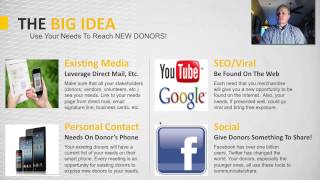
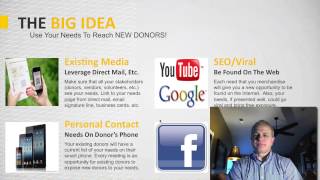
Hi, my name is Jim Grady. I am the CEO and the founder of GiftGiv. GiftGiv is designed to be world-class technology for nonprofit organizations. What is GiftGiv all about? GiftGiv is a tool that allows you as a nonprofit to give your donors a choice in how they meet your needs. Most nonprofit organizations today ask for their donors to give them unrestricted cash, and many donors meet that need happily. However, there may be a group of donors out there that would prefer to meet your needs in a different way. America is the land of choice. We are consumers All Americans are consumers. The way the story is told is that every donor you have is a consumer. Now, not every consumer is a donor, but every donor is a consumer. So by giving your donors a choice of how they can meet your needs, you may find yourself in a situation where you can get additional donors, particularly new donors or younger donors, to contribute to meet your needs. What is GiftGiv? GiftGiv is made up of 3 parts: a merchandising engine, a fulfillment engine, and a thank you engine. The merchandising engine allows you as the nonprofit to put your needs out there in a way on the internet where that donors can see a story around the campaign or the needs that you have. If you can tell your donors a story that makes them laugh and makes them cry, or makes them cry, they may be more likely to meet your needs. What we do at GiftGiv is give you a way to upload video, pictures, audio, and text easily into the need so that the donor can actually see the person who has the most need is responsible for that part of your organization talking about that need. Humans are wired from birth to react to other humans and their request for help. The other thing that the merchandising engine does, which is very interesting, is that it allows you as a nonprofit to share with other nonprofits in their creativity. So, if a nonprofit puts up a need and it's done very cleverly and you like it and you think this is really fun or really heartwarming, then you can actually just copy that and change the name and use that for your particular campaign. So it's very creative, very easy to use. Macy's, the department store, has spent 100 years learning how to merchandise. They know exactly what part of the year people will buy camping equipment, when they will buy appliances, bathing suits, etc. So this brings some of that merchandising and marketing ability to your nonprofit. The second part of GiftGiv is the fulfillment engine, and the fulfillment engine is very powerful. It allows you to reach through the system and go into Amazon and pull in the needs. So let's use an example of an iPad. If you're using an iPad or wanting to have the need for the iPad, you may go in through GiftGiv, go into Amazon, bring in an iPad, then click on the number 5. Now you're asking for 5 iPads. You may have other needs in GiftGiv as well, but what happens is when donors come in and let's say they're meeting the need for the iPad, they can make micro donations as low as $10. So when those micro donations add up, one person can put into $10, one put in $50, one put in $100, etc., etc., etc., until those add up to the amount of money you're requesting for the iPads. Then what will happen is that the iPads are then shipped independent of any other need that you might have. So it's micro donations, you can appeal to smaller donation, donors that want to give you less money. It'll ship when funded. The other thing is that the donors can see who else funded that item, so they can look for people they might know or see there's a lot of interest in this particular item. You can set up recurring needs, so if you have something you're requesting continually, then those will also be listed in there in the system and they'll come up automatically. And the donors can also set up donations that are recurring. You can have it so that if somebody wants to give you a cash gift, you may direct them to GiftGiv and let them put it in as a match. So that when donors between now and Easter, between now and Christmas, or between now and whatever impending event that you have, the money that the donor had given in cash would be matched. So if I put in $100, then that would automatically become $200 if I had a 2-for-1 match. You can— the system keeps track of all tax records for donors and the system is— really handles a lot of your logistics because FedEx and UPS and Amazon are the best logistics companies in the world. You can ship each need to a respective location. You can send it— each one to a different location and you control the timing. So, it's very powerful in the way that it helps donors react with you, allows them to micro-donate, and allows you as the nonprofit to control where the needs go, when they occur, etc. The third part of GiftGiv, which is a very important part, and in our research of developing this product for the last year to year and a half, we have been told by donors many times that the only time they heard from a nonprofit was when they needed additional funds other than a tax receipt. So what this allows you to do is when you— when your donors meet a need, the donor will automatically be notified when that need closes out, so when the money is met. So on their cell phone or their computer, but on their portable device particularly, it will light up and say that this need has been met. An email will be sent. Then when the item ships, they will receive an email notification that the item has shipped, so they know exactly what's happening. And then thirdly, if you choose to do this when the need has arrived, so when the 5 iPads, as our example goes, are actually in the hands of the children and the teacher's crying and everybody's happy, then you'll be able to take out a cell phone, Android or iOS, the iPhone or any other cell phone, film that, click a button, and then that video will automatically go back to the donors that participated in meeting that need. So it's further confirmation and heartwarming confirmation that the need has been met. So, GiftGiv, how does it work? It's very simple. You start with— there's really only 3 steps. You start with a list Pick the items that you want. You can put up as few or as many as you want to. Start with— you can have campaigns so that you can have a campaign, as we mentioned, for Easter. You can have a campaign for a particular race. You can have a campaign for a particular event. Whatever is natural for you. And then within the campaigns, you can have needs associated with that campaign. And you can put video at the high level, the top level. Which is the very, very top welcoming people to the page. You can put video at the campaign level or text, pictures, etc. And you put the same video, audio, text at the needs level. So you start with a list, then you merchandise that by telling a story, putting the words around it, putting the video around it. It can be very simple or it can be as elaborate as you would like depending on the dollar volume. Anytime if you're Many times we've seen if the nonprofits are asking for something substantial like a van, like a vehicle, or like something that costs a lot of money, they may want to put a bigger story around that because it's a lot more money. If it's something very, very simple like toiletries or basic needs, you may want to tell less of a story or you may want to make it fun and clever, but you merchandise it. You can again copy other things that have been done out on GiveGive. And use the creativity of others to inspire you. Thirdly is you want to market that and you want to get that out through your existing channels and let people know that there's a different way that they can meet your needs. All of these are very simple. The system takes about 5 minutes to set up in terms of get it going, set up an account, and then each one of these needs takes a little while to get it set up depending on how much effort you want to put into each need, but not that long. So what's the big idea of GiftGif? The big idea is that what you as a nonprofit want to do is not just reach your existing donors, even though you want to do that and you want to give them choices because they're consumers also, but you want to reach the existing donors and make, you know, develop a deeper relationship with them by thanking them properly, but as important is you want to reach beyond your existing donors and through your existing donors to reach new donors. And you want to do that in a way that's cost-effective. If you can do that in a way that doesn't cost you anything, then that's really a big win for you as a nonprofit. So here's the 4 things that GiftGIVE allows you to do that potentially you can't do now or can't do as effectively to reach new donors particularly. One is using your existing media. Because you can put a barcode in a message a link with your exact needs. So there's no guesswork. People can't buy things they don't know about. They will know. You can put it on your direct mail, you can put it on your email signature line, a link at the bottom. You can put a link on a barcode on the back of your business card that says, "Meet our needs, click here." You can put it on anything and everything that goes out of your organization, and you'll be surprised how many things go out of your organization. Stationery, emails, all over the place. When people are sitting in your lobby, you can put information out there on a television screen where the needs are scrolling by with the videos and have a printed flyer out there. The system allows you to do that very, very easily. Print up a flyer where it has your exact needs for that particular campaign. So there's a lot of opportunities to use existing media to reach out to people. Secondly is personal contact. Because all of your needs will be on your donors' cell phones, their iPads, whatever type of pad, their computers, and as I mentioned, the television, but particularly the cell phone, it will be with them at all times. In most cases, people have smartphones today. The world has changed quite rapidly and most people have a device that allows them to display, has a screen. So, by putting your needs on GiftGiv, every one of your donors, every one of your stakeholders, whether it be your vendors, etc., if they want to show your needs to someone like, "Would you close this out?" or "Can I show you this? I've already made a donation. We only have a little bit left. We'd like to ship this. Have you thought about this nonprofit?" Then they, when they're at lunch or all those encounters that people have, this right there in their pocket, your needs. And what you're thinking about here potentially is over the next 10 years, how many encounters do people have where it is natural for them to bring up your needs? So this is a byproduct of using the system. There's no work on your part, it's just available to your donors to show to other people or your stakeholders to show to other people. Thirdly is SEO and viral. Each one of your needs, because of the way we do it at GiftGiv is available for Google and Bing to find each night. So if you think about yourself putting up tens, hundreds, whatever number of needs over the next 10 years, every one of those will be an opportunity for you to have your needs found on Google. Hopefully the top of the first page on Google or Bing. Those are prime real estate in the world. Everyone goes and buys things today, almost everyone buys things in the same way. The saying is that no one, no one likes to be sold, but everyone loves to buy. So give your donors, your potential new donors, a way to buy. They all go on the internet looking for things, regardless of your age these days, looking for things, doing the research, and then they come and make a decision. So you'll find yourself out there in a prominent place on the web just because you posted your needs properly. Secondly is, this one is YouTube. As we all know, the word viral, which means that a video, a need, a story was put up on YouTube or Vimeo and it caught on. And we all know there are stories out there particularly the one of Charlie Bit My Finger, which if you haven't seen it, you can go to YouTube and look. It's really, really funny. And it was a little boy and his younger brother stuck his finger, the bigger boy stuck his finger in the little boy's mouth just to see what he'd do, if he'd bite his finger, and he bit his finger very hard. And what happened was that caught on and 503 million people have viewed that video to date. Basically greater than the population of the United States has viewed that video. Now, yours may not go that viral, but you may not have any viral, but you may have some viral, and it's free exposure for you as a nonprofit and just a tremendous boon to your marketing efforts, and the cost is zero. So, and thirdly, or fourthly rather, the last category is social. In social, you're trying to reach not only your Facebook page, your Twitter followers, or your Pinterest account, or LinkedIn, Google Plus, or any of the other social networks, but you're really trying to reach your donors or your stakeholders' social networks. So by doing it, by putting your needs up this way and doing what we prescribe at GiftGIVE, You'll be setting up these needs in a way that your donors or your stakeholders can take these needs out to their social networks because if you have 500 or 1,000 or 10,000 or 50,000 donors, then you want to reach the 50,000 Facebook pages that are out there because that's very, very powerful for you over the next 10 years or so. So, and all of this is changing. But the thing to note is one of the top brands in the world, Coca-Cola, makes it their job every day to get you to think about their product today. Not— they know you know it. Everyone almost on the planet knows of Coca-Cola. But they're trying to get you to think about it today. And by doing this in a way that you create all of these opportunities for donors, particularly new donors, to find you on the web, then hopefully that will lead to a greater influx of traffic to you, a greater awareness of your message because again they can see your people talking about their needs and explaining the nonprofit. And it'll lead to a greater increase in your broadening of your base of donors and lead to people meeting your needs. New people coming in to meet your needs. So how does— what does GiftGive cost? We have a transaction fee, which none of this is paid by the nonprofit, is all paid by donors, and this is on goods. And then we get paid by Amazon. We make a market for Amazon. Doesn't cost you or the donor anymore. Amazon just pays us in order to make this market. What's called an affiliate. Then on cash needs, if you do put up cash needs, because you can put up goods and go through Amazon, post it, then we'll ship directly to you from Amazon. Or you can put up a cash need. The cash need would be a salary, it would be we need paint and carpet for the bridal room here at the church, it would be things that don't necessarily fit and don't come, are not available, don't come from Amazon, but you still want to put a story around them and you want to tell about that need. So you can put almost anything on GiftGif. We would encourage you, the nonprofit, to consider putting on GiftGif anything you might be planning on buying yourself. If you want to buy a new copier or if you want to buy computers, why not give your donors a chance to participate. They may meet all the need, they may meet part of the need, they may meet 40% of it, but at least they've engaged you there and you can step in and pay the remaining, in our example, 60%. But you've enlisted their— because their money and their heart go together and allows them to join you in your cause. Give them a chance to do that. So finally, GiftGiv in its essence is delivering world-class technology to nonprofits. The world has changed. Many industries have seen tremendous change because of the internet, and we see that this is coming to nonprofits. There are many, many, many nonprofits right now trying to put up wishlists or what would be considered bridal registries on Amazon. This is that idea but much more robust. And we're just starting in the sense of the development of this. This is kind of like the iPhone 6 years ago, and it will develop very, very rapidly. We're building in some amazing tools that you can take advantage of for free as a nonprofit. So we encourage you to take a look, set up an account, give it a try. The worst that happens is that people do know your needs, you get organized about what you need, And in many cases, because of the way the system is designed, even if someone comes and says, "Wow, these are great. There's a lot of needs here and I don't want to go through this, but I would like to give cash," then they can bypass the specifics and actually just give cash and let you use it how you want to toward the needs. So, we've really tried to think this through at a very detailed level and give your donors a lot of choice when they come in, make it very easy for them to participate, and make it fun for them. In a way that they might want to share that with others, particularly people that have never heard about your nonprofit. So please give the system a try, and we hope you enjoy it. Thank you very much.