Contractor Radio - Sales Secrets of a 20 Year Vet with Dan Walrack
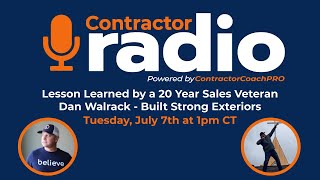
A recorded Contractor Radio interview (YouTube) where Jim Johnson interviews Dan Walrack, a 21-year roofing sales veteran. They discuss Dan's career path, sales techniques (rapport-building, neighborhood ownership, networking with adjusters/agents/property managers), time-management, use of Facebook/social branding (the 'pose'), handling insurance inspections and scope sheets, and work–life balance including prioritizing family and financial frugality. Dan shares a standout 2017 storm year (~$6.5M in residential sales over 7–8 months) and practical advice for new reps.
Chapters
Oh, come on. Hey, everybody, it's Jim Johnson here with this week's episode of Contractor Radio. Our broadcast for contractors to help them with their strategy, help them with their game, to kind of get an edge, hopefully, on their market.
And.
And today we have somebody very near and dear to my heart. I posted on Facebook yesterday, I said, this is the best sales rep that I ever hired. And there's a little story to it that I recruited him for like a year and a half. It took a year and a half. I told him he was going to be good at it. He wanted to keep working at, I think it was a Pizza Hut. And so he wanted to keep working at Pizza Hut.
And.
And so he did that summer, but I kept working on him. We played basketball together and finally got him into the game. So, everybody, this is Dan Walreck or Wally. Welcome aboard, Dan. Glad to have you today.
Thank you. Appreciate it. Humble. The introduction you gave me there.
He's a rock star, and we're gonna find out today some of the reasons why he is a rock star. You guys that are watching on Facebook and checking it out there, we can't necessarily see your names on there, but if you make comments, we do see them. So we'll just call them out. Somebody says they're excited for this one. I'm excited and cautiously, a little bit scared. We'll see what Dan comes up with today. But Dan, just kind of tell us the story. Like, how'd you get into this? I kind of led into it a little bit. But bring us up to speed with where you are today. 20 years now. Is that. Is that right?
21.
21 years, man. And most of that is a sales guy, right?
Most guys with sales, yeah. I. 21 years of doing sales. And I mean, even when I owned my own company, it was sales. I sold, sold, sold. So how I started off doing this is like Jim said. I was in college, got my degree in physical education, health and fitness. I got a couple minors in coaching and adapted PE and outdoor recipes. And Jim gave me the old line for about a year and a half. You'd be really good at this. You'd be really good at this. And I'm like, you know, it sounds too good to be true. You can't make money doing that. Nobody's gonna do that. I don't sell vacuums. That's not my niche. Right, Six. No, man, you'd be really good at this. I promise. So that was my graduation, was it? Didn't you finally hook me or we went out to dinner?
Yeah.
I know the place. I don't know. Remember the name Copper kettle. There you go. So we went out to dinner and finally I said, all right, I'll give it a shot. I'll do it for the summer. You know, I'll, you know, whatever, whatever it is for the summer. I got nothing going on. I had a teaching and coaching gig all lined up, ready to go. And then we went out to Oshkosh, I believe and I gave it to summer and I made more in, you know, three, four months. And I would have made an entire year of teaching at a 22 year old kid. That was a pretty good deal. So, so then I pretty much was hooked after that. Nobody ever told me that up north here that what you sell sometimes you have to bank over for spring. So I had all these jobs left over for spring. That was money in the bank starting off in the spring.
So that's how we suck you in, man. That's how it is.
They got you on it. So then I had to cancel my teaching thing and 21 years later here I am still doing the same thing and 20 years of straight million plus producer. So.
Well, I, I think you kind of got both of it in. You got this life that is pretty cool. But you still do a lot of coaching and stuff, right? Like you're heavily involved with your kids. Football, baseball.
I run the booster program up here for football and I coach, traveling, baseball and I'm the seventh and eighth grade head football coach up here. See, I do a lot of work.
Best of both worlds, right? Like I got to make some.
It wasn't like that at the beginning though, you know that.
What do all those other coaches that work there at the school or teachers think about?
Like, ah, they have a good time. They, they know that I'm, I'm passionate, I'm aggressive. I suppose I take that into work too. You know, I'm passionate, aggressive about work too and see a lot of things come and go in this business. It's like, it's, it's a soap opera, you know what I mean?
But it's cool that you bring that up. Like what are the things like 21 years ago, what's changed from then?
Oh goodness. Well, and in the sales part of it, I mean all these new guys now are just, they take a lot of stuff for granted. You know, we were out there plugging the streets. We were out There, you know, 7:00' clock in the morning till 7:00' clock at night, you're sitting on a tailgate you know, and you had to generate your own jobs. You know what I mean? Nowadays jobs get generated for you. They tell you where to go, they put you in the spot. Back then, we had to go look for leaves on the ground. We had to look for dents on car hoods. I mean, we were driving around everywhere trying to find it. But once you found it, guess what? You kept your mouth shut, because that's where you sat and you worked and you worked and you worked and you. And you made it. So.
Yeah, it was kind of all about owning that neighborhood, right? Oh, yeah.
That's why you're there at 7 in the morning.
That was some of the first things we taught is like, don't like, scatter yourself all over a city. You know, find that neighborhood, work that neighborhood, own that neighborhood, make that neighborhood your office.
And.
And you were really good at that. And one of the reasons why I recruited you is your ability to make friends easily. Like, you're just now going naturally outgoing. Were you always that way as a kid too, or did that come on?
Yeah, I've always been outgoing. I just relate with people, and it doesn't matter what that person's into or whatever, you just relate with them. I mean, as a salesperson. I mean, the first thing you should do as a salesperson driving up to a person's house is if they got the garage door open, look inside. I mean, I think you taught me this. Look. If they've got a fishing pole hanging up, talk fishing. If they've got packer colors, talk packers. If they got whatever, make them feel comfortable with you as a person before you start trying to go into a niche on what you do. You know what I mean? Because it is what it is. I mean, you start talking to people and make them feel comfortable, that person is gonna be more open to talking to you.
So, yeah, it's one of the mistakes I think a lot of salespeople make is they get right into it really fast. You know, hey, you know, going around, we're meeting homeowners I'm working with so and so over here. I'm here doing free inspections. Would you like me to do one for you? And they skip that part about being likable, being somebody that's creating themselves as another human being, maybe even their next door neighbor, possibly a friend, before they start talking about why they're there. And that's always been one of those things. Like, I try to. I try to look at each person as a possible new friend, a new relationship. I'm still friends with my very first person I ever sold, Tom Wicks. I still talk to that guy to this day. He's a uber Viking fan. And if you remember, back in the day, I had a yellow truck with a green and white stripe right down the middle of it. It was the Packer truck. And I drove up to all those houses in Minneapolis that were all Vikings fans with that truck. Talk about a conversation start. It was like, man, instantly started conversation. And we'd talk football for five or 10 minutes before we even get into talking about what we were there for. Well, I'm here. I might as well go ahead and inspect your roof, right? Yeah, sounds good.
Go ahead, man.
And I don't know if people really look at that rapport building as importantly as what it is. So you got rapport build. What's the next thing you're gonna do?
The next thing I do is when I meet with a homeowner. You know, my whole point of meeting with a homeowner is I'm there for a reason. I'm there to help you out. You know, I'm not there to sell you anything. I don't have a free box of steaks to give you. I don't have anything. I'm here to help you out. Know, if you want that roof taken care of, why not have me inspected for you and have the best guy do it? I mean, I'm going to get it approved. And so that. That's my thing is people. People tried. Like you said, Jim, people try to rush so fast through it that they're missing the parts that are the most important parts. The most important parts is building that relationship. You know, that homeowner. You're going to be with that homeowner from A to Z. You know, you have to build that. They have to feel comfortable with you. You know, I always tell everybody this. Now, I said, when we're all said and done and they write that final checkout, nine times out of ten, if you've built that relationship where it should be, that homeowner is going to ask you. They've been working with, you know, your company for two months maybe, and they're going to ask you at the end, who do I write the checkout to? Why? Because they don't care about the company. I mean, they do, but you know what I mean? They don't. They care about that person they worked with. They care about Dan Walreck. Dan is who I worked with. They don't. I could have been whatever. Mouse Pad Incorporated. They don't care. They care about me.
And that is the thing, right? Like, I. I think people buy people. I think they. There's more to it. You know, they want good service and quality, value and all that, but they really buy from people they know like and trust, which is. Yeah, you got to get past that part first before they even care too much about the company. Hopefully the company that you're selling, you can stand up for and say, hey, they're great. I know you work for a great one right now. Built strong exteriors there in Minnesota. A little plug for those guys. And Tony, he's a rock star. I like that guy. He does a really good job. A lot of experience in this industry, too. So you're now 21 years into it, but if you could go back, Go back to the very beginning. What's time? Yeah. What's the most important piece of advice you would give your younger self getting into this?
I would say. I would say probably the biggest advice I'd give guys, just starting off in this. There's two. One, I'd say networking. Networking is ginormous in this business. Absolutely ginormous. The second thing I would say is because a lot of people. A lot of people have that mentality where they think they know everything in two months. You know what I mean? It's going to take you a year to two years to get it down to the point of where you know all the objections, you know, basically everything that you need to know. And you know what you're still learning after 21 years. I still learn something every day. It's just because this business is such a. It fluctuates so much. There's. You're always going to get. I mean, now we're into, you know, last year or two, we're. Now we're doing drone inspections. I mean, who would have thought 21 years ago we'd be doing drone inspections? When I'm up there, I want to.
See Dan do a drone inspection.
I've done two. And I told the. I told the adjuster. I'm like, listen, man, I said, let's just you and I get up there. This drone thing. I said, how do you even get to feel the shingle, you know? Well, you know, we got to look for.
So here's one thing I know. A drone can't tell me if a seal is broken.
That's what I'm saying. Right. But I haven't had too much experiences with that because most of the adjusters, I'm pretty. I mean, a lot of people have dealt with Allstate. I guess they do a lot of drones. I haven't. I haven't come across a lot of all states, but whatever.
Well. Well, that's kind of purposeful, right? Like, we'll talk about that in just a second. Now, that first bit, whenever you're in as a. As a new guy, you mentioned this networking aspect of things, but in order to network, you got to do a few things. You got to, like, count up all the people, you know? Right. Like, they could be helpful in your networking, but you got to get out and meet people, too. Like, you got to go out, you got to knock those doors. You got to do that dirty work, really, for. I always told people the first three months or so, if you're and heavy at it and you really work those referrals and build that network, you may never have to knock a door again. Now, do you knock many doors nowadays?
I have not knocked a door in probably 13 years. 14 years, maybe.
13. 14 years. That's. That's amazing.
So, I mean, I've worked my neighbors where, like, if I'm out doing a job build and a neighbor's outside, I'll walk over and talk to them or stuff like that. But literally walking up and down the street, knocking the door. It's been at least 14 years.
And most of that time, all of that time that I know of, you've pretty much been in that western Wisconsin, or actually state of Wisconsin, state of.
Minnesota, back a little bit in Madison, a little bit in Illinois, a little bit over by Appleton area. But it's been pretty confined to, you know, two or three states at the most.
And that's one of those things I always try to get across to sales guys like you. You've worked this hard to get to know these people, to build up a network of people. And this fresh storm hits and you want to go chase, you want to go run after that thing when you have this whole pipeline just sitting here wanting to send stuff to you. What's your advice there?
It's hard with my advice because I have, like you said, I've got it networked. So, like, I mean, I bring donuts and bagels and I bring things to my insurance agents that help me out, to property management companies that I'm in line with, working with. But you got to keep. Keep that rapport up, and then you take care of them, they take care of you. But like what you said, as far as running to a new storm, I mean, storm or no storm, I'm gonna sell A million and a half every year. Anyway, it doesn't matter to me. A new storm just makes it easier, you know, New storm makes it like 2017, you know what I mean? For me?
Well, we always talked about that. Like, you know, a storm would come up, a bunch of people would rush in, they'd work it for six months, maybe a year, and then all of a sudden they're kind of gone, right? And it's just all this work is still out there to be done, and it's just finding those little pockets and getting after. And that just takes a little persistence and tenacity. And that network, you actually mentioned it. A couple of, like, key people for networking. Your insurance agents and property management company. Anybody else that kind of fits that.
Well, I do, I do a lot of. I mean, really, anybody. Anybody you can use as a network. I mean, my financial plant, my financial advisor, you know, he's plugged me with, you know, 30, 40, 50 jobs. Agents, property management companies, adjusters. I mean, you know, I know a lot of adjusters. A lot. I mean, just today, to be honest with you, about two hours ago, I just got a call from an insurance adjuster. Said, hey, I'm gonna be sending you over a lead. It's a big job, so be ready. Lady calls me up, she's got 700 squares of roofing that she wants to come out Thursday and get her ready to roll. She goes, can you handle specialty shingles? And I'm like, what's your specialty shingles? She goes, a grand sequoia. I'm like, no problem. And that was all of a five minute phone call. Why? Because that adjuster I've met 70 times in my life and we've built up that rapport where he knows I know what I'm looking at. And you built a rapport. It helps. That's called networking.
So, yeah, he knows you're gonna call it straight, which they're looking for the same thing, you know, whether it's an adjuster, an insurance agent, property management, they want somebody they like, know and trust because you're selling them just as much as you're selling anybody else. But when you do it with what I call authenticity, Dan is Dan. Like, there's no getting around. Dan's not trying to pull the wool over anybody's eyes. He's just being Dan. And he truthfully does want to just help out whoever it is that he's working with. And by having that kind of attitude, people are just attracted magnetically to you. Like, I want to work with this guy, he's kind of fun and pretty cool, and he sounds like he knows what he's talking about. And so, yeah, let's work with them.
Well, you hit it on the head there, Jim. This. This business, to me, 21 years doing this, you know, a lot of people come in and a lot of people come out of this business. I'm still having fun. I. I love doing this business. To me, this business is all. All fun. And it's a game. And if you play the game the right way and you're honest, loyal to people, it's a fun game, you know, so it's competitive. I love it.
That's how I knew you'd be good, by the way. Not only were you outgoing and you could talk to people, that part I got right away. But the competition part of you is what was really the reason I recruited you. You're probably the most tenacious person I've ever met on a basketball court, especially for as unskilled as you used to be. Dan started playing basketball as a football player, and he understood that he was a little stronger, had a little bit lower center of gravity and. And everybody else and just asked, what do you want me to do? We said, go rebound. Don't shoot it, ever. Just rebound. And he's like the, The. The white man's Dennis Rodman. This unbelievable. Just go get rebounds like nobody I've ever seen when I saw that, like this, hey, give me what you want me to do and I'll go be the best at it. I'm like, man, he would be amazing in this if he applies that same attitude. And he did. He did a great job of it. I'm super, super happy for where you've come. So now you live in Hudson, Wisconsin. You got wife, three boys. Four boys. Okay. Four boys, all playing sports, I'm sure. Right. And so to this point, not including your family, what's your greatest achievement?
Well, I would say not including family. My greatest achievement, work achievement, I would have to say, would be. I would have to say probably my 2017 storm, that it worked, because I did things in that storm that I really didn't think I could do. And through networking and things like that, I mean, I did six and a half million dollars of residential sales in eight months. Seven months.
That is incredible.
So almost $800,000 a month in residence.
Those are numbers that you don't hear very often. I think that's the highest number I've ever heard in residential sales. You got me doubled up on my best year, and that's super cool to hear. What made all that the perfect storm? Why did that work out the way it did for you?
This is what, this is. What's gonna be funny is that storm was huge in the cities. Blaine Anoka, that area up there, out of my $6 million worth of sold jobs I did. I maybe did 10 roofs up there. I worked on the outskirts of the hailstorm. And I used my homeowners, which it sounds horrible, but it's true. I use my homeowners to feed me more homeowners. Do you know what I'm saying?
Yeah, you're supposed to. They're your network.
Yeah, that's, that's. I used all my homeowners to network me. So what I thought of is if I used each one of my homeowners to give me an additional five to 10 other homeowners and it. Everything seemed to have lined up so perfectly in that storm where it happened that way, where I was literally putting in 25. I mean, I built 364 roofs myself. And that, that is some incredible gutters. All that. And so that's how many jobs I did in one year. And it was. It got to the point, to be honest with you. It got to the point. And Tony can attest for this, it's got to a point where it got a little bit out of. Out of control. I mean, granted, he had to bear with a lot of the heartaches on helping me get organized with that because you know how my organizational isn't. Isn't the best, which I need to work on, so.
Well, I think you should maybe give a shout out to some of that great support that you have.
Yeah, I agree. We have a. We have a fabulous people in our office. The owner, Tony and Davey do a great job. We've got great office staff. Audrey Michelle, she does great with supplementing. Jackie is a fabulous production manager right now. Her quality control staff is doing a great job. You know, they're doing that. They're going through some learning curves and things like that. But that's what new people do. I mean, there's the sales reps. There are fabulous. I've never been with a group of sales reps except the days way back when, when we were dinosaurs where you know, you have five, six guys in a room that are all million dollar guys that you don't. You don't get that too often. And this business, once a guy hits that million dollar threshold, he thinks he knows the entire business and ready to.
Roll, you know, so, so, so what Advice would you get? So there's, there's sales guys out there, right, and they, they're competitive, they're aggressive, they want to see what they can do and they're thinking about, you know, going out on their own and, and doing their own thing. What, what advice would you, would you give to them?
Well, the first and foremost is a lot of people get that misconception that, oh, all I gotta do is just go do this. It's easy, no problem. They don't think of the aspects of responsibility, insurance. You know what I tell a lot of people is grass is not always greener on the other side. And don't ever, no matter what you do, don't ever burn your bridge because if you burn your bridge, you know, it's, it's hard to get it back, you know, and would I ever go do it again by myself? Maybe someday. But I really enjoy doing what I'm doing right now. Working for a person that, you know, does that treats me well and you know, I just go do my thing and I don't have to worry about the responsibility. You were just talking earlier about me coaching and doing all that stuff. Well, if I own my own company and I did that, there's no way I'd be able to do that, you know, being done by three o' clock in the afternoon to go coach. You know what I mean?
But you're a sales rep that gets done at three o'clock in the afternoon. How do you do that?
I'm usually done every day around between three and four, so.
So okay, that's cool. How do you make that happen again?
I don't knock doors, so networking has all my appointments I set up. And the other thing that a lot of people need to do too, with insurance adjusters, they're people too. You need to treat them with respect. But you need to, you need to control your appointments and your adjusters appointments also. You know, a lot of people think, oh, the adjuster just tells me what time to be there. No, I, I set my appointments up so I don't miss an adjuster appointment. But I set my appointments up from 8 o' clock till 2 o', clock, 3 o' clock after that.
So how do you, how do you get that adjuster to like. Because guys do struggle with this. We talked about this.
Even in our office, the new guys all struggle with this.
And, and so some of it's your relationship, right? Like you've got a relationship with a guy and they know you now. You've been around for A while. But you got this new adjuster saying, hey, I'll be there at 10 o', clock, I'll see you there. Or, sorry, 4 o', clock, I'll see YOU there. And you're like, no. And so what is it? What does that look like? How do you turn that around to get it to a time that works for you?
Well, I explained him. I explained I also have a contract with a homeowner, too. And I basically explained them. Listen, I've got three other appointments scheduled at, you know, during those times, I'll give you three other options of days and times at work. Let me know which works for you. But in doing that, you have to let the homeowner know that, hey, it's very apparent or very important that you're there with the insurance company because you're, you're their advocate. Up on top of that roof, you know, you don't go to. How was this line? You remember this line? You don't go to court without a lawyer. Right. You taught me you don't go to court without a lawyer. Why would you have an adjuster on your roof without a roofer? Right?
Yeah. And be a roofer. Don't be a policy interpreter, don't be a negotiator. Just these are the things that are wrong. This is the scope that I have and, and stick with that and you're pretty safe. This is what it takes for you to do this roof.
This is the one thing that for 21 years, I still do the same thing from day one that we did on Oshkosh. And you know the name of the homeowner, I'm not going to say it on online here, but you know which one from this day forward, I do know you have that. You know, everybody's trying to go, you know, computer and virtual and all this other stuff. I still have my notepad with my sketch pad on it and I do a roof scope sheet. Every single house I do, I adjust that house. I basically look at that house. If I was the insurance adjuster, I start from the left corner and I walk around that house and I write everything I notice as damage on that property, from landscape lights to mailbox to a bunch of stuff I don't do. I mean, I don't do mailboxes, I don't do landscape lights. But what I'm doing is I'm building that rapport with that homeowner and I'm walking around the house. And when I'm said and done, I walk up to that homeowner with pictures and with my thing said, this is what I notice on your house that is damaged. These are the things when I meet you with your insurance adjuster that I'm going to get taken care of for you. Yes, Some of these things we don't do. But as long as I get these things taken care of for you, that money's your money. Do with what you want, get them taken care of. That doesn't matter to me. That's your money. But what you're doing is you're building that rapport with that homeowner that, hey, you're here to help me out. You're here to be my advocate. Of course they're going to call you back to meet that adjuster because they want you there with that scope sheet. And so when I meet that adjuster, I have a copy of that scope sheet. I hand that directly to the adjuster with my card and say, these are the things the homeowner myself noticed that were damaged on their property. So that adjustment, his mind knows, okay, this is what the homeowner, my insured, knows is damage on the property. These are what I need to take care of.
That was a great way of putting it. It wasn't. This is what I noticed, and what we say is damage is this is what I noticed and the homeowner noticed and they believe to be damage on their property. Like, that's. That's because it is more about them. They're the one with the contract with the insurance company. We're the one with the contract with them. We aren't there to negotiate what policy covers and what it doesn't or anything like that. We're just here to help them get to where they need to be. And it's really kind of up to them to be that person on your team. We always describe it as a game. It's a three player game. And last time I checked, in three player games, the one that has two on the team usually wins. And it's your job, Mr. Homer, to decide whose team you're going to be on. You're going to be on the team that's trying to make sure you get everything you're supposed to. You're going to be on the team that's trying to, you know, save a few bucks. And it's pretty easy to convince them to be on the winning team. So what would you say are the, I don't know, two or three most important things that you would tell a brand new guy, Go do this to be successful.
Two or three Most important. Well, the first thing I would tell them is, you know, you have to get out. You have to be out there and be seen. That's important. You have to be. You can't, you're not going to be as successful as some of us in this business if you're out there at, if you don't come to work until 4:30 at, in the afternoon and you're staying out till 6:30, that's not gonna work. Something that I've always learned about this business, rain days. It doesn't matter what. To me, I treat this job as a 40 hour week job. If you're not putting in 40 hours a week plus, you're not going to make the big money in this job. Because when I first started off, there was guys that trained me yourself, Scotty, a bunch of guys that trained me that even if I had nothing going on, I would sit there and I would just ask questions. I would sit there and stare over someone's shoulder, you know, what are you doing? How are you talking to the insurance company? You know, because those are all things you can learn. And that's part of the problem with the new guys. And we're even finding that in our office today is, you know, I'm going in the office at 7:30 in the morning doing paperwork and doing stuff, putting in orders, things like that. And I'm the only one sitting in there, you know, and it's like, my gosh, you know, where's all these new guys? I mean, it's raining out right now. Why you should, why are you not in the office?
What could they learn from looking over your shoulder today? Right.
Yeah, well. Or asking questions? I think asking questions is a huge thing in this, especially for guys that have been doing this for 20 years. You know, what would happen in this, what would happen in this scenario? How would you do this? You know?
Yeah. Not every office has a guy with 20 years of experience that you could just go to. And one thing I know about, if somebody asks you a question, you're going to answer it. You're going to give them. You're going to give them the help they're looking for.
Yeah, why not?
Well, some guys don't. Some guys like, man, I'm too busy, go away. But you're not that type of guy. You've always been helpful to everybody. All right, so next thing you guys that are watching, there's quite a few people watching on Facebook and in various other areas. If you've got questions for Dan, like if you said, hey, you know what, what would you know? I'm struggling with this thing, whatever that thing may be. Maybe it's an objection. Maybe it's, you know, being active. Like that's. Dan just talked about that. The importance of being active in what we do and treating it like a real job, not a part time job.
That a lot. Jim, do you see newer guys doing that a lot? Where they treat it more as a, you know, if it comes to me, I'll take it, but.
Well, it comes down to human behavior. This. If expectations aren't set like we set that from the beginning. Our expectation was we are going to get after, we're going to go, we're going to work, we're going to be hard at it every day. And if people weren't like that with us, they didn't stay very long with it. You'd see me scoot them out the door. And so when you set that type of expectation and you also do that like you saw me in there every day, I work my butt off and you set that example, then people tend to do it because it was set from the beginning. But when we don't set a standard like that or example like that, we tend to see some of that type of stuff that guys don't take it as seriously as they probably should. I think a little bit of that is because they don't understand the opportunity that's in front of them and how fleeting it really is. Like, you get a big storm and it all seems so easy. But if you don't hammer it, and I mean hammer, hammer and build that network and build those connections, build that giant network of people through that opportunity and you just take what comes to you, take what's easy. Well, when it dries up a little bit, you're going to be the first one that has to leave because you aren't making any money. And I see that as a big issue today, this idea of having a scheduled time to do the things you need to do to create that knowledge. So I want to talk to you a little bit about Facebook. So one of the things I noticed about Dan on Facebook is Dan's on Facebook. He's on Facebook quite a bit. So you have a thing that you do, right? And. And so I call it a shtick. But for whatever reason, what made you do it? Was it something you. There we go. Yeah, exactly the pose. Right, right. So where'd that come from? Where'd that start?
I would say, shoot, 16 years ago, 15 years ago, I was on a roof with one of your old, one of our crony buddies, Corey. You remember Corey on a roof. And he's like, this was back, you know, one of, gosh, I'm dating myself dinosaurs. But you know, when the, the picture phones would come out and all that stuff, you know, not the old Nextel scuba Steve phones, you know, and he's like, let me take your picture up there. And so I'm standing up on a big steep two story house in Illinois. And he's like, he's like, well, first he said to flex, and I'm not gonna flex up on top of the roof. And then he said, give me a pose. So I went with one of these. I threw out, I threw out the pose. And he goes, he goes, that's your pose. And I said, well, every big two story I'm gonna do, I'll do the pose on, you know. And so it built from there to now. It's like, it's funny because on Facebook, like you said, I have people on there all the time saying, I see on the roof, but I don't see the pose. I, you know, but what it does is it's basically a metaphor and it's, it's, it just keeps people thinking about roofing, right? Siding, gutters, decks, windows, things like that. So now they're thinking of me. Well, when any of that stuff comes up, they're thinking of the pose and then boom, instantly. I mean, I get messengered all the time about people, hey, Dan, do you do this? Dan, do you do that? You know, and it's like, well, yep, yep, we'll take care of it. And so you're right, Facebook's been helping out immensely on, on retail jobs.
Or you're kind of Dan the roof man now in your network of people, because it's what it is. It's a social network and you understand networking. And if you were just standing there with the sign in front of you or standing there with a homeowner or standing out in front of a house you inspected. I see a hundred of those, I mean, all the time. But you're out there going like this and it just, it stops somebody as they're going through their feet. Why is that guy making that crazy, weird pose? And then they read enough about it, they go, oh, so this guy does roofing and it just sticks with them. And I think that's important. I think that's important in this aspect of being remembered that I was somebody that was different from everybody else that you saw and that poses. I don't know if it was accidental or if it was just something that happened. But what a great example to all these new guys, like, come up with something that makes people stop.
Stop. Make them choose you. Make them recognize you.
So here. Do any of your other guys there have a pose or anything like that that they're doing?
Not that I know of. They all tease me a little bit about that one, but not that I know. I mean, and it's. What's really funny is when you do some of the roofing and siding for people that have, you know, that have seen that on there, they've asked to do it before. I mean, I'm sure you've seen it a few times where I've had a homeowner busting it up with me, you know, insurance adjuster, do it with me up on top of the roof.
Yeah, I picked the one of you with the cross today. That was the one I put on there. That one was pretty cool. You're on a church, and you did the pose right in front of the cross. And, you know, faith is pretty important to me, so I thought that was a good one for you. You're a good dude with a lot of good advice for everybody. Dan, this has been great. I got. I got one more question for you. Always finish with this question. So we all only have so much time on this planet. We all know that, right? One life to live. Live it to its fullest. I think you do that every day. When that time comes and people are there to remember you, what do you want them to remember you for?
Well, first and foremost, I want. I mean, work aside, I want to remember me for being a great dad. You know, I want. My kids are the most sacred thing in the world to me, and so I want them to remember me about, you know, dad was here to do that. Dad was here to do this. And, you know, part of the reason I'm only a sales rep, to be honest with you, and not an owner of my own company again and things like that, is the fact that when I owned my own company and my kids are small and I was traveling all the time, I wasn't there for some things. And I taught myself. And I thought to myself, when is. When is. You know, money's not the most important thing in the world. You know, this job, you can make a lot of money in it. We all know that. You know, those that have been good at this for 21 years, selling over a million dollars for 20 years straight, you know, you can make some good money in this, but you Know what? Money is not the most important thing. I don't want my kids going. I don't want to go missing a baseball game because I had to go sell one more roof. You know what I mean? I don't want. I mean, it's not. Nothing against this job. This job is great, a lot of money, and you guys will be great. But family is the most important thing to me. And it's. I don't want to have to look back and say, God darn it, I miss my kids such and such. You know what I mean? So that's part of the reason I got out of the business too, as an owner is because I wanted to be done. But like you said, I want to be done by three, four o' clock so I can go take my kid to baseball practice. I can go watch my kids, you know, concert. I can go do whatever and spend. So that said, now what I want people to look back at me in this business, family, family aside, is I want people to look back at me as, here's a person that gave everything he had toward the. Toward whatever company is working for or himself and gave a hundred percent. He's not somebody here to screw somebody in the back or. I'm loyal to a point where I'm as loyal until I get screwed in my back. You know what I mean? It's. I'm. I love it. I still love doing the job, and I'm gonna be. Keep doing. I'll probably be 60 years old doing the same damn thing. The day comes when I don't love this job anymore, and it's jobs to me, considered a job and not fun. Probably the day I'm gonna retire and take my metal detector on the beach and go find some shark tea.
So a couple things. I know that was supposed to be my last question, but I got two more. All right, let's do the shark tooth one first. Like this. I got to go do this with you. This is the crazy thing. And this doesn't have anything to do with. It doesn't have anything to do with roofing, but it has everything to do with relationships. So Dan and I have known each other for a long time. There was a period of time where we weren't connected, but we connected back up. And Dan starts talking about hunting these fossilized Megalodon teeth, which are giant prehistoric sharks. I'm like, well, what are you doing? He goes in the rivers of Florida, and you got one handy around there?
I'm looking, man. I'm seeing if she had one around here, because this is where we kept them.
And I'm like, in the rivers of Florida, aren't there alligators and stuff like that in that water? He's like, yeah, but they don't really bother you. And so he convinced me to go do this with him. And I had one of the most enjoyable times I've had in a long time hunting these giant shark teeth. And so I want to thank you for that. More of a statement than a question. Here's my question. There's something very important I remember about you. You are an extreme Taiwan. You will save money like nobody's business.
Frugal.
Frugal. Okay. You're extremely frugal, which I call it. Tight one.
Yeah. Or cheap. I suppose you could use that one, too.
That would be. And so that has put you into this position because you mentioned this about a year ago or so that, you know, I could retire if I want to. I'm kind of thinking about it, and if things go a certain way, I may just do that. How important was that attitude throughout all this time to getting to where you are, where you could actually say, hey, how old are you now?
I am now 40. 43.
40, 43 years old, and you could retire. That's pretty amazing.
Could have retired about three, four years ago. But I still, like I said, I still enjoy doing what I'm doing. I really do enjoy it. Which, you know, a lot of people look at me like I'm crazy, but to me, there's nothing better than driving up to a person's house, seeing them. They need your help. And that's, that's why I view every house as. I'm not here to sign a person up. I'm not here to get another set. I'm here to help that person out. If they want my help, great. If they don't, you know what? I'll go to the next one. No big deal.
Well, how important is it to these new guys and these young guys in this industry to save their money?
Well, most important, that was the first thing that I was taught when I first started this. When I was a young kid. You taught me that. Listen, I know you're gonna make great money in the summer, but if you don't save your money over the winter or save your money for future endeavors, you're just gonna get your toys and there's gonna be nothing with it. I spent 21 years of. Of selling a lot. I mean, I've probably done 100 some million dollars worth of jobs in 21 years. Maybe something like that. That's. And I've saved and saved and saved to where now, you know. You know how it is with financial planners. You have your money making money for you. So it's not. It's not the money. It's you. You hit it on the head. When we talk, when we first get on here, it's to me, I'm motivated. I'm not money motivated. I'm competition motivated. Right. I want to be number one on that top list every year as a sale, as a sales rep. And if I'm not, it just pushes me harder to be that number one. Do you see what I'm saying?
Oh, yeah.
I suppose that's what life, too. I mean, I want to be as good a coach as I can be. You know what I mean? I want to be. You know, you catch a big fish, I want to catch one bigger. You know what I mean? And it's. It's competitive, and I've always had that. I think I've had that because when I was young, we didn't have a lot of the things that my kids have now, and I had to push just to get to that level playing field now. I mean, I want to be on the top, you know, And I would take my skills of the sales rep against most people in the nation, you know what I mean?
It's a valuable skill to teach our kids, is the value of competition. It is to. It's not just in making the most money or selling the most. It's in being the best that you can possibly be and setting that example for our kids, challenging them to achieve those same, same things, not just giving it to. Like, we could both give our kids anything we wanted to give them at this point.
Yeah.
But that just defeats their potential at some point. Dan, this has been good, man. Really good. Great advice. Save your money. Save your money. Like, you probably knew somebody that retired when they were 50. You're like, I want to retire when I'm 40. It was. It was competition to. You put competition into all that you do, and you can't hardly avoid being successful, it seems like, to me.
It makes it work, man. It makes it work. Anybody throw any questions out there or anything?
I did not get any questions yet. There may be some on Facebook that we'll come back to because it's posted in a bunch of different places. I don't know if it's feeding in from all of them, but I'll go pay attention to. I'll tag you if somebody has a question for you. And I think you're tagged on most of those things.
And if you got any new guys that are watching this and they have questions they want to just ask a dinosaur, I mean, have them give me a shot, man. I, I'll, I'll help, I hope anybody, man, I don't. I'm to the point now where to be straight with you. There's no any sales rep out there. I don't look as competition, you know what I mean, anymore. It's.
Well, that's your, that's your competitive thing. Like you, you know, you could give them the keys to the castle, like everything ever knew, every secret that you ever learned and you could give it all to them, but they'll never work as hard as you work. That's kind of been always my attitude is like, hey, I'll give you all this stuff, but you'll never outdo me. And I think that's good advice for any of us that are people that know some stuff, help people out. And if somebody does outdo you, high five them, man. And I'm high, I'm high five.
I told Tony that from day one. I said, if you've got a rep that's going to outsell me in a year, you know what, I'm gonna go up, I'll give them big, a big handshake and say, you know what? That's impressive.
Well, I'm doing that today. I'm high fiving you. You beat me on my number one year ever, which is you're one of very few. And so that's a big high five. I'm also giving you a high five on getting to a point of retirement at 40. Before I was able to, I'm there. But now you, you beat me to it. Well done. So high fives on that.
I'm slapping one back at you for I want to be here. I'd be a school teacher making, you know, whatever if it wasn't for you. So, I mean, I know, I know it's very rare to find somebody come in this business for 21 years and being able to go back and discuss, you know, 21 years of doing this stuff because you know, when I've gone to trade shows and stuff and they've asked how many, how long have you been doing this job? And I, you know, hopefully I don't look that old, but when I'm one of the only five or ten guys still standing, when they read up the 20 year old mark and there's thousand people in the audience, boy, it definitely makes you feel old, doesn't it? But yeah, I can probably say that on this screen right here. I'm not the oldest one doing this business, so.
No, you're not. I got you beat there for sure.
Like how my cheeks are all red and everything here. I spent a lot of time in the sun the last four days on roast. You know that that's good.
You're doing what you love doing and that's, that's really the key I wanted to share with everybody is find a way to love this job because it is very rewarding, fulfilling, and it can help you achieve some things potential wise far beyond just the money. Dan's living, breathing, crazy proof of it. Hey, thanks. Thanks, man. Really appreciate you hopping on. I know how big of a deal it is to get some of your time like this. Go coach your kids today. And thanks a lot for being on.
I appreciate it. Thank you so much.
You guys can find Dan on Facebook at Dan Walrack, which I think he's the only person I've ever met with that last name other than his wife, which he forced upon her, so. And you can find him. Thanks, everybody. We'll see you on our next episode of Contractor Radio.
Thank you, everybody.










