Financial Wisdom for Contractors with Timothy Wingate
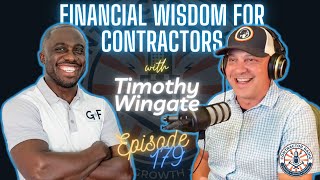
Timothy Wingate, founder of G F Financial, explains why contractors fail financially. Most start undercapitalized, then blow cash on trucks and tools instead of building reserves. Wingate pushes contractors to fix cash flow, structure their business right, and stop making tax decisions blind.
Chapters
Hey, everybody, it is your host here at Contractor Radio, Jim Johnson, also the head coach at Contractor Coach Pro, where we help contractors grow and scale their businesses by becoming better leaders, installing the processes and systems to make them scalable, and then with the whole idea of positioning them where they have personal and financial freedom. And it's kind of cool. Like today we're going to be talking about some financial freedom and how to get there, because there's some. Some questions, like one of the things about construction, depending on where you're at and what trades you're in and how good you are at sales and how good you are at creating value, we can make a lot of money in this business. But are we smart with it? Do we have a lot to show for it when it's over, or do we misuse it and do crazy, weird things with it? I've got a very good guest on today. He's got a pretty strong track record, and it actually comes from a. A family aspect of things. I want to just welcome to the show Timothy Wingate, the founder and president of G F Financial. Timothy, good to have you on board, brother.
Oh, man, thanks for having me. I appreciate it. Thank you so much.
Yeah, this is going to be a fun time today because we are talking about this thing where there's a certain amount of profit that we can generate in this industry and being wise with what we do with that profit, positioning our businesses well and how they're structured, what we spend our money on, understanding our cash flow. All of those things are so important to how much money you end up with in the end and the risk that you keep yourself from. So could you tell us a little bit about your history? What, what got you into this? What brought you along? And a little bit about G F Financial today.
Yeah. So it's interesting. My father was. Is a contractor. He's a GC. He's been licensed since 1984. So I grew up in the construction industry. Grew up slaving out there in the Florida sun, you know, hitting the dirt hard. Yeah.
I'm from Houston, Texas. Man, I know what you're talking about. It's terrible. Yeah.
Yeah, it's terrible. I don't know why he did that to me, but he did pay me below minimum wage. By the, you know, matter of fact.
That'S what kids are for.
Yeah, that's what kids are. But I learned a lot. I learned that I didn't want to work in the sun. I also learned that, you know, these guys need a lot of help. They. They're they're great at running their jobs, running the projects and doing those type of things. But I had, I saw a lot of up and downs with my dad financially. You know, I mean, he had a good, good years versus bad years versus good months versus bad months and did not understand it as a kid. But definitely when I got to be an adult, I understood that he just needed some assistance and some guidance around his finances. And definitely getting a degree in finance helped me out a lot to understand the economics of how this world works and what we need to do with our money. Also having a focus on the tax side of things and getting my EA license allowed me to see how can we save money, you know, for the company and for the individual through taxes. So just putting those two things together, I saw that I could really just niche down in the construction industry and help them because I like these guys. You know, these, they, they, they're real, they're down to earth. And when you're their guy, you're their guy. And so that's why I chose the construction industry. And that's why I said I can see myself doing this for a very long time in this niche.
That's pretty awesome. Like dad gc, right? And I got to send this kid to college. What should, what should I have? Oh, how about finances? Like that's. Get that thing covered. I can't wait to meet your dad. It sounds like a pretty smart guy.
Really smart.
Really though as a contractor, we're good at what we do and usually two sides of the coin. We're either really good on the production side of it and through that great production and great customer experience, we get lots of referrals. Right? We get continued word of mouth type business. The other side of it is the sales side of it. Like hey, we're, we're great at marketing and sales and generating business. And that seems to be the common theme between who starts a business. Like they do one of those two things really, really well. But from a, running a business perspective, excuse me, perspective. And really that's like why we exist. That's a whole different animal. You know, building whatever it is you build, whether it's putting a roof on or building a skyscraper, that takes us a skill that is far and few between, to be honest with you. But the idea of running a business, eliminating risk from you from a financial and economic standpoint, those aren't things that we get a lot of schooling with. Especially getting into contracting, it's a pretty low barrier of entry. It's not real Hard. You can go take a test and get your contractor's license. At least in some states. Some states. And a hammer in a truck, you're a contractor, right?
That's it. That's it.
And so people wonder why contractors get such a bad rap. It's because they're not required to go get any kind of business training or financial training or any of that kind of stuff. They just assume like, hey, you do good work or you can sell me a job. They're a contractor. What are, what are some of the biggest things that whenever you get involved with a contractor that you noticed right away that seemed to be thematic, the mistakes that might be made that we could solve pretty easily if we just knew about them.
Starting a company with not enough capital. So that's one of the first things I see, like they go out and they, or misuse of the capital. So going out, buying all these tools, I mean, contractors, they love tools, you know, tools, machines, you know, all. Yeah, trucks, you know, and so they go out and, and buy all these things in hopes that it's going to make them a lot of money. And, and sometimes they get in debt with those purchases as well. You know, a truck loan, equipment loan, you know, even sometimes they're financing their, their tools with their local hardware store and those type of things. And so those things get them in trouble. So you want to make sure, number one is like, how do I ensure that I'm starting this company with the right amount of resources, financial resources. And then the second thing you need to think about is how I'm going to get my name out there. You know what I'm going to specialize in the marketing side of it. Some of these guys don't really spend a lot of time on the marketing side. And so they find themselves in this tough seat because it's like, hey, I can really go out here and perform well, but I can't get the customer to the door, you know, so how do I, how do I get that pipeline or how do I even manage that? I can't even return phone calls because I'm out on the field doing all the work. And then I got about four or five messages, you know, to return back, but it's already 5 o', clock, 6 o' clock at the end of the day, you know, so it just. A lot of those things are happening too. So getting a handle on your marketing and getting a handle on how much, how, what type of resources I need and how much of it do I need to start this company on the right foot.
I already like you, Timothy. I think you kind of hit the nail on the head. I think a lot of us go out there and we. And sometimes it's almost organic how the business starts. Like, you're working on somebody's house, and the next door neighbor's like, hey, can you come work on my house? And all of a sudden you got this side job, and then it's another side job. And then all of a sudden you're like, okay, I got to go get my business license and set up a bank account.
Right?
That's how it tends to start for a lot of folks. And they're in business, but they don't really.










