Sales Secrets of a 20 Year Veteran with Dan Walrack
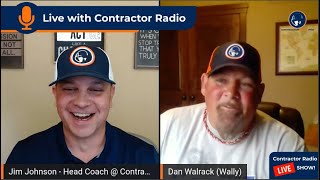
Dan Walrack, a 21-year sales veteran, talks about leaving a planned teaching career for full-time sales after one successful summer. He shares how he works a neighborhood consistently, protects his leads, and builds rapport with homeowners by finding common ground before pitching anything.
Chapters
Hey, everybody, it's Jim Johnson here with this week's episode of Contractor Radio. Our broadcast for contractors to help them with their strategy, help them with their game, to kind of get an edge, hopefully on their market. And. And today we have somebody very near and dear to my heart. I posted on Facebook yesterday, I said, this is the best sales rep that I ever hired. And there's a little story to it that I recruited him for like a year and a half. It took a year and a half. I told him he was going to be good at it. He wanted to keep working at, I think it was a Pizza Hut. And so he wanted to keep working at Pizza Hut, and so he did that summer. But I kept working on him. We played basketball together and finally got him into the game. So, everybody, this is Dan Walreck or Wally. Welcome aboard, Dan, glad to have you today.
Thank you. Appreciate it. Humbled introduction you gave me there.
He's. He's. He's a rock star. And we're going to find out today some of the reasons why he is a rock star. You guys that are watching on Facebook and checking it out there, we can't necessarily see your names on there, but if you make comments, we do see them. So we'll just call them out. Somebody says they're excited for this one. I'm excited and cautiously, a little bit scared. We'll see what Dan comes up with today. But Dan, just kind of tell us the story. Like, how'd you get into this? I kind of led into it a little bit. But bring us up to speed with where you are today. 20 years now.
Is that.
Is that right?
21.
21 years, man. And most of that is a sales guy, right? Most as a sales.
Yeah, I. 21 years of doing sales. And I mean, even when I owned my own company, it was sales. I sold, sold, sold. So how I started off doing this is like Jim said. I was in college. Got my degree in physical education, health and fitness. I got a couple minors in coaching and adapted PE and outdoor recipes. And Jim gave me the old line for about a year and a half. You'd be really good at this. You'd be really good at this. And I'm like, you know, it sounds too good to be true. You can't make money doing that. Nobody's gonna do that. I don't sell vacuums. That's not my niche. Right? He thinks, no, man, you. You'd be really good at this. I promise. So that goes. My graduation, was it. Didn't you finally hook Me or we went out to dinner.
Yep.
I know the place. I don't know. Remember the name Copper kettle. There you go. So we went out to dinner and finally I said, all right, I'll give it a shot. I'll do it for the summer. You know, I'll, you know, whatever, whatever it is for the summer. I got nothing going on. I had a teaching and coaching gig all lined up, ready to go. And then we went out to Oshkosh, I believe, and I gave it to summer and I made more in, you know, three, four months. And I would have made an entire year of teaching at a 22 year old kid. That was a pretty good deal. So then I pretty much was hooked after that. Nobody ever told me that up north here that what you sell sometimes you have to bank over for spring. So I had all these jobs left over for spring. That was money in the bank starting off in the spring.
So that's how we suck you in, man.
That's how they got you on it. My teaching thing. And 21 years later, here I am still doing the same thing and 20 years of straight million plus producer. So.
Well, I think you kind of got both of it in. You got this life that is pretty cool. But you still do a lot of coaching and stuff, right? Like you're heavily involved with your kids. Football, baseball.
I run the booster program up here for football and I coach, traveling, baseball and I'm the seventh and eighth grade head football coach up here. See, I do a lot of work.
Best of both worlds, right? Like I got to make some.
It wasn't like that at the beginning though, you know, that.
What do all those other coaches that work there at the school or teachers think about, like situation?
They have a good time. They, they know that I'm, I'm passionate, I'm aggressive. I suppose I take that into work too. You know, I'm passionate, aggressive about work too. And see a lot of things come and go in this business. It's like it's, it's a soap opera, you know what I mean?
But it's cool that you bring that up. Like what are the things like 21 years ago, what's changed from then?
Oh, goodness. Well, and in the sales part of it, I mean, all these new guys now are just, they take a lot of stuff for granted. You know, we were out there plugging the streets. We were out There, you know, 7:00' clock in the morning till 7:00' clock at night. You're sitting on a tailgate, you know, and you had to generate your own jobs, you know what I mean? Nowadays, jobs get generated for you. They tell you where to go, they put you in the spot. And back then, we had to go look for leaves on the ground. We had to look for dents on car hoods. I mean, we were driving around everywhere trying to find it. But once you found it, guess what? You kept your mouth shut, because that's where you sat and you worked and you worked and you worked and you. And you made it.
So, yeah, it was. It was kind of all about owning that neighborhood, right? Like, oh, yeah, that's why you're there.
At 7 in the morning.
That was some of the first things we taught is like, don't, like, scatter yourself all over a city. You know, Find that neighborhood, work that neighborhood, own that neighborhood, make that neighborhood your office. You were really good at that. And one of the reasons why I recruited you is your ability to make friends easily. Like you. You're just now going naturally outgoing. Were you always that way as a kid too, or did that come on?
Yeah, I've always been outgoing. You just. I just relate with people, you know, and it doesn't matter what that person's, you know, into or whatever. You just relate with them. I mean, as a salesperson. I mean, the first thing you should do as a salesperson driving up to a person's house is if they got the garage door open, look inside. I mean, I think you taught me this. Look. If they've got a fishing pole hanging up, talk fishing. If they've got packer colors, talk packers. If they got whatever, make them feel comfortable with you as a person before you start trying to go into a niche on what you do. You know what I mean? Because it is what it is. I mean, you start talking to people and make them feel comfortable, that person is gonna be more open to talking to you.
Yeah, it's one of the mistakes I think a lot of salespeople make is they get right into it really fast. You know, hey, you know, going around, we're meeting homeowners I'm working with so and so over here. I'm here doing free inspections. Would you like me to do one for you? And they skip that part about being likable, Being somebody that's creating themselves as another human being, maybe even their next door neighbor, possibly a friend, before they start talking about why they're there. And that's always been one of those things. Like, I try to. I try to look at each person as a possible new friend, a new relationship. I'm still friends with my very first person I ever sold, Tom Wicks. I still talk to that guy to this day. He's a uber Viking fan. And if you remember, back in the day, I had a yellow truck with a green and white stripe right down the middle of it. It was the Packer truck. And I drove up to all those houses in Minneapolis that were all Vikings fans with that truck. Talk about a conversation start. It was like, man, instantly started conversation. And we'd talk football for five or 10 minutes before we even get into talking about what we were there for. Well, I'm here. I might as well go ahead and inspect your roof, right? Yeah, sounds good. Go ahead, man. And I don't know if people really look at that rapport building as importantly as what it is. So you got rapport build. What's the next thing you're gonna do?
The next thing I do is when I meet with a homeowner. You know, my whole point of meeting with a homeowner is I'm there for a reason. I'm there to help you out. You know, I'm not there to sell you anything. I don't have a free box of steaks to give you. I don't have anything. I'm here to help you out. You know, if you want that roof taken care of, why not have me inspected for you and have the best guy do it? I mean, I'm gonna get it approved. And so that. That's my thing is people. People tried. Like you said, Jim, people try to rush so fast through it that they're missing the parts that are the most important parts. The most important parts is building that relationship. You know, that homeowner. You're gonna be with that homeowner from A to Z. You know, you have to build that. They have to feel comfortable with you. You know, I always tell everybody this. Now, I said, when we're all said and done and they write that final checkout, nine times out of ten, if you've built that relationship where it should be, that homeowner is going to ask you. They've been working with, you know, your company for two months maybe, and they're going to ask you at the end, who do I write the checkout to? Why? Because they don't care about the company. I mean, they do, but you know what I mean? They don't. They care about that person they worked with. They care about Dan Walreck. Dan is who I worked with. They don't. I could have been whatever Mouse Pad Incorporated. They don't care. They care about me.
And that is the thing, right? Like, I. I think people buy people. I think they. There's more to it. You know, they want good service and quality, value and all that, but they really buy from people they know like and trust, which is. Yeah, you got to get past that part first before they even care too much about the company. Hopefully the company that you're selling, you can stand up for and say, hey, they're great. I know you work for a great one right now. Built strong exteriors there in Minnesota. A little plug for those guys. And Tony, he's a rock star. I like that guy. He does a really good job. A lot of experience in this industry, too. So you're now 21 years into it, but if you could go back, go back to the very beginning. What's. Yeah. What's the most important piece of advice you would give your younger self getting into this?
I would say. I would say probably the biggest advice I'd give guys just starting off in this. There's two. One, I'd say networking. Networking is ginormous in this business. Absolutely ginormous. The second thing I would say is because a lot of people. A lot of people have that mentality where they think they need.










