Jim Johnson walks through a sales technique called the deal closing inspection. He says thorough on-site inspections with photos and measurements can push closing rates from 30-50% up to 80-90%, as long as you set clear time expectations upfront and focus on the customer's needs instead of rushing to close.
Chapters
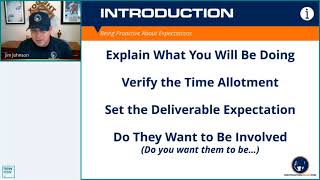
Good morning, everybody. Welcome to our weekly huddle. This week on the deal closing inspection. This is one of our favorite ones to do and we're kind of updating this one because there's actually a few things that we might consider out there whenever we're doing our inspections. So we do this in an effort to give you this ability to sign more deals or to gain more customers. As I've gotten better and better at sales, one of the things that I've noticed is this word closing kind of has a negative connotation to it. Unless you're a salesperson. Salesperson hears the word closing, they want to hear the content that's going to be involved. But when you think about this idea of closing somebody, it's almost like you have to convince them that you're the right person for them. Where that should be self evident. You shouldn't really have to close somebody. It should be obvious that you are the correct choice. One of the components of that is your inspection. So let's kind of set the scene here. I've gone out to a home and this could be either way. I could have gone on an appointment, I could have knocked on a door and, and this homeowner has now told me that I can do an inspection. And I probably have given the first part of my presentation, built a little credibility with my company, a little credibility for me and set those things up. I probably asked a few questions as far as objection defeating questions to try and make sure that I know what is the concerns of this homeowner and what their expectations are of me, what they're looking for in a contractor. And so now I'm actually going to start my inspection. And so let's kind of get that started. All right, so I've gone through the first part of my presentation. Now I'm setting the expectations for my inspection. So the first thing I'm going to do is I'm going to explain what I'll be doing. I'm going to be looking at your roof, your siding, your gutters. Maybe you're a roofing company and that's what you do. Maybe you're a cabinet guy or you're a, a landscaper. Explain exactly what you're going to be doing and set the expectations on what they're going to get back into that deliverable. Okay. And so when I get done with my inspection, these are the things that you're going to get back and then verify the time allotment. So Mr. Jones is going to take about 20 or 30 minutes. I've got to get some measurements, take some pictures, and I'm going to take all those pictures, bring them back down and show them to you. You could go a little bit further and say, I'm looking for these type of damages, maybe show some pictures, you know, maybe you have a presentation that's got some pictures of those things. And so we're going to show, you know, I'm looking for wind damage, I'm looking for hail damage, I'm looking for dead grass. Like whatever it is that you do, you want to say what it is that you're looking for to kind of set those expectations of this time that it's going to take to do it. And so if I can show more pictures and show more things I'm looking for and the level of detail that I'm looking for, I can justify my time allotment a lot better. Now, those of you that are in the roofing game and do a little bit of storm work, it's always seemed to me like there's this, like, race to see how fast I can get it done and get somebody to sign with me. And usually that type of approach, a guy is ending up closing. Maybe 30 to 50% of people that he talks to are signing or gaining them as a client, customer, 30 to 50% of the time, depending upon his ability. But if you go through and do a great inspection and you do a great presentation, you can increase those closing percentages up into that 80 and 90 percentile by doing a good job. So in the end, you really have to meet less people to get more customers and be more profitable and save time and really maximize your effort while you're out there, think about it. That person that's in front of you right now is your biggest opportunity to sign. So instead of rushing through everything and trying to see how fast you can do it, set some kind of contract signing speed record, take your time, do a really good job, be there to treat, care and serve for this customer. And you'll be surprised because when you get to the end and you put all of these pieces together, this presentation, this inspection that you're doing, the discussion that you do, and, and then finishing that presentation, you do a really good job. And that last question you ask is, hey, Mr. Jones, do you have any questions? And he says, no. Great, let's get you on the schedule. Great. Let's get to work with your insurance company. Great. When do you want to start your job? Great. How do you want to pay check or credit card? And so you can go to that closing question really quickly, because he didn't have anything that was missing from the equation. So Matthew says that's the difference between working for what you want versus working for what your prospect wants. Yeah. So I can remember when I first got in the business, my whole goal, like, as I approached the door. This sounds terrible to me now, when I approached the door, I pictured that door like doors upright, right? That was a thousand dollar bill on that door. Every single time I was walking on the door, the mental image that I put into my mind, knowing that if I was able to obtain this person as my customer, that that would be the amount of commission that I might make on that job. And so it was all about the money for me. It was all about me. It was a very selfish aspect of things. And whenever I flipped to thinking, hey, you know, this is really more about that customer. And so every time I walked in the door, I changed the mental image and I changed that mental image to this person could be a friend. So I pictured one of my friends up there, and it went a whole different way. We get into that and some of the psychology and how you approach somebody, but just know that there's a couple different ways that you can approach this. So if it's the speed thing, I get it. I know why you do it. But maybe taking a little bit more time, you'll close at a higher percentage. And finally, the last part of this is, do they want to be involved and even do you want them to be? Because you really kind of control that. In most cases, every once in a while, you'll have a customer that's pretty adamant about going on the inspection with you. But in most cases, you can direct it. And so we'll talk a little bit about that later this morning. So know your gear. So I'm getting ready to do my inspection. I'm going to go do my very first one on a new salesperson. Know the gear that you have and what you need to perform that inspection. Sam.