The Value of a Winning Process
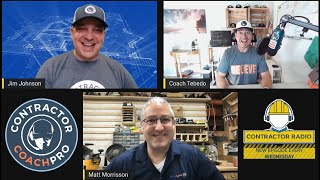
Jim Johnson talks with Nathan and Matthew Morrison about why home-service contractors need documented processes. Processes let you scale, clarify who does what, automate tasks, and make your business sellable. Start simple, map customer milestones, test-drive the handoffs between roles, then share it with your team.
Chapters
Foreign. Hey, everybody, it's Jim Johnson, your host here at Contractor Radio and the head coach at Contractor Coach Pro. And the goal of our podcast is to give the listeners who we hope are home service contractors a little bit of education, a little bit of strategy, tactics, and hopefully a little bit of entertainment while we do this. And today we're going to be talking about one of our core principal topics that we teach and work with with the contractors that we work with. We want to share that with the wider world out there, and it's important. So we're going to be talking about process today, which in reality kind of a boring subject, but the value of it is you can't even really put a number on it, on what it does for a business and what it allows a business to do whenever you do one. So I have actually brought in two people today to help out with this conversation. One of them is one of our coaches. He works with our clients on process quite a bit. His name is Nathan. And then we also brought in the guru of process. I'll tell you a little bit about him. I used to work at Acculinx and we signed up this company and put them on Acculinx and this guy was the integrator for it. And he was the biggest thorn in my side that I've ever had in my entire life in dealing with a customer. And he's also one of the most valuable people that I've ever met in my life because of what he did while he was onboarding with that software. He literally broke every piece of it and told us what it was wrong with it and what we should do with it and how to make it better. And because he's such a process oriented mind, his name is Matthew and I'm going to bring him on in just a few minutes as well. But before we get there and we talk about what the value of process is to your business, let's get a word from our sponsor and we'll get rolling here shortly. Our sponsors are what makes this possible. We love those guys. And. And just take a couple seconds and we'll be right back. You're not using Hell Trace. It's definitely worth the money. That money invested was one cell was already bought. We've got from deny or declined 2x of being bought just because of Hail Trace and the storm reports that they.
Give us, not only do I know.
Where the storm's at sometimes as they're happening and I can already head right.
There to the storm, but also after.
The fact when I'm out knocking on doors. I can show homeowners the map and what kind of hail was in their area. We've seen a huge return on our investment, and I have no doubt that you will, too. All right, everybody, we are back from our sponsor message. I really appreciate all of them and them making this possible for us to do for the greater world out there. And hopefully we're helping home service contractors. We've been getting tons of comments about our recent podcast, especially the coaches roundtable, and we've got another one that are coming out this week that's going to be amazing. This one's going to be amazing in a couple of weeks. So in order for it to be amazing, we better bring on the guests and quit listening to Jim talk. And so first, I want to bring on Nathan, our other head coach here. Nathan, welcome aboard again.
Good afternoon.
Good.
And then we have the guru of process, Matthew Morrison with acculinx.
Hey, good afternoon. Thanks, guys.
Matthew, I want to talk about you first. You deal with this every day. Like, this is why people buy CRMs is to start integrating some process into their world, communicate better and have an order and format to what they do. And so in your tenure, how long have you been at accu links now? 10 years.
It'll be 10 years is August, which is almost kind of weird to say, you let alone think about it.
And so to finish the story I started earlier, thorn in my side.
Welcome.
So good at what he did in building processes. He literally worked himself out of a job. And he calls me one day, he's like, hey, I don't work here anymore, and I don't know what I'm going to do. And I said, well, I don't know what you're going to do either, but I do know you're going to work for us. I don't know what that's going to entail, what that looks like or anything like that, but we're going to hire you. And so that was one of the most enjoyable moments in my life. I sit here and I think about that and I go like, I mean, what a. What a cool situation that turned out to be, I think, for all parties involved. And so, Matt, thank you for being a thorn. Thanks for being a thorn in my side.
Anytime, anytime.
So in your tenure there, what have you noticed about process? Just from a high level, what is it? What difference does it make?
I think you can tell the difference between a company that has one and hasn't won. Right. I think what's interesting is if I get a company. You know, look, there's some competitors out there. I'm obviously biased, but if I'm just being honest, most of our competitors are pretty good, too, right? I mean, they do a good job, they have a good product, and if you've got a good process in place and you work and you trust the process, it's probably going to work out, right? The ones that make me nervous, the ones that say, oh, you're our 4th or 5th CRM, they all suck, but Acculinx is going to make our lives better. And I. I mean, I guess if they told me that they had used each one of those things to their full capacity and they realized that there was things they wanted to do, it couldn't do, fair enough. But when it's all just a matter of they suck, they suck, they suck, but you're going to do good, then I'm wondering how long until you think I'm going to suck? Because I'm starting to wonder, is there something else going on here? Right?
Is there.
Is it not clear what people are supposed to do? Is there not accountability to holding people to what they're supposed to do? And I think having a process really highlights the vision of that company, or maybe the lack of one. It lets you be able to see what's really important to them when first comes to shove, you know?
Now. Now, I don't want to get you in trouble with Accu Links or anything, but would you say that a CRM is the. The silver bullet for a company getting their processes down?
Absolutely not. I mean, I think it's a key part of it. I think it's. And look, you're not going to get me in trouble because this is what we say, right? It's. It's a part of your process. Your process. Look, I'm, you know, acculinx is not going to go out and knock a door or run a Facebook campaign or ANSW phone. You got to do that, right? Aculinks is not going to swing a hammer and install a roof, and it's not going to send a warranty off to your supplier or your manufacturer and get that golden pledge or platinum or whatever certificate in the mail, right? So it's going to be.
But all that stuff's in development right now, though, right?
But that's. That's the stuff that acculinx is going to support, right? Or any CRM for that matter, is going to support. It's going to create a centralized place where you find that information and it supports the process that you built. So it's important that people know where in the program they're going and what they're doing when they get there, who should they notify about this versus who should they notify about that? And that's really what the process is. I mean, I've seen companies that are horribly. I say horribly, that are just huge, that are using accolades. I go to their offices and it's just like, it's a wonder. Not like, you know, how are they doing this, but how on earth. This is cool, right? And then you get these like, four main companies that are like, well, accurately. Just doesn't work for us. I'm like, yeah, but this guy with 200 sales guys found a way to make it work. But he's got a process in place, right? He's got a way to make it work. He's got the leadership in place and the clear vision of what they're doing and the right people in the place to actually make it happen. So I don't think it's as much about. I think the process really speaks to whatever CRM you're using. You got a good process, you probably make good use of anything from an Excel spreadsheet to backlinks or anything in between, right?
So if I'm hearing you correctly, what you're saying is that you should create your process first before you decide what you're doing.
Have a pretty good idea of what's going on. Now, look, your CRM may bring about capabilities or ideas that you didn't have before. But I oftentimes think of like, you know, the old ad about the goldfish. You put the goldfish in the small bowl, the goldfish is only going to get so big. You put that goldfish in a bigger bowl, the goldfish gets bigger. And so sometimes companies come to accolades. And I'm, I'm not trying to be pro acculate. I mean, I am by profession, but I mean, at the end of the day, I'm. I'm objective enough to recognize that other CRMs offer similar things, right? You come to them and then they have capabilities that you didn't have before. Maybe they help you track something better, run better reports. They automate some process where they do whatever they do, right? All of a sudden that's a thing you couldn't do before. And so you might retool your processes a little bit, recognizing, hey, you know.
We work a little bit better if.
We incorporate this thing over here, or maybe we don't do it the way we've always done it. We start to Use this thing. And yeah, it's a little different, but overall, there's more wins than losses here, you know, and it ultimately yields to a better product.
So, Nathan, whenever we're putting a process together, what are some of the things we should be looking for as we do that? Is there like any key things you should be going, hey, I need to look at this and this and this when I build a process?
Well, I mean, the first question I probably ask myself is, what is the process for? I mean, we're kind of using this word process. Like everybody might know exactly what we're talking about. But in most companies, numerous processes. Right. You may have a hiring process, you have a termination process, a disciplinary process, you might have, you know, planning a company event might be. Have its own process. I think for the purpose of kind of what we're talking about right now, we're kind of talking about your client or customer path process. How does a customer make their way through your marketing, through your sales, through your approval stages, into. Into pre production in progress? Oh, there's some accumulates. Right. Like this lead prospect, approved, completed, invoiced, and closed. Did I get those right?
Hey, it's been years.
We both don't remember them.
I do remember those. And so in acting's call is milestones. Right. And you know, other CRMs have milestones, I think, but the concept is like, what are the milestones or the major stopping points? Starting and stopping points that a customer finds themselves along that journey. Right. So if they engage with your marketing and they're interested in talking to your company.
Right.
They might reach out to you or you're out reaching out with them, and then there's probably a little bit of a gap in time between interest and an appointment. Not always, but sometimes.
Right.
So how do we get to that? And then once we're on that appointment, then what happens? Right, so what are the milestones that occur first and then inside of those milestones, what happens? Who's supposed to do what? When are they supposed to do it? How long is it supposed to take? What. What tools like ACCU Links should they be using to accomplish those tasks?
Yep. And I think that's what's. What's interesting is that I mentioned at the beginning that, you know, when you get to observe a company's process, you really start to get a feel for where their values are, what their vision is, what are they trying to do. Right. Not. Not. Yeah. I mean, I think it's safe to say that most of the people watching this. What are they trying to do. Yeah, they want to swing a hammer, you know, siding, roofing, gutters, some other trade that's kind of associated to that. They want to make some money, of course. But most the companies, especially ones I know that work with you guys, they've got something a little bit more than just making money and swinging hammers that they work for. Right. They've got. They've got a why? And like, I was just with a customer before we hopped on here, and it was like the second word out of their mouth after they introduced themselves was that they were big on custom customer communication. And that was. And that was obvious that that was a huge part of their entire process and workflow and how they format everything else that they do was around that. Right. And so that gave me really good insight into. Without them saying anything directly, it gave me really good insight into how they think, where their values are. And, you know, of course, in my capacity, then, of course I wanted to show them how that was going to work within the system that we had.
But.
But just as that company, independent of the system that they were using, that was clearly a big part of their process. Right. It showed their values out without them having to say what their values are, because that's what they were putting priority on.
One of the things, too, One of the other buzzwords that we kind of hear in our industry right now is the word automate, right? Like, got to automate automate. Because automating allows you to reduce the manpower needed to accomplish a particular thing. Okay. But I know that at least from, like, having been a contractor, someone just saying you need to automate everything you possibly can is like. It's like saying you should dig for gold wherever you think you can find it. It's like, well, is that this spot or this spot? I don't know what that means. Well, having a process like you're talking about your client, who's huge on customer experience, they're probably building touch points for customer experience throughout their entire process. Some of those touch points might possibly be something that could get automated, but in order to identify areas that you can automate, you probably should have your process built.
Yeah, exactly. Otherwise, it's like having a box of Legos and not having the instructions of what you're building. You know, so it's like you can do whatever you want, but you don't know what you're doing. Right. And I really, you know, I really think that a process starts at a high level with a. With a leader, with an owner type. Right. With the leader and owner type having a vision. What do I care about?
Right?
What's, what's, what's our purpose so that we can then build a process that supports that.
Yeah. You know, whenever we're working with companies, one of the very first things we do is culture and vision's a part of that together. And we do that first because it has such an impact on what you're going to do with process. Like, you can't do a process without knowing where you're headed. So that, that's awesome insight there, Nathan. You. You said automate. Right. Like, that' One of the things I think also it allows you this opportunity to delegate to where you can start to see where I can delegate some of these hats off of my head to other people so that, you know, I'm not doing everything. Especially as a smaller company. I would throw another word in there too. Like, it also offers the opportunity to eliminate, like looking at our process and going, do we really have to do that or am I just making this more complicated than it needs to be? I think sometimes we get caught up with this idea of the perfect process, that that's what we're after. And so it's a little bit of paralysis by analysis, trying to get it all nailed down just perfectly. And so you never create one because it seems daunting and overwhelming and all that other good stuff where the reality is you're trying to get the ideal process. Like, what's the. How's it ideally supposed to go once we know ideally how it's supposed to go? This customer journey that Nathan's talking about, whenever it deviates from that, I can then create processes for that. So when something goes wrong, here's my go wrong process. Like, here's a repair that's got to happen. So that's the process for that. And the other thing about a process that I found to be unique and I had a little bit of, I don't know, philosophical epiphany on is it's A to Z. It's step by step by step by step by step by step until the end. Anywhere where that thing deviates, like it's an if then type statement. If this happens, then do that. That then is a new process that has to happen. It may return back to your process, but it's outside of the actual overall ideal way you would like it to go. Because if you don't start with the ideal way that you would like it to go, that fits your vision, you wouldn't even know how to create those Processes for when it deviates. One of the things I see a lot is insurance restoration contractors, they do supplementing. And so if they do any kind of supplementing that might come outside of the process, they have a supplement process and then it returns back to their ideal process when that thing is done in some cases. But if both of them are happening simultaneously, you can't have two processes that are one process. Does that make sense?
Yep.
It's literally two separate processes.
All right, So I think, I think what's interesting that you're saying there is that it's important to recognize that there could be exceptions to a rule.
Right.
And I think so long as those exceptions are discussed and understood. Okay, like we'll keep it simple and say the case of a supplement. Right? A supplement, at least in the world that I came from, that could happen when the job gets turned in before you ever swing a hammer. That could happen during the course of a job because you would just realize during the job, oh crap, there's a third layer of shingles that nobody saw. Right. Or that could happen after the fact where somebody has to supplement for something else. Right. I've seen it happen at any and sometimes all three of those stages. So that's an, that's a predetermined and pre agreed upon exception. So to your point, Jim, of course there should be a little rooster tail that goes off and has its little deal and then it closes up and it gets back in the training room. We keep on going. I think what's important is that you don't empower everybody to decide that their situation is an exception. Those exceptions should be planned for. And nobody just unilaterally decides to drop the process because, well, it's difficult for me in this situation. Does that make sense at least? I think that's a potential hazard, right. That everybody now has an exception that nobody agreed to and there was no process for their exception and their exception decides to unilaterally bypass half the steps that they were supposed to.
You know, he's most guilty of that, right? This is a little coaching moment. You owners are the worst about that. You commission your people to build out a process because you know you need it. And then when you happen to sell your one off job or whatever as an owner, you go in there and blow up everything that you, you had them put in place. So if you're doing that, stop it. Let subscribe to the process. You had your people builder that you built as well.
Our mutual friend Bob Hamilton calls that the seagull method. Of management where you swoop in and crap all over everything and then leave, you know, and, you know, when I, when I go to a company, especially one that's been using our program for a while, I'm always looking. It's like you either get like, you know, the two extremes are everyone loves the program and I'm just there to maybe help them out, enhance some things, show them some new things. That's great. But then it's like a. Oh yeah, we love acculinx and everyone's using it and it's great. But you know Jim, the owner, I mean, he doesn't, he still turns his files in by paper because, you know, he's so busy and, and whatever. It's like, no, you've just set yourself up as the exception to the rule. And every guy in your company, or girl for that matter, that doesn't quite like the rules, is looking to you and say, well, Jim doesn't have to, so maybe I don't have to.
Right.
And instead I've always said, and I, I realize I might be a little bit of an idealist and I recognize that there are outlying situations. Right. But as a general rule, I've always told business owners, you shouldn't be the exception to the rule, you should be the one following them exceptionally. Right. You should be the one that stays longer to do your paperwork the right way because everybody saw you do that, right? Not because they're going to see you, but because they're going to see you. Right. And you should be the one that's out there sticking up for that. And if it sucks, then it sucks, then you change it. But now you realize that it sucks as well as everybody else, but if they can see that, well, he can do it and he's the owner and he's doing all these other various things. I guess maybe I can too.
You know, it's a good sidebar.
I just was picking on Jim because I know he's the owner.
Yeah.
But not, not because that's you. For the record. For the record. TV land.
So we're having a little bit of Internet issues here. Sorry about that, everybody. Listen, the content's great though, so we don't want to, we don't want to end this just yet. How about we take a quick break for one of our sponsors and we'll come right back.
Want more 5 star reviews from your customers? At Signpost, we make it easy for your customers to give you great reviews on Google, Facebook, Yelp and more. Our software connects with industry specific solutions Driving even more reviews from your customers. Drive loyalty and repeat business by sending the right messages at the right time times to your prospects and customers. Message your contacts from anywhere, anytime, using text, photos and video all in one app. Check on progress with campaigns and review generation across Google, Facebook and Yelp. Visit signpost.com and get your demo today.
We are back. Sorry for technical difficulty. My amazing editing team can make us look amazing, even if we might not be all the time. And I have no doubt they will because our production department is rock stars, because they have a process. That's what we're talking about here today is process. And we've had a lot of like, good insight, but we talked about something I thought that was kind of. We kind of glossed over a little bit. I want to go back to IT company with 200 people. Process kind of nailed down, looks pretty good. You're like, wow, moment. And then you got this four people in a company and man, it's chaos, right? And was it actually easier for the company that was 200 to do that because they have more people, or was it something that you think they kind of started that way from the beginning.
You know, I wasn't working with that company when they were substantially smaller, but I would imagine you might say it's easier. We'll have more assets, we have more managers, we have more people to run materials, whatever the case might be. But I think that's also 200 individuals that you still have to corral in some way, shape or form, right? I'm not saying corral like, you know, train them, but you do need to make sure that they're all on the same page and that they're actually on the same page. Right? They're actually doing what's on that page. So I think that comes from having managers. But, you know, you're what you're really almost dealing with. There is just little squads of people, right? You might have, I don't know, 5, 6, 8, 10, whatever, sales managers or team leaders that have their own little small squads who are responsible for making sure that process is kept right? So on a microcosm, it's just small, little pods of small companies, if you will. I mean, of course they're all feeding up to a much larger organization. But if you, the three of us all have teams of 5, 6, 7, 8, 10 people, our responsibility is to make sure that process is met. You and I don't care about the other 80 or 90 people on the team. It's our five. It's our small little Potential. Right. So I think a process there, I think. I think that what it does is it empowers those people to kind of run that like it's their own little company, if you will. It's their own little team of people that they're gonna. As long as the overall mission gets done, they're gonna run it their way. I think that's what a process does, is it empowers people. They know what they need to do. They know what their boundaries are, if you will, but they also know what their allowances are.
So, Nathan, whenever you. We work with all sizes of companies, everything from less than a million to. I think our biggest company we've worked with is 65 million. Is it different process at a different time? Like, is there a different level and quantity and quality of process when you're smaller and bigger?
Yes, I believe it is. I believe that when you're. When you're smaller, you can almost substitute the word process for a plan. We just need a plan. If somebody calls us on the phone, what do we do?
Right.
And you don't necessarily need to get super deep into the nitty gritty if it's only you and three other people, because a lot of those people, they're just. They're wearing a lot of hats, and they kind of know what they're supposed to be doing anyway. But let's create something resembling a plan. And here's the thing. The plan doesn't even have to be perfect. Like, Jim talked a little bit about the perfect process. It's just we have an idea of what we're trying to accomplish, and that thing is going to evolve, and it can be fairly high level, especially when multiple people are wearing multiple hats. That is like. That is the tagline for every small business. We're all wearing a lot of hats, right? Well, when you want to grow, it doesn't mean that you try to hire more people who can wear more hats. You want to start dispersing those hats amongst other people. And as soon as you begin to do that, your process needs to get more detail. So now we need to define a little bit tighter what that hat means, right? What that. What the person who wears that hat is supposed to do.
Okay.
And so when you're small, your process can be basic, and that's perfectly fine. A lot of people doing a lot of stuff. But at least put a plan together that has some overlap so that people. Things aren't falling through the cracks. But then as you grow, more detail is needed to define those roles. So for Example, if you've got somebody who is a sales manager and they're doing as a sales manager, they do they recruiting, hiring and onboarding. They're doing training, they're doing coaching, they're doing. They're out in the field. But then they're also responsible for sales reports, closing percentages, general overall revenue. They also need to be providing profitability reports. So they've got all these reports. They also need to provide. They're doing all these things, right? That's a big hat for a sales manager. And when the sales manager is only managing six, eight guys, he can probably wear pretty much all those hats. But when all sudden that sales manager has 12, 15, 20 guys, some of those responsibilities need to come off of them so they can focus on what they're best at. And we need to create a new hat for somebody else that might be a sales manager's assistant, right? And that person is responsible for pulling reports that they can give to the sales manager and maybe doing some job approvals and things like. That's what we call scaling. But you can't do that unless you have these things defined. So if you're a small contractor, don't worry about having every little thing planned out. And I know there are a lot of guys out there I've met who are like that. They'll overthink it to death. I'm one of those people who would be like, likely to do something like that. Okay, so guard against doing that. But that overthinking it to death is going to be really handy as your business starts to grow and you're creating, you're creating down to the nitty gritty what people are supposed to do.
Yeah, you mentioned, you mentioned milestones earlier. And I think that's almost more important when you're smaller than it is necessarily when you're bigger. Like nailing those right is really important to say, hey, these are milestones a job goes through for me. And then inside of that milestone, what are the major tasks where they start and finish? There's a start and a finish to it before you move to the next task that we got to get done inside of that milestone before it gets handed off to somebody else or moves to a different functionality in my business. Would you agree with that?
Yeah, I think so. I think knowing what those things are is important. I think also as to Nathan's point, as you start to bring people on, right, Knowing what those processes are, like some of those nitty gritty steps like you were talking, Jim, start to inadvertently help you Define well, what does that person need to look like? What do their skills need to be?
Right?
And like an example, when I got to aculinks, it was like what, 10 of us, 12 of us. I mean, there wasn't many, right? So it was like there wasn't like a full time job to just sit there and talk to customers. We didn't have that many customers. Right. To talk to you full time, 8 hours a day, 40 hours a week or whatever, right? There were some weeks and other weeks there weren't. And so it's like, oh, Matt, you want to help with some Facebook stuff? Okay. I mean, there was, it was something to do, it was something to learn. It was better than sitting around on my thumbs.
Right?
And you know, you want to do these little things and these little things and eventually acknowledge got large enough. They were like, hey, why the heck is Matt doing that? We need to build these processes in place for marketing. Well, now guess what? We need to, we need a marketing person now. We need to know, we know what their roles are going to be. Because what's Matt doing? And maybe what, what, what do we always wish Matt could have done, right. Because he just didn't have the time or the ability or the whatever to do. It starts to define who that next person is or at least the next slots that you're gonna put into your firm. So now you know, okay, maybe this year we want to focus on that slot, and next year this slot, the year after that, that slot. But you start to create that, that shape of what this is going to be.
So I think we're at a point now where the listeners would understand that process is important.
Yeah.
It might look different when you're smaller than when you're bigger as amount of detail that's involved. But what is the ultimate value of a process? What's the return on investment? Like if I, if I'm going to spend the time doing one, which it is some time, right? There's, there's some work involved there. It's what we call proactive planning, like putting things in place so that things go better later. What are some of the key value propositions that you get out of that by doing that work?
Nathan? All right, I can go.
Yeah, I'll take a crack at it. I mentioned the all important word scaling. Right. Like everybody talks about that all the time. Like a guy that's like a two man show and he goes, I need to scale my business. You're not there yet. Right. But if you ever want to get there, having the process built is important. A lot of things flow from your process. As a matter of fact, we have a champion coach over here on the HR side of things, and she helps people build job descriptions and compensation programs and standards and accountability for people. All of those things I just mentioned flow from a process. So if you want to know how to build a job description for your sales guys and how much to pay them comes from your process. You want to know what an admin person should be doing or what you want them to do comes from your process. And then if you want to create standards for how much of a particular thing they're supposed to do over a particular period of time so that you can measure it and then hold them accountable and then also incentivize them for doing the thing that you want them to do, all of that flows from process.
So I think. So just wrap his up real quick. What I heard from that was scalability allows you and affords you the ability to scale your business because you know what you're doing. It makes it easier to teach somebody what that is. It's easier to define what they do. And you can measure it. You can measure this process and say, hey, it's taking this long to do something. Could we do it any quicker? Because if you can do things quicker while still keeping quality, your profit goes up. Okay, Matt, you're up.
I was thinking it provides. It provides a bit of definition, right? We've all. I'm guessing you guys have. We've all been to a company that has some amazing people, right? The one thing about contracting companies, and maybe it's because they live a little bit, like, outside, like, the professional norms oftentimes, right? They're like, hiring people that they know that they're friends, you know, whatever the case is, right? They tend to bring on some amazingly talented and resilient personalities, right? These are amazing people in your team. But, you know, when you're in the small level, when it's 2, 3, 4, main operation, and you have the office manager who just does everything that isn't sales, I guess that's fine, right? But when you get to the point of having more chaos rolling around, people want to know a little bit about, well, what exactly is my job, right? Do I. You know, if my job. If my job is to do X and Nathan keeps coming to me and having me do half of his job, I'm gonna start get a little bit bitter. I'm gonna start getting a little bit upset. I'm gonna start having a little bit of drama. I know roofing companies don't have dramas, but other trades do sometimes have some drama. Right. You know, and I think, you know, you go to these companies like, oh, you know, yeah, they're all good, but, you know, Nate into the corner, he sucks. I've never really met people that suck, but I've met people that didn't exactly know what their job was or felt like they were just getting piled on top of. Right. They become bitter. Maybe they start thinking they should get getting paid more than you're paying them. Maybe they start seeing all this money rolling around and seeing the Rolex is going after the sales guys, and I start thinking that some of that money should be going to them. I've seen it happen at the company. I used to work for it. Right. Girls sold like a million dollars because, you know, she could. And she just was allowed to sit there and fester in not having a very clear idea of what she was doing, doing all the things, and eventually deciding to, you know, get some bad feelings about it. Okay. So I think what a process does goes hand in hand with the job description. You start to define that role. You start to define that person. They know what they're doing and they feel good about it. And if they don't, then maybe we can find a place where they will feel good about it. Right. You know, not like another company. I'm like a different part in that process. Right. Maybe. Maybe what they really liked was the marketing and the production scheduling was just kind of what they did because there was nobody else to do it. Right. And now we want a marketing person. Well, let's slot that person over there. That's what they really love doing.
Yeah. It starts to help identifying, putting people in the right seat on the bus. Yeah.
The right people in the right seat.
Especially as you start to split out duties and you start to grow and scale, it's like, oh, this person really fits their better than over here. That's really the person we need to hire. I think you. You mentioned that. It brings some clarity to what it is I'm doing. I got clarity on that. Which when somebody's clear on what they're doing, they usually perform better. Some of the things that I see is it gives capacity to owners. Owners gain capacity because now people know what they're doing and they're not having to all the time remind them. Yep, not this step. That step. You gotta do this one, this one, and this one. And they're getting this phone call the time. Like, what am I supposed to do now? You can stop that phone call just by getting a process written out and saying, hey, this is the order of format that we go. I would agree with Nathan. It creates a lot of scalability.
Yeah.
This idea to be able to scale is almost impossible without a pretty well defined process, at least laid out in an order that makes sense to other people. And you'll find as you grow and your business gets bigger, you'll have more and more processes. That ideal process will start to get more and more refined. And then last but not least, I think it brings value to a company. If you ever have aspirations of selling your business, you'll never be able to sell your business. If you don't have processes, there's no value. The only value that exists in your business is you. And if you get taken out, there is no value anymore. Your business is worth nothing. But if you put processes in place, you start creating automations, you start delegating to others, you start eliminating things you don't need to do. And the business can operate without you because it's a well oiled machine. Now you have something that's valuable that somebody else will want.
Yeah.
You guys agree with that? No.
Absolutely. I was thinking, as you were saying that, I was thinking it's like if, if I don't know how to job cost or if Nathan doesn't know what to do if we're a bundle short or have an extra bundle and all we both do is just, hey Jim, what do I do here? Hey Jim, what do I do here? Hey Jim, what do I do here? We don't have a business. Well, you don't. At least you have a job, right? You know, I, I read a book years ago that somebody recommended called making money is killing your business. And that was his premise, is like if you can't as a business owner leave for three weeks and put your phone down and never pick it up and not have your business fall apart, you don't have a business, you have a job. Right?
And the job, just so you know, that job that owner has is he's contractor Google. Yeah, that's who he is. He like everybody's googling him by typing in his cell number, texting him or, or dialing his phone number and calling him and going, hey, I need some information. You're my Internet for contracting. Can I get that information? And what we have to do is, for lack of a better term, is create that same search feature in documentation instead of coming to me for it, it's over here. You go find it there, hit the search bar, there it is. And there are tools out there that are available to take it to that level. But I think when you first start, whether you get it down on a document, a piece of paper, just saying, hey, these are the steps in order, or you use a spreadsheet and nail out your milestones, either way works because it helps with that communication clarity, which I think is what we're looking and shooting for when we're first starting to scale. This ability to communicate our process quicker and faster. So it gives me more capacity to work on the business instead of being the business. That's good stuff, guys. That's. That's really good. Before we leave, now that our technical difficulties have been resolved and we're going to get some really good stuff here, If you were going to build a process for a home services contracting business, where would you start?
I'd start with what we're doing. You'd start with me? Thank you. Thank you. No, I'd start with, well, what are we doing now? What are we working with? Right? What works well and what doesn't work so well? And what do we want to work better? Right. You got to have a vision for it. You got to have a guiding light that even guides the entire process. Right. Do we want to have some robust, massive marketing team that just feeds leads to our company? Well, then that kind of defines a little bit about what that process is going to look like. Do we pride ourselves in our door to door knocking abilities and getting in front of people and we feel that's the most value? Very cool. Then that's gonna kind of define what that process is gonna look like. But you got to have a pretty decent picture, at least for what you want you, what you stand for, what your business stands for.
How about you, Nathan?
So when you say, where would you start? Do you mean I do not have.
A process or like.
Like what? Like physically, what do you mean? I'm not sure I understand.
I'd stand about two feet that way, Nathan. And about two people.
Yeah. I do not have a process. I know I need one. What's the first thing I need to do?
You call a coach.
I'm just kidding.
I think that you need to, first of all, I mean. Well, I can tell you what we tell people to do, and I've got no problem doing that. We tell people that they first of all need to understand what are the positions that exist in their company? What are the jobs that exist? Okay, number one, and I'll give you a quick basic down and dirty One, you usually are going to have a sales manager type position, a salesperson type position, an admin type position, a production management position, and then probably some kind of person in the field, like a project management person of qa, whatever. I would say those are like the five most common roles that I see in a company. And then.
And usually when you're small, played by one person, right?
Yeah. Like independent.
You might be wearing two or three hats. Yeah.
Maybe I should put it this way. Those are the hats that exist in your company. Those are the hats that exist now. You might only have two or three people in your company and all five or six of those hats are being worn by those two or three people. But those are the roles that are being played out inside your business. Whether you have one person for each of those hats or one person for two of those, or three or four of those hats. Does that make sense?
Yeah.
So it would be that milestone configuration that we talked about. Now, like Jim said, whether or not you want to write it out on a piece of paper, whether or not you want to use a word doc, or whether or not you want to. I like the spreadsheet methodology personally. You want to understand the hats that exist and then, and then the milestones.
Right.
And then the key components depending on the site. Once again, detail is going to depend on the size of your business. But the hats, the milestones, and then the major things that happen inside of those milestones. And that's where I would start.
Yeah, I would agree with that. This, if you don't know, and I'll go into the hats a little bit more. Like a lot of times we're small company, it's one or two of us and, you know, maybe a couple buddies. We need to identify what those hats are that we're really wearing. Not owner and sales guy and run materials guy. It's production, admin, sales, marketing. Like those big major pillars of our business. Which we really think of this as like the pillars or the legs of a stool. And you most, most time hear three legs of a stool. Production, sales and administration. We kind of see a fourth leg there. Marketing. A lot of people usually incorporate in sales, but ends up being that fourth leg that really makes your business stable. The seat is the owner. The owner is the one that is going to drive what this process looks like in each one of those pillars. And when we're just one or two people, we're each one of those pillars. So we got to say, okay, for those pillars where those hats, the hats that I have in each one of those pillars are these things. Get them written down, because I want to start taking them off at some point. Once you get clarity on what those are in your process, you also know what your weaknesses are. That's your first person. That's the first person you're going to go for is, I hate this thing that I do. I hate sending invoices. I hate writing payroll. I hate. I need an administrative person. That's who I need. Because if they did that, I could go and sell more all the time. It would be wonderful. Or I could go and install more, because I like doing that. Whatever those two things are on those pillars, does that make sense? Would you guys agree with that?
Yeah. I've always noticed that if there's one owner in a company, and I'm sure somebody will tell me there's an exception, there always are. But in general, if there's one owner of a company, they're either the sales guy, where, yes, what they love and dream of doing is getting in front of people and solving problems and overcoming objections and all the things that go along with sales, or they're what I'm going to lovingly call the nerd. They love spreadsheets and they love efficiency, and they love negotiating, better pricing with the suppliers and so forth. That's not to say that neither of them value the other side of the coin. The sales guy will necessarily come in and work on a spreadsheet, and the nerd will necessarily go out and close a deal. But they long for one or the other. And if there's more than one owner, it's usually the fact that some sales guy found some nerd and they got together and they said, okay, you're gonna stay in the office more or less and handle that, and you're gonna go in the field more or less and handle that. Right? And so that seems to be universally true.
Okay, so, last thing, final parting shot. You get one thing to say about process. What is it?
I say you got to test drive it. The smartest thing I ever saw a guy do, he had more people in his office than I've seen most companies have in their entire headcount. He had 50 people in his office, right? And he was coming on with Accu Links, and he had this process in place. Now. He had some really sharp people, but at the end of the day, it hadn't actually. They'd been defining things, but they hadn't actually done it. And he called me in. I think I was on a zoom call or something like that. And he says, all right, I got one person that represents every step along the way. He might have had three or four admins and three or four people here, but at least one person that represents every step along the way. And he said, who answers the phone? Some girl raises her hand. Cool. What are you gonna do? Well, I'm gonna type it in here. Show me. Tap, tap, tap, tap, tap. Who are you gonna give it to? That guy. Show me. Click. Okay, cool. That guy. How do you know she just gave it to you? I get a message. Show me. Okay, cool. Now what are you gonna do? And he did that. He was everything. What are you gonna do? Show it to me. Who are you gonna give it to? Show it to me. Next person. How do you know she just gave it to you? Show it to me. Basically, it was a baton pass around the entire room. Right. And we got like two thirds the way around the room somewhere, and somebody got stuck. Oh, I don't know what to do. Right, okay, cool. So what are we gonna do? And they kind of chatted and they figured out a solution.
Cool.
We got it off the of her plate, Moved like one or two more people down the road. We got stuck again. Nobody could come up with a solution. Okay, I guess we don't have our process yet. See you next week, Matt. Thanks for the call by Click. Next week. Who answers the phone? One girl raises her hand. Show me. And until he could get all the way around the table now, he was bigger than the average person probably watching this call. Is he? It took him a while to iron those kinks out. If you've got three, four, five people, this is probably a relatively quick discussion, but it's something that needs to be had. It lets you know that that baton doesn't get dropped somewhere. And I'm assuming Nathan's gonna do it. Nathan's assuming I'm gonna do it, but neither one of us are actually doing it.
Right. You know what that is? That's just like role playing in sales.
Yep, it's exactly what it was.
Just role played. What's supposed to. You role play your sales process all the time. Why don't you role play your ideal process? Make sure that that dude taught me.
A whole lot more than I think I taught him. Right. It was impressive to watch him go around and he's like, until this can get around, there's no way I'm putting the full weight of my company on that program until I watch it work or until I know what we're gonna do. And for the areas where it won't work, you know, Pretty impressive. All right, Nathan, role play it out.
You gotta follow that up with your parting shot.
I mean, I think it's actually not all that unlike Matt's really. Is that the process? You can. You can create as many as you want, put them in B, put them on your shelf, stick them in a, you know, in a thumb drive, have a digital version. If it doesn't get into the hands of your people, it does you absolutely no good. If it's not talked about, referenced, and continually evolving, then it's probably worthless. And you still. You spend a bunch of work on something that nobody's using. So the rubber meets the road in the distribution of your process. And that guy Matt was talking about crushed that. So the distribution of your process is how it actually works. It's where you find out whether or not it works. Right. Because, look, you're going to write it, and it's not going to be perfect. It's going to have problems. Okay. But it's better than nothing, and it's going to get better as you continue to refine it and find those issues. So don't just write it. Don't just go through the motions and then set it on a shelf. Put it into your company.
Company, yeah.
I would tag on top of that and make sure it happens. Right. Don't just say, well, I gave Nathan the handbook. Right. Like, no, you got to make sure he's actually doing it. Check in on him and, you know, whatever, until we know it's part of his habits, you know? Yeah.
Inspect what you expect.
Nice. That was a good parting shot right there, guys. Thank you very much. It kind of kept you a little bit longer than I was thinking. Thankful that our technical difficulties squared up a little bit here so we could get this content out. Thankful for you guys. Grateful to have the resources that we have to be able to go to and really talk some through some of these things that they're really good at. I think you brought a lot of insight, education, a little bit of entertainment to our listeners. And just thank you both for being here today.
Thanks for asking me on Jim. It was a pleasure, always. Absolutely.
Anytime.
And just to let everybody know, I asked matt like 3 hours ago if he wanted to be on it. This is how much Matt likes process. He's like, absolutely, man.
Let's talk.
I was like, can you give me.
An idea what you're going to ask questions about? No, we like to go ad lib. All right, well, let's go have fun with this one? Yeah.
He's just shooting on site from the woodworking shop. I think it's cool.
Absolutely.
He's got his woodworking process going on.
If I'm not working with roofers, I'm doing this. So it's after hours for me. So I'm down here. I'm just gonna take the shirt off and go make some sawdust. So that's it.
All right, guys, I'm gonna let you go. I'll wrap this up and we will see you down the road.
Bye. Bye.
All right, everybody. That was our podcast this week. Great, guys. Matthew Morrison is one of my dearest friends. I love him to death and what he brings to the table. He just sees things in a different way than I do, and I see value in it. He's actually one of those people that brought me capacity because he's good at things that I'm not good at. And some of the things that take away from from today's show. Process uber important. Like it is a foundational building block of your business. If you don't do it, scaling is going to be extremely difficult. And if you do scale without one, you're inviting drama into your business. You're inviting chaos. You're inviting very unhappy customers and very unhappy people that work for you. So take the time to take a step back, get your process down as well as you can do it, get it done as well as you can do it. And not strive necessarily for perfection, but get a starting point. Get this thing laid out in a way that says, okay, from this milestone to this milestone to this milestone, this is what we do and how we do it, and we hand it off this way to the next person. I think there's some of the things were clarity of communication really important for you. Communicating people, people ramping people up and getting them to speed quickly. Capacity through knowing who to identify and take the hat off and hand to the next person that I bring into my business. Scalability, being able to grow because we have a process, we can just plug people into it. And finally, it creates value for your business and you get to start positioning yourself to work on your business instead of being your business. And I can't think of anything that I want more as an entrepreneur, which is to get control of my business so I can scale it and find that personal and financial freedom that I was after whenever I started my business as an entrepreneur. If that's what you want to do, contact us here at Contractor Coach Pro. That's what we do with contractors every day. We not only do process, we do a lot more. All the things before it and all the things after it to get you in position to really scale, grow your business and find that freedom that you're after. I hope you enjoyed today's show. If you're interested in finding out more about what we do, you can always hop on a strategy call with one of our coaches and we'll do an actual strategy call. A coaching call, not a sales call. Coaching call. All you have to do is go to our website, contractorcoachpro.com click on the button that says assessment. Take that assessment. Our process kicks in at that point and you're going to get a link back to an invite to have a coaching call that is time convenient with you. And one of our coaches will hop on and based on your assessment, give you some coaching. Hopefully you find value in it. Walk away from that, a better business that day. And if you want to engage with us and grow your business and do it faster than you were able to do before, that's great too. Either way, we enjoy doing what we're doing. We're here to love, serve and care for our industry and empower you guys to believe in yourselves that you can do this. You all have the capability. It's just a learned skill set and anybody that wants something badly enough can learn that skill. So that's our episode for today. We'll see you next time around here on Contractor Radio. Just go to our website, contractorcoachpro.com click on the button that says assessment. Take that assessment. Our process kicks in at that point and you're going to get a link back to an invite to have a coaching call that is time convenient with you and one of our coaches will hop on and based on your assessment, give you some coaching. Hopefully you find value in it. Walk away from that a better business that day. And if you want to engage with us and grow your business and do it faster than you were able to do before, that's great too. Either way, we enjoy doing what we're doing. We're here to love, serve and care for our industry and empower you guys to believe in yourselves that you can do this. You all have the capability. It's just a learned skill set and anybody that wants something badly enough can learn that skill. So that's our episode for today. We'll see you next time around here on Contractor Radio.










