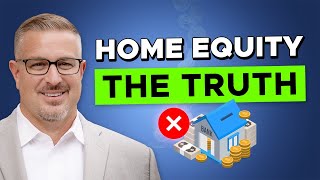
Jim Striker argues that paying off your mortgage fast is a mistake. Home equity earns nothing and sits locked up, while rich people like Elon Musk and LeBron James keep mortgages to invest cash elsewhere for higher returns. He shows how borrowing against your home instead of paying it down can build more wealth.
Chapters
Most Americans have over $200,000 or more in this account, and it could be costing them millions. In this video, I'm going to share with you what could be a huge financial mistake you could be making with a large chunk of your hard-earned money. Hi, my name is Jim Striker, and I help people recover at least $1 million that they are transferring away unknowingly and unnecessarily so I can help them recover those transferred dollars to solidify their retirement goals, all without impacting their current lifestyle or taking on any market risk. The money deposited in the account is not safe from loss of principal. Each contribution made to this account will result in less safety. The money in the account is not liquid and you must qualify to access it. The money in the account does not earn a rate of return at all. The income tax liability increases with each contribution to the account. And when this account is fully funded, there is no income paid out at all. Seriously, would you put any of your hard-earned money into this account? I bet you wouldn't. But sadly, most people are because this account is your home equity. You see, your home is not a great place to store hundreds of thousands of dollars. So let me explain just a teeny bit. This is the account that Dave Ramsey, Suze Orman, your mom, your dad, everybody tells us to pay off as quickly as possible because it's your mortgage, right? And so nobody teaches that you shouldn't pay off your mortgage and the reasons why. But why do people who have more than enough money— Elon Musk, Dave Ramsey, Suze Orman, LeBron James— all these people have more than enough money to pay off their mortgage? But they don't. And the reason they don't is because they have leverage. They love leverage. Home equity most of the time represents more than a mortgage being paid off. It's an asset that homeowners can borrow against to meet important financial needs, such as paying off high credit card debt, student loans, tuition, long-term care, and the list goes on. For example, if you have a $300,000 house and you have a mortgage balance of $150,000, then you have $150,000 of home equity sitting in the walls of your home that's not liquid, it's earning you no rate of return, is not doing anything for you. I would ask you, like, is paying down debt the same as making money? You'd be like, no, because paying down debt is actually paying down debt. Yeah. So you can't pay down debt to make money. No, only making money is making money. So why would you want to try and pay off a debt instead of making money? I know that sounds really confusing, but that's what people are doing. They're trying to get a 15-year mortgage and they're trying to pay their house off. And all of that money that they're putting towards their mortgage balance is not earning them any rate of return. That's why, you know, your income tax liability increases with each contribution. When your mortgage is fully paid off, there's no income paid out, right? So why would you not want to be saving your money instead of a vehicle that's not going to pay you anything when you're done versus an account that is going to pay you something when you're done, right? So is the goal to have a paid-off home in your life? No, you're not going to get an award for that. You're not taking that home to heaven with you. Means nothing. What you really want is where can I put my money that's going to be the most efficient for me to get to a place where I don't need to work and I can, quote, live the life that I want to live. And it's not going to be in the walls of your house. You go to your parents' house and you look in the drywall, there's not $100 bills in there anywhere, right? But old people think that's what you do. I'm sure most people still think, even in today's day and age, that paying off your home is a good idea. And it's one of the biggest mistakes that people make in their lives. Let's say you came to me and you said, hey, I have $500,000 in my right pocket, cash, and I want to buy a $500,000 house, so I don't need to take out a mortgage. I'd be like, okay, so you have $500,000 in your right pocket and you want to go buy a house. Perfect. So now take the money out of your right pocket and go buy the house. What do you own? A $500,000 house. Well, what if you did this? What if you came to me and said, well, what's the minimum amount of money I can buy that $500,000 house with? Well, let's just say that you put down $100,000. Okay, well, now guess what? You still get to buy the $500,000 house, but you also have $400,000 left in your pocket. So now you have $900,000 of assets working for you, not just $500,000. Yes, you have a payment on the $400,000 mortgage that you got, but you also have interest that you're able to make on the $400,000 you didn't put in the house. So would you rather have $900,000 of assets or would you rather have $500,000 of assets? The truth about home equity: homes are designed to house families, not store lazy, idle cash, often referred to as home equity. You know, your investments, those are designed to store cash. Your home isn't. Having too much home equity sitting in the drywall of your home could be costing you and your family hundreds of thousands of dollars of otherwise payable interest, opportunity cost, and liquidity. If you're someone who has any further questions regarding is paying down your mortgage the right opportunity for you in your short-term and long-term overall financial plan? Leave the comments below and I'll see you in the next video.