AI-Boosted Content Creation: A New Era for Entrepreneurs; with Raj Goodman-Anand
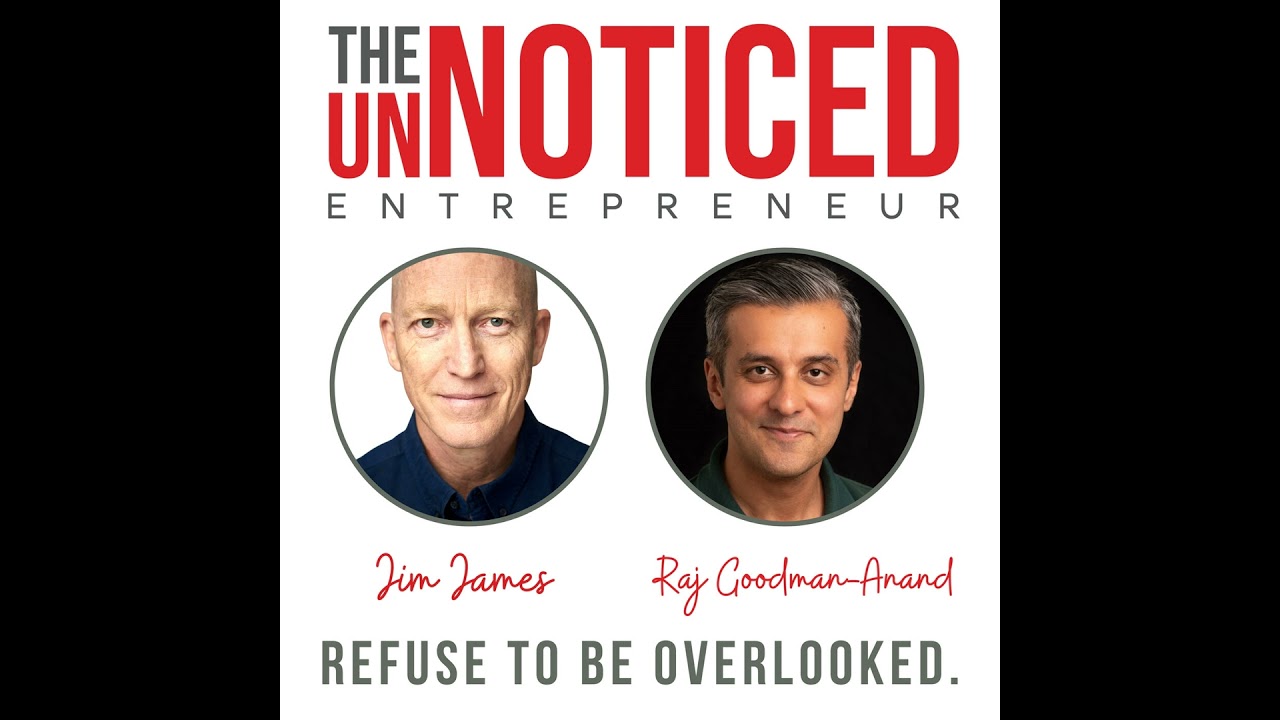
Raj Goodman-Anand, CEO of Goodman Lantern, explains how AI tools like ChatGPT and Midjourney help entrepreneurs create content faster, but warns that quality and human storytelling still beat volume. Google now ranks human-written content higher, and his firm uses AI for research while keeping human writers in control.
Chapters
Hello and welcome to this episode of The Unnoticed Entrepreneur with me here in the UK, Jim James. And today we're going to meet Raj Goodman-Anand, who's normally based in England but today is in Thailand, uh, and he's the founder and CEO of a company called Goodman Lantern. Raj, welcome to the show.
Hey Jim, thank you for having me. How you doing?
Uh, well, I'm well thanks, although I'm slightly jealous of you being in Thailand because such a beautiful, beautiful place. Um, But Raj, I'm delighted that you've come and taken the time to be with me on the mic, 'cause we're gonna talk about AI and content creation using AI. We're gonna talk about some of the trends, some of the tools, how we can avoid making some basic errors with AI. So it's very topical. So Raj, tell us, how can AI help the unnoticed entrepreneur to get noticed?
Yeah, great question there, Jim. And just gonna mention why I'm talking about AI. I was on a PhD at the University of Sussex doing research in AI, a lot of work in neural networks, which is now used quite a bit within things like ChatGPT. And sort of in the last 20 years, we've been working a lot in marketing, content marketing, especially the last 8, 9 years. So yeah, that's why I'm talking about AI and content. But well, I think We have just seen the power of AI. It's just a glimpse of it, tip of the iceberg with what AI can do, especially with what we typically call content creation or looking at opportunities within production of ideas into almost complete or almost ready thoughts. That could be in the form of writing, Images, animations, video, audio. So there's a lot of tools which have been created and already launched which can really help listeners to generate their own content. And it's fascinating because 2 years back, this was just a talk and today we're all using it.
Yeah, right. And I was interviewing some people a couple of years ago for The Unnoticed Entrepreneur, you know, just at the very beginning of the AI revolution. It's— and it really has become that. Where do we start, Raj? Should we first of all look at what is, if you like, the key aspect to look for when you're deciding to use AI-generated content for your business?
Well, I mean, what I'll say is that AI is broad enough to be used in a whole spectrum of industries and businesses. There isn't many businesses which you— in which you can't use AI. Just to give you an example, the other day I had an uncle who came over and he had an insurance problem and I helped him create and write emails back to the insurance company to argue his case. And I made him like get about $7,000 in the back of a couple of emails using the policy from the insurance website. And then looking at their replies and his replies, generate some really awesome emails all through ChatGPT and a bit of intervention from us. Wow.
So that's the, if you like, conflict resolution side, Raj. Do we want to look then at the different aspects of marketing? Content creation. What would you say would be some of the key tools that non-tech savvy entrepreneurs can use? Because, you know, some of these tools like Midjourney, you have to log into Discord and you have to give it a prompt. What are the accessible AI tools for my fellow unnoticed entrepreneurs?
So I guess the easiest one probably is, you know, people talk about every day now is ChatGPT. OpenAI, the company, has launched ChatGPT. And then obviously there's Bard, which is Google's response to OpenAI's ChatGPT. Both of them are known as the LLM or like large language model is it based on. And this basically is taking a lot of content online, driving through robots, it's called a black box robot, and then it can create answers and responses to remix your situation. into existing knowledge, which these black boxes have within them and help you create content. Now, this could be, we talked before, text, it could be images, videos. So we talked about Midjourney. It's a bit more complicated because you need to first kind of install it to Discord and then use it. But, you know, I say that could be used by anybody because The first step is hard. But once you have given— get a tutorial by someone who can explain this to you, the actual next step is very simple.
And there are some more sort of commercially available ones like NeuroFlash, for example, in Germany that have actually come on the show and talked about being able to put text to pictures. And of course, in Canva now, One of the apps that are installed in Canva is just a text-to-images. Um, the quality of the images are not as good as Midjourney, of course, uh, as far as I can tell. Raj, here's a question for you. If every entrepreneur is using ChatGPT to create blog articles, they're using invideo.io to create images and moving video. How does anyone look different? How can you differentiate yourself?
Well, that's the million-dollar question, isn't it, Jim? As we get lots of people using these tools, we will have an array of content coming in. Suddenly, when production has gone 10x or 100x, And then how do we really differentiate the real thought leaders, the real companies versus the ones who are faking it or not there yet, for example? And there's an element of that in entrepreneurship to effectively make it. But at the end of the day, when we consume content, when we look through the— open our televisions and we see tons of channels, we watch one channel at one time. As a human mind can only focus on one thing at one time, we need to narrow it down. That analogy can be taken also to content as well produced by AI. So what I'm trying to say with that is that in the coming years, we'll have more content produced, but people and companies who have real thought leadership or real sort of biases towards content, which makes it stand out, which adds real value for the end user, will win. And it's about that all the time. I think the quality of content will always matter more than the quantity of content. So it's not about 5 or 10 pieces of content. It's about that very high-value content.
Roger, that's a really great point about the need for quality. Over quantity, because a lot of the tools that we're seeing now are really about generating volume, as if volume in itself was worth having. Raj, how are the search engines going to start to treat this really sort of torrent of content that's being generated? And you can now, through platforms like Zapier, just of course automate the posting and some of these other tools like Buffer, for example, you can really sort of, you know, set it and forget it, can't you? Right. So how will the search engines cope with this flood of content?
Well, 2 answers there for you, Jim. One is that try an experiment with ChatGPT. Try entering one piece of content, which is thought leadership content, which is really high value. And one which is not, and ask it to then give it ranking based on uniqueness and thought leadership. And that is a great way to see how does OpenAI, ChatGPT, or Bard look at content itself. Because these are the future search engines we're going to start using. We start to kind of search the next company, entrepreneur you're going to work with via these tools as well. These are the next version of search engines, right? That's one thing. So these tools understand which is unique content and which is not. It can tell you straight away and give you ranks based on the content itself. So we can't fool these anymore. You know, there was a time when we could kind of almost get away with keyword stuffing in search engines. that era has gone and it's in the past. These are smarter models. You can understand things much better. That's one.
So Raj, when you say it can understand the difference, to the layman, with you, with your PhD, nearly PhD, but you've got a lot further in this than I ever have got, how does it understand the difference? Because by knowing that, we can determine Whether, you know, do we need to write things ourselves or make videos ourselves? And then we're kind of back to square one. Or is it that there's a halfway house somehow?
Well, I think it's worth understanding how these language models actually work. So these language models cannot, they don't really understand the whole context as such. It understands, it just knows the next word is going to write, for example, but it basically has built itself a pattern based on the data which was fed into it to build this program in the first place. So it has, first of all, all a kind of a database. It's not really a database, but it's a kind of database in its mind, in the tool. That's one. Number 2, it has a pattern recognition system in it. So it can recognize what's unique and what's not unique. And that is, it can then tell you, for example, if the content you produce is unique or not, and if it's high value or not based on patterns it's matching across inside. No one really understands how it actually works because unlike a regular program, AI is not a program. It is trying to mimic the human mind. And the human mind itself is unknown, so you can't really understand OpenAI and ChatGPT as well, fully.
I see, right. So in a way, perhaps like the human mind goes, oh, that's an interesting idea, or that's a new idea, or it says, well, I've kind of heard that before, I've watched that movie and it's like another one, right? We have a natural intuition about what's genuine and unique and what is kind of repetition. And then, so you've mentioned a tool, before we started recording called ChatGPT-0 or GPT-0. Tell us, what is that? Because we haven't heard much about that. And what role is that going to play?
So GPT-0 is sort of a small program which can understand and tell you if that content created is done by ChatGPT-3, 4, Bard, AI only, AI and human beings, it can detect that. Now, what's interesting is that they're not the only one who can detect that content creation. I'm sure so can Google and Bing and other search engines. Why is that interesting? Well, we earlier spoke about how we can produce hundreds of pieces of content very quickly automated through Zapier or through Buffer, for example. In comes these detection software, which can tell you how much of that content is human, how much is AI. And famously, Google loves to change the algorithms regularly. There used to be a clause in Google's T&Cs or the small print that AI content is not permitted on this site. They took it off recently. It won't come back again. And they can start to rank human content higher than AI content because it shows thought leadership and it shows effort and it shows real talent. So my point simply being, it's not about going full throttle on AI. It's about going fast and going slow at the same time, really understanding what actually works, what's really human-centric, what actually adds value for the end user, customer, prospect customer. That's what we should be actually focusing on as opposed to the hype in AI or what AI can do for us.
Interesting, Raj. And you've got on your website about content mills, and but actually you've got native English writers that you're talking about for your business. Do you want to just tell us how you're getting your own business, Goodman Lantern, recognized? Because you are also an entrepreneur, you've got experience with EO as well as membership chair, but Tell us a little bit about your business and how you're getting that noticed.
Yeah. If you look at our website, goodmanlondon.com, it's content by humans for humans. And it's super important that that's still followed by us is because at the end of the day, we aren't talking to machines. We're talking to human beings who have emotions, who like a creative mindset. And so So how do we use AI? We use AI in the beginning, the research part for some of our content, but then the actual production of the content happens through real human beings putting in real hours and then edited by, again, real human beings as well. It's super important to do it that way because it's clear and obvious that certainly working with large companies that they really care about human-centered content that adds value to the end users. And so does Google. We've seen that even now Google ranks like human-centered content better than AI content. And it's not because AI content is bad. It's when AI content has been developed without actual thought put into it, having a unique angle to it, having some real value creation at the end of it.
I love that. I think that's fantastic. And it's essentially a positive message, isn't it? you know, humans eventually will be rewarded for contributing genuine and authentic content to the marketplace. Now, one obvious point here, Raj, is that you talk about 80% of your company are women. It even says here that the future is female. Should I be worried as a male? Am I going to be, you know, made redundant both by AI and the better half of our population? What's the strategy there?
Well, it's less of a strategy, more of a goal and a mission which we have. And this might be looked at in 2 different ways. One thing is that what powers entrepreneurs to be the best version of themselves every day? When I wake up every morning, I'm thinking about how can I create more jobs for women around the world, especially in technology and marketing, because I'm an engineer. And in my sort of schooling, I saw there were more women, and then they kind of dropped out of university in engineering, and then there's pretty much hardly any coming into the workforce. And that's a problem for me. So I want to solve that problem. The other way of looking at this is having a mission like TOMS Shoes, for example, or having a mission like Patagonia, for example, makes the company stand out. What drives them is more than just money. And that's actually a very powerful message in the marketing of a company as well. So, you know, this is, but having it genuine, people can smell BS and you can smell bluff. So if it's something that you believe in, I recommend it's a good part, important part of the marketing.
Okay, Raj, I love that. And You've been running your own businesses for, you know, for many, many years. Is there something that you've seen doesn't work, something you've tried as an entrepreneur that you've, you know, from a getting noticed perspective that you've had to try and then walk back from?
Well, I mean, there are tons I can talk about. I think the one thing which I would say works, and this probably is across all parts of business, is delegation. Elevation. And that's an important part. So there's a time we began the businesses where I would do everything. I'll do the marketing, the sales, I'll do the strategy, the execution, the operations. And realized actually that was, I was good at nothing really. I was like, you know, penny wise, pound foolish. And the day I decided to delegate the work to team members, having a team structure, know, getting my team to kind of work on, um, different parts by elevating them in their roles. That's when I saw business actually start growing dramatically. Right.
And, and what was the implication of that from a communications point of view? Did you step back from being, if you like, at the front of the brand, for example?
Well, I think from— I mean, the focus changed from actually looking at working in the business to on the business. So I'm actually involved more on the strategy part and to be a bit of a face. But I would say the delivery part of it, I'm completely out of it. I don't do any delivery. I bring in smarter people. Probably, you know, I feel like if I don't bring in smarter people than myself, then I'm doing something wrong. So I bring in the smartest people possible in different roles, as it were.
Right. And I see that under the Goodman Lantern, for example, that you're not front stage on the website. For example, right? So you've managed to detach yourself from the brand, although your name of course is cleverly embedded in the company name. Raj, if there's one piece of advice from a getting noticed perspective, um, that you'd give my fellow unnoticed entrepreneurs with all of your experience both with tech and as an entrepreneur, what would that be?
Well, I think The one thing I learned, and this is experience share, which is, you know, there are multiple ways to grow in marketing. It could be outbound marketing, inbound marketing, it could be, you know, video marketing, TikTok marketing. Instead of going after all of these things, start with one and really embed that into the strategy first is what I've learned. So for example, for us as SEO, we are an inbound marketing company. And so we use that for us. It works really well. Once we have perfected that, now we, you know, then we are embarking on different strategies and have been growing in other parts as well. But really honing into one strategy and getting it right is my recommendation based on my experience working in the space.
Raj, I think that's great advice. And it's so interesting, of course, hearing you say experience share. That's an EO phrase coming back. Fantastic. Very fond of EO myself. So Raj Goodman Anand, you're You're in Thailand today, but you're normally in the UK. How can people get hold of you?
You can find me on LinkedIn. I'm Raj Kudman Anand on LinkedIn, or you can find me on Twitter. I'm just starting to really get into Twitter more and more so. So it's Raj Anand on Twitter.
Raj Anand, thank you so much for joining me today on the Unnoticed Entrepreneur Show.
Thank you, Jim, for having me. Absolute pleasure.
Well, it's been a pleasure, hasn't it? And illuminating. And I feel much more educated now about AI and reassured as well by Raj that actually our own authentic content will hold its own, and we're not going to be buried by the avalanche of AI content, as the search engines will prioritize human-centered content over machine-generated content. Hope you've also found this interesting, and if you have, please do share it with a fellow unnoticed entrepreneur. Rate the show if you can on your player, really helps. And until we meet again, I just encourage you to keep on communicating, and thanks again for listening.
More from Jim











2 people, infinite agents, 1 billion dollar idea #AIAgents #Startup #Productivity