Brad Sugars: Leverage AI for Exponential Business Growth
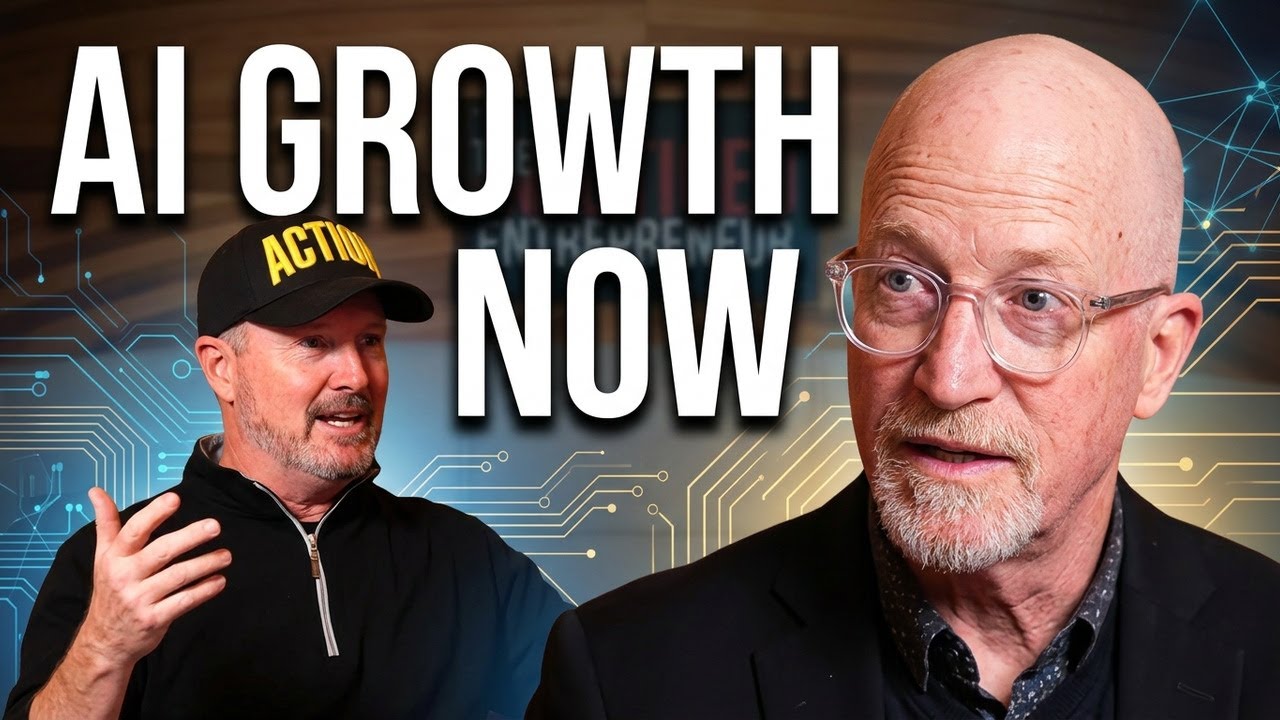
Brad Sugars argues AI shifts us from the information age to the intelligence age, where machines interpret data and act on it. Start by experimenting with ChatGPT, Copilot, and Claude, then adopt AI-enabled accounting software and embed it into team habits. He predicts a 40-hour workweek could compress to 20 hours, and outlines a $500 startup idea: an AI-driven financial consultancy built entirely by AI.
Chapters
AI is waking people up to say, I need to take action.
If you are alarmed about AI, you are thinking that maybe it's going too fast for you, or you've been missing out already, or you're trying to catch up, then this interview with Brad Sugars is for you because Brad Sugars is the world's leading business coach. He's run ActionCOACH for over 30 years, and Brad answers some key questions about whether it's too late, how to get started with AI and what it means for you and your business as an entrepreneur, and also what he would do if he had $500 and had to start all over again. So Brad, with AI, tell us a little bit about AI for you and when did you first encounter it? What made you think, aha, AI is gonna be pretty big?
Yeah, it's interesting that we now call it AI, but Google's been AI for 20 years. The algorithm that Google goes and does its searches is artificial intelligence. It's an algorithm that searches data. But when we look at what AI is becoming now, the speed with which there is adoption is a lot slower than most people think it is. The average business owner is still struggling to update their Instagram properly, and yet we're looking at AI. Now we've got about 80% of businesses saying they're using AI. There's only 1% to between 1 and 3% that are saying they're using it at a high level type thing. So we've still got time is the first thing that I think people need to understand. I've been playing with the AI programs now for several years.
Yeah.
When people understand we've moved from the information age into the intelligence age, I think that's where they start to get it. Because in the information age, it's all about getting information. In the intelligence age, it's interpreting that information. And there's too much information today for one person to be able to do it. Like, you take a CMO of a business, right? So marketing, CMO, How would a CMO today read all of the analytics and all of the understandings of their website, their social, their HubSpot, like everything to be able to read that every day or every week is almost impossible. Now to connect it all into the best one today is probably Computer over on Perplexity to connect it all up to that and have it give you an analysis and then go and fix things for you. You know, that is one of the fastest ways to understand that, take in all the information AI can, and it can process it for us.
And I think what we're also seeing is the move from information to the agente, where it's doing the tasks with the information, right? So we've got the trend of having all the information on a dashboard, and now Claude or Perplexity or Manus is able to take the information, actually do things, like with Claude Cowork, for example. When you say 1%, companies are really only implementing at a very fractional level. Where do you think entrepreneurs and business owners should start, Brad? Because for many entrepreneurs, I think they're just overwhelmed, right, by the bombardment of do this, do that. Where do you advise them to start?
Anything new, the idea is you start playing with it first. You don't start using it first, you start playing with it. So play with ChatGPT, play with Copilot, start having it write something for you. Just do the basic things. The problem with most of it though is that it's reactive, meaning you've gotta ask it to do something type thing. As you said, now we're getting to a phase where it will suggest to you what needs doing type thing. So for example, our coaching app, it's not waiting for you to say, hey Brad, what should I do today? It'll come to you and say, hey, here's 3 things you should be thinking about based on. And so once you've connected it to your accounting or your sales or whatever it is, it will give you suggestions. proactively. But the average business should be thinking about 3 things. Number one, are the companies you are having do work for you using AI? So for example, if I've got a marketing agency, are they having people do the work or are they having AI do the work? Because if they're having people doing the work, it's costing me 5 to 10 times as much as it would if AI was doing it, sort of thing. So you think of AI as People got used to the idea of having virtual assistants that lived in other countries, so it was much cheaper type thing. Well, AI is the ultimate virtual assistant, but you've got to be able to direct your virtual assistant to be able to do. Now, soon you won't have to direct it, it'll direct you.
Yeah.
So that's the first thing. Are the agencies and companies you're using using AI? Second, is the software you're using AI-enabled? If your accounting software isn't AI-enabled, then you've got to start upgrading to an AI-enabled software so it can do the thinking for you. Okay. And third is get your team using it. So for example, if I'm sitting in a board meeting with my team, historically we'd say no computers. Today we're like, have your laptop in there and any idea you have, I want it in ChatGPT or in whichever format you're using. I want it in there within 10 seconds of the idea. and you getting it because like I show the average business owner, go to ChatGPT and say, ChatGPT, write me a prompt to do a SWOT analysis of my business. And this is the first lesson for everybody. Don't ever write the prompt yourself. Ask it to write the prompt because your prompt will be like 2 lines. You ask it to write a prompt to do a SWOT analysis of your business. It'll write a 50 to 100 line prompt. Copy it, paste it back into a new chat and boom, away you go. But I get them to do a SWOT analysis of their business and within about 10 minutes they're just blown away because a full SWOT analysis, you'll hit deep research or use the full capability. So yes, you need a subscription for that. And I don't get any benefit from any of them. I like Perplexity simply because it has great teams capability. Computer is phenomenal and it's one subscription for all subscriptions. I think that's where we should be starting.
Okay. So we do some playing and I think, as you say, we're also seeing the The existing legacy architecture. Talk about perplexity with the Microsoft ecosystem. So you've got to get your legacy systems working with whichever AI architecture you want to use. You mentioned about letting the AI start to do some work for you. What about some of the security issues? Because you can be training, especially if it's an open, an open platform, you can be training the LLM on your own.
Mm-hmm.
Content, right? Your own data.
So, well, some of it you do want to train it on your own data because you want people to be able to find you too, remember?
Yeah.
Because as an answer engine, people are using it like they use Google because that's what they're used to doing. So they'll go to ChatGPT and say, what's the best podcast for me to listen to on how to grow my business type thing? And it'll give it a few suggestions. So you definitely want it to be able to find you in that way. And anyone that tells you SEO is dead is completely incorrect because what does the LLM do to go and find you? It still has to search the archives, which is still the Google or Bing architecture type thing. So we've still got to have that. Let's be blunt about the change in the world, Jim. When I started in business 30 years ago, I met Mike Bash. He was founding vice president of Federal Express. And he said to me, Brad, 80% of business is system— is systemic, meaning 80% of business is routine. You're doing the same job day in, day out. So build a system for it, checklists, systems, et cetera. And he said, 20% of business is humanized, so make sure you train your team well to handle the 20% that needs human interaction. We're going to 80% will be computers and robots. Now we're at about 40 to 50% of business is computers and robots today. If you just look at the car manufacturing industry as a simple example, cell phone manufacturing, it's— no, there's 5 humans and 1,000 bloody robots doing the whole thing, sort of thing. So we've got to understand that that's where we're moving. Now, 100 years ago to this year, Henry Ford changed us in from the 12 hours a day, like sunup to sundown, 6 days a week. You had the Sabbath. He moved us to a 40-hour workweek and he started paying his wages much higher than anyone else did. And everyone thought he's crazy. Business is going to go crazy. You can't possibly do that. My prediction is we're going to move to approximately a 20-hour workweek in the next 10 years. Now people will say, oh, you can't possibly do that. Yes, you can, because your people are doing 5 to 10 times as much if they're actually using AI than they did before. And then your company will not be necessary. We will have, Jim, I'll make a prediction. We will have a $1 billion a year company with one employee. We will have that in the next 10 years.
I've heard there's a couple of brothers that have got a billion dollar business. And so it's completely doable and it's happening now.
Yeah, you'll have agencies and outsource stuff, but you won't need more than one employee to have a billion-dollar company with the way the world is moving. So these are some of the things that we've got to be understanding. The labor force— and this is a massive shift in the world— you're moving from the old business model of labor being what you sold. So you hired someone and you sold them out at a higher rate than you hired them type thing. Well, now it's about capital. So how does the capital be worked? So it's instead of just having people working for you, now your money working for you is going to be much more of a thing. So there is some massive shifts happening. And I think a lot of people are still stuck in the current thinking type thing.
Yeah.
And it's hard to get out of current thinking if you're a small business owner. And you are facing problems like, well, the economy shifted and I've now gotta change this immediately type thing. And that's where a business on the back foot is gonna find it hard to take advantage of AI because they're on the back foot.
Yeah. But I think there's a couple of questions in there. One is first of all about the legacy workforce. 'Cause Brad, you talk about that if it's going down to a 20-hour work week, those people will probably be more productive than the 40-hour 'cause we are now getting—
Correct.
Superpower, right?
A 20-hour work week's gonna equal an 80 to 100-hour work week.
Yeah. Yeah. I think of it like the Shadouk, the Egyptian water lifter. One person has now 10x the power using AI. What do you do in terms of helping the company to bring the team along? Because there are going to be some winners and some losers in the workforce as well.
Well, there's going to be changes in the workforce. I don't see that there's going to be losers in it because the workforce just changes. When we invented dishwashing machines, Jim, Instead of having 3 people washing dishes in my restaurant, now we have 1 machine. Change happens. And we can go back to dishwashing machines. We can go back to a fishing net versus a fishing pole when the first net was introduced.
Yeah.
So all of these introductions change the workforce. So for example, 20 years ago, you wouldn't have paid someone to walk your dog for you. Now people pay people to come and pick up the dog poop, for goodness' sake. I mean, these are the changes in the world of work. You wouldn't have 30 years ago paid someone to walk you. Nowadays people get a personal trainer and they go, oh, it's my trainer. No, it's not. It's your paid friend. We know that, you know. But the reality of what's going on is that the work will shift.
Yeah.
When you were a boy, Jim, how often did you go out to a restaurant for dinner? Almost never. Now people will eat out 3 to 5 nights a week. I know some people, they eat out for breakfast, lunch, and dinner every day of their life. It's crazy the way that We think this change is destructive.
Yeah.
If we look back at, I'm pretty sure 54 now, I've seen at least a dozen things in my life where they've said, oh, it's the end of the world. Oh, it's, you know, Y2K. Oh, 2020, 2012, the Mayan calendar. Everything's ending. AI, it's the end of the world. You know what it is? It's another change.
You're absolutely right. I think the sea change here is that with the agentic AI, where it's actually going off and doing the tasks. I just started using some platforms for image and video content creation, right? So you type in a prompt or you upload an image and it makes a movie for you, right? So there's a whole class of people that either have to change the kind of work they do or the tools they use.
The people that have been in that work have to start using AI and be better at it because let me be blunt, you using that tool will be nowhere near as good as a guy or a gal that's been in the movie industry for 20 years using that same tool. Their eye, their knowledge, their skills using that tool will be much better. But again, like even simple, my audiobooks, I used to have to go and sit in a studio for 2 days to create my audiobooks. Today I press a button and there's my audiobook done. It's created sort of thing. I've created 5 audiobooks in the last 2 weeks.
And you were prolific before AI. So, but then the message has to be as well for any business owner, Is that AI is an opportunity as much as it is a threat, right? You talk about it within ActionCOACH. What about for your coaching and how are you using it within the company for client service, for example, and helping your client base?
Well, so let's be blunt. If you have a bad system, AI will not make a bad system good. If you have a bad product, AI won't make a bad product good. If you have bad service, AI will not make bad service good. So let's be clear on that one first. You must have a good product, good system of delivery, good service. You must have all of those things to start with.
Yeah.
AI then multiplies that. You know how marketing is a multiplier? Social media became a multiplier for business. Well, AI is a multiplier of what already exists. So my coaches will be able to, using AI, be far more effective with their clients. So they'll get clients results faster, but they'll be able to handle more clients because the AI will do a lot of the thinking work Right. But even the simple one of the day-to-day AI coach. So imagine, Jim, if in your company Coach Brad called your team every day at the end of the day and asked them, what did you get done today? How did you go? What were your scores for today? What are you doing tomorrow? What's gonna happen tomorrow? So AI Coach Brad interviews every one of your team for 10 minutes at the end of the day every day and then creates a log Or a report back to you saying, here's how your company did today. Now you think of how much more effective that makes coaching and how much more effective that makes your managers, your leaders.
And even now you can use, for example, with Claude Cowork, I've created a schedule that reviews all my emails each morning and tells me what I need to do, and it can review them at the end of the day and see whether I've done them or not. So it really becomes, to your point about the billion-dollar company, you're liberating your coaches then to focus on the people time. Presumably as well with the clients.
You know, because there are certain aspects of coaching that will never be replaced by AI.
Okay. Like which ones, Brad? So tell me, tell me, see the work being for people.
When I'm sitting here with you, Jim, coaching you and your business, and I notice the way you say something and I start to talk to you about, well, hang on, you said that this way. Why is that? What's going on there? Let's get into the detail nature of that. Having that human-to-human conversation, it's like going to a concert versus listening to the music on your iPod.
Right, right.
It's an experiential thing. And this is why, say for example, Louis Vuitton stores are full right now, but stores selling basic products are empty. Not empty, but less full than they used to be because I would rather click a button to get a regular product. But the experience of going to a Louis Vuitton store, the experience of going to a concert, So we will always crave the experience as humans.
Yeah. And that's what Thomas Pine talks about in The Experience Economy, right? They talk about as we start to have more and more time, disposable time and more disposable income, we'll move towards experience economy businesses as well.
Well, I just invested in longevity businesses back in my home in Las Vegas for one simple reason. Health will become a far greater priority for the human race in the next 5 to 10 years than it's ever been. Because we will have more time. So people will want to work out, they'll want to get some exercise in, they'll want to take care of their mental health more. All of these things when you're working less hours. I know my second eldest daughter has just gone to a full-time job from college, going to full-time job. And her biggest complaint is that she can't go to the gym at her 11 o'clock class time sort of thing. I hate it. And I say, well, this is the challenge of the 40-hour workweek. Well, once we move to a different workweek and You know, this is also part of, if you go back, COVID virtualized us by about 7 years. So we moved 7 years ahead. And I use the number 7 because Amazon said that their package numbers they did were 7 years in advance on their predictions. So that sort of said that we moved 7 years in 1 year. Well, if we look at what AI is doing and the speed with which it's moving us— You just look at the human health aspect of this. Once, once AI actually has access to all of the world's data on cancer, it's gonna solve it. But you've got all of these universities and pharmacy companies that all have that data hidden away.
Yeah.
Imagine if all of that data was in one place. Look, Jim, what, what we look at today is people that have massive goals are changing the world at a, at a rapid rate of knots. JFK did it by saying, we choose to go to the moon, not because it's the easiest of things, because it's the hardest of things. And that led to GPS systems, it led to microcomputers. There's so many things that came because he set the goal of going to the moon. We sit here today with Elon being the, the crazy man of the day saying, I want to colonize Mars. And everyone says, well, Elon, you can't do that. He says, why not? They said, well, you'll need better spaceships, you'll need better communication systems, you'll need better batteries, you'll need better tunneling, you'll need robots, you'll need all these things.
Yeah.
All these things are being invented because of the crazy goals of one man. But this is where I think that anyone who sits there in their life today and says, well, it's too late, or I'm too early, or I'm too young or too old or too this, this is a reset for you.
Okay.
This is a reset saying, I don't care where you're at right now. If you put yourself in the next 30, 60, 90 days, learn AI. Just go and play with 10 different programs. Go and play on it, learn it over the next 90 days. You will come up with ideas for businesses and things that can be solved using AI that'll just blow you away. Everyone has the ability right now with AI, a laptop, not even a laptop, a phone for goodness sake. It's better on a laptop, obviously, but you can create whatever you want today. The game has been reset and even if you're behind, you can catch up based on AI and helping you out.
It's a fundamentally optimistic picture from you, really, that AI is gonna be creating new opportunities, creating more time for people to do things that will be more rewarding for them. It'll create new categories of business. Where do you see the dangers, if you like, just as a cursory note, where do you see the dangers maybe for businesses and entrepreneurs?
Yeah, it's interesting, Jim, 'cause I'm not hardwired to look for dangers.
No, I know you're not.
That's why I ask that question. I'm hardwired to look for opportunity.
And I love that, but I'm also mindful that for all these people who are going, yeah, but—
Danger number one is that you don't even bother, right? I know people that said, well, I'm not going to bother to learn social media. Well, that's just dumb. I'm not going to bother learning AI. Well, that's just dumb. We're going to live a lot longer now because again, AI is helping all the solutions for health. You've got to do it. So danger number one is that you don't get into it. Now, danger number two, the Terminator. The whole world's going to be robots. They're going to take over. Listen, I've already ordered my first robot to be in the house. I think they'll be phenomenal to get it. cleaning or gardening or doing something for me, that sort of stuff. That'll be phenomenal. But if you look at where guys like Sam Altman— now they're much better at this than I am, right? There's the OpenAI guy and they look at what they're programming into the system and that it's already proven by different examples that Claude will overwrite stuff. So Anthropic sit there going, what is that? How did that work? How did that happen?
Yeah.
Look, they also told me that Y2K planes were going to fall out of the sky, and they also told me, and they also told me. So no, I'm not, I'm not hardwired to look for the road crash. I'm hardwired to look for the sunset.
Yeah, which is great. And that, look, that's a great message because there are a lot of people who are saying maybe take the ostrich approach, which is— I think I'll wait.
You take the ostrich approach, you know where your butt is, that's for sure.
You've got to be in the air and the sand will definitely come right over you.
But here's the thing, We as humans naturally find a way to go through and overcome all challenges. We naturally do. Like when I, I was born in 1971, that was when the Club of Rome predicted that we would run out of oil in 90 years. And you sit back and you look at how much oil we have today, and we've still got 500-odd years worth. Yeah.
Yeah.
Because usage is down and all those sorts of things, Jim. So I believe that if you allow the If you're one of those people that allows the one reason not to do something to be stronger than the 9 or 10 reasons to do it, then fantastic. But you'll fall by the wayside.
Right.
The way the world works is the same as a tree. You're either growing or you're dying. And people go, no, I'm going to be in status quo. If you're in status quo, the weeds are growing around you. You know, the market is going to beat you. So you're either taking advantage of this opportunity or you're going to get beat by it. And it's not by AI. You're going to get beat by your competitor who's using AI.
And that's the key thing, isn't it? You're going to be beaten by the people who are picking up and carrying it. With what you're doing with ActionCOACH, and you've got the coaches being augmented with AI but not replaced with AI, are you seeing a new category of client, of company that's coming to ActionCOACH that's AI-centered, that's facing different kind of problems?
You know, I think when we look at the customers that are coming to us as ActionCOACH, there's 3 groups of them right now. There's the baby boomers who want to sell, so they need to fix their business to be exiting, right? And that's 30 to 40% of business owners are in that category of wanting to exit. You're going to have an exit from your business, either negative, you kill it, it kills you, or positive, a passive exit or a financial exit type thing. So of course we set them up for the passive and financial exit. So that's the first category of person. The second category of person that's coming to us is the one that wants to take advantage of opportunities that are out there. They see the opportunities and they say, I need a team to help me get through this. I don't, I don't think I can do it on my own. I need outside coaching or outside advice or outside help to get there.
Yeah.
And then your third group is really the group that is saying, I'm panicking, and they leave it till it's too late. In some cases, and they're in panic mode. And fortunately or unfortunately, AI is waking people up to say, "I need to take action." COVID did it with so many businesses. We look at the economic situation right now with oil prices and all of those sorts of things. It wakes a lot of businesses up to say, "Dang!" And if you wait till there's a negative in the economy or a negative in the marketplace, then. Dang, don't wait till you get disrupted. Be the disruptor. And that's what AI will help you do.
One final question for you, Brad. Imagine that you didn't have ActionCOACH, didn't have this amazing business, and you were starting out and you had $500 and AI was here. What business would you be setting up and building, do you think?
I would, given my, given my knowledge, I would probably set up an AI CFO. So an AI business that would help you analyze your numbers in your business, probably an AI CMO. And I could probably do that in about 10 minutes flat. And because I'd have AI build it all for me.
Right.
And I could do it as an app and I can do it as a consulting service. So I would then have AI call companies and email companies to offer my services to them and have them book in a phone call. I'd have AI build the videos and the website for me. That would allow me to promote those services to people. Build an AI, I'd have AI build me an app that allowed them to score themselves currently and give them some basic knowledge. And then when they're ready, they would sign up for the subscription-based service because the best businesses are always repeat businesses. So subscription membership, retainer-based businesses, that's what I'd do. So yeah, I would have AI do majority of the work.
Nice.
And the last thing I would say is I'd make it so that my business could be global. I'd have AI put it into the top 15 languages for me. So I'd have it running in China, India. I'd have it running in all of the biggest economies in the world very fast. So yeah, it'd probably take a week, maybe 2 to get that done.
So Brad Sugars, it sounds like AI is not gonna slow you down. Thank you so much for sharing your thoughts with me today.
More from Jim











2 people, infinite agents, 1 billion dollar idea #AIAgents #Startup #Productivity