Brand Stories That Reel in Your Audience
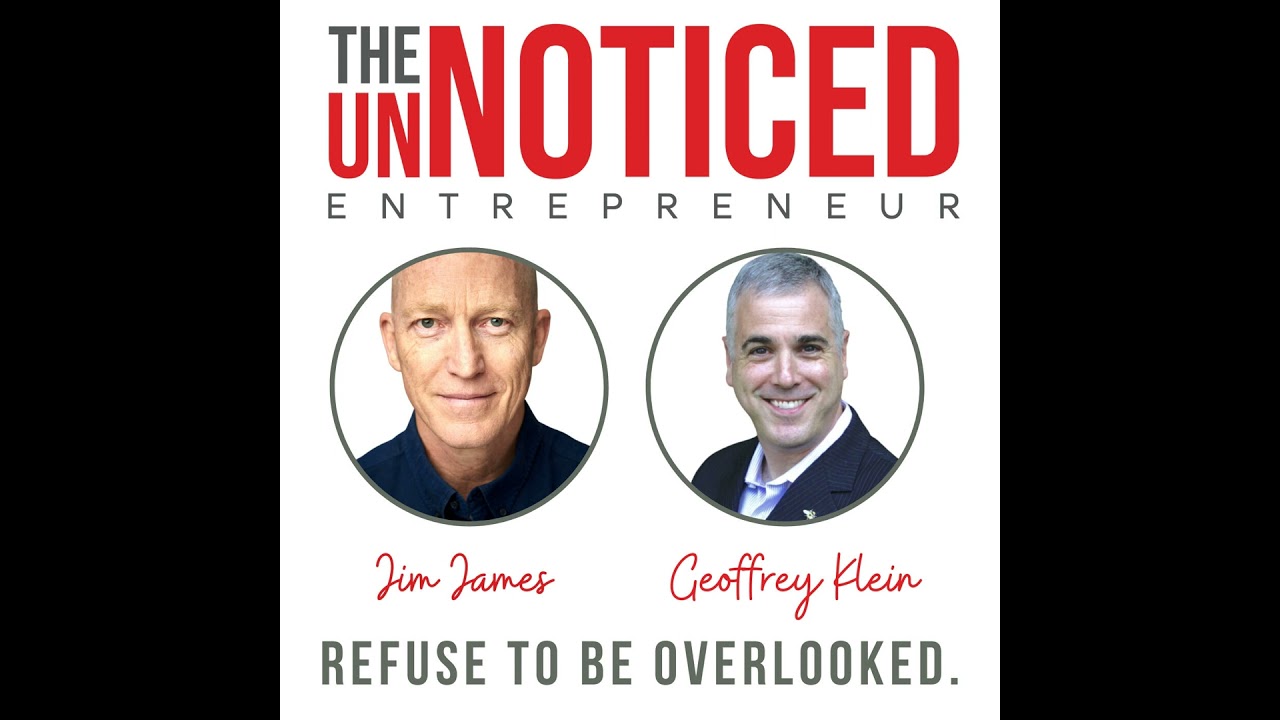
In this episode of The Unnoticed Entrepreneur, host Jim James interviews Jeffrey Klein, president of Nine Dots and author of The Content Beast. The conversation explores how entrepreneurs should craft brand stories, emphasizing the importance of being relatable over merely credible. Klein introduces his "11th commandment" – know thy audience – and explains how deep audience research (demographics and psychographics) drives effective storytelling. He argues visual content (animation, video) outperforms text and audio because the brain processes images faster and retains them longer, and he offers tactics for converting podcast listeners into visual content consumers. The discussion contrasts vanity metrics (followers) with meaningful engagement (true fans) and highlights the need for content that delivers value. Klein delves into the rise of generative AI, presenting a "human bookends" framework where humans craft prompts and edit AI output to maintain brand voice and accuracy. He recommends specific AI tools (ChatGPT, Stable Diffusion, DALL‑E, Synthesia, Lumen5, VEED) and stresses the importance of prompt engineering and fact‑checking. Klein shares a personal marketing mistake – saying yes to too many projects – and advises entrepreneurs to focus, collaborate with good partners, and experiment with data‑driven content. The episode concludes with a free 21‑Day Content Marketing Playbook giveaway, plus Klein’s recommended resources: The Marketing AI Show podcast and Profit First by Mike Michalowicz.
Chapters
And welcome to this episode of The Unnoticed Entrepreneur with me, Jim James. Today we're going to Villanova in Philadelphia to meet Jeffrey Klein, who is the author of a book called The Content Beast. Jeffrey, welcome to the show.
Thank you very much for having me, Jim. Appreciate it.
Well, I'm delighted that you're here because not only are you a beast around content, but you're going to help us to understand which is more important. Is it to be relatable or credible when you tell a story. You're also going to help us to understand what kind of story we need to be telling our audiences, because if anyone's got a problem deciding which story they should be telling and how they should be telling that story, this episode's going to really help them, I think. So, Geoffrey, let's start. First of all, there's this theory that you need to tell your own story as an entrepreneur, and the company has to tell its own story. Is that right or is that wrong?
It's right and wrong. So, yes, I think it's really important for people to understand what you care about. People, more and more, they want to understand that a company has a soul, you know, that there's something to them beyond the faceless corporate machine of trying to make money. And sort of that origin story that a lot of people will tell is that's its goal is to basically make sure that people go, I want to do business with that business. I want to understand that they actually— so it's an emotional appeal why you should be interested in having business with us. And I think the trick of those stories is to understand that you have in that story show that you care about your audience. So, you know, a lot of times we talk about the, you know, starting with your why. I'm a big fan of Simon Sinek. And I think usually when you have a why that's powerful, that's why a lot of businesses start, because they saw a problem they wanted to help with. And so in an ideal way, your origin story would not just showcase who you are and what you do, but why you do it and why people should care. And it's often, you know, I forget that it's people don't want to know, people don't care about what you know until they know you care.
Yeah.
Which I think is a super important concept in business, believe it or not.
And Geoffrey, you've got your own business, Nine Dots. So, I know I jumped into the first question to get you warmed up. And Geoffrey, just for anyone that doesn't know, actually spent 10 years in Manchester, so probably might have needed a bit of warming up. But he has married a Mancunian woman who he's taken back to America, exported some of the best of Manchester with him. But tell us about Nine Dots then and what you do there as, I think, know, a creative working in visual and visual storytelling, Jeffrey?
My goal, I believe, is to help people tell their story. That's kind of my idea. And the reason is I think as human beings, we're all trying to communicate more effectively. And I believe that the best way to communicate that is by telling a story and that the best way to actually tell a story is visually. So we produce animation and videos for businesses so that they can Try and connect with their audience to grow their business. And we often start with when you talk about the origin story versus the kind of conversion story. The first question I ask any audience, sorry, any client, anyone who's going to look to create something is who's your audience? In my book, I talk about the 11th commandment: know thy audience. Because if you're telling a story and it doesn't matter to the person you're trying to reach, then it's just you know. a waste of time. So it's always about, you know, visualizing your story in a way that's going to matter to your audience that you're trying to reach.
Jeffrey, on your website you have some fabulous animations, so plainly you've been busy, uh, with Toonly or one of the tools like that you've been making. Um, why is video and visual, in your view, more important than, than text or even audio? As we're doing a podcast.
Yeah, well, one of the things I would say is that, yeah, I'm a writer, so, and I always have believed in the power of words. And so I think when people hear, oh, I do visual storytelling, that means I don't care about words, and that's not the case. I actually think it's, you know, when you're crafting the best movie in the world, you need to start with a script or the concept. And so I think that's still true. But that being said, the best way to engage with an audience And a lot of statistics is by telling something visual. You know, we process, you know, the brain processes visual communication 60,000 times faster than text.
Sure.
So, and there's a million other reasons why, but we, you know, we can understand visual much better and we can also remember it much better, you know? So it's a shortcut to getting people to understand what you do, And then also having that emotional connection. So the power of story and visual is really a one-two punch. That is why, I mean, I believe in it. I'm passionate about it. And that's why I do it because that's what it's been shown to do. Now, that doesn't mean you ignore everything else. You know, one of the reasons I like visuals, because when you create a video or an animation, it's actually tapping into a couple different things because it has, for those people who learn auditory, for most people who learn visual, but—
Yeah.
About 60% of us are visual learners. And as a result, give yourself the best chance you can to try and connect with that audience. And I think it's just been shown time and time again that in most cases, visual is gonna win out in terms of making that connection for them to understand what you're talking about and to remember who you are.
So in that case, if you are, say for example, on a podcast as a guest and you're doing something, you know, audio, Audible. What's— what do you think is the best strategy to get the listener to go from the audio experience, which they, you know, by all accounts will listen to but maybe not remember in the same way as video? How do you get them to, for example, your website or a place where they can consume the visual content, which is more impactful and more engaging?
Again, I think it's about your audience. And so if your audience prefers to listen to audio only, don't shy away from that. So I think again, it's about understanding where people give you their attention. And I'm a big fan of listening to podcasts. I listen to podcasts all the time. And even those that are video, I'll sometimes just listen to the audio only because I'm driving my car or I'm going on a walk. And one of the things I think why audio has really risen is because it enables you to do that kind of multitasking. I also think it's really important when you think about content to think about where is the audience in their journey. So we talk about the buyer persona, the buyer's journey. And so at the top of the journey, you're trying to grab their attention. And so the kind of content you're going to do is probably going to be shorter, probably going to be much more focused on them and getting them into your funnel. And I don't talk about that much, but I think again, it's about How do I hook you so that you want to then go and look at my website and look at my videos and all those things? So I think it's about the way you convert them is by making sure you have valuable content so that they want to learn more.
When you talk about valuable content, Jeffrey, I had one guest on my show called Diana Kalkovich, who is a LinkedIn expert. She talks about the difference between having followers And having influence. Can you just tell us, you know, what's your view? Because when it comes to content, a lot of people create content, don't they, that almost is content for content's sake. How do you help and define content that is, I think you would call it relatable or credible? How do you help with people to make that equation work?
Well, I have to give credit because that distinction is something I talk about a lot and James Rolata, who's a fellow speaker, professional speaker, shared that with me. Businesses are often starting from a place that I have to prove myself. So I have to tell people how long I've been in business and the awards I've won and all these accolades and all the things that I'm, you know, they can do. And unfortunately, I believe that nobody cares about what you can do. And I tell people that, like, what do you mean nobody cares about it? I'm like, nobody cares about what you can do. People only care about what you can do for them. And that's why it's super important that your content is relatable more than— yeah, you have to have a threshold. You can't have no talent and no ability and expect people are going to work for you. Maybe the first time they will. But at the end of the day, people are looking to connect. And so being relatable is way more important. And so the way that you do that when you're crafting stories is about finding— is A, Alumnus Commandment, know thy audience. Spend the time to actually understand what they care about. You know, when we talk about demographics and psychographics, the psychographics part is about, you know, lifting, looking behind the curtain of your audience and saying, oh, they actually, this is their interest and this is things that they care about. These are things. And the more you know, the better you'll be able to share content that they're going to engage with. And that's the distinction in terms of vanity metrics and success. So, having lots and lots of followers is just that, a vanity metric. It doesn't mean that you're moving the needle. And there's a book, I think it's called A Thousand True Fans. It's about, you know, I'd rather have a much smaller audience that are engaged than lots and lots of followers who don't give a— don't care. And I'll give you an example. There's a guy, Name's CJ Reynolds. I don't know, not really well known. He's a YouTuber, makes his living by sharing educational content. He's a former teacher. He has less than 80,000 followers on his YouTube channel. There's this assumption to make money on YouTube, you got to have millions of fans, millions of subscribers. That's just not true. And I think it's true for small businesses and business in general. It's not about how many fans, it's about how many engaged fans you have.
Jeffrey, I think there's a wonderful distinction between what's, you know, what's credible and what's relatable. I think one of the challenges that many marketers are having, which I'd love to pick your brains about because you've written this book, The Content Beast, which is coming out soon, is about content creation using AI. Because, you know, even just a couple of years ago or even just last year, content creation and feeding the machine was a pretty laborsome job.
Right.
And certainly the last, what, 8, only 8, 9 months, right? ChatGPT on the tech side, but also tools like Synthesia on the AI animation and avatar side and Lumen5 on the video creation side and VEED are creating content for you As a business owner at speed, right? What's your view, um, on how people as entrepreneurs can use the AI and how are you using yourself to create content that is, is still relatable and it is still you, even though maybe some of the bulk of the heavy lifting hasn't been done by you?
I am a believer in Leaning into new technology. So let's start from there. And I think there's always gonna be groups of people that are wary of something new. But as many people have been commenting on, you know, this fear of losing your job is like, you're not gonna lose your job to AI, you're gonna lose your job to someone using AI. And therefore, I think it's not a— I don't think marketers have a choice whether or not to lean into AI. The big challenge, the big change was last year because of generative AI. So AI has been around for years and years, but generative AI that was accessible to anyone is where the big shift came. But like any tool, and I believe that AI is a tool, you need to learn to use it well. And therefore there is an art and the need to educate yourself on how to best use it. And so I have this idea of the human bookends to AI marketing. So the machine's in the middle and you have a human on either side. You start by having, you have to tell the machine what to do. There needs to be that human prompt engineer, which I love that term because then I can be an engineer without having to actually have any engineering skills. But it's about crafting the input to make sure you get the actual output. And it's not as simple as saying, oh, I want you to create X. You need to— one of the things that a lot of people miss, and I share this with people, which is the first thing you need to do when you're prompting any AI is explain to the AI who the AI is. What character are they going to play? What role? So as an experienced copywriter, please write me an article on You know, blah, blah, blah. And so I think to then the AI does a really good job once you've given it the proper prompts to come up with something pretty good, but not good enough. And that's the thing, which is why you need the human on the other side, that human editor who can take the output and make sure, A, it's accurate because we still have hallucinations where it makes stuff up. So you need to fact check and make sure that whatever it's saying is actually true. But more importantly, from my perspective as a brand person, is that the tone is how you would speak, how you would write. It has to be on brand, which again, if we didn't have that second human element, what would end up happening is a lot of the content will be generic, will be the same as everybody else because you're just asking it to produce something. You need to have that conversation with AI to get it from where it is to where you want to eventually have it go. I was Working on a certification. And one of the things I said is that AI doesn't necessarily make less work. It shouldn't make more work, but it doesn't make less work. What it does is it produces better results. And that's, I think, the thing where AI needs to be leveraged to enhance or augment what you're doing rather than trying to replace what you do.
I love that. Bookends. And I guess almost another analogy might be like having a sous chef. The chef still has to decide what the menu is going to be and still has to prep it before it goes to the client in the dining room. But you have someone to chop the vegetables for you, saves you a lot of time, doesn't it?
I like that analogy. I think that's a good one.
Thank you.
It's about having, you know, it's a collaboration. It's a machine and human collaboration that bears the best results.
Yeah, I think that's absolutely right. That's wonderful. And I can see you're starting to use that presumably with the content beast book you've got with Nine Dots, with the animation. Are there any tools that you would recommend, Geoffrey, to, you know, me and my fellow unnoticed entrepreneurs that you're using that you like? Let's stay away from ChatGPT for a minute because I think that's almost become the sort of bread and butter of AI, hasn't it?
Well, what I would say is the need to improve using AI is taking something that you may be familiar Like ChatGPT and learning how to use it better because it's, it's like having a very powerful, um, you know, someone, someone said about AI, it's like the most powerful paintbrush, but it's still being held by a human for now.
Hmm.
Um, but if you don't take any courses on how to paint, I don't care if you have the, the finest paintbrushes and the finest paint, you're not gonna be able to, you know, come up with a masterpiece. AI is going to be dominated by the big players. I'm afraid that's the case. So whether it's, you know, Google Gemini is coming out, you know, or Microsoft's Copilot and OpenAI's ChatGPT or Bard, I mean, the big players, and I get bombarded every day with other tools. Everyone's got a tool. A lot of them are layered on top of ChatGPT. And I think for the common marketer, you don't need more than ChatGPT for the most part. Stable Diffusion is one I really like in terms of graphics, in terms of— and again, it's a starting place. You know, I have designers that I work with. I'm not replacing them because there's some— at least not yet. There's always going to be some need for customizations that I don't know that AI is quite there yet. And I played with DALL-E. DALL-E's improved a lot. When I first worked with it, the examples were beautiful. And then my, when I asked it to do something, it failed.
Yeah, yeah.
But I actually started trying to create the Content Beast character with DALL-E and it was not a good thing. So that's why I had a designer come up with, this is what I wanted and AI couldn't get it.
Funny.
So I think it's not there yet. It's moving at such an alarming pace that I think one of the things is, is don't get overwhelmed. I was talking with a colleague who talked about something called AI overwhelm, which is we're all like, oh my God, where do I start? Just start being curious. That's, I think, which is a marketer's biggest asset is to be curious.
Yeah. And I guess it's also sort of an entrepreneur's default is to be curious and trying to deploy new tools where they're available. Jeffrey Klein is the president of Nine Dots, which you started with your Mancunian wife, right? And I haven't got onto the football yet. We've avoided it. asking, but I will ask you, of course, which team you support at the end, if you're allowed to say that on air. But can you give us any idea maybe of a mistake as an entrepreneur that you've made with marketing? Just because I always like to ask fellow entrepreneurs if there's something they've done that hasn't worked out, not to embarrass you, but just so we don't all try it at home.
No, and I think I made lots of mistakes. I think you're not a good entrepreneur unless you make mistakes. I think it's fail fast and learn from you because then it's not a mistake, it's a learning moment. So, I think that's how I try and contextualize it in my mind so I don't feel like a failure. But I think as an entrepreneur, you got to take risks. I mean, that's part of the nature of being an entrepreneur, but you have to learn from them. And so, when I first started my company, I'm like, what do you need? So, I would do anything anyone asked me to do in the marketing space, which was great because I was getting Opportunities to really learn what I liked, what I didn't like, what I was good at, what I wasn't good at. But I spent too much time— my big mistake was not learning fast enough about where to focus my attention. I was so worried about leaving money on the table that if someone asked me to do something, even if it wasn't something I liked or was particularly good at, I said yes. And I think there's an art of saying no. The mistake is saying yes too much. If you're saying yes to everything, you're going to run into trouble. And you need to find what it is that you like to do because one of the things that if you like to do it and you have a talented team around you, you'll get better and better the more you do something. It's like that. So, I think the mistake I made was not saying no soon enough, especially in the beginning when you're worried, and have faith that what it is you know is the right place to focus on is where to go.
Okay. That's wonderful. And plainly, you've done really, really well in building this. And with the Nine Dots, if there's a piece of advice on the other way, Geoffrey, as an entrepreneur and author and TEDx speaker, is there something that you'd say you would recommend that people do to build the kind of profile that you've managed to attain?
Yeah. I mean, part of it, the opposite is to have focus, but I think it's also surround yourself with good people. I think that's really important, finding those partnerships and those collaborations that really do help you. And then obviously the joke is create consistent, relevant, valuable content, story-driven to connect with your audience. But it is about, first of all, that 11th commandment is always going to be the tip. I say, if you forget everything else, Remember the 11th commandment, know thy audience, because the more you understand the audience, the better everything else will come. And don't be afraid to experiment. I always say that marketing is part art and part science, and the science part requires some experimentation. So it's okay to take what are best practices, you know, and conventional wisdom and try them, and then take a risk trying it a little differently and seeing what happens, paying attention When you take those experiments to the results to then learn and iterate and find out what works. Because someone says, when's the best time to post on LinkedIn? Well, and it may say noon on a Tuesday, but you may be doing noon on Tuesday and it's not working. And then you find Friday mornings works really well. There you go. The answer is different based on data and research and experimentation. So don't be afraid to do that, but pay attention to the results. And then learn from them.
Okay, wonderful advice. And that you've, as you say, 11th commandment, know your audience. Um, and I think at the end, at the very end, you're going to give us a giveaway, aren't you, that people can use, a content marketing plan that people can download at the end of the show. We'll give the link to that. Jeffrey, now I'm asking, uh, my guests who are plainly learned, a podcast and a book you can recommend.
So I'm leaning way hard into AI. And so I've been looking for what I think are really good AI podcasts. And I'll give you the one that is now my go-to every week. It's called The Marketing AI Show. And it's by the people behind it have created something called, you know, the Marketing AI Institute. Paul Horatzer and Mike Caput have just done a great job They're very obviously very smart guys who are looking at everything that's going on in AI in that past week and then putting it in a show and going through it in a way so that you can be up to speed on all the things that are happening in AI. Because I think that's, again, a threshold places just to be aware so that you know, oh, Google just released Gemini. Well, what is Gemini? And so they're giving you accessibility to the news of AI, which I think will keep you in the know. Wonderful.
And Geoffrey, a book from you?
There's so many good books. One of my defaults is Profit First by Mike Michalowicz. And I think the reason for entrepreneurs, we do all this work, spend all this time, effort into making money, generating income. But if we don't make profit, We go out of business. So this changed my business when I implemented the Profit First system so that you're taking basically your income and you're allocating it every month to different— to tax. I, every year when I had taxes, I'd have to be like, uh-oh, where am I going to find some money for the tax? Now, because it's a habit of taking my income and allocating it, it's a lot less stressful. I actually make money and I'm able to pay for things in a much more seamless way that keeps me from going crazy. So, yeah, a great addition to how we run the business.
Yeah. Thank you. That says Profit Is a Habit. That's a fantastic book. And actually, there's a website called Profit First Book. But Jeffrey, you're kindly going to give listeners a A free gift, what would that be?
So in the Content Beast book, one of the things I wanted to give someone was something very easy for them to take away. And so I created the 21-Day Content Marketing Playbook. And it's basically what you do every day for 21 days in terms of getting your ducks in a row. So that is a PDF that has things you can— it's a worksheet that you fill in. And so I'm gonna People don't even have to buy the book. You can, but it's a way that you can just download the playbook to help you get started or to help you go from where you are to get better.
Great. And where will people go for that, Geoffrey?
So, I'll have a link to the direct to the PDF to get it.
Okay, great. So, what we'll do is we'll put Geoffrey's details in the show notes as always, and it's nine.media.com. Geoffrey, is that the best place to get ahold of you or on LinkedIn?
I'm a big fan of LinkedIn. That's always the best way. But people can get ahold of me through email, jeffrey@9dotsmedia.com, or LinkedIn, or any of the other places that you would normally find people.
Jeffrey, thanks for coming on and bringing a beast of a show talking about AI and the content. I'm looking forward to the book coming out.
Thank you so much. It's been a real pleasure.
Well, it has been a pleasure. And I have to ask you, final question, United or City?
So for 10 years, people asked me who I support. And for 10 years, I gave the same answer, the Eagles.
Jeffrey Klein joining us from Villanova in Philadelphia. Thank you so much for joining us on The Unnoticed Entrepreneur and getting a politician's answer about which Manchester team he wants to support. Thank you, Jeffrey.
Thank you.
So we've been listening to Jeffrey Klein. And if you have a question about what you should be selling or telling your audience. One of the insights that Geoffrey shared really is that it needs to be relatable as a story. So worry less about your credibility and your own backstory and more about how your story is going to resonate with the audience that are going to be listening to it. And his 11th commandment, know your audience. And if you don't know them, go and find out what they need, find out where they are, listen to them, talk to them, poll them, or just go and meet them as we talked about with Ipsos who are actually just going out and meeting customers to see what they're actually doing. So thank you so much for joining me, Jim James, your host on this episode of The Unnoticed Entrepreneur. And as always, please do follow the show because I don't want you to miss another great episode. And do please tell a friend because we're all entrepreneurs together and we need as much support and guidance as we could possibly get. Until we meet again, I just encourage you to keep on communicating.
And Oh, stop.
Oh, as you can tell,
More from Jim











2 people, infinite agents, 1 billion dollar idea #AIAgents #Startup #Productivity