Entrepreneurs can party ...at least they can after 25 years in business. In conversation with Scott
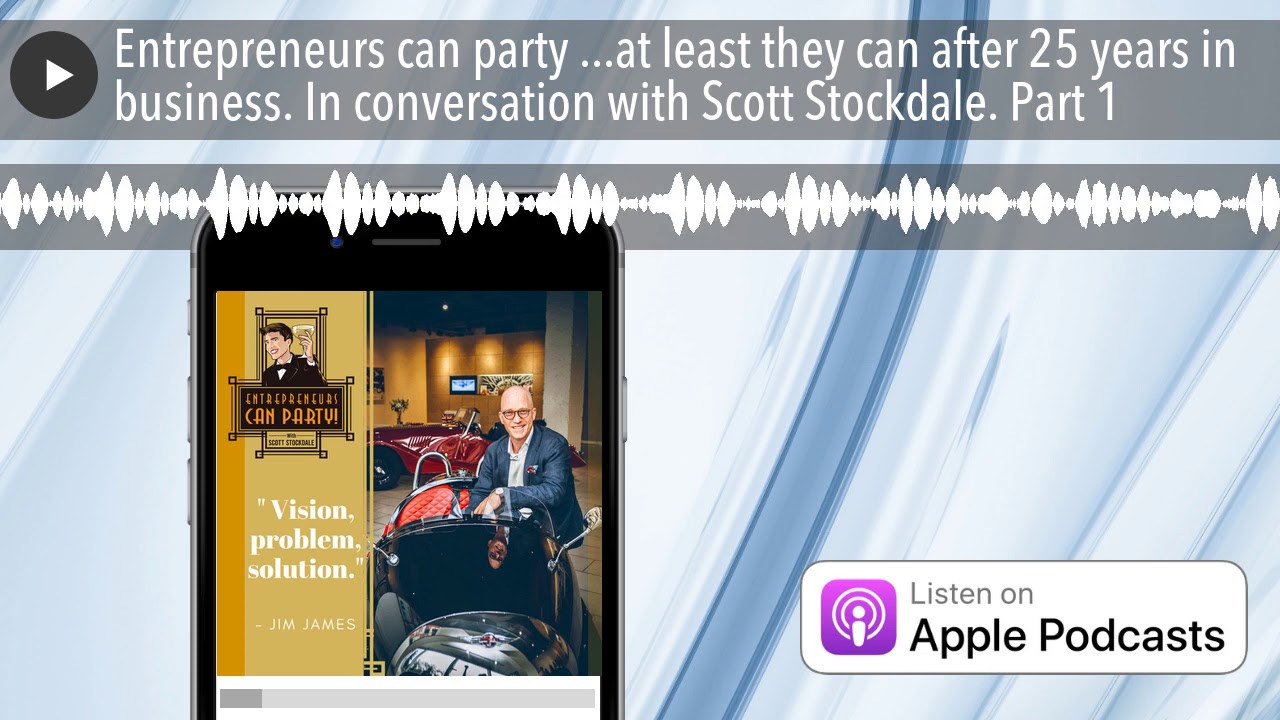
In this episode of the Entrepreneurs Can Party podcast, host Scott Stockdale interviews PR veteran Jim James, who reflects on more than 25 years of building and running EastWest Public Relations across Singapore, China, and the UK. The conversation begins with Jim’s unconventional start – raising funds for an overseas program by sky‑diving at 18 – and follows his move to Singapore at 24 to launch his first agency. He recounts expanding into Beijing in 2006, navigating Mandarin language challenges, and later establishing a geography‑independent, knowledge‑driven agency that operates without permanent employees, using the Zoho platform to coordinate freelance consultants worldwide. Jim shares practical Mandarin learning tactics (radio listening, language exchange, Pleco dictionary app, WeChat auto‑translate) and observations about English proficiency in China. He also discusses the benefits of an Uber‑style PR model that matches the best‑qualified freelancer to each client, emphasizing quality, accountability, and reduced overhead. Throughout, Jim offers anecdotes about cash‑flow management, cultural adjustments, and the impact of pollution and COVID‑19 on work practices, illustrating how his experiences shape his current business philosophy.
Chapters
Hello and welcome to this episode of Speak PR. It's a little bit of a special issue where actually I'm being interviewed. Scott Stockdale, who has a podcast called Entrepreneurs Can Party, kindly invited me to share some of my life story as an entrepreneur from over 25 years of starting businesses in Asia and now the UK. So instead of a PR talk, I'm going to actually share some experiences that I've had about Businesses and running businesses in the UK, Singapore, and China, and my experiences of how I even got into public relations. So I'm going to turn over the mic to Scott, who in turn interviews me. I hope you enjoy this.
Hey, come on in, come on in, and welcome to Entrepreneurs Can Party. Let me show you around. This is an entrepreneurship podcast for business owners, entrepreneurs, creatives, and those aspiring to be so. The aim is to introduce you to inspiring, like-minded people who are doing what they love every single day and having so much fun in the process. You see, business can and should be fun. You'll have the opportunity to hear their stories, be given tools and advice to succeed, and to taste what is possible when you think and dream bigger. Me? I'm your host, Scott Stockdale. And I'll be learning just as much as you as I show you around. It's my job as a fellow entrepreneur to tease out their habits, routines, successes, failures, favorite resources, books, etc., etc. All that good stuff. Alrighty, make yourself at home, grab yourself a drink, and let's get this party started. Hey, hey, welcome to episode 68 of Entrepreneurs Can Party. I'm your host, Scott. And on today's episode, I am joined by Jim James. Jim is an entrepreneur and PR specialist who has provided counsel to over 500 clients since 1995 with East West PR Agency. Just to make you feel old, Jim, that was the year I was born. So a very long time. So yeah, since 1995, Jim has run 3 suitcase startups. We'll explain what that means in the episode. And it started when he flew to Singapore at age 28 to start a business. he had never run before. In 2006, he started one of several businesses in Beijing, and in 2020, he returned to the UK to build an international agency without any employees. His team of on-demand professionals operate remotely from all over the world. Now, Jim's knowledge and experience oozes during our chats, particularly when it comes to practical business development tips. In our wide-ranging conversation, we discuss how Jim learned Mandarin Chinese, which is something I'm currently learning as well, why he decided to set shop in Singapore, leaving 20% of your assets at home when you move abroad, and so, so much more. So without further ado, I am delighted to be able to welcome you to the wonderful Jim James. Okay, so hey Jim, welcome to the show.
Scott, thank you for having me on Entrepreneurs' Campari. I love the podcast. Love the way that you're building this up.
So thank you. Thank you so much, Jim. That means a lot to me, and it's a pleasure to have you on. I know we've chatted a couple of times now, and it's a delight to finally have you on. And the fact you've gone to so many lengths— because for listeners listening right now, Jim is currently in Somerset orchards in his camper van, and we managed to make this work. So yeah, I'm delighted to have you on, Jim. Do you have a party trick or a hidden talent that people might not be aware of?
Y'all, Scott, you may not know this, but I was a little bit of time thinking that I might be from Louisiana. When I was a little boy, just a pup, I lived in South Carolina, but everybody said I really should have been from Louisiana, not from South Carolina. But I don't know if that's a party trick.
I love it. It's very, very Tom Hanks, Forrest Gump-esque. Your wife, she's a fan, isn't that right? She likes the Louisiana accent?
My wife's from, uh, also went to South Carolina, to North Carolina University. And, uh, but when I do that, I do my Berber shrimp, and I think one of the few times I can get her to laugh. I think she's laughing at me rather than with me.
Take it either way, a laugh's a laugh. Um, well, I'm so, like I said, I'm so happy to have you on. PR is your— it seems to be the name of your game, so very much looking to kind of dive into a little bit of that. Something which really stood out for me— well, there's so many things that stood out for me kind of doing the research into your background, One of which is actually being in Beijing and Singapore. So something I wanted to ask you is, can you speak Mandarin Chinese? And the reason I'm asking this is because it's something I'm currently learning at the moment. I've been learning Mandarin the last few months, and I did when I went to China myself in 2015. I figured that I probably needed to learn a bit of Mandarin, which I've since forgotten most of it. But I figured, you know what, people in China might not speak English. So, yeah, what's your Mandarin Chinese like? Can you speak it? And can you—
Yeah, I think the answer is that my children prefer it if I don't. I was in China for 13 years and in 2004 I went to the BLCU, the Beijing Language and Culture University, and I studied for 8 weeks in the morning, then I ran my PR firm in the afternoon and I learned enough to get around. And over 13 years in China, I felt quite proud of my achievements, but my children say that I shouldn't do it in public. As far as I'm concerned, I can get enough food, transport. I've done some business in Chinese, but I didn't take any of the qualifications with it.
I believe there's over 800 characters, just, you know, like, I suppose the equivalent of the UK alphabet would be, what, 20, however many there are. And then, yeah, to go from that to like 800.
Well, the real problem with Mandarin is that it's character-based as opposed to alphabet-based. So, you know, once you've learned the 27 alphabet letters, you can build any number of words. But in Chinese, you have to learn that character for itself. And the second thing is that the characters don't sound the same as they look. And the third element is that 2 characters together can mean different things than standalone. So my favorite is huo, which means fire, and tui, which means leg, but huotui sammingzhi is a ham sandwich. Same characters, same pronunciation, but if you put the two together, it means ham. So it's a fun language. I encourage you, it's great mentally because it's a great academic challenge. And the other truth of the matter is that if you do make an effort, even at a low level, people in China really appreciate it. So, you know, if one assumes that there will be mastery, that's quite a great ambition. But if it's to, you know, introduce oneself and to make other people feel that you've made an effort to understand their culture a little bit, it's also beautiful. I mean, the characters are beautiful to look at, so there's a little romance about it as well.
Yeah, absolutely. How did you go about learning Chinese? I know it's, you know, you might not necessarily have it kind of nailed on and, you know, mastery level, but in terms of kind of those basics like, you know, greetings and and restaurants, things like that. Yeah, how did you go about learning that?
Well, one thing was when I went to BLCU, to the language university in Haidian, at night I would listen to the Chinese radio. You know, in the same way that you'll meet lots of Chinese who have learned English through television and through music, there's— it's free coaching, right, to go online and listen to Chinese radio, for example. Then secondly, I found a young student who wanted meet at, they call hu xiang fu dao, you know, I help you, you help me. So they wanted to learn English and I wanted to learn Mandarin, so we would spend time together. And I also took, in the early days, I took a dictionary because the students— a dictionary with me everywhere I went. I would spend hours getting any food. Now of course you can use things like Pleco on your mobile phone and it'll actually scan the characters And will read them for you. It'll find it for you. Yes, so the technology means that one can take mobile with you. The only other thing is, of course, now that if you— if one uses apps like WeChat, there is a function to auto-translate. So I've had more than one meeting with Chinese where I'll say something in English and they are sitting with me in the room and they press the button on their WeChat And it'll automatically translate both audio and written into Mandarin for them.
Oh, amazing.
We're getting to the stage where now there's almost simultaneous translation as well that can be done. So it's not that it's not relevant to learn, but, you know, I was in a hurry because running a business and I was later in life, but you can use technology now to get there a lot quicker than I ever did.
I like the sound of that character where you scan the character and then it translates it for you. What was that called again?
Pleco. P-L-E-C-O.
P-L-E-C-O. Ah, okay, I'll definitely be checking that out. That sounds really cool. Um, with the, with the kind of meetings and stuff, do— did you find that many of the people in China actually do speak good English, or was it very much kind of you have to muddle your way through on both sides? Like, you both can— do you know what I mean?
I think it comes down to generation. The younger people speak much more English. Remember, there are more people in China that speak English than in America who speak English.
Really? Wow.
And so when I started my business East West Public Relations in Beijing in 2006, I was intent on using my Mandarin, and I had some— I had, you know, 6 staff and I would labor through these meetings and eventually someone just put their hand on my arm and said, Jim, we really appreciate you trying, but it would be so much quicker and less painful if you spoke English. And what one finds is that especially through the younger people, but also in government, for example, you'll find all the government people speak great English, people working in tech, even now people in supermarkets and so on will want to practice their their English on you. So if anything, more people want you to speak English to them than want you to speak Mandarin to them.
Well, that leads us nicely on to— we've kind of skirted around it a couple of times— your PR agency. I wasn't quite sure, is it something you're still kind of actively involved in, or is it the other business which we'll kind of get on to that you are more involved with?
Yeah, no, I'm absolutely still running East West Public Relations. And so the agency has offices in Singapore and China and now the UK and just picked up a new client to do work in America. Okay, Scott, yeah, well, about EastWest Public Relations, back in 1995 when I was 28, I went to Singapore to start EastWest Public Relations and I rented a space and hired, and within a couple of years I had 13 staff and we were one of the biggest independent agencies in Southeast Asia. And then I went to China in 2006 and opened the offices there then in 2008, opened some offices in Bangalore. I'll end up basically working for the staff because once you've got that many offices and that many people, you spend all your time doing recruitment and management and so on. So this time I've come back to the UK, and over the last 4 years I've been working on a strategy that I call geography-independent and knowledge-driven agency, and where we're really working towards having a zero-employee agency which is virtually everywhere or everywhere virtually. So I now use a branded platform which is called Zoho and on there I have all the processes and documentations required and I have consultants who work with me on projects just like they would in a movie and they come together as a freelancer to work on a particular project but using my email brand legal entity. So for the clients, they're really only getting the best of the people for that particular project, retainer or short-term. But as an organization, I no longer have the drama of trying to manage all the people because people increasingly don't want to work permanently anywhere. And also they don't want to go to travel. And we've seen this with COVID especially, and it's been a catalyst, but I've been working on this now for 4 or 5 years because in China young people couldn't afford to live in Beijing and the pollution was so bad that on some days you couldn't travel. So you got to 250, 300 AQI, which meant you couldn't see the other side of the road almost in Beijing.
Hmm.
So some of the dynamics in Beijing were a precursor to what we've seen in COVID. So I've been working on a business like this for quite a long time. So EastWest PR is a global brand. We help business-to-business clients and we have clients like F-Secure and Tech Data and Rosti, for example. So big blue-chip clients that understand that it's the value of what we deliver that's important, not having a large overhead. Because also when you have an agency with a lot of staff, what happens is that when the client comes in, the consultant who has the most bandwidth is allocated to that project, not necessarily the client gets the consultant who's the best qualified, which makes sense, right? Because actually agencies are in effect freelance hiring services of talented qualified people with a particular specialism. So by having this really almost Uber-style model or an Airbnb model for PR, we can still assure the client of quality delivery, but what they're going to get is the consultant that really is best appropriate but who's also motivated financially to do great work because they don't have a salary and a job and a desk regardless of how they behave on that client. They're judged You know, by the quality of the work, which is why we've now signed up for TripAdvisor— for Trustpilot. So we start to then have accountability as well.
Yeah, I will definitely ask you more about kind of diving into the specifics of that model very shortly. I just want to kind of take it back almost to the origin. So this was something you sent over to me. You started my— or in your words, started my PR agency because I jumped out of a plane at age 18. Now that's quite a hook, and you had me there. What took you to Singapore in the first place and then to China? Would you like to kind of talk to us more about that? Sure.
When I was 18, I applied for Operation Rally, which I'm not sure whether you're familiar with, but it's a program where young people go overseas. It was like a Duke of Edinburgh scheme but in hard. So you'd go overseas. In my case, we went to Australia for 3 months. And so I won this place. You had to compete. So you had— they'd have like 100 applicants for every person who would get a place. And you had to go on tests. And you had to go and do physical tests to see who could withstand some of the hardships that you'd go through. So I got a place, which is fantastic because you apply and then you go and do a hard weekend. And, you know, by the end of the weekend, sort of 10% of us were left. There's sort of things like jumping, you know, going through water and sleeping wet at night and cutting. Anyway, so I got the place, but then of course it needed £2,000 to go. And so I knew I could do it, but I couldn't afford it and my family couldn't afford it. So I worked selling toys in a supermarket. And I was never going to make £38 a week, as it was then, enough money in the time before going to university. So it occurred to me, I would do something that I was afraid of, that other people were afraid of, that might generate some sponsorship. So I decided to jump out of an airplane, tackle my fear of heights, and also raise some money. As a result of going around to everyone else on the shop floor called Rysons at the time and asking everyone to donate, I raised £1,000 from what was in effect an afternoon of jumping out of an airplane. Much more lucrative than selling toys. And as a result of jumping out the plane to sponsor, I rang the local newspaper called the Kentish Gazette and they covered my story. I said, you know, I really want to go, this is my issue, I'm solving it by raising money. And then I got some coverage. And a result of the coverage, I went to a local outfitter and said, I can get us news coverage if you give me some equipment— hiking boots, backpacks, and so on. because that's part of the £2,000 I needed, right? I said, then I can get you some coverage in a newspaper. So this local store said, sounds like a good deal. So I got the kit and got this local Kentish Gazette newspaper photographer to come down to the store and show me with all my things, and the store manager got interviewed. So as a result of this completely, you know, amateurish and impromptu 18-year-old attempt to raise some money for what I really wanted to do. I managed to make my money and I also went, well, you know, actually I never knew anyone who did anything like this. My parents were academics and social workers. But, you know, within 3 months I'd managed to accomplish the task and then a big company said, oh, this is quite an interesting story, you know, we'll lend you some, we'll give you some money as well. As a result of solving problems really, I didn't think I could do PR. I just was How do I get money? Do something interesting. How do I make someone else think that's interesting? People found it interesting because a young guy tackling a problem, being proactive and so on, right? Went to Singapore at the age of 24 from Manchester and just thought, wow, you know, this is amazing. So 1995, I decided I would leave England and go and set up in Singapore. Now that was part 1 of of a 40-minute, and as you know, I keep everything to 20 minutes. So I've chopped this into 2, and in the second half, I talk about some of the learnings of starting the business in Singapore, how I manage cash flow, and then how I decided to go to China to start East West PR and then get involved with importing Morgan sports cars to China. So that's the end of this half of the interview with Scott Scottsdale, and there'll be another half coming right afterwards.
More from Jim











2 people, infinite agents, 1 billion dollar idea #AIAgents #Startup #Productivity