Getting noticed by over 27,000 Gen Z-ers from across 111 countries to help entrepreneurs
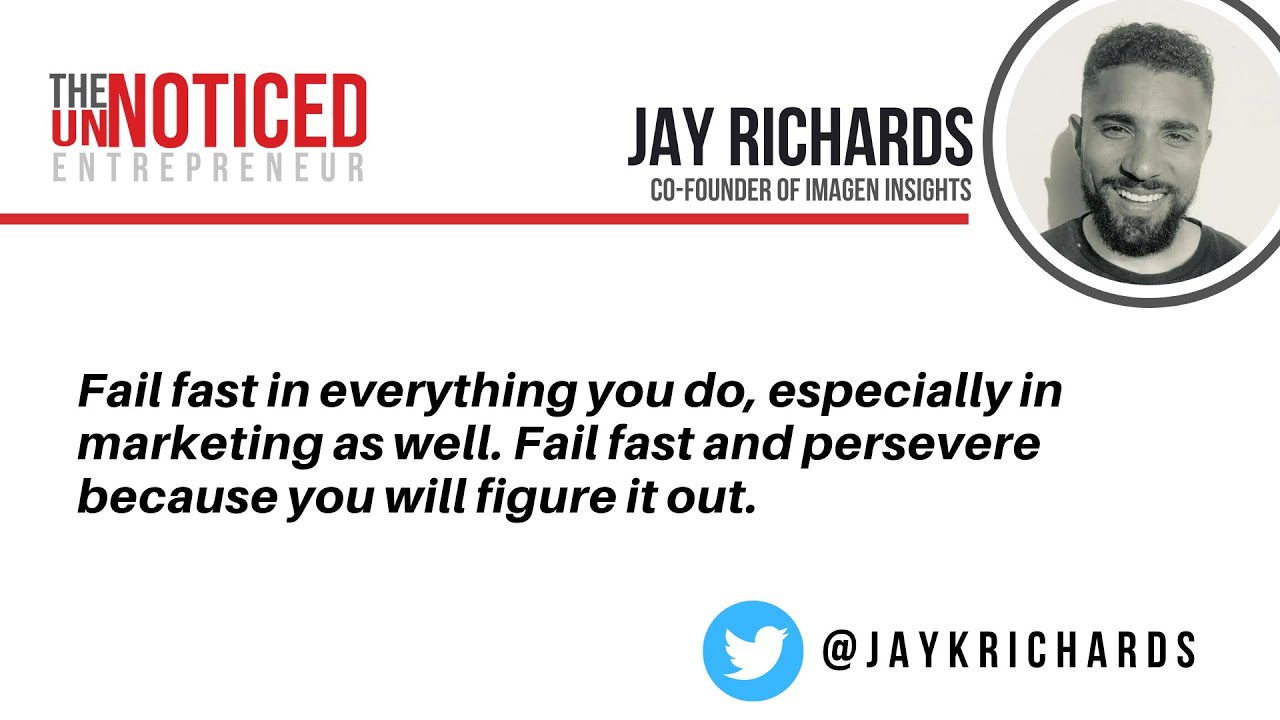
Kat Agostino and Jay Richards built Imagine Insights into a community of 27,000 Gen Z researchers across 111 countries in three years. They convinced brands that qualitative research matters by treating participants as a real network, not a panel, with daily LinkedIn posts, referral incentives, and offline events. Their advice: solve a real problem and let passion for it drive everything you say.
Chapters
Hello and welcome to this episode of The Unnoticed Entrepreneur. Today, I'm very delighted to have not one but two guests. I have Kat Agostino and Jay Richards joining us from Imagine Insights. Welcome, you two.
Hey, thanks for having us.
Hi.
You're welcome. And look, thanks for joining me because you both built an amazing qualitative research business targeting Gen Z. You've got over 27,000 Gen Zers, as I believe, across 130 countries. 11 countries, helping big companies understand what Gen Z people are thinking about. We're going to talk about how you've built that business today. So welcome to the show.
Thank you. Thanks for having us.
Thank you.
Why don't we start with either one of you? Because I know you're both co-founders and you share this out, telling us a little bit more about Imagine Insights and what you do and how you do it.
Yeah. So in a nutshell, Kat's smiling because she knows I'm about to go into my thing. But so in a nutshell, our mission is to help Gen Z to shape their future. And realistically, we know the best way for them to do that is with brands because brands are shaping countries and culture like our governments only wish they could do, especially our government, right? So what we do is we enable brands to crowdsource qualitative and quantitative insight from our community. We have a community of 27,000 Gen Z in 111 countries. They're 60% female. They are 14% Black, 15% Asian, 20% from a low-income background, and 20% from LGBT communities. Actually diverse. And we're able to crowdsource this insight from them within 72 hours. So from a quantitative perspective, that's nothing new. And that's been done for eons. But from a qualitative perspective, if you want to do good qualitative research, you have to do a focus group. Focus groups are both time-consuming and expensive. So we designed a platform that you can get that same depth of insight, but at the scale of quantitative research. So that's in a nutshell, that's what we do.
Wow. Kat, how did he do? Did he nail it?
Always. He's had lots of practice.
He's done it.
Does it in his sleep.
Look, and the business is only 3 years old. I know you raised some money at the beginning, but you're already profitable, which is a credit to you to get that scaled that quickly. And what I'd love to do is to learn from you both how you've accomplished that. So who'd like to go first and sort of explain maybe the first barrier to getting the business, you know, started from a communications perspective, of course, you know, because you've got 2 different audiences and you've got your customers, the brands, but also you've got your community. And I imagine one can't exist without the other. So I think, Jay, Kat's asking you maybe to have this one.
Yeah, absolutely. So yeah, we came together, like you said, it's been nearly 3 years. Our 3 years will be in November. Very exciting. And I think the big thing to say is that there was ultimately very shared values about what we wanted to do with the business. And that was to help young people in a way that would open doors for their future. And that absolutely is still the number one value and the number one reason that we set up the business. Without our young people in our community, then we wouldn't have that business. We wouldn't be able to go to brands and talk to them about this amazing thing that we can provide if we didn't have those young people. So I think the big thing here is that Jay and I, although are extremely different people, we think differently, we have completely different outlooks and skill sets, but we share the same values. And that is so, so important for the foundations of the business. And that is why we've been able to grow and to continue to grow and able to build the community and also build the amazing brands that we work with because we have got that differentiation, but we can still come together on the reasons why we're creating that business.
Yeah.
Kat or Jay, do you want to explain? You've kind of got 3 different audiences, haven't you? From a sort of co-founder's perspective, you've got, as you mentioned, the brands and you've got the community and you've got your own team. Would you like to just address in whichever order you like the communications challenges and how you overcame those?
Yeah, I think from a brand's perspective, that's a lot of my role. So a lot of my role is meeting brands virtually or physically wherever the hell they are in the world. So a lot of that is really enabling them because the problem that we encountered initially is that research just isn't attractive. It's not sexy. It's normally the last thing that people consider. It's normally influencer strategy, PCP, flipping media strategy, everything else. Our first challenge really was enabling people to understand that research was important, that research was valuable, and that it was needed. So That was the first role in communication going, okay, actually research is good for you. It's good for your business. It's going to add value. It's going to make you more money in the long run. So that was the first challenge. And the second challenge was people seeing that we exist because nobody knew we existed. So that was a lot of my role at the start was really just whether it was speaking engagements from like a sales perspective or on LinkedIn, just very much just messaging and creating content or whatever it may be to get us out there. So people can say, okay, Imagine Insights are doing something, Katja are trying to build something. So that was a massive challenge at the start. And the way we overcame that was really just Being consistent with. So Kat will know this really well. I post on LinkedIn every single day. I have done for about 3 years, if not longer. I'm constantly sending folks emails just once a month, but anybody that I've ever come into contact with regardless of this business, they get an email once a month from me, just helping to keep us top of mind, but just adding value. Every single post I do, every single email I send, nothing is salesy. This is what we're doing. This is what's going on in our business. This is what's going on in the Gen Z space. This is something you might find interesting. If you find it interesting, Reach out to us. If you don't, that's fine. And if you want to remove yourself from the list, remove yourself from the list and just be very casual about it. And we found off the back of doing that, as we said, we've built a great profitable business, which is good. Then from a community perspective, that's what I was going to say from Kat next.
Yeah. So from community, I mean, we do speak to basically any organization, whether that be an educational body or youth organization, anyone that we can speak to that has young people within that business, within that organization, we will provide workshops, webinars, or We'll go into the school, we'll do assembly, we'll kind of go and talk to young people about the opportunities that we offer so that we can give them the choice to join the community if they want to. But a huge part of our community growth comes from referrals. So we have these amazing young people and we offer referral fees for them if they introduce new people to the community. So if they've had that experience, and we hope that is always a good experience, then they're quite naturally going to invite their friends, colleagues. family, peers to join as well. So that's a huge part for us. And then we also have the reason that we call it a community instead of a panel, which a lot of research companies will be used to, is because we're always having the two-way dialogue. And by that, we are asking them what improvements they want to see to the platform, what we should be doing better, what type of resources we should be offering them. We invite them to our podcast, to panels, they're on with speaking engagements with us. So there's a lot more than just the getting paid to work on briefs, which of course is the number one reason, but there's a lot more that we can offer to that as well. So that communication just has to be two-way.
That's wonderful. I love the way that it's an ongoing relationship with the people, as you say, in the community. They're not a panel. But I do want to come back because you mentioned about the number one problem is companies not really knowing that they need research. And you've then mentioned about consistency of delivering information, but how did you overcome the view that research is so low down the priority list? You talked about kind of being visible, but that's a little bit different to overcoming the objection to doing research in the first place.
Yeah, I think the main thing is just getting people into a room. So I realized early on when we are engaging with people, the reason why people think research is important is because they actually don't understand the challenges that they are facing. A lot of the time they've been given a tick box, which is achieve this revenue by next quarter or get this number of views or this engagement. And a lot of the time we've been tricked into thinking that's actual metric that matters. That's the KPI that's important. But a lot of my business meetings that I have with folks, wherever it may be, is I ask 2 questions. I say, what are you excited about over the next 12 months? And then what are the challenges that you're facing with what you're excited about? So what are you excited about? And then what are your challenges? And I always find in that first one, that first question, they're all very excited telling me about everything that's coming up. And then the second one, they go, oh snap, we didn't realize these are the challenges that we're gonna be facing. Because I really got them to ruminate and sit on it and think on it. So then by the time I talk about what we do, All I'm doing, like Kat said before we got started recording, all I do is just show them that we're solving a pain point. So instead of it being me trying to pitch insurance, I'm going, you've got a pain point and here's the medication for it. You need paracetamol, here's the tablet for it. Do you know what I mean? And I think that's the thing that we do very well is we don't try and upsell anything. We just say, you've got pain, here's the solution. And then once you do that, people go, I see the value in research. And that's why our clients at Amazon Prime Video and Puma and whoever else, Google, Unilever, the reason why they come to us is because we're solving a pain point for them.
Yeah, that's wonderful. And really making it part of the process internally, as well as say management-wise, they're often given KPIs to get coverage, for example, or to get click-throughs without necessarily knowing exactly why. One question then, are your brands attempting to sell to your communities or is it very much sort of an insights and an engagement? That'd be useful to know. Yeah.
So the whole premise of the work that Icon People do is to provide their brutally honest feedback and their unfiltered, unedited thoughts, which can be— we say brutal because they can be very brutal. So, you know, a brand has to be very open to the fact that they're not going to get praise all the time. You know, things are going to be taken very seriously by our young people and they're going to be honest about it. So it's not a case of, you know, just providing a bit of data, it's providing very rich qualitative information that then they can take away and actively make changes to their product, their design, their branding, whatever that, you know, business or marketing challenge might be. And that's what we encourage our brands to do, is to make sure that they are actively taking that information and making changes for the better.
Right. So it's fantastic. So it's sort of, there's an integrity there and it's not a sales— are there any particular trends then that you're seeing in Gen Z Across all of your clients that you think people should be aware of? And in fact, that you may be incorporating into your own communication strategy?
Yeah, I think one of the big things, and Kat alluded to this eloquently earlier, is that the idea of research has always been so transactional. And when we started this business, when I was speaking with Kat about it, and I was speaking about what I feel like where the industry is going to, Kat and I, we came to a decision that research, because it's been so transactional, it's just not been attractive to the people that have been engaging with the research. There's always just been, I get paid £2 and then I'll see you next time you've got a survey. And when we started to build this community, the entire premise was, is if we can make a living, breathing community, like Kat was saying, where they get invited to events and they can meet up with each other and they can go on holidays together. And we're starting to organize gigs and festivals. All these things we're starting to put together because we're realizing that if we can get this community to meet in real life and it goes from online to offline, then there's an added element to it that isn't really out there. And I think the ability to communicate that effectively to the community, but then also to clients, the clients see the added value. And that's the reason why a lot of our clients, because we're a risk, if we're being honest, we're a startup. So they're taking a risk on us because they know that the community and how they add value.
Jay, let's just switch gears slightly. That's the community. And we've talked about the brands, which is great. But obviously you've got a team and with co-founders, whilst you plainly sing with one voice, how are you managing The sort of internal communication, because being one founder has one set of challenges. Two, from a communications point of view, there are lots of opportunities for things to get misunderstood, duplication. So I'm not sure which one of you gets the nod on that answer.
We have to be really honest. We have to talk about, you know, we're a business, we're a startup, we are still learning. We don't know everything, right? Things are going to go wrong. There's going to be pressures. There's going to be money worries. There's going to be all these things that come with life. business, but unless we are completely honest with each other, I often say that we're like each other's therapists because, you know, we have every possible emotion, whether that's laughing, crying, you know, hugging, whatever it might be. We have to be open to the fact that it is a bit of a rollercoaster. And I think what works for us is for us to be transparent and honest with the team. So we are so, so grounded in feedback, not just from the kind of 360 feedback we perspective, which is important, but in all of the one-to-ones that we have with the team, with all— in all our meetings, we encourage feedback both ways, because we're just humans after all, and we're going to get things wrong. We are also sadly not Gen Z, so we need to rely on our younger team members to make sure that they're upskilling us and we're learning from them as well. So communication, transparency about the good and the bad, I think, is super important for a really healthy business. Okay.
And Jay?
Yeah. And I definitely think, oh yeah, off the back of that, I think one of the interesting things is Kat knows this, this is nothing new. My brain's always like, I'm always 2 years, like I'm living in some other time zone. I'm always like, oh, this is what we're doing in 5 years. And so, and so Kat and I were like 2 sides of one brain. So Kat is very much what's happening this month. And I just don't like, I don't know what's happening this month. I'm like, that's too stressful for me, but Kat is so good. So I'm like, oh, I feel like we should do it. And then Kat's like, yeah, I feel like we should be doing that also. And then she's like, have you ever considered this? And then we create this crazy vision, but then Kat's very good at going, okay, so how can we implement that right now and then carry that out? And I think when we're communicating to the team, I will regularly jump onto a call and be like, guys, this is the— we're going here, we're going there, and everyone's like, yeah, woo-hoo-hoo. And then Kat's like, cool, so this is the practical next steps of how can we get there? And I think sometimes, to be transparent, actually Kat and I were speaking about this in our 360s together yesterday, is where the team sometimes they hear the rah, rah, rah, vision, vision, vision from me. But then sometimes they don't realize that Kat and I have spoken about that beforehand and it's just me that's delivered it. So sometimes people think, oh, all the vision comes from Jay. I'm like, Jay, that's not happening. Kat and I are speaking for hours on end about this stuff. We're waffling together, just talking shit. Sorry, talking together. And then we literally, then the vision comes out and I'm normally the one that tells him. I love doing that part. But then also Kat then a lot of times does the management stuff. So Kat's like, guys, 360s are coming out. Guys, timelines, guys, KPIs. And then people are like, oh, that's all coming from Kat, not realizing that Kat and I have had those conversations behind the doors, but actually they're hearing it just coming from Kat. So we're actually working on the moment. We're still trying to get used to it is where sometimes Kat can do some of the vision stuff because we've both come up with the vision together. It's just sometimes I prefer dishing that out. And actually the management stuff, we've both decided that together, but a lot of the time it comes from Kat's voice. So we're actually trying, like today I'm going to do the team call. We're just trying to learn how to Sometimes just shift those roles slightly, not taking away from what we're naturally good at. I naturally love the vision stuff and I hate the managing stuff. And, but we can both talk about those things because we both discuss them behind the doors. That makes sense.
Yeah, absolutely.
And I think it's being comfortable in also what you want, like we are very comfortable in that situation. So if other people perceive that's fine, but actually if one of us was uncomfortable doing something, then we would just change it.
Yeah, 100%.
Yeah. You know, this sounds like a really powerful and a very dynamic way of leading and growing the company as well. And what about structurally? You know, I love the technology of this as well, of running a company. Can you explain some of the tools that you're using? Because, you know, there are 2 of you and you've got teams and you've got, you know, 27,000 people around the world, 111 countries, hard enough to run a small business from one place. So what tools are you using to keep the communications sort of shared and live and transparent?
So from an internal perspective, we use our main, like, 2 tools are Trello and Slack. So Slack from a daily communication perspective, but Trello, I mean, honestly, I think Jay and I live, sleep, breathe Trello. And we hope that the rest of the team will eventually like love and appreciate what Trello does for us. But I think our personal lives, our work lives run on Trello, and I just can't recommend it highly enough for an organizational tool.
Oh, wow.
Okay. That's high praise. And that's creating a platform because I'm not so familiar with Trello. That's a Knowledge management, is it? And messaging?
So yeah, it's task management. So basically any task that you have throughout your day, month, week, year, you have what are called Trello boards and you add those tasks. You can do it for everybody in your team. You can move stuff around. You can have reminders. And this is, by the way, not sponsored.
That's right. Free licenses. But I think, Jay, you mentioned beforehand, you've built the community on AWS, on the Amazon Web Services. Do you want to just share a little bit about that as a platform for reaching externally into the community? Yeah.
So in a nutshell, Amazon Web Services is literally the platform that we've built our web app on. We're in the process of building our mobile app, both Android and iOS, which is exciting. But when we first raised investment very early doors, maybe 2018, one of our first investors were not private equity, a venture capital firm, but actually they did it personally. So they didn't do it for the firm themselves. But when they invested, they let me know that they actually had Amazon Web Services credits. So basically you get these free, you get free money from Amazon to use their platform. Basically, I think it was like $50,000 or $25,000 or something. And it lasts over 4 years. So it means our Amazon Web Services bills are literally nonexistent, which is phenomenal. So it means that we've been able to build the entire platform on Amazon Web Services for free this entire time.
That's amazing. And I have to put a link obviously to that in the show, or at least a link straight to you for people that want to find out more about it. If there's a takeaway, you build a Fast-growing business in an interesting category and globally from England. A takeaway, a key piece of advice from a communications perspective that you'd like to share with a fellow entrepreneur, a fellow, maybe unnoticed entrepreneur like me?
I think, you know, firstly offering a service that people need and it solves a challenge, but really believing in that vision. Because if you do, then all of the communications, your passion will come out in that communication. You know, every time we talk about the business, not only do we believe we are genuinely solving a challenge, but We believe in what we are creating and we are so passionate about it. And I think if you have that, communication will grow and grow and grow and get noticed for sure.
That's wonderful. And Jay, speaking with one voice there, or did you want to add in anything?
No, that's perfect. Couldn't have said it better myself.
Me neither. Kat Agostino and Jay Richards joining me from Imagine Insights. Thanks so much for sharing today, building a wonderful and sounds like a really progressive business, both in terms of what you're doing and how you're doing it. Thank you so much.
Thanks, Jim.
Thank you so much for having us.
You're more than welcome. So you've been listening, as I mentioned, to Kat Agostino and Jay Richards here in the UK for Imagine Insights, all to do with Gen Z. So I will put their contact details in the show notes. And until we meet again, I ask you to please share this show with a fellow entrepreneur that you think might enjoy learning how to get noticed. And if you like the show, please do rate it. It really helps. And until we meet again, Do keep on communicating.
More from Jim











2 people, infinite agents, 1 billion dollar idea #AIAgents #Startup #Productivity