How a print on a shirt can help entrepreneurs leave more brand footprints; with Raitis Purins
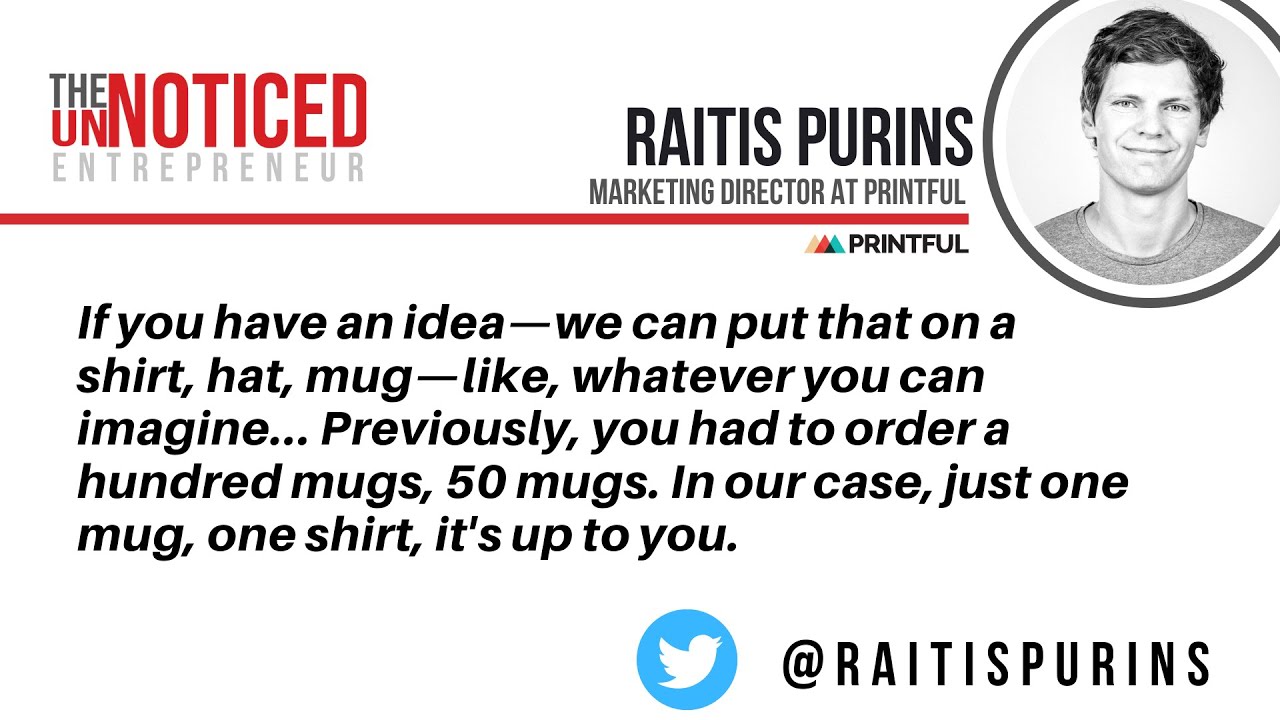
Raitis Purins, Marketing Director at Printful, explains how print-on-demand merchandise lets entrepreneurs build brands without inventory risk. Printful operates 10+ global facilities, offers zero minimums on 400+ products, and integrates with Shopify and 20 other platforms. The company serves 300K customers including Coca-Cola, turning fans into walking advertisements.
Chapters
Hello and welcome to this episode of The Unnoticed Entrepreneur with me, Jim James, and in Riga, Latvia, I'm going to try and pronounce his name properly, Raitis Puric. Raitis, how have I done?
Hello, Jim. Awesome. Glad to be on your show, Jim.
Look, it's fantastic. And I don't speak Latvian, but we are going to talk today about how merchandise can extend the value of a brand and create brand ambassadors. So you're the marketing director at Printful, and I'm even wearing a full complement of Printful merchandise today. Tell us, how does Printful and merchandise help an entrepreneur to get noticed?
So if you have an idea, we can put that on a shirt, hat, mug, Jim, like whatever you can imagine. So when we have eased the barrier for anyone who wants to start doing that, so previously you had to order 100 mugs, 50 mugs, In our case, just one mug, one shirt, it's up to you. And basically, that's what we have done, making that much, much easier.
How have you done that? Because you're absolutely right, in the past, promotional items, you had to have a minimum order, and it made the cost so high. How are you managing to make merchandise affordable and accessible to entrepreneurs?
So we actually solved our own problem a couple of years ago. We'll celebrate our 10th birthday next year. So we just celebrate 9. So before print, we had the e-commerce store, cydervitamins.com. You can Google it, still, still live. And anyone were able to actually order their own motivational quotes, get shit done, learn, fail, experiment, stuff like that. So you can put on the wall. And with posters, it's easy. You can cut any size of the poster if you have a printer. You can print any color, so it's easier to do that on demand. But when it comes to the mugs, to t-shirts, different colors, different sizes, hoodies, and we wanted to also offer that to our customers. It was 10 years ago, so we're starting looking around, is there anyone can do that high quality, quickly, fast through API, not just submitting some email stuff like that? So there was no one around who were able to actually do that. And so 10 years ago, almost 10 years ago, there was idea of Printful that we can offer anything on demand. We purchase the right equipment, we started to figure out the process, how to actually do that. And as I'm saying, in some way, Printful was made by developers who didn't want to leave their computers to actually print something on a t-shirt. So, and they wanted to do as lean as possible that no one has to move. So we can also offer the lower price.
So that's fantastic, solving your own problem. And now Printful is quite a large company. And one of the issues that I was looking to solve when I was looking for print on demand was local fulfillment to save costs of shipping and also time to delivery. Do you want to explain about Printful's worldwide footprint now for implementation?
Yes. So we started in the USA. I'm from Riga, Latvia, but as we know, the biggest market is there. So we actually opened our first facility in the USA. Now we have 3 locations, California, Texas, Dallas, and Charlotte, North Carolina. So we have 3 facilities there as that's our biggest market. But as for us to actually provide a good service, shipping is really important and logistics important. That's why I know everyone buys on Amazon because they can do their job quickly and faster. For us to provide a good service, so we needed a new facility. So we opened a facility in Europe, have one in Riga, Latvia, because we are from here. We have in Spain, in Europe, also in the UK, Birmingham. So as it's much harder to ship there from Europe. So we can be fast. We have also location Mexico to serve the US market, expanding there, have Canada, and we also now have partners in Japan, Brazil, and Australia. So basically we are all over the world. So more than 10 locations.
Yeah, which is fantastic. So it means that one can design a product like my hat, for example, and have it made anywhere around the world, wherever the customer is closest. Now, Let's just talk a little bit about how an entrepreneur, any business owner, can go online and design their own product. Do they need to go to Canva or Photoshop and upload a design that's already made, or can they use the platform itself?
So you can use our platform, just our platform. So Printful.com, we have a Design Maker. So probably if you are a company owner, you already have your own logo or some brand asset, you can just come to our website. Upload it, pick the right product, pick the right color. You have all the features. Okay. Not all the features which Canva has or Photoshop, but we have the most popular ones like fonts, some, some basic designs. I know you can switch them to right, to left, stuff like that. So just come to our website, upload your own logo, pick the product, and just hit couple of times next and you can order your own merch.
So just tell us then, right? Just What kind of merch do you have available? Because that's another issue, isn't it? Sometimes the range of merch is very limited with some POD suppliers.
So we have more than 400 unique products, and we have included their colors. So for example, we have a t-shirt which is available in 30 colors, different sizes. So that's basically the most popular product, t-shirt. When it comes to merch, you think about t-shirt immediately. So that's the most popular product. But besides that, we offer like, just look at Jim, hat, mug, phone cases. We have also other non-apparel products like bottle, phone cases, posters, and framed posters. So we have apparel products like shirts, hoodies, sweatshirts, different kind of things. We have all over print products. Like when you think about t-shirt, it's something printed or embroidered on you. So we also offer printed and embroidered items. That's also could be a Leggings, bikinis, shorts, swimwear, even bags, backpacks, like everything you can imagine, like just come to the website and even beanbags, by the way. So pillows, it's like even hard to remember all the products offered. So basically what you want is there.
Well, right. So having, you know, made a number of items myself, I really like how you can deploy the same brand assets across different products. Just tell us then about the sort of minimum orders, because that's often a stumbling block for people that want to start merch ranges, which, as you say, now almost become an e-commerce store. Tell us about some of the practical issues facing, for example, the minimum orders or minimum stock values.
So our minimum order volume is zero. So if you can come to our website, printful.com, and just see, you can register, play around, and no one will ask you to pay for it. You can play around with Design Maker, different products. We offer that and it's easy to do. But when you want to purchase something, our pricing is made that it's for one item with at least one design. So for example, cheapest t-shirt costs less than £10. So it's there, it's available for anyone. And yeah, if you want to order 25, we also order, I know, bulk discounts if you need that kind of amount, but the idea that it's That's one. And the magic part, like if you want to offer that to your customers, you can publish 5 different colors, mugs, hats, phone cases, and it'll just stay on your website. And as soon as someone will buy, only then Printful will receive the order, will pick the item, only then start printing it and send to end customer in your brand. So basically there's no Printful mention. Probably your listeners have received something from Printful, but they have no idea that it came from Printful, came from the small ecommerce store.
And I think that's a really great point that you're only making it when it's sold. So you're holding no inventory, no stock. That has a sustainability impact as well, doesn't it, Raitis?
So yeah, it's one of the factors. It's much more important than when we started 9 years ago. that everything what we are printing or making, creating in our facility is already sold. So there are almost no waste goes. With bulk printing, you could order 25 t-shirts, but maybe they'll never be worn because like no one will buy them.
Just explain then from a, if you like, a marketing strategy perspective, how can merchandise play a role for a company? Because in the past, we've always thought of it as Kind of a giveaway, maybe at a trade show in exchange for a business card?
There's different ways, so it depends from your business. As I'm saying, anyone can use Printful. Of course, you can always use a mug or t-shirt as a giveaway on social media, but it's also the way how you can basically finally put your brand outside your website, because pretty often it's something you see on a website, but you never basically feel it or touch it, and that's a way how you can give it to your superfans, not probably every of your customers, superfans. They will be happy to wear your product and be the ones who will walk around the city and basically show that, okay, this is, I know this is my billboard in some way. And that's one of the probably most common audience I want. Like, I know that musicians is not maybe entrepreneurs, but in some way they are because they want to be, they want to earn money with their music. And one of the ways they are I know, playing concerts and people are buying tickets and merch. It basically comes naturally in their mind. That's one of the first things they want to do. And they don't know how many people will actually buy their merch. And through on-demand, that it's one or a couple of items, it's just the way how we can prolong the brand. People want to support you, they will actually just be happy to wear a product, making it live. So that's the best part.
I love that. And I think you've mentioned something there about having a store. Do you want to just explain how an entrepreneur or business can monetize their merch? What are the integrations with some of the e-commerce websites? Because that's another outlet, isn't it, to generate revenue?
Yeah, we would say that Printful is— we are not the t-shirt printing company. So there's a lot out there. So that's the easiest part to actually print something in a product and then send to someone. So we are, first of all, we are IT company because we have created integrations with different platforms. Like everyone knows Shopify, Etsy, and WooCommerce, Magento, or other e-commerce platforms. So Shopify is the most popular one, but we have 20+ integrations ready. So we have created that it's easy. You can actually set up your Shopify store with Printful in a couple of minutes if you want. Just go to the Shopify, either Printful, find each other's app, connect together, then upload design, push a couple of buttons, pick the right product, And as we call it, we push the product to Shopify store, then it appears on your Shopify store. Like, no one sees that it's from Printful and it's connected automatically. So, and then someone sees on your Shopify store your product, buys it, we immediately receive information and only then we are charging you for the order. So we receive it, we start the fulfillment, and at that time point already someone already says, have paid you as well. So basically, you are earning from every order. It's almost that you can't lose. Someone buys your item.
That's fantastic, isn't it? Because from a, as you say, from a cash flow point of view, you're selling it before you've bought it. Almost like a stock option trade, isn't it? It's fantastic.
Yeah, almost like that. So there's some delay because payment processing happens, but it's almost like that.
Wow, that's fantastic. And what about the sort of trends that you're seeing for companies, for example, for localization of merchandise? Are you seeing any ways that companies maybe that are multinational taking the same merchandise but making it, you know, more appropriate to their local customers?
Actually, not so much. I know that our goal is that, for example, if you offer a t-shirt with your design and someone buys that in the USA, Or Australia, you will receive it from the nearest location. So basically that's our goal to actually offer a quickest possible fulfillment. I think a while ago I asked like, is there any like product preferences? Like, of course there's some seasonality that hoodies start trending faster in some place where it gets colder quicker and faster. There's, you know, mugs, which is always popular when it's colder, stuff like that. We're talking with in Spain, they want t-shirts with pockets. Because that's where they put the cigarettes because it's not easy to carry cigarettes in your swim shorts, something like that, but there's not so many things. So it's more about design, which you can adjust. It's about the language, it's about the trends. Of course, for example, the time we enjoy as a merch company is when the US election happens. So that's basically every day before US election, someone says something. And you can easily put that in product. And then it's a pretty big deal in the US election. So people want to basically show who they will support during the election. So that's every day you'll see designs. It'll never be trendy in Europe because we don't care about that. And we're often basically social causes also is a big thing, like in Europe and in the world globally, the war in Ukraine as well was a pretty popular thing that, okay, not a popular thing, not the correct word. So that was pretty trendy that people created stores, you ordered something and some of the money there goes to donation to Ukraine as well. So social cause is also a big thing.
Yeah, you've hit on a really good point there about sort of the topicality of merch and then what POD allows. Can you give us an idea of the timeframes? Because some of those things are very time sensitive, aren't they? How long does it normally take then, right, just to design and then actually have a product ready to be delivered?
So for me, it'll take longer to design because I'm not a designer, but I try to do something with Design Maker. But the magic part of print on demand that you can easily test your ideas. Maybe someone will go viral on TikTok as it's now a big thing, and then we'll be the company who fulfills, doesn't matter, one order or 1,000 orders, it'll be still the same time, as quickly as possible. So in our case, so what we promised that we will fulfill any item 2 to 5 business days. In most of the cases, it's around 2-3 business days. It's basically fulfilled, it's ready to ship out. And it depends on from the location. So probably if I order something through AliExpress, usually I'll receive it in less than a week. So it's much challenging maybe to compete with Amazon, but remember, you're not competing with price, you're competing with the design because that item will never be available on Amazon or somewhere else. So you're selling uniqueness, so basically additional value. So in our case, I would say in most of the cases up to the week. You order today, you'll receive in a week.
Yeah, that's fantastic. That means that you can really do some last-minute work. I just want to touch briefly then on people making designs and perhaps maybe not having them for e-commerce, but maybe for their own promotional stores and internal. How do people get the images that they've created in order to share them with, for example, their teams or their sales teams or their marketing teams? How do people liberate the images of the designs from Printful into their social media?
So we also have a promo maker. So we have the mockups. So we actually offer you anything what we can offer that you can use that on social media to actually drive traffic to your website, that you can actually show how the design will look in real life. And that's, we called it mockup. So you don't have to actually do the photo shoot. So basically I can go to the website. In a couple of minutes, I can start selling it and I can send you a link to Jim and he'll be able to actually buy in a minute. So we are continuing to work to basically lower the barrier on entering to actually start selling online, to actually access your own merch.
Wow. That's really amazing how sort of low cost and how quick you're making this, right? So can you give us an idea of the scale of the customers that you've got now? I mean, are all Your customers, big companies or are they small? And how many items are you making, for example, per month?
So most of our customers are small customers, actually those who get 10 orders a month, because for those who are bigger ones, then very often makes sense to actually do that on bulk more often. But we also work with bigger, larger brands. For example, we have Coca-Cola working with us. We print merch for SpongeBob as well because we can offer customization. 'Cause every design or website can be unique. So if you want, you can even add for one merch your name to another merch my name to the product 'cause it's unique, it's made on demand. You don't have to order 50 shirts prior and to actually offer that for your designs. So we offer something no one can offer and under one roof we can also offer t-shirts and mugs. You need 2 different printers for that and if you want to do that on your own, you have to find different suppliers who can actually offer that. So I think in last year or so, we had more than 300K customers made at least one order. So there's a lot of customers. Last year we finished with revenue a little bit less than $300 million in a year. So a lot of many customers using us. And as I have to remind my team that we have to build solutions that will impact 10,000s of customers because we need them that they will grow. So that will impact the company. This doesn't matter if our number one customer will grow by 100%, it will not make a big difference for us. So we have to build solutions for small customers.
I love that. And as you say, the raison d'être of Printful is very much in the framework of serving entrepreneurs because of the scale advantage. Final question, as you know, I like to ask you writers, how does Printful get itself noticed?
I think the First, most important part is that you have to do your job really great. So if you will do a great job, everyone will refer to you. So if you will, I know Jim yourself, you will, someone will ask you, hey, can you offer a company who can print your merch? You will suggest Printful because hopefully you're doing a great job. So that's number one rule, which is helping to grow our business kind of because of huge base that works as a word of mouth machine. But In the first stages, there's two things I want to mention. One is that we at the beginning we had our first integration was with Shopify. So for you to be an e-commerce basically seller, you need something to sell, and we offer that. Otherwise, if you don't have anything to sell, you can't be an e-commerce I know customer. So we had an app on Shopify, and people noticed that. So there are people. Checking that, and that was one of the accelerators. So work with the best, work with the partners that's helping you. And really at the beginning, we started invest also in SEO so that people can easily find you on Google. So we're doing basically from the day one, we are initiating that. So, and now works as a machine. So it's really good to be an answer to people question on Google. So they have incentive, they're naturally coming and want to see What do you offer? What do you not offer? Of course, we have around that, but those are 2 basic things. Work with the best partners and be answer to people questions on Google.
Raitis, that's fantastic. Thank you so much. I'm going to let you explain, give us your full name properly without my English pronunciation of a Latvian surname. And where can people find out more about you?
So my name is Raitis Purins. You can find me, of course, on LinkedIn. Feel free to add to my network. I post about how great Printful is there, so you can follow that. And of course, you can find me on Twitter and Instagram, but there's mostly Latvian stuff. And if you want to learn more about Printful, we are basically available everywhere. If you'll Google us, you will find us. So printful.com. And we actually, if you are not even speaking English, we are available in many languages. So just Google us.
Raitis, thank you so much for joining us on the Unnoticed Entrepreneur Show and explaining how merch can extend the value of a brand, but also how accessible Printful has made it. So I'm very grateful to you and the Printful team for doing that. And thank you very much for sharing with me today, my fellow entrepreneurs, how they can use merch to extend their business. Thank you.
Thank you, Jim. It was awesome to be on your show.
More from Jim











2 people, infinite agents, 1 billion dollar idea #AIAgents #Startup #Productivity