How Dan Cumberland gets himself and helps get others noticed using videos in a snap
Dan Cumberland built VideoSnap to turn podcasts and webinars into short-form videos with AI B-roll and captions. He grew early users through webinars and joint ventures, bundled the tool with three-day training, and uses customer chat to shape the roadmap. His philosophy: generosity and helping others is how you get noticed.
Chapters
Welcome to this episode of The Unnoticed Entrepreneur with me, Jim James. And today we're going all the way to Seattle, Washington to talk to Dan Cummler. Dan, welcome to the show.
Thank you so much. So fun to be here. I love this show. Love what you're creating. It's such an amazing resource. Thank you for inviting me to be a part of it.
Dan, well, you know, I'm flattered because you're creating an amazing resource and we're going to talk about how you're creating VideoSnap, which is a very useful tool for anyone who's creating content and that wants to make it into short-form shareable content. But we're also going to talk about your journey as an entrepreneur and how you're getting this business off the ground and how you're getting VideoSnap noticed so that people around the world can repurpose their content more easily. So Dan, why don't you start off? Tell us what's VideoSnap, what's been the journey to creating VideoSnap first?
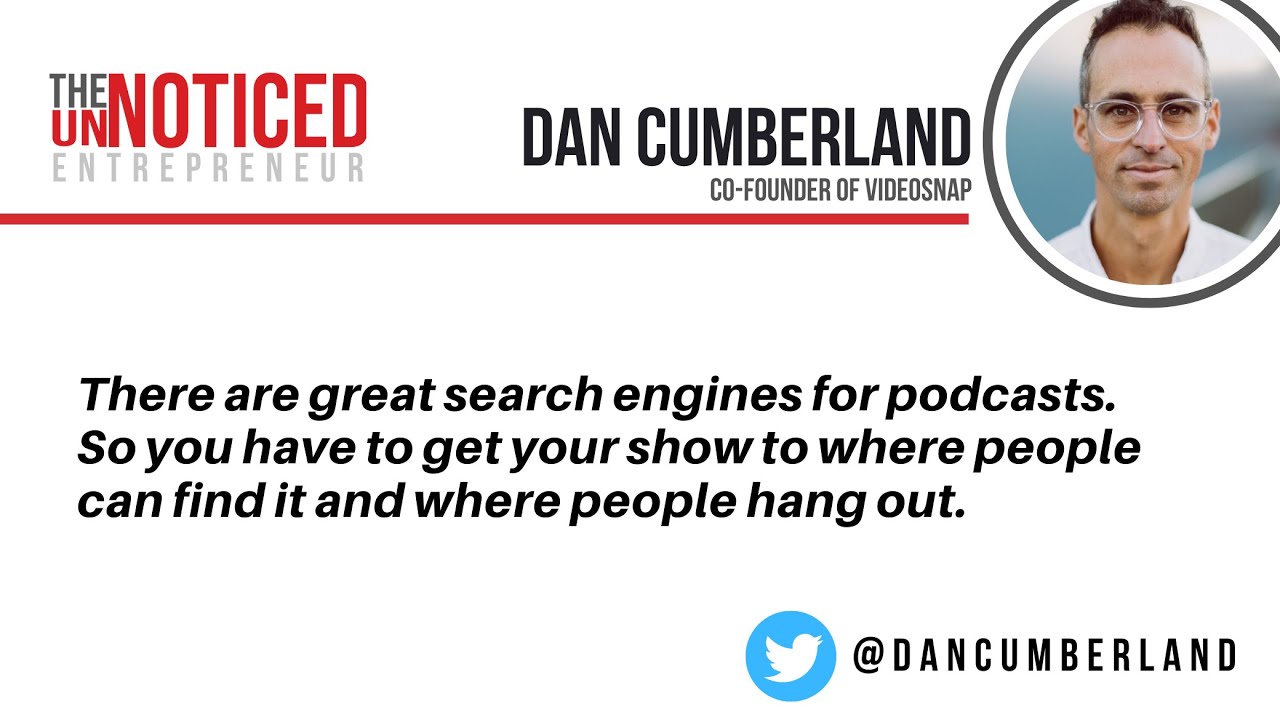
Love it. Yes, thank you. Well, VideoSnap is a tool for repurposing long-form speech-based content. So you can think of like a talk, a podcast interview, a webinar or something like that into short-form viral-ready video. We do that with a few steps that I could describe, but one of the core features is that you take someone talking to the screen typically, and the final product of that is a short clip of that, really the gold moments, those really aha moments where the person will be talking and then it'll clip to AI-sourced B-roll footage that brings to life the topics that are being sourced. Or topics that are being talked about. So whatever the theme is, the words that are being spoken, they'll be on screen in front of the person, and then it'll clip to other footage that brings to life that topic. So it makes a really fun, engaging short-form video that's ready to go on TikTok, YouTube Shorts, you know, all the places where the algorithms can get it in front of more viewers. And really this came from my own— it's a scratch-your-own-itch product. I have a podcast and I always struggled with discoverability. Podcast discoverability is challenging. There aren't great search engines for podcasts. So you have to get your show to where people can find it and where people hang out, and that's on social. So that's really where I started is how do I go about getting this long-form piece of content that doesn't do well if I just put a podcast into social? No one's gonna click on it. No one's gonna engage with it. So you wanna get it in the format that works for the algorithms that it's really about, you know, that engagement. It's really about creating something that's fun to watch. You know, that dopamine rush that people get that the algorithms favor to try to get you hooked. Try to play into that in a way that then gets people knowing who you are. knowing what your show is about and building that relationship with them.
That sounds really useful because currently if you have long-form content like a podcast, you have to create maybe an audiogram, for example, which is just, you know, the waveform, or you're trying to find ways to maybe have an interesting picture, but you're talking about actually having B-roll, which presumably is royalty-free and no infringement of copyright, presumably, Dan.
Yeah, and it's exactly, so it's an alternative to the audiogram approach and in my opinion makes a more engaging piece than just an audio. Audiograms are great, but if you want something that has more life to it and that would do better on, again, something like TikTok, you're— an audiogram's not gonna do well on TikTok, but something like this could.
Dan, and just a quick thing, clarification, would I choose the segment that I want or does it auto-choose?
Yes, great question. So the way the process works is you'll upload your long-form piece, it transcribes the whole piece, and then you can go through the text and find that section. So you have to choose it, but you just go in and you highlight the text. So, it might be a paragraph. It should be short. YouTube Shorts is a max of 1 minute. Often, the pieces that do best are 10, 15 seconds. So then, you just select that text, hit a button, it extracts that text, breaks it into these moments, and then puts that B-roll behind it with the text on the screen in front of it.
Wow. I can really see that solving, for example, my own TikTok issues or frankly LinkedIn issues, right? Because otherwise, the ROI on that short-form content Isn't great enough to spend the time to go and research and pay someone to do post-production on it, right?
100%. That's exactly right. And we were using Descript and other tools to edit the show. And then I had a content person and she would be going through the content, finding like those best moments. And then she would be going back and forth with our editors, find the piece, extract the piece, then edit it. And it's just so many moving parts with so many people, so many tools. So we've streamlined that whole process. So now that one person, my content person, you can do the whole process yourself.
Yeah, Dan, that's fantastic. And I'm sure there'll be some integrations that I'd love to try later on. For example, I'm a big user of Descript already, but I don't want to bog people down because, uh, not everybody may be quite as nerdy as I am. I love this tech. But Dan, you know, this is a show about entrepreneurs to get noticed without a budget, and I'd love to hear the genesis because you have a business which is about the Meaning Movement. And you're a photographer by background, and yet you are, I think, on your 3rd venture in tech. So can you just tell me, how are you accomplishing getting noticed in what is actually a different role to your core skill set?
I love it. Yes, such a good question. I mean, it all for me comes down to relationships and partnerships. And that's really where, just to choose one to focus on with VideoSnap, the way that VideoSnap came about Was through a relationship that I had with a friend who owned a development agency, 923.co. They're fantastic. They're a venture studio is how they think about— they're more than just a development shop. They really partner with people to bring strategy, product strategy, help you go to market in a way, not just build the thing because that's to the specifications that you want to build it, but help you find the opportunity in the market and build something that captures that. And I met Andrew Amen, one of the the partners there via a Facebook group for entrepreneurs that we were both in. And he posted an introduction. Here's what I'm up to. Here's the things that I'm doing. And I don't even remember what it was in his introduction, but I commented and said, hey, I'd love to just jump on a call and chat. I'd like to just welcome people to the group. It's not a group that I own or anything, just like to be engaged there. And then we got on a call and it was a great call. Talked a lot about sales and marketing. That's a lot of, you know, what, where my competency has been. And then that ended up being a monthly call that we would, or every few weeks we would just had a recurring event and we would just jump on a call and just kind of talk about our businesses. And ended up being just a great fun relationship. Then over time, as the idea for VideoSnap emerged and started thinking about this could be something, went to him and his team and said, what would you think about forming some sort of partnership, building something like this? And is this a good fit for your business? And it just was the right thing at the right time for them to say yes to. And that's how it's done in my life, how it has been in my life, that a non-technical 3-time software founder, and it has always come through partnerships with development developers or development shops who see the value that I bring to the table through a preexisting relationship. And then that becomes a partnership.
Dan, I love that. And so where would you classify your value and how do you frame that? Because obviously you can do that one-on-one, but then you've also got your main business, The Meaning Movement. Can you just talk about how you position yourself? Because if they're doing the due diligence on you, There's a whole bunch of communication work you're doing consciously, I know, to put yourself in the frame. Yeah.
Yeah. It's a great question. So, The Meaning Movement, as we were kind of talking about before we hit the record button, and this bit of repositioning has been about purpose and meaning in people's lives, but really focusing mostly now on entrepreneurs. We start businesses to find freedom, to make more money, to have less stress, and end up with none of those things in a bit of a prison of our own making. And there's no way back. We've burned our bridges. And so, I help entrepreneurs to build a life that they love along the journey and enjoy the journey. You know, we were talking about some of your entrepreneurial journeys and the travels and all the things that have come through, you know, as a side benefit of being an entrepreneur. So I help people around those ideas, but in so doing, I'm releasing, you know, I have a podcast that I interview, do interviews and create content there. And so there's a lot of ways that people can find me, see me, and I think build a lot of trust with me via the content that I'm producing and whether that be on the podcast, on LinkedIn or other places where I'm getting content. So I think that's a big part of it. And to circle that all the way back to Competencies, I think that in a lot of ways, one of my core competencies is relationships, caring for people, being kind and generous. But I think that translates in the marketplace to building trust, to marketing, to having an ability to see opportunity and find the right people to bring together a team to chase after that opportunity.
Dan, you know, love the way you've explained that, the need to also be kind and generous. You also though, with VideoSnaps, You've managed to get this partnership with this studio, which sounds amazing, but then you've built it. And as we know, people don't come just because you've built it, but VideoSnaps is off the starting grid. Tell us, how have you got the VideoSnaps noticed? How do you get those early beta users?
Yes, such a good question. And that is like the hardest part of entrepreneurship, right? We did our formal launch with VideoSnap, formal being I posted about it on social and said, here's this thing I've been working on behind the scenes for a long time. I hadn't really talked about it publicly. And a lot of people commented and it was great. Hundreds of engagements, which is, you know, a lot for me. And then of all of those, I think it resulted in 2, maybe 3 trial signups, right? And it's like, well, I made this thing and I'm so excited for everyone to see it. And then the conversions to users from that group of people is very low. So we make these things and we're like, okay, now come and find it. And that's not how it works. We have to go find the users. And the way that it worked with VideoSnap, so at this moment, because I like to build in public, just be transparent. As I can be, we have about 50 paying users. And so we're early and we just launched a couple weeks ago, but launched again being public. But prior to that, for the last 6 months, we have been selling it via webinars, joint venture webinars with other businesses that, that are in our network, me, myself and my business partners. And so what that looks like is looking at who we know that has users or an audience, fits a demographic that would be interested in this idea of repurposing content. So maybe they're content creators, maybe they are agencies that are, you know, doing social media or ad agencies or have a parallel kind of service that they could offer this as a service to their clients. And then we built a webinar that presents the idea, sees the opportunity that we see around short-form video and the idea of putting your content into a format that will do well in short-form video. When you look across and just, I mean, the short version of this is that whole presentation is that all social media is moving towards short-form video. All the platforms are elevating and highlighting short-form video. So I really see this movement that's happening where more and more video is gonna be where people are spending time. It's already one of the biggest search engines. YouTube is one of the biggest search engines on the internet. So to get your content where people are searching, eyeballs are already spending time, is the tool, the way, the path towards, you know, building your following, building your podcast. Or if you're an agency, there's a ton of opportunity to do that for other people that are trying to build their brand. Build their podcast or whatever it might be. So talk, go into more depth of like how people are doing that. This is what I do in that webinar presentation and then give people an opportunity to join. We sell that on an annual basis. So one of the things that we did with that first group is to get them onto an annual plan. That's the only plan that we sold on those webinars to get a little more revenue from them. Also to get them bought into the journey that we're taking on, going down with the development of the tool. And then On top of that software subscription, I did 3 days of training with these folks about how to think about repurposing, how to approach a long-form piece of content and find, think about like, what are the pieces of this are gonna do best as you go about repurposing them all the way from that to, if you're an agency, here's some ways that you can approach clients to sell this as a service and those types of things. So really kind of creating this whole package and some of it is creating more of an offer. It's not just like, okay, here's an opportunity, here's a software, but here's an offer that's compelling. That takes you, not just solves that problem that the software solves, but gives you the tools that you need to implement it either in your own business or as a service for others.
That really comprehensive approach. It sounds like you've got a lot of education as well to get people across the chasm and hold their hand on not just identifying the need and then how to solve it with people, as opposed to like, there it is, try it for X dollars a month. It sounds like you've really had to shepherd people along.
Yeah. Especially early on, right? Because you think we take for granted how complicated software is and how complicated, like a free trial. We talk about a free trial funnel, like all the moving pieces. So, you know, someone joins, how does that work? What is that user experience? Do they have to put a credit card down? What happens after that trial ends? What are the tools that that software company is going to be using to help someone make that transition from, from not paying to actually paying? All of those things, there are a lot of variables that you can't just say, okay, jump on my free trial and assume that's going to work. trials of software that are successful have been tested and often have a lot of venture funding behind them to work out all those kinks. And so, one of the things that we were doing early on is like, we don't have the tools, the time, and the knowledge to solve all of that yet. So, we need a different way to get people involved, which is why we did the training and kind of create a package that really would hold people's hands along the way.
Dan, I love that solution. And I'm imagining now you've got a core of evangelists as well, haven't you, as well as a result of that?
Yes. And honestly, I feel like that's a growth opportunity for us. How do we bring those people along? How do we connect more with them? How do we make them feel like they're a part of something, not just like, here's the software thing that I bought and, you know, I use it every now and then.
So one of the people I've spoken with talked about not having a marketing department, but only a customer care department, Dan.
Well, that's a good reframe.
Yeah, it's nice, right? And I noticed on your website, for example, that you already are using the HubSpot instant chat.
Yes.
The minute I went to the site. Do you wanna just share your vision of overcoming the communications obstacle with people that are on the website and maybe having user difficulties? Because as you say, that customer journey, many places where people can step off the path, aren't there?
Yes. Yeah. And some of what we're doing with the HubSpot speech bubble there, I'm in there paying attention when things come through. We have another team member who's responding. And what we're trying to do there is just find out what questions people are asking so that then we can improve either the website messaging, maybe the software itself. What are the changes? I mean, I have a very robust roadmap. I kind of think of it as my wishlist of all the things that I wanna change. But the software is great as it is, and it will be so much better a year from now. But we're not gonna build those things till we know that those are the right things for our users. And that's what's really one of the people who knows software, you know, I think that this isn't new. This isn't my original thought, but to take an iterative approach that you make something, you find out how people are using it, where their obstacles are. And that speech bubble is a, I view it as a tool to keep that conversation open so that when people are saying, how do I do this? Does your tool do that? How can I go about doing all these questions then are data for us to then think about, okay, here's how we can make it easier and better for them.
Dan, are you currently doing anything with media relations? Because I'm interested that you're really working from the inside out, which is counterintuitive. When companies get a lot of funding, they go big media relations first and maybe get a tidal wave of people that become slightly disaffected.
Yes. Yes.
But it sounds like you're really building from the inside out. So I'm interested, are you doing media relations as well?
We're not doing much outside of this, right? We're doing it right now because you're media. You're a piece of my media world. And so it is very much self-funded. We haven't taken any venture funding or, you know, friends and family money, though that's something that's on the table. Like we do feel like there's a ton of opportunity here and we want to move fast and capture some market. And so how do we go about doing that? Thus far it has been, you know, kind of just myself and the team trying to spread the word. I'm getting on podcasts like this to share my experience, my own journey, hopefully bring as much value as I can to listeners and also just raise awareness for people. like yourself and benefit from something like this.
But I think as well from a communications perspective, Dan, you know, I really admire your approach because you're taking, as you say, an incremental approach to software development, but also from the community and users perspective, helping people to get across the sort of using new tools challenge. It sounds like you're doing that really patiently in a really considered way, which is really impressive.
Yeah, thank you. I feel like that's how I try to do life as much as I can is add value and help people as generously as possible.
Well, Dan, you know, my final question is going to be this. If you like, secret one tip you'd like to give to my fellow unnoticed entrepreneurs from a communications perspective, ideally, what would you say is the secret to getting noticed?
For me, I think it comes back to just being generous and helpful. I mean, that might sound very broad, but to put that into the context of, your customers, of your peers, you know, I would say even potential collaborators, but all the people that you're interacting with in your life. And, you know, I believe all the good things that I've been able to accomplish as an entrepreneur have come through other people, have come through whether partnership in some way, collaboration in some way. And that only comes about by being generous and kind in how I am in the world. And so just to kind of put that into terms for listeners, that is not just about you selling your thing and promoting your things. Nobody wants that. Everyone, when they're engaging with anything, whether it be your website or with you at a party or an event, they're not looking, they don't want to hear about you. They want to hear about them themselves and how you can help them, how you can add value to their lives. So when they land on their website, if they're only hearing about you, you're missing the point there. And the same with your software, same with how your presence in their lives. So that's the takeaway that I would offer folks.
Dan, you've been very generous with your time and your insights. So Dan Cumberland, a multifaceted entrepreneur, Thank you so much for joining me. And if you want to find out about you or VideoSnaps, where can they do that?
I love that. Thank you so much for having me. You can find out VideoSnap at videosnap.io. If you'd like to connect with me as well, The Meaning Movement is my podcast and you can just go to themeaningmovement.com and find me there.
Dan, thank you so much for joining me from Seattle and really appreciate you sharing. I personally am gonna check out your software cuz I think it's gonna really solve a problem that I'm facing with the Unnoticed Entrepreneur podcast. Thank you, Dan Cumberland, for joining me on The Unnoticed Entrepreneur Show today.
Thank you, Jim. It's been such a pleasure to be here.
Thank you, my fellow unnoticed entrepreneurs, for joining Dan Cumberland and myself. If you like the show, do please review it, but most of all, share it with somebody that you think might find this insider view. So thank you once again for listening to this episode of The Unnoticed Entrepreneur.
More from Jim











2 people, infinite agents, 1 billion dollar idea #AIAgents #Startup #Productivity