How this social ed-tech helps students #getnoticed and be entrepreneurs while still studying
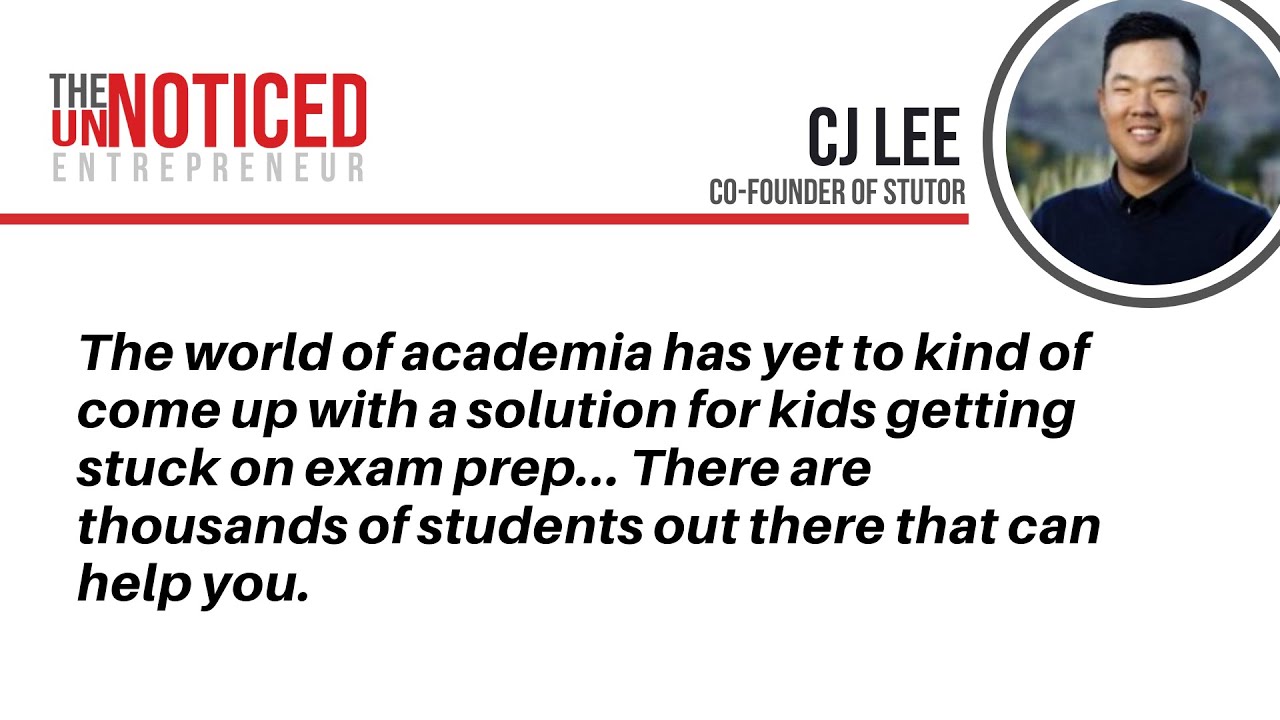
CJ Lee, a former pro golfer, built Stuta, an app that connects university students needing tutoring with peers who've passed the course. Tutors set their own rates, get verified through university IDs and video sessions, and earn money as micro-entrepreneurs instead of taking low-wage gig work.
Chapters
Hello and welcome to this episode of The Unnoticed Entrepreneur. Today we're going to talk to CJ Lee, who's actually a former pro golfer, and he is the co-founder of a company called Stooter. And he has been inventing and developing a new social edtech that will bring together students and students so one community can learn from the other. It sounds absolutely brilliant. So CJ Lee on the show today to talk to us about Stuta, welcome to the show.
Thanks, Jim. Thanks for having me.
You're welcome. Now you're gonna solve a problem that many people have got, which is that one community of students are learning and one community of students has already learned, but they don't connect to each other. And you're gonna help them do that. Explain Stuta and how it helps people become experts and monetize their knowledge that they've learned.
Yeah. Yeah. So Studer, we like to say we're kind of the first of its kind. We're an app-based platform and also web-based, but we are just connecting. We like to call ourselves, as you nailed it, social edtech. We're a social platform while also an education platform. So the general gist is any kid on any university can come on my app and say, hey, I've taken all these classes. I'm a senior or I'm a sophomore and I've taken these generals or I'm taking You know, I've taken all these major classes and I've gotten a B or B+, so I can comprehend the material. I've done it. I've completed the class. And once we verify with the university and they submit their own transcript, now they're an official tutor on my platform. So now if a kid says, hey, I need help today with Finance 201 or Writing 150 from 9 to 10 PM, or, you know, 5:30 to 6:45 PM, it pings and notifies every single kid eligible to teach that class. And so we like to kind of consider ourselves an Uber for tutoring model where we are very much just, hey, there's thousands of students that have been in your shoes that have taken your class and they can help you. So the world of academia has yet to kind of come up with a solution for kids getting stuck on, you know, exam prep. If you miss lab hours or if you miss TA hours, why do you get penalized for that? Right? There's thousands of students out there that can help you. So we're just creating a socialized network where we can facilitate that.
I think that's a fabulous idea and experiencing that as a parent trying to connect my daughters right now to people that have studied before. Now, how is Stutor different to what exists already though, CJ?
Yeah. So what we quickly found out is when I was in school, you know, Stutor was born, the idea actually was planted when I was a junior in college. I was sitting in my dormitory or in the library. It's 10:00 PM. You know, I was a former student athlete, so I, missed a lot of lab hours. And sometimes even if I did make lab hours, there's 200 kids in an auditorium and there's 2 TAs. I may not get all my questions answered. You know what I mean? If I don't show up right on time, I may just have to sit there. Hey, I have a question. And then he's like, hey, I have like 30 seconds. I'm not going to get the sufficient help I need. Right?
So CJ, look, I love the idea of matching students who have already learned the topic and students who are going to learn the topic. And in effect, making those that have already paid for their education to be able to monetize what they've learned, but also pass on the knowledge. How is Stutor different to what currently takes place?
Yeah, no, that's a great question, Jim. So for us, the expert-to-student model has existed for thousands of years, right? I mean, you could date it all the way back to the Greek philosophers of like, hey, I need a question, Socrates, can I ask you a question? Right. And so. For us, you know, I used a lot of the websites that already exist. You know, there wasn't really an app-based platform at the time. They're mostly web-based. So it was, you know, our competitors are Chegg or University Tutor here in the States. But again, there was nothing that immediately connected me to a tutor, right? We quickly found out, hey, I request a tutor and it's not even class-specific. It's just, I need help with math and it'll match me up with someone local or virtual. And the thing is, it could take upwards of 3 to 5 days. Which as a student is very precious time. And what I mean by precious is in that time you may have failed your exam because you didn't get the help, couldn't go see your professor or TA. You may have failed a couple assignments, so now you're behind the 8 ball. But for us, what we do is we immediately match up an expert, which is actually an active student. So that's the coolest thing about us is we're empowering a student to, hey, you don't need to be a scholar to teach this class. Comprehend the material, you've taken this professor. Somebody out there needs your help. So if I say, hey, I need help right now, it's 9 PM, I need it ASAP, it pings and notifies every single kid that's up and available to teach that class immediately. So that's the coolest thing about us is no more worrying about where you're going to find your help, no more waiting 3 to 5 days. And even if you did get matched up with someone off those competitors' websites that I said, sometimes you just don't really understand, right? I was a freshman in college.
Yeah.
And I'd get matched up with a 65-year-old PhD rocket scientist and he's explaining to me the theory of it all. And I'm like, I respectfully don't need this history lesson. I need help with this assignment right now. So what better source of help than a student that's taken it last semester? It's fresh in his mind. He gets it.
So a real key differentiator is actually you're matching people up that have taken the course in that specific university. before with even that professor or that lecturer. So that student's actually getting the experience that that person's had even just in the following year. Is that right?
Exactly. Yes, that's perfect.
So just tell us then about how students that may currently be, you know, working tables, delivering food, washing cars on the weekends, how are they getting into your platform? Because Acquisition of those tutors must be a key bottleneck for you.
Oh, it is for sure. So for us, we always like to tell people like, hey, why is it that students, you know, will work an hour or 2, either if it's an Uber driver or Grubhub, or if they volunteer at a local pawn shop because they need the 1 or 2 hours. It's because a lot of the times these jobs require a minimum availability of time, but as you may remember, Being a full-time student, you have a life and it's crazy. You have maybe a date scheduled or you have intramural sports or you have something came up and so you couldn't get the help. And so for us, if you have an hour or 2, you can still teach. Even if you're on a soccer field somewhere, you can hop on the virtual integrated video chat and say, hey, what can I help you with? Right? Or if you're at home and you're gaming, if you have 2 hours, why not spend it making a little money? Right? Like you can do a virtual. So as you know, COVID has really made the work from home model very popular. And so we like to say we're kind of easing the kids into the workforce because that's kind of what they're doing and they can set their own availability, set their own price and be your own boss. That's what we like to say. Yeah.
So in that sense, you're empowering a whole generation of young people to become entrepreneurs, aren't you? To sell their knowledge rather than their time.
Absolutely. Yes.
That's wonderful. Now just tell us though, a little bit about the verification process, because I think that's another aspect, isn't it? Especially in this day and age of things like security, where people will want to know that the person that they're going to be tutored by is reputable. How are you solving that trust issue? Right.
Absolutely. Great question. So for us, let's say you're in the point of view of a tutor, right? I was an active student. I would like to tutor a class. The process is I'm going to download the TutorPlus app. I'm going to register. I'm going to put in all my information. And what we require is an active student ID, an active student email, all your information that's pertinent, right? Your first and last name, just making sure that you're an active student. You upload your current classes that you're taking and the classes that you're taking right now. And you actually have to upload your transcript manually for now. And then what we do is with some schools, we verify directly. And with some schools, if we have question marks, we just kind of reach out to the student if we have additional verification purposes. And so for us, you may understand this as a father of 2 daughters, but my co-founder Tyler has 2 daughters as well. And one of his big safety precautions is, look, I have 2 daughters, one of them is going to college. I just want to make sure she's getting help. She's not going over to someone's house, especially a male. So for us, we have integrated video chat. And that's kind of a safety feature that we have. So if you don't want to meet anyone in person, why don't you just do it from your home, right? And then if something— hopefully nothing inappropriate happens, but you can always report it to us. We have the video session archived. And we can review it and we can flag them. And that's, yeah, that's kind of our process. Very simple. Okay.
That's wonderful because security, you know, is an adjunct to knowledge, isn't it? And what about reviews? Because, you know, if one uses a platform like Upwork, for example, you may get a particular vendor supplier and you can see how they performed in the past.
That's right.
What's the plan on Stuta for Reviews both ways.
Yeah. So for us, that's a really exciting feature that we have installed. When a session is done, the student gets the opportunity to rate the tutor and the tutor gets their opportunity to rate the student. Now, why you may say, well, why is it both ways? It's quite simple. I mean, why is it that Uber does the same thing? Right? It's all metrics and it's a safety precaution, but it's a value prop for us as well. So let's say a student tutor has completed 50 sessions and he consistently gets 5 stars every time. All his peers are like, you know what? Jim was really good. He's really adaptable. He's really patient with me. That's all valuable information that you can actually put on your resume that we can verify with a company. A company can say, hey, so you have 50 completed sessions on Studer and they can reach out to us and be like, is it true that James, can we see James's comments? And that's a lot of information that is probably pretty key to an employer. And likewise for a student, right? If you consistently see, if you get booked with a student that's A 1-star or 2-star rating and all you're seeing is, oh, he just wanted answers, or he was really disrespectful, you probably don't want to take that session. You know what I mean? Or it might give you a heads up. But we make it very transparent where, you know, sometimes a tutor might get a 1-star because a student was like, he didn't give me all the answers. Right? I mean, that's cause of, that's just not realistic. So you can go and read the comments that other students have said. It's like, hey, Jim was really good with me and he's taken all the classes. He brought his coursework from the past and he was really helpful. Or you can say, hey, Jim was a 1-star because he didn't give me the answers. Or, you know, it's like, well, that's not really a 1-star. You know what I mean?
Well, that does, yeah. I mean, that does seem to be the challenge, isn't it? That if someone has a tutor and then they fail the exam through no fault of the tutor, they could end up flaming the tutor, right? So how do you preserve, if you like, the integrity, CJ, in the system so that you don't get disgruntled tutees burning the reputation of a perfectly good student?
Okay. That's a great question. I love these questions. So for us, we actually have an appeal process. So if a tutor gets a 1-star, we'll reach out. You know, we have AI built into our platform. So if you have 10 5-star ratings and you all of a sudden got 2 or 1, we'll reach out and be like, hey, so what happened? And then we'll give the chance for, hey, this is what the student said. And we'll say, hey, what really happened? And then likewise, we'll go back to the student and say, hey, so why did you give him a 1-star? Or if it was a mutual 1-star, then it's probably something for us to look at, right? And that's something that Uber does. It's something that Airbnb does. It's just an integrity thing. We would hate for a student's reputation to get tarnished by a false 1-star rating because all the kid wanted was answers, right? We can manually remove that, especially if the kid is really worried about his rating.
Yeah. Cause that can be really a problem. Now, another aspect of this is the entrepreneurial aspect, right? Helping the tutee, these students to monetize what they've learned. I know in America and in the UK. Education's costing a lot of money. So people are spending thousands of pounds and dollars on getting the degree. You're helping them to monetize that, right? A much better rate than they could if they used their time and did manual labor. Tell us, CJ, how are you helping these tutees to become entrepreneurs on things like pricing, for example? Just take us through that.
Yeah. So for us, you know, one of the most exciting things is we are a very market-driven product. So what that means is. The consumer, the tutors actually in this instance, gets to set their own price, right? So if I say, hey, I would like to teach this math class, I personally think I'm valued at $10. Great. Put yourself at $10, see how often you get booked. And if you consistently are nailing it, then maybe you say, hey, I'm pretty good at this. Maybe I'll do $16 or $15, right? And then you can go up to $100. Now I'm not sure you'll get booked if you're a $100 tutor, unless you're really good. But again, that's kind of teaching students to be entrepreneurs. Like, hey, this is how much I am worth, right? This is how much that I think I'm valued at. And I think one of the coolest things is I think students will start marketing themselves. Hey guys, I'm on the Studer platform. If you need help, I've taken all these classes. You know, I'm available Monday through Friday from, you know, 5 to 9 PM. They could post that on their social media so that their friends and other people can say, hey, I didn't know that Jamie was teaching this class or Jim was teaching this class. And so I can manually download a tutor account. And I can say, hey, I would love your help, because I've heard you're really good. And so in that instance, we're teaching you how to market yourself, how to be your own boss, really managing your time, as you know, is very important, right? As a college student, that is very important. So, you know, we're going to try to take the stigma away, hey, instead of playing 5 hours of games, you can still play your games. So why not do 2 hours of games and 3 hours of teaching kids for money, right? All at the comfort of your own apartment, you don't have to go Wear an outfit, you can sit at your desk and why don't you just teach for 3 hours, make some money?
Yeah, no, I can really see how they can monetize the previous year's experiences or 2 or 3 years, I guess. It's fantastic. Quick question then, you're putting the money on escrow, are you? How are you handling payments?
So the coolest thing is I think we all can agree that the transaction of money, physical money is very uncomfortable, just sitting around. Kind of waiting around, like you just kind of look around because you don't want to see them digging through their wallet. And even through Venmo or Cash App or Apple Pay, it's just awkward to kind of sit there. So for us, we have integrated payment. You don't have to do it right away. You can shake hands like, hey, thank you so much for your help. You walk away and you can just complete the payment within a 24-hour window. And you can leave a tip if you want. But for us, we just take a tiny transactional fee, very minuscule, seriously, like it's so small. that we're not going to deter kids from popping off our platform. You know, I think I understand the big corporations, they are taking a good chunk, which is understandable, because they're so massive. I'm sure their overhead is big. But for us, we're not here to make money and tons of money off students. Our main mission is to get students get the help you need. And we just need a tiny percent to just facilitate that. And we just want you to never be stuck again. So that's kind of what we do.
I love that. Now, you've mentioned, CJ, that you're launching in the fall, which for us in Europe, autumn. Tell us a little bit about the launch strategy because you've got acquisition on 2 fronts, haven't you, of both the tutees and the tutors, right? And it's a virtuous circle. How are you going about the acquisition and the branding for Stutra? Yeah.
So right now we have a sales team, which is beautiful. And we actually have something that we didn't talk about is We actually have built a different platform for athletic administration. So being a former student athlete at the Y, I quickly saw this is just really inefficient, especially for full-time student athletes who are on the road. How are we supposed to get help? Why are we getting penalized for doing our sport? And so we built a whole different platform where student athletes get a premium membership, whether they're on the road or not, they can hop on. And we actually archive the video sessions for them. So, you know, one of the things that we do is our sales team's going out, we're pitching all these athletic administrations. And the coolest thing is they give us their student athletes and their tutors. So we already have an existing tutor base so that the regular student body can use, right? And other than that, I mean, our launch strategy is going to be, I think students are going to hop on fairly easily because they need the help. But it's definitely going to be interesting and fun to see the growth of tutors, acquisition of tutors. And we're going to, our big market push is let's take this negative stigma away from the world of academia that you need to be a scholar. Let's just get that out of the way. Do not need to be a scholar. You need to be someone that has completed the class, gotten a respectable grade. You have all your assignments and you just remember everything about that class. And some other student's gonna pay you for that. That's all we ask a tutor. You don't need to be, hey, I need to see an A. I need to see, I need you to take a test for you to be a registered tutor. No, no, no, no, no, no. We're just saying, hey, complete the class, come on my app, get paid for your knowledge, and off you go. And then with students, we're just gonna say, hey, I know you've been stuck and I know you're cramming. So hop on Studer and stop Hail Mary Google searches and stop endlessly looking at the PowerPoints, hoping that something else clicks, right? Because we've all been there.
Yeah, that's fantastic. And I can see, especially you might have some surge pricing towards exam time and people will be definitely working to get online and get booked up ahead of the time. So CJ, a tremendous journey from, you know, golf and playing professional golf to now being an entrepreneur. If people would like to find out more about you and about Studa, where can they go?
So right now we are in the process of setting up our social media accounts. So that's going to be really fun. We hope that our target demographic, which is college students and parents, they love our message and they love our marketing and branding. We've worked really hard on that, but we own the .com. So we're studa.com and just hop on that website. Well, that'll be up and running soon. And my social media is @ceej_lee. You can find me there. Feel free to always reach out to me. Tyler Crawford's on LinkedIn and we're on LinkedIn as well. So if you guys, if anybody out there has any questions, I would love to chat and would love to, you know, just educate anyone on the product.
CJ, thanks for joining me. And of course I will include all of your details in the show notes. So thank you for joining me all the way from Utah to explain how you're bringing social edtech to a whole new universe, to college students. I think it's going to be fantastic on many, many levels. So Thank you so much for introducing that to me today.
Absolutely. Thank you, Jim. Thanks for having me.
So you've been listening to CJ Lee over there in Utah from Stuter with me, Jim James, on The Unnoticed Entrepreneur. Thanks once again for taking your time to listen to this show. Do please review it on your listening app and share it with a fellow entrepreneur. Really all helps to share the word. And between us, we can all become more noticed. Thanks so much for listening to this episode of The unnoticed entrepreneur.
More from Jim











2 people, infinite agents, 1 billion dollar idea #AIAgents #Startup #Productivity