How to become an authority in your industry by using the content creation flywheel.
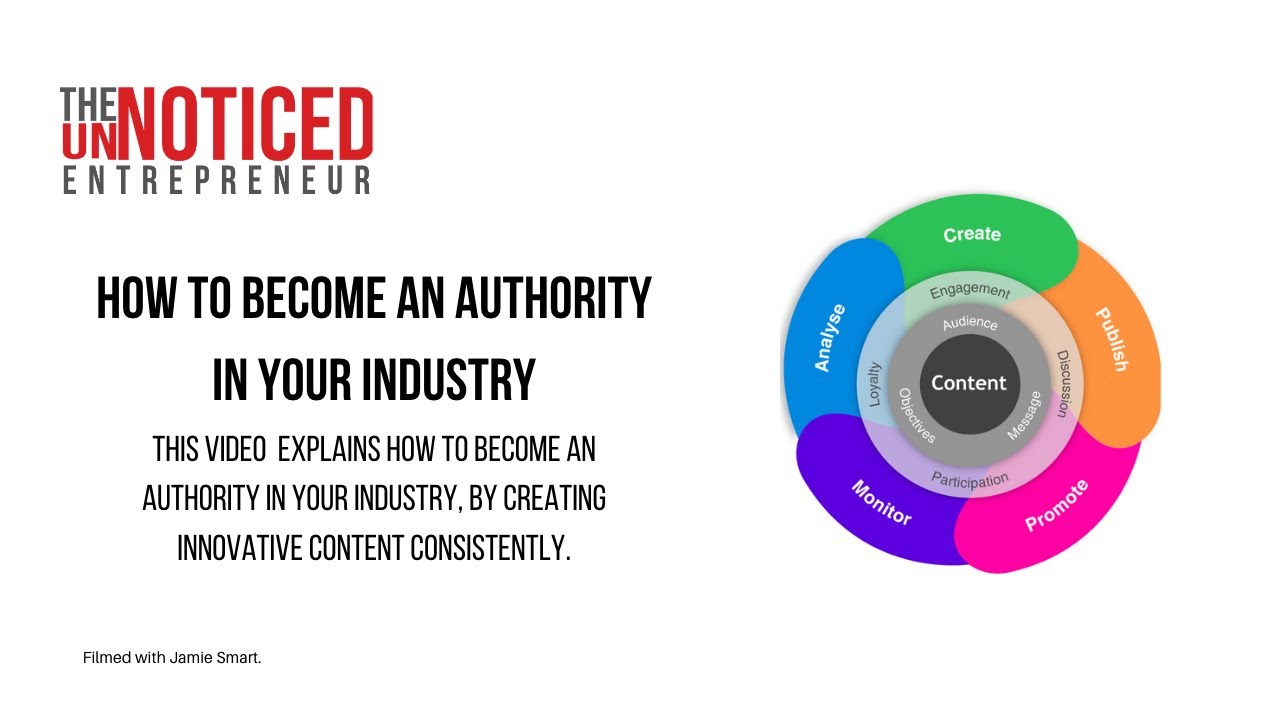
Jim James walks through the content creation flywheel: create, publish, promote, monitor, analyze. He introduces the Active Communications Index formula (content × channels × frequency) to measure consistency and move from follower status to authority. Success comes from showing up regularly across multiple channels, not mastering one platform.
Chapters
I'll record to the—
oh, did I say I'm recording? So is that okay?
Oh yeah. Oh, can you record as well? I didn't know you could record someone else's meeting.
I think I am. Oh, I think I'm literally—
I've started to record it and I've got Otter as well. So there's a couple of things to— let me just close that and close it. So, and shout stop when you're feeling that you've got too much. Okay, basically, Let me share with you first of all, this is, if you like, the potentially the sort of that, well, this is the framework, right? And at the very center, you have content and that's defined by the audience, the objectives and the message.
Can you give audience, I'm clear on, can you give me an example of objectives and message? Yeah.
So objective could be sell more books, get more speaking opportunities, get a new dealer in Africa, right? I mean, the message would be how you would translate what your organization does to that would deliver on those objectives. So, you know, you wanna launch a book, the message is I've got a book and it serves these people with this information.
Yeah, yeah, got it.
Okay, got it. And you'll see later on, um, there are, there are 3 levels to this. I'll take you through the first and the second, and we can either see how you're feeling and I'll show you the third level.
I'm a very quick study, so this all makes sense.
Yeah, well, and the idea is that it's simple, right? I mean, I built this to show PR clients and to train staff, right? That's why I built this. So the idea is that you have, you know, you have sort of 4 broad goals for content creation, right? You want to engage people in what you're doing. The next step is you want to have a discussion, right, with them. And you want to have a participation, for example, in A mastermind or a book launch or a trade show attendance, right? And the goal of that is to get some loyalty, right, to what you're doing. So those are, if you like, the mechanical elements that you're looking to have when you do stuff, right? And you'll notice this is not about which social media channel, it's not about, you know, right? It's not about that. This is—
At the principles level.
Above that, That's right. So the idea is that first of all, you create content. Makes sense. Second is you publish it, then you promote it, then you monitor it and then you analyze it. And as a result of, you know, monitoring it is the data and analyzing it gives you the what worked, what didn't work. And then you go back and you create new.
Got it.
So I call this digital content flywheel. Actually, it's any content flywheel. And this is really the basis of anything, whether it's music production. I mean, you could argue this, well, this is the framework for any content-related activity, business or otherwise. Any questions?
That makes total sense to me.
Great. I mean, it's supposed to be, I don't mean this in a rude way, it's supposed to be, does it make sense? Could you see this helping you? Let's do this in stages. Could you see this framework? Do you have a framework like this, if you like, visualized already for you and your team?
This is what we're doing. But we're good on the create and publish to some degree, but promote, monitor, and analyze, we're all over the shop on. So we're not much of a learning organization from that perspective.
So what happens is, so that's the first part. Then let me just see now. The next part is, no, I have to figure out how I do this. Do you do play and then do full screen or do you do full screen and then play on Zoom? I can never remember.
What are you looking to play?
My, here you go, Keynote.
Okay.
Do I then, does that work? Yes. Now you can see that. I kept on getting the wrong way around where you, anyway. So I've called this, are you social enough? I just moved that down there. But actually, this concept I came up with is around what I've called the Active Communications Index, right? And the research shows basically that in order for people to think of someone as, if you like, an authority, they need to come up with information that's consistent because people trust someone that turns up regularly.
Yep.
And just like a friend, or a parent, but also people want to see someone as authority that knows something that they don't know and helps them understand it, right? So that content needs to be innovative, right? And I have, I won't bore you here, but actually built a course on this, Jamie, that has information about the cascade theory and why things go viral and so on. But basically, For content to be shared by other people, it has to go from being something that people know but don't understand or think is interesting to being something that they didn't know that they find interesting but easy enough to understand.
Yeah.
So things that go viral are viral because they're a little bit interesting. and someone could share them without the risk of being asked, what does that mean? And then not be able to answer it. So all the viral stuff is stuff that's a little bit cool, but also a little bit simple. Captain Tom's a great example.
People wanna share things that make them look good.
Exactly. So, and I have a lot of background on this. I wrote a course, I think it's called Speak PR. So I have a whole body of of research behind all of this stuff, but I distilled into this. So the idea is that there are really 4 categories, right? So the idea is that if you are consistently producing innovative information, you move into that top quadrant. If you're consistently creating dull information, then, and let's face it, a lot of companies do this and you see them on LinkedIn, right?
Yeah.
They basically repost a report, right? They're what I'm normally calling a follower, right? So they're still, they're turning up all the time, but they never really have anything that people repost, right?
Yeah, they don't retweet it and stuff.
Now, the person that posts interesting things, innovative content, but inconsistently is what I'm terming an opportunist. Okay, in, in that they've got a really good something and then they go, here it is, but you weren't expecting it because they're not on a timeline, they're not showing up regularly. And, you know, these are, if you like, one-hit wonder bands, right?
Yeah.
You, you get a band, they do a great job and it's a great band and a great— or a great song even, but you never hear about them again, right? So they're opportunists. And then in the bottom left is what I'm calling the unnoticed, right? So that's the person who does dull stuff inconsistently and they're people that show up on social media every now and again with a, you know, I just got this new job.
Yeah. And you're like, so in the, in my space, in the Facebook and email space, I float between authority influencer and a little bit more on the opportunity side over the last couple of years where people will tend to hear from me when I'm a couple of months before I'm launching something new and expensive.
Exactly. So then what? I won't— I don't want to distract you with the theory behind it. But I mean, not because you don't— not because you're not smart enough, but I just don't want to lose the flow. Anyway, I'll go through it. But this idea is that The people that are market leaders, whether it's the— what's his name— Howells, Lawrence Howells or whatever, you know, they're people that you see, you know, all the time with something a little bit interesting.
Yeah.
Right. Okay. And that's the same for bands, you know, Rolling Stones, the Beatles, right? They always came up with stuff that was always fresh, but they came up with every season something new. Okay. So I guess the first question is whether you buy this concept.
Oh, it makes total sense.
The other slides won't make any sense if this doesn't come up.
It makes total sense.
Yep. Okay. And then, well, then you can tell me whether it's useful or not. So what I did was I created what I call the ACI, which is an Active Communications Index score, which basically it's a formula that you can use to ensure that your team is consistent. And I'll show you that later. But I've got some people in the Philippines working on that with with a friend of mine who has a systematization business. And what we're seeing is these huge peaks and troughs of content. And so is ACI, as I call it, which is a formula of content times channels times frequency that gives you a number. And I'll show you that anyway. So here you go. So this is my theory, Jamie, and you're kind of getting it for the first time. I built this during lockdown and then I haven't really unveiled it. So thank you for listening to it. But basically, I—
No, it's great. It's great to see.
So thank you. So the rationale is simple, right? If you measure your input to your program, you'll be much more likely to move to that top right. Because what a lot of people is, they go to the gym every now and again, have a big workout and go, oh, you know, I've lifted some weights. And what you know as well as I do is if you go to the gym consistently and do lower weights, you know, and mix it up a little bit, you'll get fit, you'll move into the top right. So the idea is there are 3 elements. It's the content you produce, but it's also the channels that you deliver it on and the consistency.
Okay.
Makes sense. Any questions on that?
No, it makes total sense.
Okay. So here, so then what happens is You know, how much content and I'll share this with you as well. And I say I actually built a course and then I kind of, I don't know what happened really. I think I sort of didn't get out and promote it. But, you know, so how much content are you creating? Right? And what is that content? Where are you sending it and how frequently?
Yeah.
Right? And this then becomes the framework that I'm working on with this group with the VA in the Philippines. It's kind of overwhelming because they're sending the same content to multiple channels all the time and getting no engagement.
Right.
Okay. Because none of it's actually very interesting because they're so busy producing.
Yeah. And that's the balance to get right.
Exactly. So that's why I'm doing my LinkedIn Live with Simon Chapizot because I realized I was in that space as well. And I'm doing that with him and I've halved my LinkedIn posts, not even half. We've gone from 4 a day to 1 a day and I'm going from zero engagement to, you know, 20, 30 people engaging.
Great.
Right. And I've got more followers than I had. Okay. So I'm sort of living my own message here. So the idea then is which one are you? Okay. So the idea is if you're an influencer and I play with the terms or authority, right?
Yeah.
So your content's innovative, you utilize optimal number of channels and you're consistent in your publishing. Okay. If you're an opportunist, your content's innovative, but you're sporadic in your—
Yeah, it makes total sense. So I flip between the top 2. I used to be super consistent and then I got knocked out by COVID and my consistency fell off a cliff.
So, yeah, so part of the reason for what I'll show you later, if you've got the appetite for it, is what I'm doing with the people in the Philippines is because if you do the theory at the outset, the other, the team can do the implementation downstream for you.
Right.
Right. And so anyway, the idea is that if you're a follower, you can see because I've got the 3 circles, 3 concentric circles of what, where, and when.
Yes.
What's happening is if you modify each individually, you'll get a change in your position, right? So if you're a follower, your content's dull, you're consistent, and you use a limited number of channels.
No, no, I really get it because I follow a lot of influencers and that sort of thing. So I can totally, like, to me, if something's not innovative, no one's gonna share it. No one's gonna engage with it.
Good. Well, yeah, I mean, it's great.
And I mean, given that what if you go back to your first slide, what you're looking to is take engagement and drive conversations that turn into conversion and that sort of thing. That's only going to happen if you in any consistent way, if you're in the authoritative influencer box. So it makes total sense to me.
Great. And in a way, that's great. Because what I kind of want you to say is this is obvious, because a bit like the Simon Sinek Start With Why, the genius is not the Not that it's complicated. It's that people go, that's good, but he gives me a framework.
Well, no, it all makes sense to me so far. And it's very much what I've been doing. But the challenge has been just getting it systematized. The way that I was doing it, Jim, was I was just running around throwing lots of energy at it. And I was doing, I was staying in the authoritative influencer box by throwing lots of energy at it because we couldn't get it systematized.
So what I've done then is to say, okay, if you're an influencer under content channels and consistency, you know, here's what you need to do, right? And then I've done the same for if you're an opportunist and if you're a follower.
Oh, can I see? Can you go back to influencer? And I just like to read through it.
Yeah. And I could share this with you.
I mean, oh, I appreciate it. Thank you.
So the idea is under content, you know, I put here about if you're, if you're an influencer, sorry, move that camera. Maybe what I do is I just, that you can think about your content becoming IP because it's not that when you're an influencer that it stops there, right? You've got to the pinnacle in terms of people following you and having innovative content. Now it's about how you monetize that, right? How you ascend to the next level of your business.
Well, so that part of it, so my business, Jim, we've very much, we're good at the—
Yes, you've done that nicely.
The ascension and generating income and all that sort of stuff. What we haven't been able to do well is get our flywheel working in a way that works well. Like I'm going on holiday for a week and I know nothing will happen while nothing will happen content-wise while I'm on holiday because we don't have anything automated.
So what I'll do is I'll show you something I'm working on with the Philippines where I took this and I put it into an Excel spreadsheet. So let me show you.
So basically, I've got a hard stop at half past, by the way.
Yes. Well, that's why I'm like, well, maybe the thing is we do what we can. Today. But basically, you know, the idea is this is the system. And then what I always want to show you was, um, so what I put online here— let me just see if I can find it. If you've got a hard stop, um, yeah, okay. Can you see my screen?
Yeah, yeah.
Okay, so can you see what I did then was I, I took that, you know, And I actually called, actually gave, I changed it slightly and gave it different names. Although it's a little bit force feeds it a little bit. It in a way makes it a little bit harder, but it makes a nice anagram. But basically the idea is that what you do is you storify your business. Okay. Then you personalize like—
Oh, I may be looking at a different screen. The one I am looking at says this is the process, the 5 stages to consistency.
Oh, sorry. Can you see this?
No?
Yes. Okay. Yeah. So basically you've got here. Okay. So this is now I put this in the sky, right? So basically here's your key message. Okay. And then how you personalize that because you've got internal partners and external audiences, right? Okay. And then how you engage. So what I did here was I created, you know, what would be your story that you'd be giving? So what the people in the Philippines are doing for Steve is I've got them to start to think about, not Steve just, Steve says this week I did something because my son found, you know, and he's like, well, hang on. So the idea is by putting at the beginning what the key messages are, where he's going, you could then say, for example, Tuesday for external audience, because we've already done the story is, you know, training clarity, clarity, the new book, whatever. What you could start to do is say, okay, here's gonna be, here's gonna be a story on, you know, chapter 2, right? Here's gonna be a story on chapter 3, whatever, right? So you start to mastermind this out. And then what I did here was I started to put down some of the channels that people can use.
Got it.
And then here's a worked example. And then the knowing, which is, I talked about this ACI. And I've been playing around a little bit with whether you have content times channels and frequency. But actually, because you can repost the same post, you get more frequency. So I've been sort of— this simplifies the equation a little bit, but it sort of misses out. This is then the what and the where, but doesn't talk about when.
I've gotta go. You gotta go, mate. I really appreciate you taking the time. This is very, very interesting. Can I— can you leave it with me and I'll reach out to you again? I'll also have a think. My podcast's very much aimed at coaches and therapists wanting to grow their business. So if you think it would be a good opportunity for me to interview about— I'll repost our conversation. But if it would be a good interview, let me know.
Absolutely, Jamie.
I gotta run, Jim. Thank you very much.
I'll send you the links to the content I've shared with you today.
I appreciate it. Thank you, sir. Be well.
Bye-bye. Thank you. Ciao.
More from Jim











2 people, infinite agents, 1 billion dollar idea #AIAgents #Startup #Productivity