How to Unlock Your Unique Genius
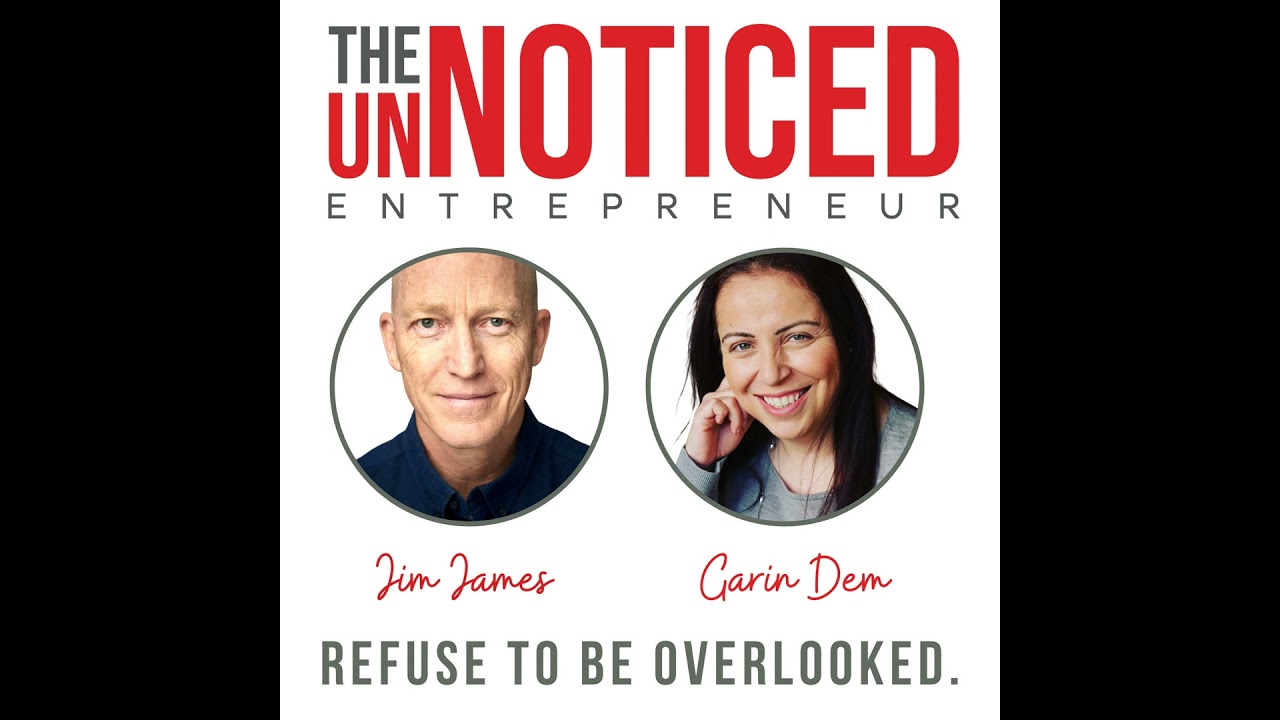
Garen Dem, a former corporate trainer, explains how to identify and monetize your unique genius as an entrepreneur. She advises picking one platform that fits your audience instead of spreading thin everywhere, building social proof through testimonials and personal stories, and treating sales and networking as learnable skills rather than innate talents.
Chapters
Hello, welcome to this episode of The Unnoticed Entrepreneur with me, your host, Jim James. And today we're very lucky because we're going to Los Angeles, to the beautiful part of Southern California, to meet Corinne Demme, who's going to join us and tell us about how we can start our own businesses. But also, for those of us that have got our own businesses, she's a consultant that helps people with mindset. So if you're having some challenges around self-confidence or breaking through some issues. Corinne's going to give us some great guidance there. She's got her own business, of course, so she's going to tell us why she's not using LinkedIn to build her consultancy, one mistake she's made, a tip you should definitely bear in mind, and her book that we will all want to read. Corinne, welcome to the show.
Hi, thank you for having me.
All right, it's my pleasure. Now, you started your own business, Corinne Consulting. Tell us about why you started the business and who you're helping and how.
Sure. I started because I was working in corporate. I was working tirelessly for somebody else, and I just didn't want to do that anymore because I thought, and I knew that there was something better out there for me. And I wanted to help others do the same because I was working with training and development in the corporate space as well. And I knew that everybody had a unique genius to bring to that table. And there was room for everybody.
So when you say there's a unique genius in everybody, that sounds nice. And maybe a little bit— I'm being cynical because I'm British, you know, and you know we are. But does it sound a little bit nice? I mean, surely not everybody. has a genius in them that they can monetize?
I disagree. I think that everybody, if they put their right mindsets to it and they have something to give to the world, they can absolutely monetize it. It is a lot to do with you bringing— being authentic and you marketing yourself the right way. You can monetize it.
Well, let's start with mindset because many people, especially that have worked in corporate for a while and especially people that are returning from parenting duties, both men and women, by the way, I can say as being a dad who's been a lot at home with my daughters, that you get out of the swing of things, right? And you feel a little bit slow. How do you help people to recover their self-confidence? Or that's the first part, and then decide what they should focus on to build their business around?
Sure. The first thing that we can all agree on is that we're human and we all have our ups and downs and we all feel like we're imposters or, you know, this isn't for me and what am I doing? We all feel that way. So it is okay to embrace that, to say, all right, I'm human. This isn't a good time right now, but we're going to learn. And everything I believe is learned, like sales is learned. I believe that owning a business, it is all a learned behavior. You're not born with this networking gene or this sales gene in your body, right? And it is all a learned thing. So that is the first thing that I would say that we all have the time to heal and the time to learn and the time to grow and to absolutely learn how to become an entrepreneur and how to become a successful entrepreneur. The second thing would be that to know that there is room for everybody. There is room for you. There is room for what you can bring to the table. And at this day and age, you can Sell your stuff globally.
Yeah. And I think as, as we're doing today, you and I, you know, you're in LA, I'm in England, and it, it is a global market. So you don't even need to find very many people in each country, and you could have a business that sustains you, couldn't you? What would you say are some of the, if you like, teething problems or, or, or some of those early obstacles that entrepreneurs get stuck with and how do you help them resolve those?
Yeah, absolutely. Part of it is they, they, they assume that they need a website or they assume that they need to be on every social media platform or they assume that they might need a brick-and-mortar type business. And those are the few things that we, we have gone through, that I have gone through when I used to do one-on-one. But these are the things that I teach through a lot of my stuff on my website with my blogs or my guest appearances on podcasts or the Business Growth Accelerator on the courses that I do have. Those are a lot of the things that I do teach that you don't necessarily need a website and you don't need to be on every social media platform and you have to find the audience that is best for you. So if LinkedIn works best for you, then get— then focus on LinkedIn and get on that. And if, if it is, um, Instagram, then be on Instagram. And you don't necessarily need a website. You can utilize those platforms as your website.
Well, presumably as well, Guerin, people ran businesses before the internet was there. And, you know, it's very possible to sell locally, uh, offline. altogether, you know.
Right.
And I think sometimes we forget in this sort of headlong rush towards digital that there are many, many goods and services that are about human interaction and human touch, human delivery, whether it's food, personal care services, and so on. In terms of the kind of work that you're needing to do, what about looking at the sort of personal brand And how you help people to find both what they stand for and how they represent that proposition. If you're saying you don't need a website, you don't need this, are there some, if you like, starter ideas of how people can do it that are maybe a little bit less conventional?
Oh, less conventional. Well, I would say to get on one of the social media platforms because it is a digital age at this time. The less conventional thing is to not necessarily be on everything, or you don't need to dance your way to get people to pay attention. You can do faceless. They don't have to see you specifically, and your brand can be a faceless one and just about your product and what you do. And they will still resonate with what you're selling and what you're wanting to monetize.
Yeah. But I think you're a big part of what your sort of proposition is that if you've got a unique genius, that you are bringing your personality out. And on your Instagram, you've got 5,500 followers, which is outstanding, right?
Yeah.
So you've already been building that business. How have you been able to build your own brand because you started from corporate and that's a big shift both in terms of mindset, financially we know that that's a challenge for most people going from paycheck to invoicing and debt collection.
Correct.
Tell us about that journey and how you managed to sort of reposition yourself so that people saw you as an entrepreneur and someone to hire as an independent consultant rather than employee?
Well, it was— it started for me in the beginning. So I had to be in the right mindset to turn around and say, well, I do have something to offer. I've been doing it under this corporate umbrella. And I was able to do it. And I was sought after in that corporate umbrella. So why wouldn't I be sought after without that corporate name behind me? So I had to do a mindset shift to understand like, okay, you know, I am able to do this and people are listening to me. I don't have that, you know, corporate name behind me, but what's the difference? I'm still me. I'm still authentically me. I'm still teaching the way I know how to teach and show people how to take themselves to that next level.
So the challenge with interviewing you is that you are fundamentally optimistic, Garen. That's the thing. I'm like, I want to find an obstacle, be like, no, I don't have any. I'm fundamentally optimistic.
No, no, there is.
No, and I mean that.
There is an obstacle.
Go on, you tell me your obstacle. Tell me your obstacle.
So at that moment, the obstacle was, at the end of the day, even though I believed in myself, a lot of people didn't because they wanted that corporate name behind me. That was that obstacle.
Exactly. And that's the thing many people realize, that they're sought after in an organization, and when they go outside, people say, well, Actually, I bought the organization. It gave security. It maybe did different types of billing and so on. And there's often some loyalty attached to a company. So, how did you overcome that? Because did you sell to the same clients but in a different guise, or did you have to go find new clients?
Both, actually. But I did start with the clients that I already knew and I already had. And I started with them. I got them to give me testimonials. I got them to, you know, I gave them a lot more value for what they paid for to get those testimonials for my site, for me to then learn and grow for myself and them give me actual feedback to be like. And they, I think, were a little bit more honest because I was on my own instead of under their corporate umbrella. So they were honest to say, well, I don't like this and you should do that. And I was like, all right, I got this kind of thing.
Yeah.
And then from there, I would always ask them for referrals. That's the biggest thing. Don't be afraid to ask for referrals, ask for testimonials. And they introduced me to this person or that person and so on and so forth. And then my confidence grew and then I knew what to posts on social media because it was the same questions that I was getting.
That is wonderful. And I think you've covered a couple of things there. One about just asking, which is often the thing that we don't do if we're in a big company because the leads come to the organization, right? And we receive them. But if you're on your own, you have to be the organization and receive them, right? So it's fundamentally different structurally. And that you've got testimonials, uh, to leverage off. That's fantastic. Right. And in terms of the, the sort of, um, messaging that you've used, have you been able to say, well, I'm no longer a corporate, you know, I'm going— you're getting the real, the real me, the real deal now? Or is— have you sort of carried on the same messaging From the corporate to the individual?
At first, I was carrying on the same message, I have to say, because I thought that that was what worked. But then I realized that I am, I'm quite direct. I'll tell clients or I will teach clients like, you know, this is what it is. And, you know, this is why you're not getting, you're not finding clients yourself, or this is Why your stuff isn't working, and so I realize that I have to be authentically me. And oh, there's my dog. But I have to be authentically me, and I have to show people like this is what it is, and this is or like the truth about stuff and the myths and the top tips that I can give you. This is what. You need for your business. And so the best thing for me to be is authentically myself and for me to bring my unique genius to show how you can lead and start a business with authenticity, with integrity, and find that people that are going to buy your stuff.
Yeah, that's really wonderful, Gerriann, because you're really leading by example there. Aren't you? You know, because you're building a business yourself in public, as it were, right? And for those that are going to look at this on YouTube, you'll see Gerin's, uh, lovely dog. Uh, is it a Labrador?
Is it?
I think he is.
No, he's a Jack Russell and Dachshund mix. He looks bigger on, on his pictures, but he's like a small little dog.
Yeah, but so we're seeing you, and I think that one of the messages there for me is that it's okay to be It's okay to be me, if you like. Yeah, it's okay to be you, whichever way around we phrase that. Yeah. And that— so were you ever worried about that looking unprofessional, that, you know, here you are trying to talk about money and closing sales and so on, and yet you've taken a very human and, if you like, person and canine-centered approach to your marketing?
Um, yes, I— in the beginnings of my business, I thought I have to be professional because I'm working with professionals and they're used to being professional. So I have to be professional. And I was always very well put together and spoke very in a very professional manner. But then I realized that if you are working from home and you're wanting to monetize your passion and your passion isn't necessarily in front of a computer. It could be, you know, making food and cooking and whatever it is. So why, like, it doesn't have to be in that corporate professional way. It is, I am professional, of course, because it is a business, but it is a more human connection. Like you said, it doesn't have to be like stiff and corporate.
Yeah. And I think that's a really good point that you align yourself with your customer group. both in terms of lifestyle and perspective. And yet running through that is your expertise of business consulting for those people. So you're very much sort of in and among the clients, but serving them with a specific set of experiences that you've got. And I love how positive you are on your Instagram. You have, you can do anything, for example, right?
Yeah.
So you're fundamentally coaching sort of optimism as well. I can see that, which is wonderful. Now, Blaine, you've come a long way in just 3 years, but we've all made one or two missteps. Uh, and the goal of this question is not to embarrass you in any way, but just to say, is there a— is there something that you would say to fellow entrepreneurs and to your clients, you know, don't try this, this one isn't a great idea?
Um, I would say don't try a lot of things on your own. It's okay to seek help. Like, I did a lot of, um, advertising on my own without knowing what I was doing, and I wasted a lot of money, um, advertising, uh, like either through Facebook advertising or Instagram advertising. And I thought, oh, this is great, and Let me throw this post out there and advertise it and spend that money, and it flopped. It went nowhere because I didn't know what I was doing. I didn't know the things that I needed to do on the background of it. So there are certain things that it's okay that you seek help yourself and you seek professional help on your own. Like you can do things on your own, but then there's a lot of times where. Just get someone else to do it.
Yeah. And I've, I've lost track of the number of people who've lost so much money on Meta ads that have not generated anything.
A thing, anything.
Yeah. Most would be better off going and buying people free coffee, uh, you know, and entertaining potential clients in person. Um, is there something that you would recommend that you are finding Working, I mean, playing the Instagram, you're living a life quite publicly there. Any other sort of strategies that you do recommend as sort of a takeaway or number one tip for entrepreneurs?
I think that a lot of it is to show yourself. I did say that you can do something faceless and you don't have to show your face and you don't have to dance or anything like that. But Showing that I'm a real person, like especially with my dog. I think that when I show my dog or I show my family or I show a little bit of my personal life, it resonates a lot more. I get a lot more engagement from people when I show something personal and what I was doing. Like there was actually, speaking of Meta, I had one of my Facebook Accounts, my personal Facebook account kind of disabled. And I was talking about that and that got the most engagement because it's something personal and something that happened. And I was like, yeah, I own a business and my Facebook account got disabled for— because of bots. And that resonated the most. So I think that the takeaway is like, be yourself and talk about anything else. You can tie it to your business, of course. When I say I love my dog and I can hang out with my dog all day long because I'm at home.
Yeah.
You know, so I can tie it to that. But people love seeing pictures of my dog and they love, you know, trying to get to know me even though they live across the pond, as they say.
Yeah, that's so interesting. So you've got clients here in the UK, presumably, uh, and around the world. It's tremendous. As you say, you can even live your own passion, and are you living proof that you can build a passion into a business?
Right.
Gherin, I'm always so inspired by people like you, and you obviously listen and learn from other places. Can you share maybe a book that you've been reading or have read and what you've learned from that?
Absolutely. And funny enough, it's actually right next to me, um, because I'm rereading this book. Um, I recommend it to everybody. I'm gonna grab it. Um, it's called Traction: Get a Grip on Your Business. This is it right here. Um, I— I'm rereading it. It's actually a great book. Um, I recommend the book, not necessarily not the audiobook, because you can write in there and highlight and and all that stuff. So I think this is wonderful about your business. And, and that's, you know, if you have a grip on your business, pretty much.
And, and the author of, um, Traction is Gino Wickman. Gino Wickman on Traction: Get a Grip on Your Business. And that's the expanded edition. So plainly he's, he's heard you're growing your business and he's had to go back and rewrite it so that They've got, you know, they can accommodate your next level of business growth. That's fantastic.
Yeah.
Garen, if people want to find out more about you, where can they do that?
Absolutely. It is my Instagram, which the handle is garen.dem, and my website, which is garendem.com.
Garen, thank you so much for joining us and giving us, you know, so much positivity and energy and, if you like, motivation. that we can be ourselves and have a business in complete alignment. It's wonderful. Thank you so much.
Thank you. Thank you for having me.
It's been amazing. So, Garin— and I, I'm afraid I've called her Garin, so I think Garin Dem is, I think, correct, right?
Yes, it's okay.
Okay, good. I, I apologize. So, Garin Dem is Garin Dem, and, uh, we will of course put her details in the show notes, and you can obviously find her on Instagram as well. And What an amazing story, building a business from corporate into her own consulting practice, growing it globally, and really living out the methodologies that she's explaining, introducing. And she was explaining to me she started the business because she needed someone to do what she's doing. And she's taken that and built it into a business that serves both her own wellbeing and that of her dog as well.
Right.
But also her clients.
Yes.
So, Gurleen, thank you so much for joining us.
Thank you.
So we've been to LA today. Fantastic. What an amazing journey all the way here from the west part of England. My name is Jim James. And if you've enjoyed this, do please share a review. It really helps. And to follow the show so you don't miss another episode. There are now over 700 episodes of The Unnoticed Entrepreneur, which also then have been made into videos, over 700 episodes on the YouTube account. And in 2 books because we make these into articles as well. So plenty for you to read and to learn, but a great takeaway to explore your genius and be yourself. Thank you so much for listening to me, Jim James, your host on The Unnoticed Entrepreneur.
Okay.
More from Jim











2 people, infinite agents, 1 billion dollar idea #AIAgents #Startup #Productivity