Is the number one result on Google the best spot for you? With John Horn.
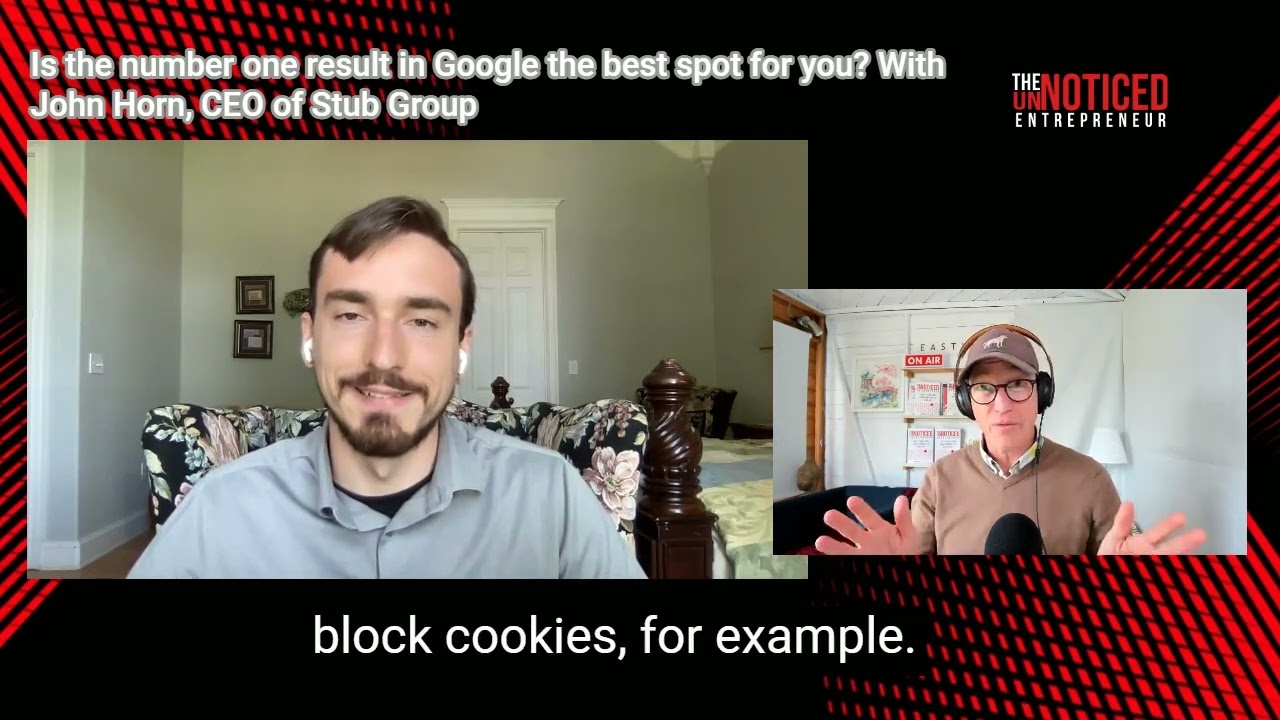
John Horn, CEO of StubGroup, explains why the #1 Google ad position doesn't matter. What matters is profitable ROI. Start by working backwards from your margins and customer lifetime value to set realistic ad spend, then optimize bids, quality, and targeting to hit that number.
Chapters
Hello and welcome to this episode of The Unnoticed Entrepreneur. Today we're going all the way to Fort Worth in Dallas, Texas. John Horn joining us from the StubGroup. Welcome to the show.
Jim, thanks so much for having me.
Now just tell us then, because you are the CEO at the StubGroup, which specializes in Google and Google AdWords and leads. Go, please tell us how on earth can entrepreneurs get noticed using Google and Facebook ads?
Absolutely. Like you mentioned, we focus on Google and Facebook, other platforms, really anything in that digital advertising space. And we're helping businesses get noticed by connecting them with people who are searching for the products or services that they sell, or even people who don't know to search for it yet, but who need to be made aware that those products exist. And so whether that be the Google search engine or people scrolling through their feed on Facebook, we're helping companies get in front of the right people at the right time.
Great. Now it seems for many of us that Facebook, Google Ads, it's become very complicated and very tech heavy. Is it beyond the reach of the sort of growing entrepreneur or can anybody do it?
That's a great question. And that's a question that we're asked often by businesses saying, hey, do we need to hire a third party to help us or can we just work directly with the platforms? And really the answer is, is both and. So You can DIY Google Ads or Facebook Ads, and they both platforms put a lot of money into advertising to small businesses saying, hey, come and do it through our platform. And you can do it. But the question is, are you going to get good results? That's the more hairy question. Because as you mentioned, those are very complicated platforms to work and figure out how to profitably spend money. And so that's why there are lots of agencies like StubGroup who This is what we do every day. We eat and breathe and figure out how do we best leverage the algorithms to maximize the return that we're driving for our clients. And also how we can spend that time for our busy clients who are also trying to run a business and execute the work when they're selling. And they often don't have time to spend in the account seeing what's working and what's not working.
I think you've raised a lot of really good points that not only time is money, but also if it's spent badly, then it's worth it, not worse than spending it at all. So, John, just tell us and take us through, a company comes to you and says, help, John, what should I do for my internet advertising? Take us through how you build a campaign.
Absolutely. Place that we start out is looking to understand as much as we can about the business who's coming to us. So understanding their numbers, what can they afford to spend to acquire new business based upon their margins? Let's say if they're selling products, you know, what are their profit How much is a new order worth to them? Also based upon the lifetime value of a customer, are they going to be a one-and-done customer or are they going to be with you for years? They create revenue. So it's about figuring out those numbers with businesses and then translating that on the advertising side to say, okay, well, if we can afford to spend X, you know, $100 to acquire a new customer, well, let's look at the cost of traffic. How much do we need to pay to get relevant people to the client's website? And let's look at conversion rates. You know, what can we reasonably assume How many of those people getting to the website will then actually take the desired course of action to purchase that product or fill out that form or call the client? And so we try to work our way backwards from the client's numbers to what's realistic in the advertising space to either say, you know what, we don't think it can work because the numbers just aren't there, it's too competitive. Or, you know, hopefully, ideally, hey, yes, we see opportunity here. Let's go ahead and test it out and start spending money, start Getting that good data, that good traffic, and then optimizing and improving over time to hit those goals for a client. And a big part of that too is figuring out what platforms should we use for that client. And we want to start out typically with the lowest hanging fruit. You know, where can we get the biggest bang for their initial buck and then work and scale from there? So if it's a client who's selling something that people are actively searching for, typically those people are going to be searching on Google. They're going to be typing in whatever, plumber near me or best software to use for this reason or that reason. And so when someone types that in, we want our client to be a solution that comes up for that. And the best way to do that typically is through advertising and then testing messaging and figuring out how to get those people to our client's website.
So you raised a really good point about the way that now it can be so targeted and also so finance-driven. John, you talk about the ads and obviously there are competing ads now. If you do a search, you say for plumber near me, you get multiple. How important is it to be the top one in that list? Because if you're a smaller company, you might still need to be on that list, but presumably the bigger brands have already well established in the campaign market. So how important is it to be number one as it is on the search rankings themselves?
That's a fantastic question because a lot of people, they have it in their mind, I have to be number one. Business will come to us and say, can you get me to be number one on Google? And what we say is that's actually not the right question to be asking, because the way that things work with Google, it's an auction. And what happens is you're telling Google, hey, these are the types of keywords or searches that we want our ad to show up for. Here's what we're willing to pay for that traffic. And then there's an incredibly dynamic auction that takes place every single time that someone searches on Google, where all the different advertisers who want that type of traffic are competing against each other based upon the quality of their ads, how likely someone is to click their ads. as well as how much they're willing to pay for a click to have their ads show up. And so you might have a scenario where, hey, yeah, being at number 1 is fantastic, because a lot of people click the first thing that comes up. But then you might have scenarios where, you know what, it's really expensive to have that first position often, but second or third or fourth position are much less expensive. And that works with our numbers, we're able to be profitable when we get traffic from there. So it's less about targeting a position, and more about having a really good foundational strategy of going after the right people with the right bids and numbers and best ads on your side to hit your goals, your profitability goals, whatever those goals may be.
Right. And so that's really reassuring actually for the, let's say, the newer business or the entrepreneur that's competing in a category that may be saturated. It's still possible then to get leads. And now when we advertise to someone, it's often just the beginning of a journey. Isn't it? So can you just explain to us, John, how does StubGroup then help, for example, on the whole customer journey and through the funnel? Because someone may see the ad multiple times before they make a decision. So perhaps you just explain how that can work for somebody.
Yeah, absolutely. That ad that someone is seeing is often their first impression, the first engagement you're having with them. And it might be follow-up engagements too. Like you mentioned, a lot of people will see multiple ads before clicking or even during the process as they're researching you as a company. And so that first impression is important, but then where are you sending them if they click on that ad is just as important because if you're spending lots of money on getting people to your website and then you've got a website that, let's say it doesn't load quickly and people just get annoyed and click back before the content even loads, or the website you're sending them maybe to your homepage where you've got generic information and they've clicked an ad talking about a very specific problem and they say, oh, this isn't relevant to me, click away. You're going to be wasting all kinds of money on that ad spend. And so we help our clients think through who are we targeting, kind of where are they in the conversion funnel based upon what they're typing in? Are we going after people who need to be educated first about why they need your product? Or are we going after people who've been through that and they're just, you know, about ready to make a decision and they're looking for the right place to go with? And so we help our clients think through those realities and try and craft the landing pages and where we're sending that traffic on the client's website to best match those pain points that are in the mind of the people clicking through those ads and that are best suited to funnel them towards whatever action we want them to take, whether it's placing an order or making a phone call or filling out a form or, or whatever that action is.
So I've got to ask one point about the customer journey is it doesn't all take place on the same platform, does it, John? What about this sort of transition from desktop to mobile? And now location-based advertising. Is that really making it too complicated to use Google Ads or Facebook Ads, for example?
Yeah, that's something. It's been a reality for a long time. Traffic from mobile devices has been more than 50% of total traffic for 4 or 5, maybe even 6 years at this point. So it's been something that we've been working with for a long time. And it definitely, it makes it more difficult to track the journey that people are taking if let's say they they start their research on their phone when they're riding the bus. And then when they get home, they go to their computer and go back to the website, or maybe they see a Facebook ad and they click through that. So there's a lot of segmentation to that journey, a lot of different data points and fragmentation. But there's a couple things that we look to do to try and, you know, make that a unified journey in terms of what we can see on the tracking side. Some of that comes down to tracking and identifying people across devices or across platforms. And there's a lot of ways that we can do that with the tracking codes that we can implement for clients. And then some of it is, you know, testing and kind of modeling out and saying, okay, you know what, we allocated this amount of ad spend to this platform. We know our tracking is not 100% accurate, but we can look at different date ranges and say, did we move the needle during that time period when we did this? You know, what happened in terms of sales or traffic to the website? And then when we tested this different thing, how did that change? And so a lot of that comes back to ongoing optimization and measuring as much as possible about what's happening with the traffic we're driving to the client's website.
Wow. And then you mentioned there about moving across to the client's website with the tracking. How are you being impacted by the ability of consumers now to block cookies, for example? Is that making a big difference? You're getting lots of like black holes now on that customer journey?
It has definitely made it more challenging. One of the biggest single challenges on the tracking side of things that has happened recently is Apple last year when they did their iOS 14 update and made it very easy for people on iPhones to opt out of being tracked across apps and mobile websites. And what that has done is it has made it more difficult to track the journey and to do the types of targeting that ideally we'd like to be able to do. But it just means that we need to take different strategies because at the end of the day, the people are still the same. They're still using the devices, they're still looking for these products and services. And so we have to just get more creative about, for example, on the Facebook side, we're going to run Facebook ads, we have less actual tracking visibility, maybe let's send all of our traffic to landing pages just built for Facebook. So we know that people coming through the forms on those pages came from Facebook, even if the Facebook tracking pixel isn't able to track, you know, every single one of those submissions. So things like that you can do. And then Again, it's about going back to the basics of, are we running good campaigns with good messaging that send people to well-crafted landing pages that actually meet the needs that they have, and then, you know, trying to fill those gaps in as much as possible on the backend.
So you mentioned there about good campaigns. John, can you give us, you know, one or two tips on what makes a great campaign? What makes a great ad? Because you'd refer earlier on to the fact that you know, the algorithm chooses not only the most sort of well-paid, but also the best creative ads to show.
Absolutely. A lot of people, when they talk about good campaigns, they focus on what we call vanity metrics. So they're saying, oh, I got X number of impressions on my ad, so many people saw it, or even so many people clicked through, I've got a great click-through rate. But none of that really matters if that's not increasing your bottom line as a business. So what we care about as a good campaign is, are we making you more profit? Are we getting you whatever your KPI is, whatever that key performance indicator is, it's actually going to make you money? Is this campaign doing it? And then are we able to scale that and continue doing that better over time? So that's a factor of the conversion rate of the traffic we're driving, as well as the click-through rate of people who are seeing our ads and then clicking through. And that goes back to the messaging, to the targeting, and even to the tracking on the backend.
John, can I ask a question about the difference between B2B advertising online and consumer or B2C? Are there any sort of main differences that your clients need to take account of between the 2 different disciplines?
Yeah, we do a lot of space in both and there's definitely differences between both. One thing that often comes into play is the time lag between someone clicking on an ad, for example, and then actually taking action on a client's website. Often in the B2B space, you might see a longer time lag as, you know, a business researches multiple options, maybe puts out, you know, quote requests, quotes from different vendors, things like that. And so you have to factor that timeframe into your campaigns and even into measuring whether something's been successful. So if it takes a month for someone, you know, between filling out a form and them actually making a decision to move forward with you, when you look at your data to analyze how much money you're making from your campaigns, you got to factor that into that. Okay, we've got this pipeline in place. Here's what we can can expect to get moving forward, stuff like that. On the consumer side, typically it moves a little more quickly. Now, certainly there's, there's plenty of times where there could be a longer lag as well, especially if it's higher price point product or service, but usually it's going to move a little bit more quickly there. And then also you've got to take into account on the business-to-business side of things, often the person that's initially seeing your ad or getting to your website, they might not be the decision maker. They might be researching on behalf of their superior, or, you know, they might be one stakeholder out of 5 or 6 who have to sign off. And so you want to make it really easy for them to have information to share with those decision makers and be able to, you know, get that buy-in from stakeholders and clearly understand their mind, what sets your business apart. Whereas on the consumer side, you know, maybe they've got to check with their spouse, maybe not, but, you know, you're often working with that decision maker. And so that process looks a little bit different.
Yeah. Okay. Really good insights there. And what about the creatives, John? Does it make a difference to have just text, which presumably is less expensive, or have infographics and video? Any guidance at all on the ROI between those different formats or even audio now?
Yeah. So on the advertising side, really the placement and platform is going to dictate what type of ad you're running. So for example, if you're on Google search, you're going to have text ads. If you are on Facebook, you could do a bunch of different things. Typically the more engaging and visually stimulating your ads can be, the better. So video, if you can, video is often going to perform better than an image. An image is often going to perform better than text. Same thing on your website and landing pages. If you can drive people to a page with a video about your product explaining, hey, here's how it works. Here's how it fits your need. Maybe video testimonials from customers, that's often going to have a greater emotional impact than just imagery. Same thing, you know, imagery versus text. If you just have a page you send traffic to with a white background, black text, nothing on there, A, you probably already look outdated compared to your competitors. And B, it just makes it harder for you to emotionally connect with, with consumers. So videos are good.
Yeah. And then presume more expensive. We haven't touched about really how much people should spend or could spend. John, in your experience at the StubGroup, Any sort of minimum viable budget number for people? Can you give any guidance on that? I know it's like a, how long is a piece of string question.
Exactly. It's like you said, it's one of those things that does depend per client, but we're able to figure it out per client because an auction is what's taking place on most of the platforms that we're running for clients. And so the traffic for, let's say a plumber is going to be a very different cost than the traffic for a lawyer or an e-commerce website or fill in the blank. But we can take a look at those markets and do projections and say, okay, here's approximately what traffic is going to cost. And then we can kind of work our way backwards to say, okay, well, you know, if we want a minimum of, let's say, 100 clicks a week for a client, here's roughly what it's going to cost. And here's what that monthly budget would look like. And we might say, okay, if we get 100 clicks per week, that gives us enough data to start to see what's working or what's not working and start to make improvements. Over time. But that minimum number of clicks is going to depend upon the type of business we're working with. If it's kind of an impulse buy where someone either they will or they won't make a decision right away, well, you can much more quickly say, oh, this is working, or this isn't working. If it's a product or service that people are really going to research and take a while before they make a decision, you're going to have to collect more data just because it takes more time to really see a pattern or trend in that data.
Right. And if someone wants to work with an agency, John, like StubGroup, how is it in effect self-funding? Because I can tell you're going to save clients a lot of time and money too, but what sort of cost would it be to a company that wants to work with someone like yourself?
Yeah, time and money is really that big benefit, like you mentioned. And in terms of how much it's going to cost, there's all kinds of options out there. There's a wide range, certainly. I would say to work with a really a good agency. At the bare minimum, you're probably going to be spending at least $1,000 per month. And usually there'll be a percentage of ad spend part of things as well. So usually an agency is going to take maybe between 10% and 20% of the ad spend that you're spending with Google or Facebook as their fee as well. The idea being the more you're spending, the more work they're having to put into things to manage that spend. So it's usually going to be somewhere in that range. And that can feel very high for a very small business. And sometimes it is too high for them and it just doesn't make sense to work with a third party. But at the same time, I like to compare it to hiring a plumber, for example, for your house. You could go and work on your pipes yourself and it could work well, but you know, if you'd make one wrong move and the water starts spraying out over your living room, suddenly you're hiring restoration companies and carpenters and mold cleaning companies. And you wish you just paid that money to get an expert.
It's definitely a false economy. And John, final question, CEO of the StubGroup over there in Texas, how do you get your business noticed?
I like to say we eat our own dog food. We run a lot of digital advertising campaigns ourselves, targeting people who are searching for help online for an agency or a partner to come alongside of them and help them. So we do that. And we also do other outreach as well, you know, PR, email outreach, outbound, podcast interviews, even just like this one. And even finding partners, let's say other agencies who have experience doing maybe SEO or PR or podcasts or whatever, and saying, hey, we'll help your clients on the paid side of things, kind of partner there to help them make a win-win for their clients.
John Horn, CEO of the StubGroup over there in Fort Worth, Texas. Thanks so much for joining me and sharing amazing insights. I know I've not given you very much time on such a big subject. Thank you for sharing today with me.
Absolutely. Thank you so much for having me on, Jim.
It's been my pleasure. And you've been listening to John Horn. Of course, I'll include all of his details in the show notes as always. And thank you so much for listening to this episode of The Unnoticed Entrepreneur.
More from Jim











2 people, infinite agents, 1 billion dollar idea #AIAgents #Startup #Productivity