It’s Not About You: Customer-Focused Marketing Tips from a Pro
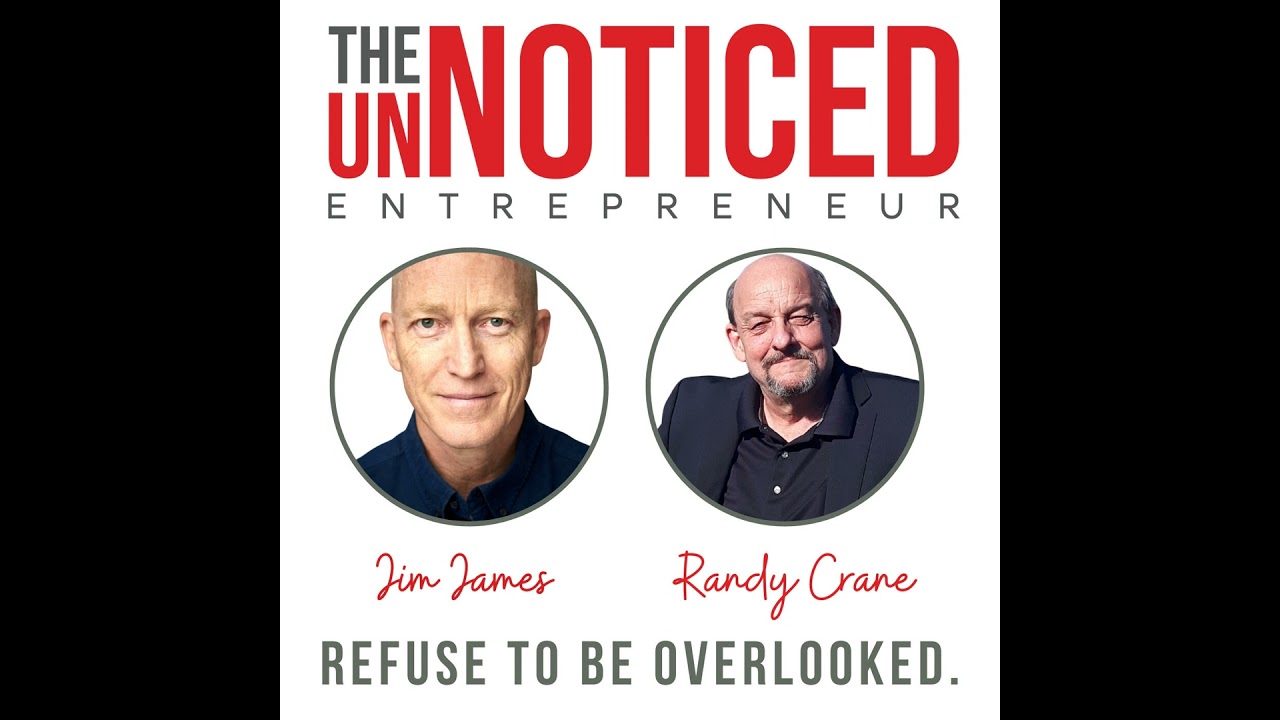
Randy Crane, founder of Fearless Marketing Canada, shares 40 years of marketing experience on why customer emotion matters more than your business. He walks through research methods like customer interviews and emotional mapping, explains why B2B needs LinkedIn while B2C thrives on TikTok, and says ChatGPT is useful for brainstorming but can't replace genuine human feeling in copy.
Chapters
And hello, welcome to this episode of The Unnoticed Entrepreneur. Today we are going to Toronto and we're going to get 40 years of wisdom condensed into 20 to 25 minutes because we're going to talk to a fearless marketer. We're going to talk about whether or not you need an emotional connection to customers. We're going to talk about what does and doesn't work, how WhatsApp and ChatGPT and AI have been transforming our working lives. We're going to talk to Randy Crane. Randy, welcome to the show.
Jim, thanks a lot for having me on your show. I'm so excited to be here.
Well, I'm excited to have you because, you know, you and I have quite a lot of history together. I mean, you started your agency in 1993, Fearless Marketing Canada. I started EastWest Public Relations in 1995 in Singapore. So you and I are of the same generation, young man.
Oh yes, we are, sir.
It's good. It's good. I've had people on the show that have actually weren't born when I started my own company. So it's great to have, you know, a peer-to-peer conversation with you. We're going to talk about being courageous, about the need to do things differently as a marketeer. So tell us, Randy, when you talk about fearless marketing, why is that important for entrepreneurs to Be fearless.
You know, Jim, we're taught from the time we're children to do the same things as everybody else does. Okay? You go to school, they teach you the same stuff. You go to work, they teach you the same stuff. And they want you doing everything the way everybody else does. It's easier to control that way, which it is. The problem when it comes to any sort of sales or marketing is that it's not what you do. When you do things the same as everybody else does, you get lost in the saturation, or the, in this case, the oversaturation of the market. So, you know what? We live in an evolved society today where Scrolling through Facebook and scrolling through Instagram and scrolling through websites is a key factor in our lives. Nobody has time to sit and look. And so, whatever you need, whatever has to happen, has to happen at the point where the person gets engaged. You have to be able to engage your audience. Okay? And in order to do that, you have to produce something that that audience or that person or that group wants. Okay? This isn't about you. This isn't about the customer. This is not about the business owner. It's not about your product. It's not about the services that you provide. Nobody cares. What they do care about is they care about themselves. So, your journey should be the journey of your customer, not your journey. And you know, Jim, we see this all the time, and you know as well as I do. You go to a website and you go, oh my God, you know, this is just about— yeah, they're all about, look at me, look at me.
Yeah. Okay?
And I think you see the same websites as I do.
Okay?
They all do. A lot of them do the same thing. Today, companies are focusing more on the customer's experience, the journey, the overall temperature of the customer. And that comes back to their emotions and how their emotions relate to your product or service.
So Randy, though, let me just ask you a question, because if you're encouraging entrepreneurs to be fearless on the one hand, but on the other hand to display really just what's relevant to the customer, to the person that's coming to the website or to the shop or even the Shopify website, how can you sort of instruct give guidance to the entrepreneur to be fearless when actually you're asking them really just to be sort of almost just reflecting what the consumer or customer is looking for. How do you bridge that gap?
I think you have to know what the customer wants. And this is where, you know, your research and development come into play. You know, and I've seen this 1,000 times where Customer turns around and say to me, oh, well, I need a website. Okay, great. Well, you know, I, in this day and age, God, any idiot can, can put up a website, but can you put up a website that's going to convert? Now, here's an interesting point. You don't start with a website. You end with a website. You don't start with social media. You end with social media. So what does that mean? Learn your customer. Learn your customer. Learn who your customer is. And you don't do that by saying, oh, you know, I'm going to sell to Susie down the street, or I'm going to sell to my Aunt Molly. You know, that's not what this is about. If your business is here to make an impact, then you need to know who your audience is and why they would want to buy from you. Now we do this through research and development. So for me, my, my normal practice is I want to speak with their customers. Who are your customers? You know, and once I sign up with the customer, with the client, I'll, I'll go out and I'll talk to the customers. Why do you buy from us? You know, what do you like best? What do you not like? What can we do differently? And I'll get that information from them. And then what I'll do is I'll go back And I'm going to start interviewing people. You know, maybe I'll do a small focus group. Maybe what I'll do is I'll sit and I'll ask a series of questions or do a survey or something like that. And from that information, I'm going to then pull in some— I'm going to pull in additional questions. Like, for instance, if I needed that product, how would that make me feel? Okay. And, you know, looking at a process, and this is a process for me, you know, I'll make a list of what are the problems that this product solves. And then what I'm going to do is I'm going to list the feelings that I have when I have that problem. And then I'm going to try to figure out the emotions that drive those feelings. Then on the opposite side of the page, I'm going to make a list of the solutions, how they make me feel after I buy, and the emotions that drive those. From there, with the additional information I have, I want to do a little competitive analysis, find out who else is selling the product and how they're selling it. And then from there, I can start putting together some initial copy. You know, I want to be able to inspire the customer. And you see, you can't— you know, if I said to you, well, you know what, you need a CRM system. And I started asking you questions about how you feel about writing copy. That wouldn't make any sense. So, when I look at a situation, you know, well, my boss asked me to find a CRM system. Well, how does that make you feel? Well, you know, I got to do all this work. I got to do this. How does that make you feel? What emotions drive those feelings? Because when you know what the emotions are that drive the feelings, it changes the entire game.
And do you think, Rusty— Randy, sorry, do you think that the emotions are different in a business-to-business setting to a consumer setting? How do you see that as playing out differently? Because you have this great customer journey and sort of almost emotional journey as well, don't you, through the whole discovery and buying cycle? How do you see it as different?
I think the people are people. Okay? People are people. The mechanism and how I deliver the content would change. Like, for instance, if I'm doing a B2B campaign, that B2B campaign may be focused on Website, sales funnels, LinkedIn. Okay. Maybe Instagram where a consumer, maybe more contest-oriented, Facebook, Instagram, TikTok, that kind of thing.
Okay. So, really, so the emotional part is still there.
Oh, yeah.
But the delivery is different. And yeah, we also talked just briefly before we started recording about about WhatsApp and about the power of, you know, mobile and also the arrival of AI.
Oh yeah.
So Randy, what's your view of, for example, the impact of mobile on marketing and using tools like, you've mentioned TikTok, but things like WhatsApp where now it's becoming almost sort of messenger-based as well as, you know, in As sort of web-based. What's your view on the sort of messenger and the impact of that both on B2B and consumer?
Well, I think, you know, the, the, and people have adapted to the, um, you know, the, the cell phone. Okay, now not speaking for you, Jim, but for me, I still have to have a desktop because you know what, my eyes aren't as good as they used to be. And I find it hard on the phone. But I think for the young people coming up today, I think that's, you know, 80% of users today are searching the web on their mobile devices. Okay. For me, it's not a, it's not really a good fit, but I think for majority, it, you know, Everything you do needs to be mobile responsive.
Yeah, and certainly in it— yeah, and certainly in Asia, you know, mobile has been the way to get communication happening. Randy, and what about the impact of AI and ChatGPT in helping business owners to create— for example, you talk about the customer journey— is that something you see AI as being able to help with, or is it creating a false narrative because the AI doesn't really understand human emotions.
Oh, I'm really glad you brought that up. As a marketer, and that's really what I can speak from, you know, I see the advantages today of ChatGPT. I think, you know what, as a writer, you know, I've always been, once I get writing, I'm actually good at it. But it's getting that start. So I think ChatGPT is a great way to start your writing. So if you get— if you suffer from blank page syndrome, absolutely, that's a great way. You know, if I'm looking for a topic to write about, or I want a summary of something, then it's ideal for that for me. But to get it to write Um, my copy? No. And the reason being is this, is that human beings connect with other human beings. They don't connect with machines. And ChatGPT is just a machine.
Yeah.
It doesn't realize emotion. It doesn't feel what you're doing. Do I think, you know, I was reading an article a while back that said that, uh, uh, the human brain processes something like 40 billion bits of information per second. Okay, well, if that's the case, then, you know, ChatGPT is like way behind. Is it going to happen anytime in the near future? I doubt it.
Yeah.
So, you know, I, I, I— to be able to replace what, what, what's up here, I, I don't think so.
No, I think, I think you're right there. So it's got, it's got a role to play, but not a role to replace us. Which is fantastic.
Now, and just, just to add to that, you know, and I know that people, marketers want to use ChatGPT as a shortcut. Trust me, it's not a shortcut.
Yeah.
Okay. It's, it's, it's not going to produce the copy or the quality of the copy that you need in order to inspire someone to buy from you because that comes from the heart. It comes from the heart. And when ChatGPT doesn't, it doesn't have a heart. It's just a machine. So when human beings know, they instinctively know when something is authentic or something is fake. Jim, you've done it many times in your life. I've done it many times. In my life, you know what? It's that whole thing. You know, I could smell a rat. You know, and the point that I'm making to this is is that I want I want authentic in my life.
Okay.
I want to know that when I'm talking to you, I'm not talking to a machine. And you know, like I said, when And it's not any one thing. It's not any one. It could be a word. It could be a sentence that you say that just kind of off me a little bit.
Okay.
That sounds perfectly good when you say it, but it just kind of doesn't sit right with me. That's where ChatGPT fails.
Yeah, I guess. And human intuition It's still amazingly acute, isn't it?
It's huge.
Randy, now let's change the subject just slightly because you've been an entrepreneur since '93, uh, and, you know, you and I both had agencies through the, through the '90s, right? And through the noughties and through the tens and through the twenties. Um, as an entrepreneur, it's probably too far to go back to say, you know, what challenge you faced then raising, but Uh, you know, and I could— but I can still remember trying to get my first customer. Um, what challenges have you faced from a marketing point of view or getting noticed point of view with Fearless Marketing that you could share and how you've overcome those?
Well, you know, I think one of the things when I first got into marketing, it's as I mentioned to you before, you know, I was originally going to be a priest and, um, And of course, you know, when you become a priest, I mean, it's, it's a very, um, you get to the point where you are very emotionally engaged with the work you do and the audience you have. And, um, so when I left the priesthood, I wanted to become a marketer. And, uh, so I got into marketing. And, but everybody wanted to do the same thing over and over again. I mean, my first project was with a major corporation and we were doing a television ad with a budget of about $300,000. And back in those days, you know, a $300,000 budget for a TV commercial was so what, right? And But everybody wanted to keep doing the same thing over and over again. And then what they would do is they would file it in with AC Nielsen. And AC Nielsen would send over their results that they found on audience acceptance, and which I always figured their, their, their numbers were always padded anyway. And so I don't know that there was really a whole lot of accuracy during that period. When I got into my own business, and this is after 10 or 12 years of working in the corporate world, my biggest problem was transitioning from the status quo and challenging it. Okay? Because I knew that if I keep doing things the same way that everybody else does it, It's just, it's going to be a question of time before I go broke. So I needed to figure out some way of delivering content in such a way that somebody would go, oh yeah, okay, oh great, I need that, oh fantastic. Okay, and so this became a big trial and error for me and I kept studying theology and I kept studying marketing. And eventually, what happened was the two kind of became one for me. And there was an epiphany that went on and said, emotion marketing, man. This is all about emotion. And everything we do is about emotion. You know, so I think one of the biggest, one of the biggest things I had to overcome in my own life was, you know, moving away from what everybody else was doing. Okay. All the gurus and all the wonder people in marketing that turn around and say, oh yeah, you gotta do this because this is what everybody else does. You know, when you do things the way everybody else does it, You become the same as everybody else. So, for me, I think one of the biggest challenges was to rise above that, start going into the unknown, start changing the way I do things, and find that piece that I could use where marketing meets the emotions. Of your audience. Because man, I'll tell you something, every human being is emotionally connected to their problems in life, my friend. Every single one. And you know what? Everybody's emotionally connected to their dreams, their desires, their wants, their needs. So you've got a whole realm of area here you can play in. Me, I look at this and I think, well, you know what? What is it you want? Well, if, if you want this, let me deliver it for you. And you see, when you do that and you do it the right way, people will buy your product. But if you do it the wrong way, they won't. And you know what? And, and I hate to say this, but it's very cut and dry. People have to become inspired because they are emotionally engaged with themselves. They don't care about you. They don't care about me. They don't care about your website. And they certainly don't care about your product.
Well, Randy, that's reassuring, heartening, and of course, disheartening as well at the same time.
I'm sorry.
But Randy Craig, As you say, people are really trying to find some inspiration, some direction, and getting an emotional connection to the people that are selling, building, marketing the service that they're about to buy. So if there's one piece of advice, Randy Crane from Fearless Marketing in Toronto, for my fellow unnoticed entrepreneurs, What would that be in terms of how to get noticed?
Learn your customer. Learn who your customer is. Figure out what their problems are and solve their problems. Don't make this about you. Don't make your business about you. It's got nothing to do with you. It has everything to do with your customer. Be customer-centric.
Randy, that is advice through the ages. I think that's carried you for 40 years.
Certainly.
Carried me as well for nearly 40 years as well. Randy Crane, if people want to find out more about you, where can they do that?
They can reach me through my email at randy@fearlessmarketer.com. And yes, I answer all my own emails, Jim.
Well, that's the one. You're a hardworking man. And look at the testimonials on your website. I can see you have a great deal of respect and admiration and affection from all of your clients. So Randy Crane, thank you for sharing so much wisdom with me and my fellow Unnoticed Entrepreneurs today.
Jim, thanks a lot for having me. I loved the conversation.
Me too. And Randy has 40 years of experience. We've had to be brutal and put it into just a very short interview. But now you know where Randy is and how to get a hold of him, then you can reach out and get more of his wisdom and more of his support and input directly. Because on this show, I really try and connect my fellow unnoticed entrepreneurs with subject matter experts, thought leaders, and, and just good people like Randy who can give us all some guidance and some reassurance Because being an entrepreneur is not always easy, but it is the path that we've all chosen. So good to find mentors and coaches that can guide us on that path. So I hope you've taken away a lot from the conversation I've had with Randy today. Certainly about putting the customer first, also about listening to the customer and perhaps not getting in our own way, worrying about what we're trying to sell. by just listening to the customer and providing an emotional response, an emotional connection to that customer so they feel reassured and hopefully inspired by our solution to their problems. Thank you for joining me, Jim James, on this episode. If you've enjoyed it, do please review the show and follow the show. I wouldn't want you to miss another episode of the wonderful guests that I have coming every Tuesday and Thursday on the Unnoticed Entrepreneur channel. Thank you so much for listening. Until we meet again, keep on communicating.
More from Jim











2 people, infinite agents, 1 billion dollar idea #AIAgents #Startup #Productivity