Learn from a $24 m Parisian company's social media strategy | The UnNoticed Entrepreneur
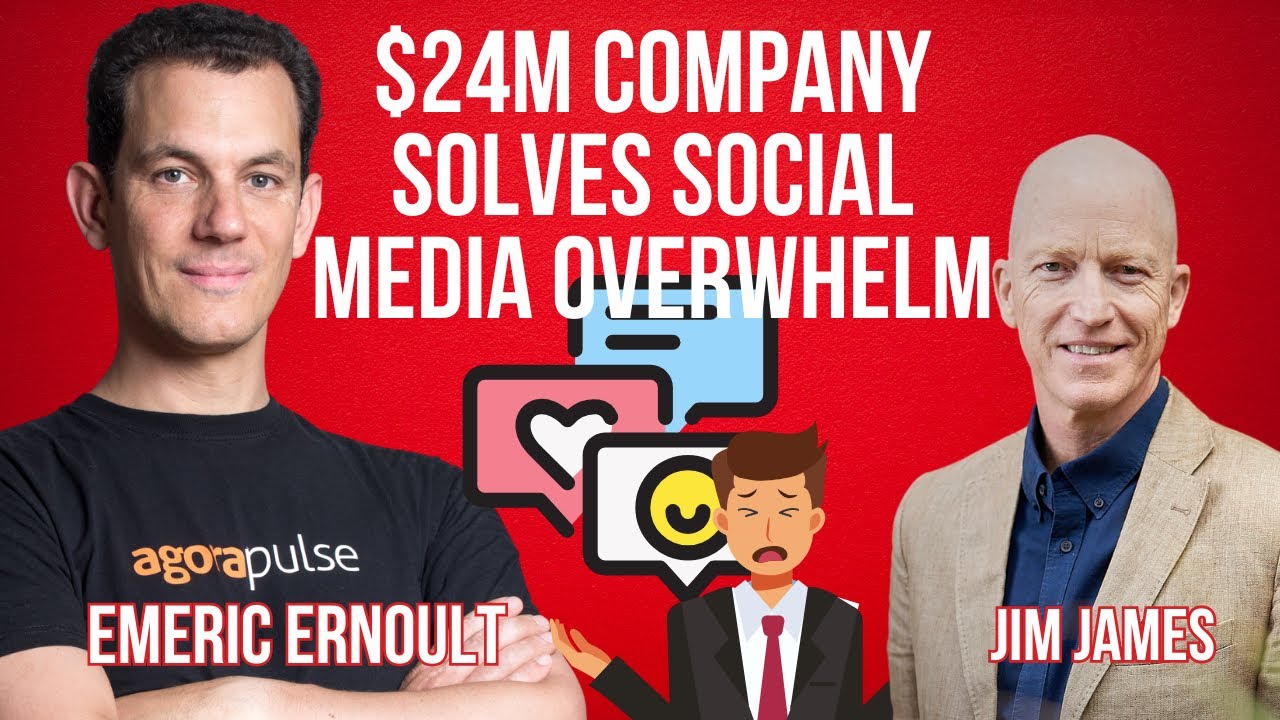
Aymeric Ernault, CEO of Agorapulse, explains how his Paris-based social media platform helps businesses measure ROI by linking GA4 data to individual posts and team members. A 12-person plant-based medicine company generates $75K monthly from Instagram alone using the tool, which starts at €49/month.
Chapters
Et bonjour. Welcome. Bienvenue to this episode of The Unnoticed Entrepreneur, where we're going to Paris today. Because if you've ever suffered the challenge of overwhelm, where you've got lots and lots of social media channels all sending you notifications and you're trying to manage all of those, you'll know how difficult that is. And today we're going to talk to Aymeric Arnoux, who is the CEO and founder of a company called Agorapulse, who've solved that problem. We're gonna talk to them about how they built their business and bootstrapped it from zero to now $24 million a year in revenue with 170 staff around the world and with over 31,000 clients solving the problem of social media overwhelm. But importantly, he's also got a secret, which is a secret sauce he's gonna tell us about, which is how you measure ROI from your social media. Emmerich, welcome to the show.
Well, Jim, thank you for having me. You already summarized everything perfectly.
Thank you. I'm only summarizing what you're gonna help us to understand, and I hope My French wasn't wasn't too embarrassing there for us.
Your French was parfait.
Ah, merci bien, merci bien. Je vous en prie. Okay, so I won't do any more of my basic English schoolboy language. Henrik, tell us about Agorapulse because so many of us have got more than one social media channel, and then we we suffer from going in and out of all the different platforms and trying to prioritize, especially if we then have VAs, for example, managing those for us. We create content, but we don't really then manage the conversation and the follow-up afterwards because it becomes overwhelming. So tell us about Agorapulse and the solution that you've created.
Yeah, so it's the problem we discovered 12 years ago when we started the company is exactly the one you described. It's a bit overwhelming. It's all over the place. You have to log in, log out in many different platforms, many different places. And back in the days, there were no native tools to do none of that. Today, there are native tools that are helping you. Post on scheduled content. You have a scheduler on LinkedIn, you have a scheduler on Twitter, you have one on Meta as well. So it's better now, but it's still a bit complicated. And if you have a team and if you have a lot of activity on those social profiles and if you want to measure things in one central place, it's still a big problem. And software like ours, we're not the only one in the space, obviously. You can see that Sprout Social is one of our competitors, Hootsuite, Buffer, like all these software, they are helping you. taking that overwhelm and that social media chaos out of your world and giving you efficiency and an effective way to do it faster and do it better. But that's the main value prop. But we also have this, as you mentioned, this unique value prop because otherwise we could be compared and say, what's your difference with this one? Oh, our color is a little bit different, our interface a little bit better, our support is more responsive. No, there's one thing that we do that they don't do, which is measuring the return on investment, the ROI of your social media work. And like I shared with you, I filed a patent in the US for this, so it has to be legit, right?
Yeah. Congratulations. That's fantastic.
It's very hard to do. It's really hard. It's a very hard— it's a new language to me, everything. And as I shared with you, I used to be a lawyer, so I speak lawyer, but not patent lawyer. It's a very, very specific language and way of describing things. But we did that, and I'm pretty happy about what we've done because we are able to— when you connect your GA4 Google Analytics account, we are able to look at conversion and revenue, you know, platform by platform, profile by profile, content, piece of content by piece of content, team member by team member. So we can go very deep into what each action that you do on social is bringing value to your business. And that's a big— that's my vision. I want to help businesses to see the value of their social media work.
Emre, that sounds amazing because so many people now are creating content, also creating social media content using AI. So there's this proliferation of content. Tell us, how do you then, if you like, track that through the funnel? Because if you've got so many pieces of content going out, for example, on LinkedIn, maybe on X, maybe a video on YouTube, from a practical point of view, how are you tracking all of those different pieces through AgoraPulse?
You know, at the end of the day, we didn't reinvent a wheel that was already existing. There was a wheel that was doing it for email marketing and marketing automation. Automation and for paid advertising. When you look at paid advertising or email marketing, they're already tracking all of this coming from different emails and different email campaigns and different ads and different platforms and different ad campaigns and ad creatives. Like, that variety already exists in email marketing and paid. And the way they're tracking it was simply not applied to organic social. And we took those principles and those technologies and applied them to organic social. Adapting them to organic social. And that's simply what we've done. Like, take something that works somewhere else that were never implemented on organic social and giving the same results basically, allowing you to go very granular on what works and what doesn't. Where before, all you had on Google Analytics was this is what you got on Facebook. But what if you have 112 Facebook pages like some of our customers? Oh, you don't know which one is bringing what because you don't know You only have a big number for Facebook, but nothing else. So like we brought the granularity of the measurement.
So to be clear, with Agorapulse, people can be scheduling their content online across multiple platforms. It's distributed, but also there's measurement and tracking all the way through to, I guess, to shopping carts and stuff like that. Is that right?
Back to their website and what they sell. Absolutely.
Yeah. Okay. That's magic. And I have to ask you this at this point, because it sounds like a panacea. Is this only for big companies or can SMEs afford this as well, Eric?
It's a good question. Interestingly enough, the customers of ours who are crushing it at generating revenue on social are mostly small businesses because small businesses are more flexible in trying social as a channel, as a way to grow their business. And some of them, when they have a big community of fans, like just to give you one example, I mentioned that example with you earlier. We have one of our customers who sells plant-based medicine and people who cure themselves or who treat their health issues with plant-based medicine are passionate about this because they don't want the drugs. They don't want the traditional drugs that doctors are prescribing. They want the plants because they feel it's more healthy, it's It's better overall for their body and them and their loved ones. So, they're very, very passionate about it. They talk about it. They ask questions about it. It's more than just a way to cure themselves. It's a way to live. And so, there are a lot of online communities. People support each other and so on and so forth. So, social for this company was an obvious choice as a channel. And that's how they build their business and they're generating somewhere near to like $75K a month on Instagram alone, which is crazy when you think about it. And it is a small business, but they're absolutely crushing it on Instagram and Facebook. It's a Facebook group and an Instagram account that are doing the best for them. And they're a very small business. Like, they're, I think, 12 or 13 people. So you don't have to be big. Actually, I would argue that the bigger you are, the more difficult it is to go and invest in social to create a revenue-generating channel. And also the bigger you get, the more customers, like for us, for example, our revenue now is so big, then for social-led revenue to have a dent, it would have to be really, really big, which makes it even more challenging.
Yeah. And we'll talk about that later, won't we, Emmerich, about how, you know, as you get bigger and bigger as a company, the client size often grows as well and requires a different kind of marketing strategy. We'll talk about that in a little while, but basically for 49 euro a month, uh, somebody could get access to AgoraPulse and, and both manage their social but also to track the ROI on their socials. That's a really fantastic—
Yeah.
Well, it's a great ROI, if I, if I can say that there, Memory. That's, that's wonderful. Um, you did touch out there on, on a client. You're in a fairly unique position because you've been running AgoraPulse for over a decade, uh, now, to know what does and doesn't work. Can I ask you, with your position, having seen so many clients, obviously it's, you don't track their data, but you get to see, you know, trends and so on. Some mistakes that you think some companies are making when it comes to social and expecting an ROI from that?
Yeah. Well, the biggest mistake I see is that people treat social as just a channel to regurgitate their content. Like, hey, here we have a new blog post. Let's post it on Facebook and Twitter and And whatever and not try to trigger conversations or try to capture the audience's interests based on that content. So, that's the biggest mistake I see. Hey, here's— we have a piece of content, let's distribute it through all the channels. Let's send our newsletter, let's send it into our customers through an in-app message in our app, let's put it on Facebook, let's put it on Twitter. That's usually a big mistake because when people see stuff coming to them from social, it's just a a link and a quick title, they're not going to be excited. So, you have to find a way to make your social content engaging. I mean, people want to go and ask a question or answer something or have some sort of a comment, like a conversation about it. When you're triggering that, then you're actually increasing your score in the algorithm. You're being seen more and And people's interest gets higher than where you're just trying, hey, click on my stuff. Here's my stuff, please go check it out.
Yeah.
So that's the biggest mistake. And it's hard to do though, and it's a lot of work. So I understand why people don't do that and go the simple route of just posting, clicking, copy pasting, and you're done. And the second mistake I've seen is that people prioritizing social when they should not because it's not the right channel for them now. It's too early for them. They have other channels they should be focusing on. And like I told you, in my early days, I focused on SEO content and influencers. I didn't do anything on social for at least 2, 3 years until $3, $4 million of revenue. And it was the right thing for us to do because that's where we got our initial traction. I probably wouldn't have my initial traction on social. And I also think it was not my forte as a person. My forte was on content creation and relationship with real, real relationship with real life people. So I went to conferences and I built relationship with people who had an audience. That's how we got started. Or it could be the opposite. Like, people, it would be the right thing for them, but they don't see it and they don't think about investing in it. So for example, if you are doing something that's relating to home improvement and you don't have a strong Pinterest strategy, you're probably missing a lot because Pinterest is absolutely amazing for home improvement, decoration, and all that kind of stuff. My wife spends her days on Pinterest like, oh, look at this, look at that, what do you think? And that's how she thinks most of the products she buys for our home improvement needs. If you're not present in my wife's journey on Pinterest, you're missing her money, basically.
Yeah. And I guess it's interesting as well, maybe during lockdown and COVID, a lot of people became very comfortable with social and content creation and agencies and now AI creating content. And it's easy to kind of remain remote. The other day on a Facebook group, someone was talking about creating mailing lists and getting thousands of mailing lists. And, and I said, you could just buy people donuts and coffee. Yeah, you know, we used to go and meet people, uh, and not worry about thousands but having some high-value conversations. But as you rightly said, Emmerich, every business needs a different strategy. And in a way, that's what keeps us all guessing.
Yeah.
But now, you, you've been running this business for a decade. For 10 years before that, you had some some trials, and you kindly shared earlier some that didn't work, but you've managed to build AgoraPulse into a brilliant machine. As an entrepreneur, let's just talk about what you've been doing. How have you managed to then build this business up? Because it's grown with 30,000 customers. It's changed, hasn't it, as well? Tell us how you're managing the transition and how you're helping to grow the business now.
Yeah, it's changed drastically several times, not just once, but at least 2 or 3 times. I'm going to give you a very, very high-level answer, but I think it's also a very important answer. As a business owner, to all of those who listen to us right now, you are not the right person to take your business to the next step. You have to become that person. And I was not 10 years ago the person I am today. If you take me 10 years ago and you put me in my position right now, my business will fail because I would need to learn all the stuff I've learned in the past 10 years. And the hard thing with this is that you don't know what you don't know. So you don't know what your blind angle, your blind spot, you don't know what you're missing. So you have to surround yourself with people who know that and are going to help you figure it out, that these are peers or coaches or mentors or training groups, whatever it is, you have to invest in yourself. And investing in yourself, we talked about books earlier, like reading books, listening to podcasts, and And confronting yourself with what is the closest to the better version of yourself that you have to become. And that is a constant effort that you have to invest into as a business owner. And if you don't do that, there's no doubt that you're not going to take your business to the next level.
Emre, well, you've plainly done that and you've managed to grow at the same sort of rate and stage as you've grown Agora. When it comes to getting the business noticed, Is there anything that you think that, you know, you could share that hasn't gone quite as planned? Um, plainly you've matured, the business has matured, but along the way, would there be one of those lessons, one of those mistakes that you could share with us?
Yeah, you know, I think we've, we've all made them. We made that mistake, but most people make that mistake of spreading yourself too thin in, in the, in the things that you do to be noticed, in in the channels that you invest in to get visibility and to get in people's homes or in people's offices. We all do too much, which is a hard one because in order to find the things that are going to be really efficient for you, you still have to try a lot and fail a lot until you find the right thing. So, it is that very difficult balance of doing enough so you find the stuff that works and not doing too much so you're not spreading yourself too thin and diluting your time and energy into the stuff that's not bringing anything. If I had to give some hints to do the difference between the two is be very aware of what you're really good at and what you're not really good at. I was good at creating content. So content and SEO was my forte in the early years. That's what basically took us from zero to a million, to $100K a month. And I'm good at relationship. I'm good at building rapport and relationship with people. So I basically took my butt, put it in planes, and went to the US to all conferences, marketing conferences, social media conferences I could go to, and started building relationships with influencers in my space who had an audience, who had a blog, who had a podcast, and gave me a share of voice in their own world. So, gave me visibility. Those were the 2 things that I were really good at. And I focused on those things and that took us from zero to breaking even. And after that, once we broke even, I started to have, hey, now I have more money and have more resources and more people. And then, we started to do too much. Very probably.
So just to refresh that then. So you're saying that in the early days, rather than doing lots of social media posting about AgoraPulse, you went and met people that were potential clients or were influencers that had an audience and you were interviewed by them or you got articles into their communities that you contributed.
How did that work? I gave them my product for free. In the early days, my product was not good enough, so they didn't care, but made my product became better and better and better. After some time, they say, oh, now it's really good. And I kept pushing and say, hey, I want to show you the new version, the new stuff, the new thing. And eventually they all used it. Eventually. And they mentioned it. And because they were using it, they became the best promoter of the product because they enjoyed using it and they liked using it. And they kept mentioning it on social and on blog posts and giving me backlinks and sending me traffic and mentioning it on stage at conferences. So that's basically what I did. It took a lot of time. The day I started to do that until the day it really was working, probably 3 years went by. So, it takes a lot of patience, which is not something entrepreneurs have. I certainly am not patient. But I realized very early on that if I— basically, my product was not great in the early days and I knew that. And I really early in the days, I realized that if I am not investing in building the system to basically let the world know when my product is great, when it will be great, nobody will care, nobody will know. So, I have to build a system to let people know about how great my product is before my product is actually great. And that's probably one of the hardest things to do is having this long-term view of in 3 years when my product will be amazing, how will I know? Well, how will I let the world know that it's now amazing if I have not built the relationship, the network, the backlinks, the SEO, like all the things, the traffic, all the things that are going to allow me to seize that opportunity when the product is ready. So I had to basically work as if the product was ready when it was not. So when it was, I had the audience basically.
Oh, that's fascinating. So you say really laying the groundwork. When you say system, is there something you were using as a CRM for that? Or do you mean just in terms of personal Personal presence and relationships.
For me, it was really driving traffic to our website, driving traffic to our website for the right keywords and the right values and the right problems. Even though you were not yet solving those problems and having those values, but anticipating the fact that we'll have them at one point, I need to have the traffic already coming in. They will be disappointed for a while, but once I'll have the value and I'll solve the problem, The traffic will already be there and the influencers will already be talking about me and so on and so forth. So, it was inbound. Our business was built on an inbound SMB inbound engine. So, people coming to me because they find me online and then they do a free trial and then they subscribe. And I built that engine before the product was ready to take it on.
Okay. That's wonderful. Now, as the business has changed and sort of moved to our last question, as the business has changed, A lot. And you've grown. Yeah. Has there been a change in strategy? Is there one thing you can suggest as people grow their business? The nature of the business changes, doesn't it? And organizationally it changes, marketing positioning changes. And something, Emric, I know you can share.
That's the one thing that you can always be guaranteed will happen, change. You can absolutely be guaranteed that your business in 5 years will be very different from your business today, which is probably already very different from your business 5 years ago. There's one thing that you have to be— there's one guarantee in business life is change. Like, it's not going to be the same. The people are going to be different. The product is going to have to evolve a lot and so on and so forth. So yeah, we have changed a lot. That rule applied to us as well. And the change for us was we had to move from SMB inbound to more mid-market outbound. When I say outbound, I mean, Go and proactively bring people in your world that are the people you know are ideal customer for you and not what we did in the past, which is create those SEO and that presence online and that presence on review sites so people find you when they search online and eventually go and try you. That is great but gives you very little control about who you attract. And when you grow and you need to— okay, now I need to attract retail companies with 500 employees and more. in Western Europe and North America that have at least 30 different locations. You're not going to attract these if you don't proactively identify who they are and go after them with your marketing, with your campaigns, with your emails, with your LinkedIn message, with your online events, with everything you do on the marketing side. So, that's what we do now. Before, we say, hey, let's do an event and see who comes. Today, we say, hey, let's do an event for that type of persona. in that type of industry who had that type of problem because we talked to them and we know and we're going to go after them and invite them one by one. Basically, that's the big change. If I summarize it to the extreme, that's the change. Oh, wonderful.
Yeah. So moving really from a mass marketing, almost FMCG to really to traditional or traditional industrial marketing strategy. Aymeric Arnault, if I can ask you as our sort of final couple of questions, what about a book or a podcast, book and a podcast that you can say has inspired you as you've grown AgoraPulse? Yeah.
So, as we were discussing that, and I told you I read too many books, it's hard for me to come with one book. I looked at my Audible. I have 112 books on my Audible that I listened to in the past 2 years. So, I read a lot of books and listen to a lot of books. There's one that stuck with me that I like really, really— I like a lot of them, but this one really good is the book about the story of Netflix, No Rules Rules from Reed Hastings. And I like this book very much because Netflix, first of all, Netflix story is great. It's entertaining to read because it's a company we all know and And it was a very interesting and challenging history and story. And you learn a ton about talent and culture and how to attract people and retain people and just retain the best and how you do that. I applied a lot of this philosophy to my own business, especially on the talent density and talent retention. And the podcast, so I picked a book and a podcast. I also listen to a bazillion podcasts, but one I enjoy A lot is a podcast from Leila Hormozi. And, you mentioned Leila is married to a guy named Alex Hormozi. They're a very, very interesting couple. They're amazing at business owners and business builders. At less than 30 years old, they had more money than I'll ever have in my entire life.
Yeah.
But beyond, which is not important to them, which is something I love about them, but they're not in the business for the money. They're in the business to become the best version of themselves and how how they can become that and what's the path there. And that's what I love about their view of the world. And Leila's podcast is very much about operating the business, like be a business operator. And she's really articulated. She's really good. The way she explains things resonates with me all the time. I learned so much from her and she's 20 years younger than me, but I've learned so much from her that it's crazy. So, I highly recommend her podcast.
Well, Emmerich, thanks for that and giving too. That's fantastic. That's 2 gifts, not more than just one. If you want to find out more about you, where can they do that?
On LinkedIn. LinkedIn is the best place. That's the only social network I'm still active on and I actually enjoy LinkedIn. And if you send me an invite on LinkedIn by just adding a note, say, hey, I listened to you on that podcast, so I can accept you because I get a bunch of LinkedIn invites out of people I don't know. I tend not to accept them. So if If you want to connect with me, that's the way. You just tell me where you heard about me and you heard from me, and I'll happily connect with you and ask me anything you want. I'll be happy to try to help if I can.
Wonderful. I'm putting Emmerich's details in the show notes, but it's Ernoult, which is Ernoult, sorry. E-R-N-O-U-L-T. That's right. You better say it properly.
E-R-N-O-U-L-T. Ernoult.
Ernoult. Okay. Right. Perfect. Emmerich, thank you for joining me and really talking about how you can solve a problem that affects all of us that have got social media, but also introducing the idea that you can track ROI from social media, which would actually give you a reason to decide whether to do social media or not, wouldn't it? Right. So thank you so much.
And if you figure out that it's not a good channel for you, then I'm happy to help you figure this out.
That's wonderful. Thank you for joining me today. Merci bien.
Thank you, Jim. Merci beaucoup.
So we've been listening to Aymeric, gone to Paris, and a beautiful place and a fantastic business and solving a real problem for really everybody. I hope you've enjoyed this show. And if you have, please do give this show a review and do follow on your player because it really, really helps me to know what you think about the show. And also do please share it with a fellow unnoticed entrepreneur. And until we meet again, I just do encourage you to keep on communicating. Thanks for listening to me, Jim James, here in the UK with Aymeric Ernaux in Paris. Au revoir. Merci beaucoup.
More from Jim











2 people, infinite agents, 1 billion dollar idea #AIAgents #Startup #Productivity