Make the present's unknown to the future of known experience to sell yourself; with Graham Brown
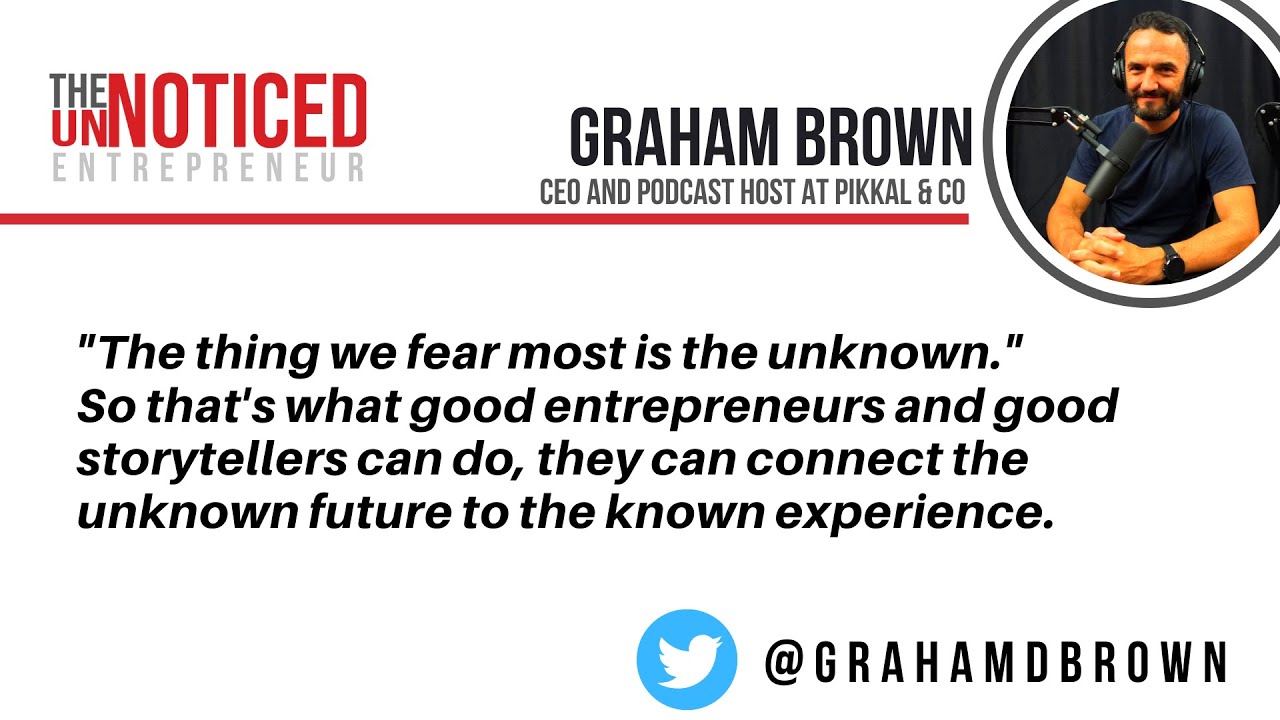
Graham Brown, CEO of Pickle podcast agency, explains how entrepreneurs use storytelling to become memorable. He describes linking unknown futures to known experiences through simple analogies, testing stories like stand-up comics do, and treating podcasts as long-term assets for sponsorship and credibility.
Chapters
Hello and welcome to this episode of The Unnoticed Entrepreneur with me, Jim James. And today we're going all the way to Singapore to talk to Graham Brown, and we're going to talk about how you can package yourself as an entrepreneur. Graham, welcome to the show.
Jim, thank you very much for your warm welcome.
Well, look, you're in a warm place, Singapore, also a place warm to my heart. Now, you're the author of The Human Communication Playbook, You're an entrepreneur in your own right. You're running a podcast agency in Singapore and we're gonna talk about a few topics including, you know, how entrepreneurs and business leaders can overcome some of the challenges they're gonna face to package themselves and talk about story systems and so on. So dive in, tell us, how do you think an entrepreneur can get noticed?
Like, this is it. We're doing it now, Jim.
You're doing it.
I'm doing it. What better way to get noticed than to host a podcast, invite lots of interesting people on, get them to share it with their network, or guest on other people's podcasts? As entrepreneurs, it's not just the budgets and the times, but it's more about the authentic message we want to put out there. So I think this is the living example of it right here, right now, because it's not just about, you know, I'm going to do this because I'm going to get sponsors, but think of all the connections. That you can create with a podcast like this.
Yeah, and I think you're right, Graham. And I think what you've also identified is that podcasting is a great way to get noticed, but it's actually a really, you know, human-centered way, right? We have a conversation. And tell us about Pickle and about the kind of services and the way that you help people, because we're on the podcast, but there's a lot of work that goes into this before you and I get here. So just tell us, how do you think people can go about You know, getting noticed and also overcoming the sense of anxiety that maybe people don't want to hear what I've got to say.
Yeah, there's a lot of, there's a lot in that. The first part, I mean, there really are systems and processes that go on in the background that you don't see. And we talk about automate to elevate, which is basically, you know, do the heavy lifting in the background such that when you turn up for the podcast, you just focus on the connection. the elevated part of that sort of human connection, if you like. So you're not worried about, is the guest turning up? Has the guest got the link? Do I have the talking points? So to make podcasting successful, it's really about having good workflows and systems. Obviously, when you have those in place, then you can focus on what appears to be the art, which is the storytelling and the human connection. So that's the first part about what makes you successful and get noticed on podcasts. Having all that in place, you can do it yourself for sure. But key in podcasting is consistency. And that's why people come to an agency like us, especially if they're a corporate, is consistency. They understand it takes time, that they could do it themselves, but why do it themselves when somebody else can do it better and keep them true to their goal in podcasting? The second part about, you know, the fear, lack of self-confidence, that's a bigger subject. So it really is about practice.
Yes. But let's talk about the fear because, you know, the mechanics of being a guest or producing a podcast are just that, right? You can outsource that. Many entrepreneurs are very confident with, you know, facts and data because those are proof points that are given to them by, you know, the marketing team or by the PR team. But fundamentally, why do you see entrepreneurs, and as you say, being one yourself for so many years, why do you think they failed to get out in front of audiences?
There are many factors, but ultimately it really comes down to believing that people buy stuff. Ultimately, people don't buy stuff, they buy what stuff does for them. And the reason why we need to communicate and why we need comms or marketing as an industry is because we don't understand what stuff does for them. Or does for us. You know, if you're a startup founder and you're pitching to an investor, you're not pitching anything apart from an idea or a story because really you're pitching them on this idea that they put their money in this business and in so many years you're gonna take them on this journey and yeah, you're gonna sell this thing, but this is the journey that's really important, right? So you have to convince that person That it's a good thing to do. It's an unknown. And this is the interesting part of the human psychology, is that the thing we fear most is the unknown. Snakes, spiders, all of that, that's nothing compared to our fear of the unknown. And the reason why we invented storytelling back thousands of years ago, you go all the way back to those sort of cave paintings in Lascaux 20,000 years ago with the animal stampedes and all that stuff, is because What those do and what stories do is they connect the unknown to the known. So when Steve Jobs stood on stage and he sold the iPod as a tool for the heart, he basically gave us an unknown device. What's an MP3 player? And connected it to a known experience. You're a music man, so it's that music, heart, love, feeling, connection, our song, all of that stuff. So That's what good entrepreneurs and good storytellers can do. They can connect the unknown future to the known experience because everything, whether it's raising money, selling a product, you don't know how that's gonna go. It may just completely screw up. Joining a company, you know, come and join my company, be part of this thing together. That's an unknown. All of it requires somebody to understand where that fits into their experience because A little bit more on the human psychology. The human brain can't distinguish between past, present, and future. It doesn't have the concept inside. All it knows is experience. So that's why if you show it something which feels familiar, then they will feel like they've experienced it before. So your point about why do entrepreneurs have that kind of fear of doing it is because they don't see storytelling as something that they should be doing, or they feel that they should be relying on fact and data. To sell themselves.
So it's interesting, isn't it? There's this sort of fundamental dilemma for entrepreneurs that on the one hand, they start a business. We start businesses because we believe in something. We've got a story, a narrative, but then when it comes to convincing other people, we think we need to appeal to the rational, logical side of the audience. You know, so there's this dilemma, isn't there, between these 2 things? How do you think though, Graham, and in your experience, can people overcome this challenge? How do they feel confident, if you like, in their own story? And maybe even, can you give us some guidelines of different kinds of stories that entrepreneurs can associate themselves with to give them a handrail to move along?
Yeah, the handrail is a good analogy. Okay, and there you go, folks, that is a story. So basically what Jim's done is given us a story in One word, 2 words. And it's basically what he's done is helped understand what I'm going to say in the context of something you're very familiar with, a handrail. Oh, what's a handrail? It's like a guide. I can hold onto it. I put my hand on it and I can kind of walk along and it's going to keep me true. I'm not going to go off and fall off the bridge, right? I'm going to hold onto this handrail. So that's a very powerful example of a story right there and then. And it just shows that, Jim, you're a natural storyteller.
Thank you.
Right. And it shows that you didn't package it in a fluffy way. That's what it is. It is what it is. You're basically taking something unknown, which is what I'm going to say, and putting it in the context of something people are very familiar with. And those simplest stories are the most powerful. The iPod tool for the heart. Even if you look, for example, at traffic lights, Red, amber, green. Now, when traffic lights were introduced, they took the idea from trains. You know, there was a similar system in operation in train lines. So they knew that when they were gonna put it on the roads, they needed something similar that people understood. Otherwise, it's gonna be chaos. That's a story. They've used an analogy of what existed elsewhere. Now, to get good at this yourself is firstly understand that exists short-form storytelling. which is taking something very simple and using that to package an idea. That idea could be your business. So for example, if I said to you, you know, we are the Uber of bicycles, or we are the lastminute.com of hotels, or whatever it may be, what I'm doing is using an analogy to help you understand what we are. Because you're like, oh, Uber, I understand Uber as a concept. Yeah, I get it. You kind of It's quite complicated, but you use a phone, you can then find a taxi, blah, blah, blah. Now, what does that look like with bicycles?
I get it.
I get it. I now understand the concept, the physics of it, if you like. So how do you get good at that? You practice it. Once you understand it and recognize it and see it everywhere, it's in everything that we do and it's very subtle. And that's why you're not picking up on it. Like handrail, that's it right there and then. How can I use that when I present? On stage about me and about my company or what I do. When I get on stage and people ask me what I do, I don't say I own a podcast agency. I tell people I'm a storyteller. It's like, okay, I get it. That's a label, a package. I understand what a storyteller is. He's going to tell stories. And can he help me tell stories? Yeah, maybe he can do that as well. Maybe he's good at it. So already you're labeling and packaging, you're using that analogy. to help people understand where you fit in. The last part is getting on stage, which really means getting on stage and facing rejection. If you look at comedians as an example, stand-up comics who I'm in awe of.
Brave.
Yeah, that idea of standing up, going up, getting rejected, doing that on a regular basis, that's how they become really, really good at it. And It's what I call and what I work with my clients on, agile storytelling, which is where you're not going to have a finished book in your head, but you can have lots of different scenes. Like, I was born here, I did this, then I went to Singapore and then I went to China and then I came back and it's all kind of like an interesting story, but it's a mess. The great thing is when you get on stage and you commit that to an audience, you get feedback even if the audience is 5 people. They read it, they give you that feedback. Yeah, that was amazing. Or you get the crickets, the tumbleweed, right? You take that in, then you improve on it and you build on it and you keep iterating and improving your material just like a stand-up comic until you see someone like Jerry Seinfeld walk out on stage. It's just effortless. No sweat under the lights in a suit. And he can deliver that beautifully. That is 10,000 hours of rejection there, folks. And that's how you get really good at it, by facing the moment of truth and taking every opportunity to get on stage. The beauty is today those stages can be this and you don't have to travel, you don't have to dress up for it, and you can do this in any time zone. And that gives people a lot of opportunities to get out there and really get good at this.
It's a really good point about practice. You know, that entrepreneurs almost go out to one big stage at a time. And of course, you feel match nerves. So getting the repetitions and the practice as an entrepreneur, speaking your story and developing it. And I love the idea of agile storytelling. Graham, we were talking about the economics of attention before we started recording. Do you want to just share with us your, you know, your concept around the economics of attention? Because that's also a really fascinating area, isn't it, as an entrepreneur?
Well, this is why we need to do it, because today attention is your biggest cost in everything. There's a war for attention out there, and data really is just part of that, trying to mine people's attention. Look at the reality. The average person unlocks their phone 110 times a day. So you're competing with that and a number of other things. Like there are no captive audiences anymore. If you're in business, you know, people don't read newsletters like they used to do. People don't come to events like they used to do. It's a very attention-stretched world. And even if you look at that word, Jim, you know, like attention, it comes from the Latin tendere, which is the same word in your muscle in your arm, right? There's the tendon, right?
The tendon. Yeah.
It's stretched. Literally, it's been stretched for thousands of years. And that's the reality that people have of your audience is that they aren't paying attention to you. And think about that, the economics of attention. In English, we say pay attention, right? We don't say give it, don't give attention, you pay. Isn't that interesting that we as an audience have to pay to listen to you?
Yeah.
So there's a distinct cost there, right? And what we have to realize is that to get people to pay, To listen to us, we have to give them something and we have to give them value. That's why you can't demand attention like you used to. The economics have changed significantly in 20, 30 years. It's a very different world in terms of that competition for attention. But the good thing is, if you can be that guy doing that thing, that little piece of real estate that you occupy in somebody's mind, that's extremely valuable. Because I tell you what, if you are that guy who does that thing, who's Jim James? Who's that guy who does the Unnoticed Entrepreneur podcast? I see him on my feed and on Twitter. He's that guy. And so when people want that thing, they ask around, do you know anybody who does that thing? What is that thing? Maybe it's coaching, maybe it's like data science, whatever, they're going to say, yeah, I know that guy. And that's how it works now, right? That's how attention works, the referral process. So it's so important for the listeners out there is that you identify what that avatar is and what that thing that you're going to do and just absolutely double down on it. And I tell you what's really useful as a guide is what do people seek you out for? try something else, but it's like maybe pushing against it a little bit. But I bet you people keep coming back to this thing that they keep seeing you as. And you may think, oh, that's a small thing. Maybe I can't, you know, make a big business just being like the number one guy in communications, you know, maybe, I don't know, vintage car businesses, brands, whatever it may be. But I tell you, the guy who's number one in that, he can make a lot of money. If he only doubles down on it and just says, right, I'm going fully and I'm going hard on being that guy. That's the economics of attention today.
Okay. Really, really interesting. Can't help but think of The Cable Guy, right? The great movie. And about that idea of the individual being packaged as a brand and in the sea of data, people can't accommodate all that data. So they go to the person they can trust who would be the storyteller for that. Now, Graeme, you've got a fascinating story originally from Portsmouth. Lived in Japan, now back in Singapore. As an entrepreneur yourself with the Pickle Podcast Agency, you know, I love to ask, as an entrepreneur, how are you getting yourself noticed, especially as you've moved to a whole new territory?
This podcasting, I think it's a fantastic way. Like you, I set up a podcast not for the reason that it became, you know, often you start a podcast because it seems interesting and then you realize, well, people are noticing what I'm doing. maybe this little old podcast with 20 episodes might go somewhere. I know you've done 500. I did 500 episodes for my podcast. And I tell you, it's like people seek you out. I became that guy. I got in front of some very good clients. I had some amazing experiences sitting in front of people that I never would've got in front of because of the podcast. One guy who was a billionaire, rather than pitch him the idea of investing in my business or buying the services. I pitched him the idea of doing a podcast, did the podcast, and then he became a client. So how about that? And I think when people ask me, how do I monetize a podcast? I'm like, it's right there. You already have a sponsor and an advertiser. You're the most valuable one right there. And what other tool will you have to have 500 meetings with people? Imagine if you could have 500 meetings with people in your industry right now, you know, what kind of value would that be for you? That is huge because you're creating something together. You're not just a guy who had a coffee with that person. You created something together that's there for years and years on the internet. So that's how I do it. And it's investing in the long term of creating an asset for yourself because it's there. I'm on your podcast. You know, I have my own podcast. People can find me. It's got good SEO. You know, if people are searching out, they often find podcasts. So that's the way to do it. It takes time, folks. You've got to invest in it. You know, it's a long-term play, but if you enjoy doing it, then it's not going to feel like work.
Well, yeah, and absolutely. And your podcast is fantastic. I'm grateful for you coming on mine as well. Now, just finally, you've got a system, haven't you? Do you want to just share for those people thinking, well, maybe I'd like to do a podcast. But at Pickle, you also have like a methodology. Do you wanna just share that top line so that people get a sense of, okay, I love, I'm sold on doing a podcast, but what would I do? Just top line. Yeah, I know you've got some guidance you can give people.
Yeah, I would say one thing to think about, takeaway is that, you know, you don't need to have a podcast to enjoy podcasting. One option is to guest on other people's podcasts and that really comes back to sitting down, defining your avatar and your With any of this, whether you are a host or a podcast guest, the number one thing that you need to start with and define and get better and better at answering the question, who is your listener? Because it doesn't matter what you've got to say. It matters who they are and what their problem is. I want to know, this is the base, the first step of the system, which is define the audience avatar. What's their name? I worked with a guy on radio. who, when he went on air, he had on his microphone a cutout photo of this reader. And it always like, I always saw it because I was an intern there. And I thought, what is that? Why does he have that? And one day when I was leaving, I asked him, what is that? And he said, well, that's my reader. I can't remember her name, but it's like, every time I go on air, I speak to you. I know her pain points. I know her frustrations. I know why she listens and why she listens to me. And that's the starting point because I guarantee if you can define that person, and get better at understanding who they are and what importantly their problems are, then you will build your brand because, you know, people don't care unless they know that you care. And it all starts there. Unless you get that right, what follows on in the system really will have no impact on growing an audience.
Graham, that's a lovely way to close out the show today. And if you want to find out more about you, Graham Brown, based in Singapore, how can they do that?
My website would be a good starting point, Jim. Go to grahamdbrown.com. It has all the info on podcasting, podcast guesting, as well as my work and my podcasts themselves. I'm happy to chat to anybody that reaches out to me on LinkedIn.
Graham, thank you so much for joining me. And you're in my second home, Singapore. So it's wonderful on lots of levels to have this conversation. Thanks for joining me, Graham Brown, who is the CEO of a company called Pickle. That's P-I-K-K-A-L. For those of you that are interested. And of course, I'll include his details in the show notes. And if you've enjoyed this conversation, do please review it on all the players and share it with a fellow entrepreneur. My avatar is someone who's growing a business, wants to go from being the personality to having a brand, but needs to use their own personality as part of that brand story. So thank you for joining me on this episode of The Unnoticed Entrepreneur.
Thank you, Jim. It was a real pleasure. Wonderful.
More from Jim











2 people, infinite agents, 1 billion dollar idea #AIAgents #Startup #Productivity