The Book Broad explains how an entrepreneur can self-publish and be an Amazon best seller.
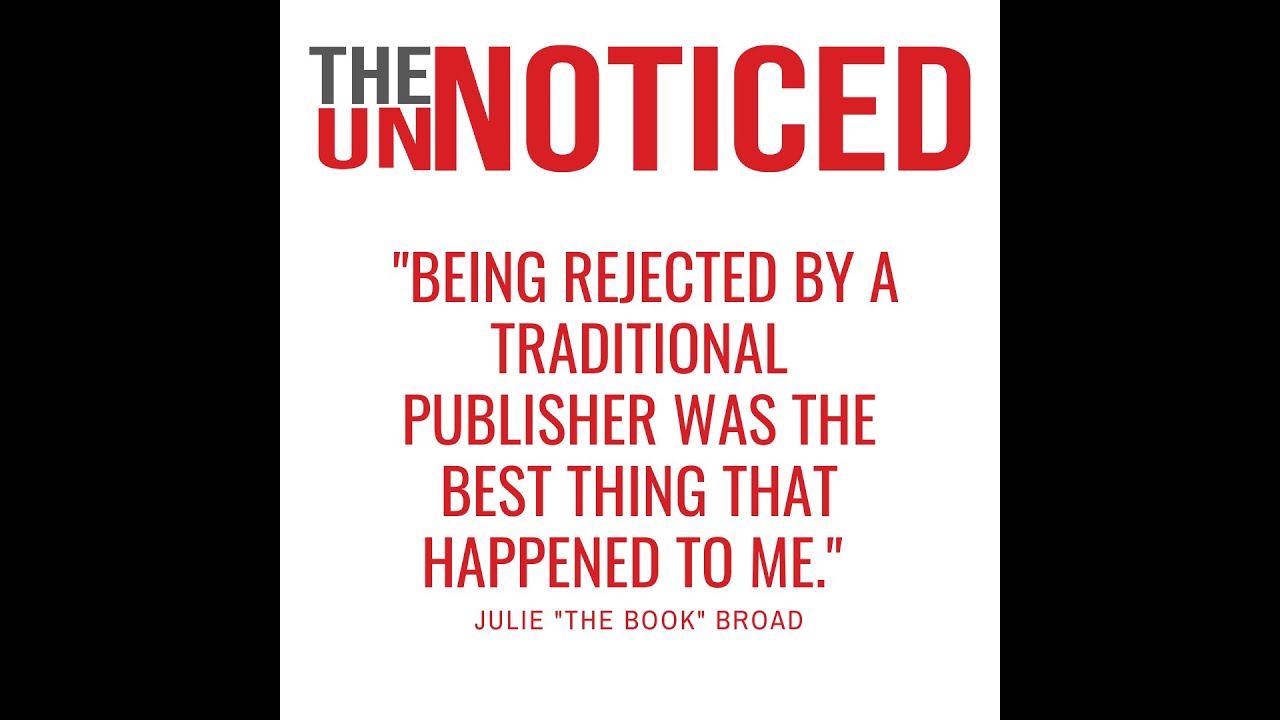
Julie Broad of Book Launchers explains how entrepreneurs can self-publish and hit Amazon bestseller status. Self-publishers earn $6 to $7 per copy versus 86¢with a traditional deal, and keep full IP rights. She breaks down her title-testing framework, pricing strategy for the $2.99 to $9.99 sweet spot, and production costs of $6 to $10k.
Chapters
Hello and welcome to this episode of The Unnoticed Entrepreneur. I'm delighted to have Julie Broad, who's joining me all the way from Las Vegas. Julie, thank you so much for joining us today.
Oh, thanks for having me.
Now, Julie, amazingly enough, I was watching your videos on YouTube about publishing because you're an expert about self-publishing books and you've got over 30,000 subscribers. And the next day I got a message to say you're gonna be on the show. Amazing serendipity. But Julie, tell us about you and what you do for business owners and how to get noticed through publishing.
Yeah, absolutely. So Book Launchers helps you write, publish, and promote a nonfiction book. And I started the company just a little bit over 4 years ago, actually, after self-publishing 2 of my own books and then helping other— in my case, it was a lot of real estate investors because I was in the real estate space in Canada for quite a long time. And it was really seeing how a lot of people would hire the right people, right? They would hire editors, they would hire cover designers, But they would put their book out there and it wouldn't sell. And even if the book was decent, it still wasn't selling. And a lot of it came back to the fact that they weren't planning, like, from the beginning how they were going to market the book. And marketing has to get layered into the entire process. And it doesn't work to hire piecemeal unless you're an exceptional project manager who can communicate your vision and kind of teach people at every stage. So I really wanted to bring it under one roof. So that busy entrepreneurs and professionals could really create an amazing book, but then have people read it at the end. And so, and so that's what I did. Yeah, no, I was just gonna say, so that's why I created Book Launchers. And there's other pieces of the puzzle that I saw that I really thought we could help people with, but that was kind of the driving force behind it.
Julie, as someone who's just launched a book and is now frantically writing to people who are not my family to buy a book and trying to promote it, You said about building marketing into the production process. Why don't you take us through the process and how you build marketing in? Because I'm certainly struggling with the post-production and post-publishing phase.
Yeah, some of it does come back to your expectations too, because some people, they see the, the people out there that launch into the stratosphere with their book, but what they don't realize is it's kind of like that old adage about the overnight success that took 10 years. It's the same thing. Somebody's book that skyrockets to number 1 and is bestseller, they've spent 2 to 5 to 10 years building an audience that was hungry for that book when it launched. A lot of people are launching the book to build the audience, which is a different approach. It works, but it's a different approach. And so you can't expect these, this extraordinary launch if you haven't spent 5 years building an audience in that space. So it is a mindset to begin with. Then the second part of it is right from day one, you need to be crystal clear on who your audience is and what the outcome of the outcome is you have for that audience. I like to pick on leadership because there's so many leadership books and And I can make it general without picking on any of my clients and making it obvious. A lot of people like to, they'll say, I have a book that's going to make people a better leader. That's fine. And that is an outcome, being a better leader, but really what does being a better leader mean for your specific reader? So really knowing that reader intimately and diving deeper into, okay, when I become a better leader, now I'm going to have the admiration of people, or now I'm going to get promotions. Or now I'm going to be able to finally get my message out that's so important, right? And so it's diving deeper into that outcome from the outcome. And that has to be the foundation of your book. That has to provide the spine. And the spine as in like everything hangs off of it for your book. You don't need anything that doesn't contribute to that outcome of the outcome. And you really have to focus all your stories, all your tips, all your strategies on that. And that's the foundation. And then as we go through, there's more, but I'll pause to see if you have any comments or questions on the first one.
No, that's wonderful. So one of the sort of observations is that many people write a book because they've got something to say. And yet what you're saying is actually, it's, you know, listen first to what people need, isn't it? And so it's a response to the market rather than necessarily saying, hey, this is— these are the tablets of stone I want to share with you.
Yeah. One of the biggest challenges I think people face is they often write a book because they've been told by many people that they should write a book. Which sets them up to believe the book is really for them, right, and about them. And sure, the book might be about you, even if you're writing a memoir, this— it might be your story, but it's not for you, it's for your reader. And you only need to tell them the pieces of information that are relevant to the reader. And this is, in particular, a challenge for memoir writers, because it's their story, and it's intimate, and it's personal. And that, that little detail about your uncle might mean the world to you, but the reader doesn't need to know it. And so it can be hard to detach yourself emotionally and really go, what does the reader need? But at every stage, I find that if you focus yourself back on that reader that needs this message and the outcome from the outcome that they're going to get and what's going to happen if they don't get this, then you can kind of drive the book forward and have that strong marketing plan in place. You'll also make better decisions about your cover, about your title and your subtitle, because you're going to be less ego-driven in the process and more really service-based. And you'll just create a stronger book From that. But, you know, while we're talking about title, I'd love to dive into that for a second, because that's a key part of your marketing.
I mean, you've already told me that I probably got the first part of my book publishing journey off on the wrong path. What I did with my book, The Unnoticed Entrepreneur, that's just come out is I interviewed entrepreneurs and experts like yourself, and then I curated that into 50 articles that made a book. So in that way, do you think that kind of almost audience participation is a a valid strategy or do you think people really need to author it themselves, but with the audience in mind?
It depends on your goals for the book. And I think there's no, there's never a right or wrong answer. Anybody who says this is how you have to do it, don't believe them because every time you say this is how you have to do it, you can find exceptions. Yeah. So I don't think there's a wrong way. What I think is there's ways that will help you achieve a goal better. And the great thing about these kinds of compilation books is if you have a thread that ties all of the articles together, or all of the interviews and the stories, and again, it has that outcome of the outcome, you still have a strong market. And I haven't read your book, but I love the concept of what you're presenting there. And it has a clear benefit. Even the COVID I love the COVID because the COVID shows what that benefit is, you know, and standing out is finally getting noticed, right? When you're unnoticed, one of the things you want is to be noticed because then you can have more business, you can have more impact, you can probably make more money. So it has that outcome of the outcome there. So it's already off to a strong start.
So I like Julie, I am going to edit out the part where you said you haven't read the book, of course. I'm going to edit that bit out.
Yeah, of course.
But I did— I am guilty of making up the title and the design myself, but most people have professionals do it. So tell us, Julie, you mentioned about the title. Share with us, how do you think of a title that doesn't, you know, get lost and sound so generic because it's just a keyword, uh, and yet be too off track as to be It's an art and a science.
And what I always encourage people is to, first of all, not ask your family and friends what's a good title unless they're part of your reader base, your ideal reader, or they're professionals in the publishing space. Because I've seen a lot of really great books get badly titled because somebody's family was really hung up on one title. It's really about your reader and making sure your book is clearly for them. And so you don't want to be too generic, like you just said, because we're not— even with 30,000 followers on YouTube, we're far from celebrity, right? That's, you need to be a household name before you can get away with calling your book something very generic. So it's really about that hook and selling that hook. And that has to be in your title. Your title has to be memorable, easy to say, easy to spell. And one of the tests, my second book was called The New Brand You. And I regret that title so much because one thing that happened, I did a bunch of podcast interviews when the book came out. And I'd say 80% of them called it The Brand New You. And they were holding the book in front of them and they were still, they were reading it and they were still saying The Brand New You. So if I had tested this with people in advance and said, hey, I'm thinking of calling my book this, and then a little bit later saying, hey, do you remember what I was going to call my book? I would have discovered that for whatever reason, the brain just doesn't remember The New Brand You. It just doesn't stick. And in the future, I will relaunch this book and package it up for authors specifically. But it is a very interesting experience. So there's lots of tests. But that's why I say easy to remember, easy to say, easy to spell. And then your subtitle, you really want to get those keywords for Google as well as for Amazon in that subtitle and really sell it. That subtitle has to sell your book to the reader and be discoverable for search engines.
And is there a tool for doing that, Julie, or is it a Ouija board of some kind for title experts like yourself?
Yeah, I haven't found it. There's brainstorming tools that if you're really stuck, you can go online. There's, if you just type in title generators, they, you can find those. They're a place to start if you're stuck. That's not going to get you to the end result. The end result, really what we do is we get ideas and the entire team contributes to the brainstorming process. And then we actually have somebody on our team that built a rating system for the titles, searching, okay, is this one available? Are there other books? Can you get the URL? Like goes through the rating system and then, then calculates how many keywords are in it and then presents them in order of the top 10 based on that. So it's like I said, it's art and science, and there's no perfect way to do it.
I guess that makes sense in that the readers ultimately are subjective, aren't they, uh, about what they're looking for. You did touch on something there, Julie, about publishing your own books versus going to a, you know, mainstream publisher. You're obviously very experienced in self-publishing. Do you want to just talk to us about the benefits and even some of the obstacles of even going to a publisher?
Yeah. One thing is a lot of people think the traditional publishing route is better because they'll sell your book for you. So you think you can show up and just write your book and they're going to sell it. But that's actually the opposite. You will get a book deal from a traditional publisher if they see how you are going to sell, you know, 10,000 copies or more. So first of all, if you think it's the solution to your marketing problems, it's not. And I got turned down for a book deal, which is how I ended up in the self-publishing space. And it was because they said I didn't have a strong enough platform to sell books. And I gloriously proved them very wrong by taking my book to number 1 on Amazon in Canada. It was fun. It was, you know, really fulfilling to prove them wrong, I gotta say. But the reason I didn't get the deal was because they didn't think I would sell enough books. So that's the first thing is you're still responsible for marketing no matter what route. But ultimately going self-publishing was really a great gift because I made way more money. In that first kind of year of selling books, I calculated a while ago, I think it was about $86,000 that I put in my pocket. Book sales versus it would have been under $10,000 with the book deal because you make about 80— the deal I was going to get would average about 86 cents per book sold versus I was making about $6 to $7 per book sold through self-publishing. So very big difference financially. And then the bigger thing for me, especially for entrepreneurs, is this is your intellectual property. And when you get a book deal, you've just given that intellectual property or sold it to the publisher. And now you don't have control over it. And this really was highlighted to me by 2 things that happened. One of my friends got a book deal with Wiley. Wiley later republished it under somebody else's name because he was no longer in the real estate space. It was his book, his words, his stories, but somebody else's name went on the COVID And the other one was a friend got a production company wanted to work with him on a TV deal, but Wiley wouldn't negotiate. He didn't own what was in the book or the title. So he had to buy the book back from Wiley in order to go through this production deal for HGTV. So it's not your stuff after you give it away. And it's huge.
You do a deal with the devil in that way. Julie, let's just go down into the pricing and the margins, because this is a show for entrepreneurs. I was interested when I priced up my book on Kindle and Amazon that there are different margins by country and for the different formats. Can you just tell us Something about pricing strategies for newly launched books?
Yeah, it depends on what your goal is. If you, if you care about how much money you make per book, you probably want to go exclusive with Amazon for the ebook because you'll make more money. And then you want to price it between $2.99 and $9.99 in order to get the most royalty from Amazon because they reward you for that. But if you really want wide distribution, so you care more about reaching people as widely as possible, then you're not gonna make as much money per copy. But so that's why I say it really comes back to your ultimate goals. Most of our clients, like about half of them go exclusive ebook, but then they go wide on print. So the print book can be available everywhere, but the ebook is only available on Amazon. And that kind of maximizes their revenue and their reach for the most part. But it is like, you have to choose, right? You have to choose what's more important to you. And then you can go kind of price things out that way. But it is a, it's a deep rabbit hole.
Yeah, but I was very interested in, so really one can be making between $3 to maybe $8 or $9 per copy. So I worked out over 327 copies, um, of the ebook, I'd be breaking even. Can you give us an idea, Julie, of what does it cost people to produce a book if they self-publish? Because that's a bit of a gray area, isn't it, for people?
Yeah, because it does depend on what you do and who you hire. So my whole strategy when I've done my books now with Book Launchers is it's as good or better than a traditionally published book. Which means we have 3 different editors working on every book. We have a professional cover designer, professional interior layout people. And you're looking at $10,000 for the most part, but give or take. There's some books go faster and they're easier and others are more complicated. But most of our clients are going to be investing a minimum of $10,000. And then we're going to be doing marketing at the end, which, you know, is more on top of that. But you can self-publish for less. Uh, it's just, you're, you have to be careful about the trade-offs, right? The quality trade-offs and things like that. But I mean, when I did my books, it's been a few years now, but I think I spent $6,000 for editors and cover, um, doing it all myself. Right. So project managing it all, figuring it all out, doing all the research. So yeah, it varies. You can do it for a lot less than that, but you do need those professionals to make your book great.
Okay, Julie, that's great. Now let's just also talk about you as an entrepreneur, because you moved from Canada to Los Angeles and then to Vegas. How have you built your brand? Because that's a great story in itself. You've got your website booklaunchers.com and booklaunchers.tv. How have you built your amazing subscriber base and your deal flow?
Yeah, it really comes back to your personal brand. The foundation of the company, I started with 10 beta clients who knew me as a real estate investor, um, but they trusted me. I had built that reputation as somebody who does what she says she's gonna do. And so when I said I'm opening a publishing company and I need clients, I had 10 people who knew me as a real estate investor say, hey, I wanna write a book. And, and they signed on to be my beta clients. So that personal brand is, is important. I had a YouTube channel, I had a newsletter, I did speaking in my previous business. And so those things were what I had built my brand on. But I also think your brand is who you are. Like I said, I'm known as somebody who does what she says she's gonna do. And I'm also known as somebody who speaks the truth. Like I'm not going to do anything shady just to get you to work with me. It's all very above board. And so I think that's really important. And then for me, YouTube's been like fundamental to everything I've done in both businesses that I've run, because it's something I enjoy and it's a great way to help people who are gonna work with me. And it's a great way to help people who aren't necessarily gonna invest in my services so I can serve and have fun and grow the business.
So with YouTube, just take us through, what do you do on YouTube? Obviously you've got videos that I can see and you've got 30,000 subscribers. Are you putting all of your content on there? Are you filming once a week? Just take us through a little bit of your content production.
Yeah, I do. I batch. I, so once a month I shoot 8 videos. And then I also, I do 2 live streams a month. And the live streams were really important for creating engagement because when I first started YouTube, one of the things I was struggling with was getting people to comment and engage with the content. So I found that having those live streams and I ended up giving away mugs and like creating kind of this community thing where I was essentially bribing people to comment, but it made it fun, right? And then it became this whole thing, the hashtag No Boring Books mug and coffee and tea and hot chocolate tastes better in it. It just became this whole community thing and everybody's got their mug after a while, cuz they comment on enough videos. And once we got the engagement, I needed a way to kind of celebrate those people. And so the live streams came in for that. And then, and so that was really kind of the pieces that layered in and then answering the questions. So I, every single comment on YouTube still, and I write down the ones that I don't have a video for. And that's what drives my content is my clients' questions. And the questions that people post on YouTube. I create the videos to answer those questions. It's really user or viewer-driven content.
Julie, that's very interesting. How did you get from zero to the first few viewers? Because it sounds like once they— once you've got them on the hook and they're looking for a mug, and of course I've got a Notice mug, which I'm just starting a Teespring account for merchandise, but how'd you get the first ones? Because it's— that seems to be the hardest part. You— once they've got engaged with you, And your personality, I can imagine them wanting to stay around, but how did you get them in the first place?
I didn't watch that. I was really focused on answering questions and creating great content. And so my first 10 videos that I posted were driven by questions that I was getting in the calls that I was having with people. When we were talking about offering the service to them, they were asking certain questions like, what's an ISBN? What— all of these things. So I write those questions down and I just started shooting videos. And I didn't watch, cuz I think you'll go crazy, especially in the beginning. I didn't watch the numbers. I didn't worry about it. I think I like kind of all of a sudden was at 2,000 subscribers and I was like, whoa, wow, how'd that happen? But it's slow, right? It's slow when you watch it. You're like, only 2 subscribers. Holy. So it's better to not watch it.
Yeah. It's the same with the podcast downloads. What you've done really successfully, Julie, though, is to continue to serve people with your passion and, and your skillset. If people want to find you, Julie Broad, from Book Launchers, how can they do that?
Booklaunchers.tv is the YouTube channel. That's where I hang out. But if you want help writing a book that's set up for marketing, you can go to booklaunchers.com/7, and that's a download. It's, it's just a really straightforward workbook for you to walk you through the hook in the beginning, who's your ideal reader, and lay that foundation so that you've got a book that's set up with your goals and your audience in mind.
Julie Broad joining us on the Unnoticed Show today. Thank you so much. I've got to go and get your download, but I think I'm already at number 5 or number 6. I think I've missed out the first few stages. I wish I'd got there beforehand, but thank you for joining us at this late stage in my career. But obviously you've got a huge amount of expertise to share with me and everybody else. So thank you so much for coming with me on the show today.
Thank you for having me.
It's been my pleasure. Okay, you've been listening to Julie Broad, who's in the Sunshine State of Nevada in Las Vegas. and talking about book publishing. And her contact details will of course be in the show notes. Thanks for joining me on this episode of The Unnoticed Show. And do subscribe. And if you want to find out more about the book, The Unnoticed Entrepreneur, it is on Amazon and Barnes& Noble. And you can find it there. So thank you so much for joining us this week. And until we meet again, wish you the best of health, a profitable business, and that you get noticed.
More from Jim











2 people, infinite agents, 1 billion dollar idea #AIAgents #Startup #Productivity