The Dumb Tax Is Real — And Bruce Campbell Wants to Help You Stop Paying It
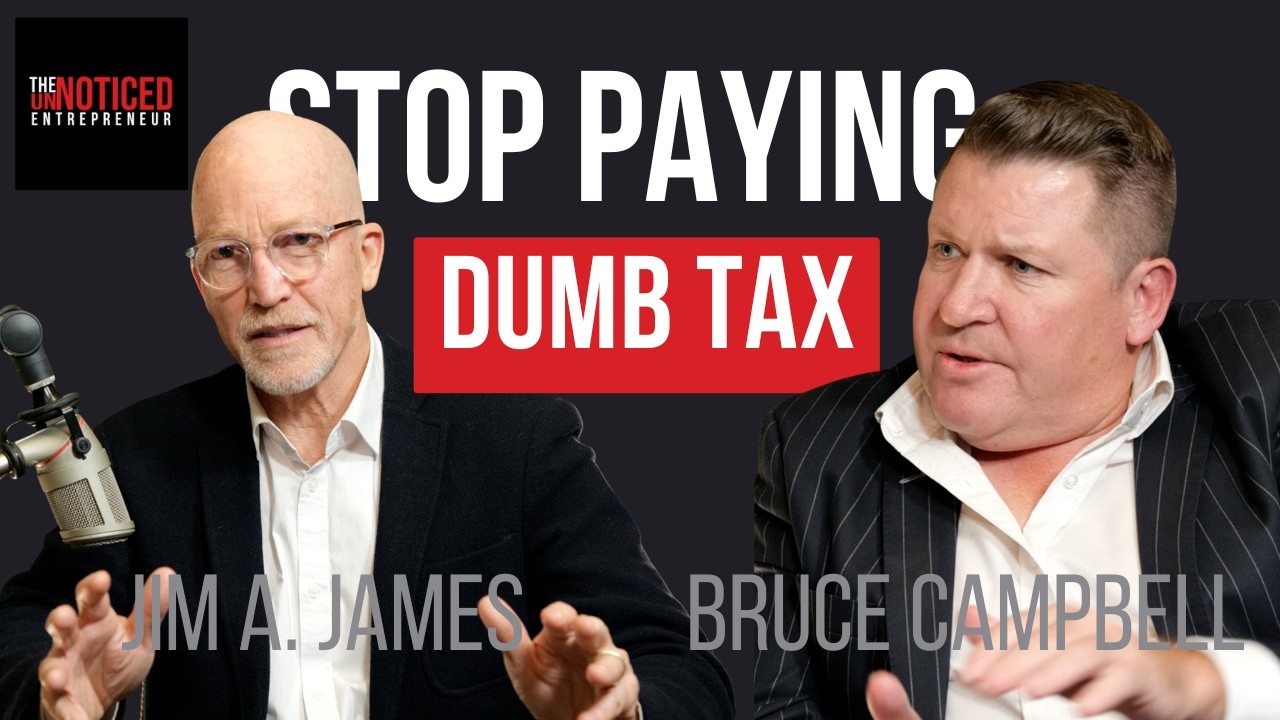
Bruce Campbell, CEO of the Entrepreneurial Business School, calls the hidden costs of bad hires and poor decisions the "dumb tax." He breaks down the Cashflow Ladder from self-employed to leveraged owner, emphasizing systems, dashboards, and hiring smarter. A chance airport encounter led him to commit $4 million to charity in Uganda.
Chapters
If I'm honest, it probably took me the first 10 years of our business to understand that, right? And now it's probably nearly more important than just growing the day-to-day operations of the company.
If you're out on your journey as an entrepreneur and you're wondering what constraints you're going to be facing and how to overcome them, then this conversation is for you because I'm going to be talking to one of the world's best business coaches. Joining me in the studio is Bruce Campbell, who is the co-founder and CEO of a company called the Entrepreneurial Business School. Bruce is normally based in Queensland, but he's in London, and he's agreed to come into the studio to share with me and you the secrets to success and overcoming those constraints that you and me and every entrepreneur will face as we build our business. Bruce, welcome to the show.
Thank you so much, Jim.
Now, why is it, do you think, that most people start a business and then fail to grow and certainly fail to exit a business? Because that's really the common story, isn't it?
Yeah. Well, I mean, look, if you think about it, most people who get into business, I would say 99% of them didn't actually ever have any formal training on actually how to run a business. So they're technically good at what they do, They inherited the business, et cetera. And then they have to then learn through trial and error. And there's lots of errors and that's what we call dumb tax, which is the tax that business owners pay when they do something dumb. It could be wrong hire, it could be wrong marketing strategy, and then they pay the price for it.
Well, you've had the Entrepreneurial Business School for over 20 years, I think. And so we're gonna talk about the Entrepreneurial Business School, but we're also gonna talk about some of the solutions I think that you've helped people to implement. Bruce, what would you say is maybe the number one reason that people pay dumb tax and what do you think we can do to cut down the amount of tax we pay?
Well, I think it, for me, it comes in 2 areas. Number one, education is, you know, for me, that's one of the highest forms of leverage is to actually have education And to learn those skills that they need to know everything from marketing to finance to how to grow teams. You'll never scale a company if you don't work out this thing called leadership and management. You've got to understand that part. So there's an education piece. And then I think the other piece, which our business is formed on, is actually having a coach and having a mentor in your corner. Let me give you an example. If every publicly listed company on the planet have to, by law, have a board of directors sitting over the CEO and the senior management, right? It's a legal requirement in any country on the planet. So we expect it in corporate. And then if you think about sport, right? Every professional sporting team It's mandatory to have a coach. You wouldn't ever get any of the teams around the world not having that. So I've got 4 kids. My youngest is Charlie, right? He's 12 years old now and he's been playing rugby since he was 5. And even for a 5-year-old, we expect coaches on the sidelines. So it sort of gobsmacks me in this day and age where business owners, where their primary source of income, Jim, is their business, yet they don't have a coach looking in to give them a hand.
Yeah. When you talk about it like that, Bruce, it really makes you wonder why people don't get a coach. So tell us a little bit about the Entrepreneurial Business School and the kind of coaching that you do, and then we'll talk about why people maybe see their kids getting coaching at school but not take coaching for themselves.
So look, I mean, we've been coaching businesses for 21 years. We do it in one-on-one, we do it in groups, which we find are very important. We've actually, I know I mentioned the board of directors for publicly listed companies, but we do the same thing, but at small and medium-sized businesses where it's also peer coaching, peer and et cetera, which brings amazing community. And the results that we get when people do the pushups is amazing. It transforms their business. And it transforms their life, right? Because they're more empowered and they're better human beings on the planet, you know, when, because there's a whole personal development side to it, not just learning the numbers as an example.
What are some of the, if you like, challenges that an entrepreneur or someone who wants to be an entrepreneur faces as they grow from, if you like, being owner-operator, that person who had the idea, started it, got the first customer to one day having a business that might operate without them, which is the ultimate freedom, isn't it? Of what entrepreneurship can offer. What would you take us through those steps?
We coach something called the Cashflow Ladder. So if your listeners and viewers can imagine a good old ladder, we all start at student, be it high school, university, trade college, whatever that is. Most people then go and get a job. Some people skip that rung on the ladder. But most don't. I got a job back in 25 years ago, et cetera. So most people do a job and then some people who do that rung of the ladder then say, I don't want to do this anymore. If I had my own business, I'd make more money and I'd have more time to enjoy it. And I say that with a bit of humor in it because then they get into—
Oh, hang on.
Furthermore, Jim, they'll say, He or she who I'm working for is an idiot. Therefore, I'm going to go and work for a different idiot being myself.
That's right.
Right.
Of course, when we start, we don't think we're an idiot. We think we must know more than anybody else. We've seen the business make its mistakes. Yeah. Right. And we think, well, I wouldn't make those mistakes.
Yeah.
Yeah.
And then you go to a rung called self where you're working for yourself. And then for me, I say this is from a mindset point of view, You get humbled in that first few years because you don't know like the tax and cash flow forecasting and team, et cetera. And there's more to it, right? And then if you're good at doing it by yourself, you go to the next rung, which we call manager, which is you've got helpers, team members, maybe subcontractors, but the business doesn't fundamentally work without you. And I normally say on that rung, a good rule of thumb is holidays, right? Is that most times you, at that rung of the ladder, you cannot go away from the business more than about 2 to 3 weeks. You go away for more than 2 to 3 weeks, the thing comes, and a lot of people that manage it, Jim, I hear them when they come back from a break and a lot of the time they'll say, sometimes I wished, I wondered why I even went on the holiday in the first place based on all the brain damage I had to do when I got back to the business.
Well, and often, for entrepreneurs, a holiday is quite stressful because one, you're not making any money, but you're spending it. But as you said, if it's a successfully run business, I should be able to leave that company and someone's running it for me and I can return to a well-operating company. So, but how do you do that, Bruce? Because that's the barrier to growth, isn't it? For most people.
Yeah.
You get into that loop as well where you think you can't afford to employ anybody to run it for you. So you keep running it and that treadmill can last for years.
Well, I would even say for a lot of people it's their whole career. They'll go to their grave in that position. And look, and this is where we come in is we help people at self and manager go to the next rung, which is owner. And that's defined as the business works without you. Doesn't mean you can have a 6-month holiday and expect the business to be still there when you get back. But the business has got my, probably one of my favorite principles and laws, which is the law of leverage. And the law of leverage, just as a definition, is ever more with ever less. So more with less. And so forms of leverage that help people get there, and there's a big list, would be systems. Is the business systemized enough so that it's not all just a people-based system? Do I have the right people that care for the company and want to take it? Or have I got a bunch of terrorists running around that I employ? Does the business have the right optics and dashboards and the numbers? So all of these, there's more I could go on with, but all of those, that's where we do a lot of coaching to get the owner and the entrepreneur to that level. So for me, that's how you do it.
So one of the challenges seems to be that as an entrepreneur, you have to see yourself differently. You kind of get into a comfortable frame of mind. You're comfortable with the client or in front of the computer or whatever. How do you help entrepreneurs that are kind of in their comfort zone? They're almost in flow in that I'm needed position so that they transition out of that into being a business owner? How do you help them with that?
Well, for me, that's the big mindset shift. When people go, like the common ones are, I'm the best one and the only one who knows how to do this part of the business. So a lot of the time they have to trust. And we've got a principle that says when control goes up, growth goes down. Right? They actually had— so when the business owner says, I'm okay to empower someone or a team, and a lot of— and actually, let's go and find on the 7-odd billion people that are on the planet someone who's better technically on what I think I'm actually great at, right? Let's go and get a better person. I think Steve Jobs said that, that you should be going employing people smarter than you. So this is where I think there's a huge mindset shift. And when people allow that control to be tapered, they grow the business.
How much of that reluctance to let go is not only the, I'm the best at it, but also if I'm not doing it, someone might steal my business. How much have you found about that, do you think?
Yeah, I think that's part of it. I think the other big challenge is people's upbringing, right?
Mm-hmm.
And they get a sense of guilt that if I'm not slaving away 40 to 80 hours a week, well, I'm not— it's like a self-worth point. And so, and for me, you know, and I'll speak from a place of I, I came from farming of sheep and cattle stations in Australia. If you are not out working, there's a whole mindset that that's your identity, right? So I think for a lot of people, particularly people who have grown up in similar, not necessarily farming, but working class, there's a whole identity piece to it. Well, if I'm not doing the hours, then I've got guilt.
Interesting. What we would maybe call the Protestant work ethic, right? That you've put in a good day's work or a good week's work, And then on Sunday, then you can rest and then you're getting stuck back into it.
Correct.
What do they need to have in place for that business to run? You talk about systems. What are some practical, if you like, tools or systems that you help people to put in place?
Yeah. So I mean, I would say a good CRM system.
CRM being?
Customer relationship manager management system. I've seen hundreds and hundreds of thousands of dollars being put down the gurgler because they didn't do the research. So they chose the wrong system. 6 months of work went in and then they had to turf it and start again. So I think that's a big one, the right accounting system, the right CFO, chief financial officer system. That's what we do actually. We've got our own proprietary software and people to take the entrepreneur business owner's numbers and then put it in a format that's nice and easy to read so that you and your coach can be talking science in the coaching sessions. If I give you an example there or analogy, if I go to the doctor, right? And the doctor's about to do surgery on me, I want them doing tests. They gotta do blood tests or x-rays or whatever I'm in there for.
Yeah.
Not just going, I think you've got this, I'll go grab the scalpel, right? So we need evidence-based decisions and I think that's a big part that I think is, you know, a real big competitive advantage of us is we've got a lot of those.
Yeah, so with EBS then you're actually helping your clients not just to rely on their own, whether it's Xero for example or Sage, their own bookkeeping, you actually have all the numbers with your own team so that your consultants can go in and give, if you like, a consistent report against some metrics. So that's also part of the benefit of having a coaching program, isn't it?
Yeah. And look, whilst we stay on systems and the pieces that help people get to that more leveraged owner rung on the ladder, I think another one is 100% around the taking team. Right. I would say any of the clients where there's say more than 5 to 10 team right up to 500 of team, it's probably the most single-handed choke point is that they don't have any real systematic way to recruit, select. So they're doing it on gut feel and I think he or she's going to work out here. So we put people through a huge amount of a system to do that. Also psychometric testing, because I want to know the person that I'm about to employ and have to deal with.
Yeah.
I got to know that all up front. I have to have actually some of the tough conversations before they sign the dotted line and walk through the door. Another piece, and there's plenty of stats on this one, Jim, Is onboarding, right? So the stats of onboarding a new team member in that first 6 months, you get that period wrong, the stats are atrocious for the person not performing or not staying, full stop, right? So in the 20s, those stats are even worse, right? So it's essentially you do all this work to get someone to come on your team. I say for a bad hire, depending on where they are in the organization from a hierarchy, I say for some of the junior ones, you're going to write a check for £10,000, dollars, euros, et cetera, right? And for the major hires, like middle of the organizational chart or even higher, it's £100,000 to £200,000.
It's amazing, Bruce, isn't it? How much time we put in to finding those people, how little we put into actually the onboarding. And there's a very good book by Dan and Chip Heath, um, it's called Moments, and it talks about how when people join, they're kind of given a desk with an Ethernet cable and a screen but no computer, and it's just sort of left to their own devices. And the importance of making it a welcoming experience and also the training. One of the things that comes to mind, we're saying About business not growing. And really we've talked a lot about systems and about people. What about innovation, Bruce, and the need for the product and the market fit? How do you help people with that?
So the one that I run into regularly is because the people or the owner at the top of the organization are so far in their business, they're on the tools, right, is that they don't have the time and they don't have the critical think time to even be able to go to an innovation mindset or place. And this is again why coach is so important is because once a month or quarter or whatever the frequency we coach on is we literally drag the business owner out of the weeds. And say, let's go and have a think about what's going to be the innovation. What's the biggest risk facing your company? All these type of questions that allows them to get out of it.
Let's just talk about the entrepreneur that has a business with their partner. I know that you with the Entrepreneur Business School, you set that up with your partner and your wife. What are some of the challenges that you think people face when they're starting a business with a partner, be it A spouse or another person they've met, maybe they've co-developed a product.
Well, I think Warren Buffett says it the best. He says, of all the decisions you make in your life, making the right one on the home front or business partner is one of the most crucial decisions you make. And you stuff it up, you're going to pay a big old dumb tax on that one, right? That's right.
It's an expensive divorce.
Is it huge? And it's not just the monetary, it's the emotional side to the whole thing as well. So for me, I spoke about this before, but I'll really kind of put it on a bumper sticker now, is that if you are not aligned with your either life partner, spouse, or business partner, it's nearly impossible to grow, right? So a lot of the time, Jim, at the front end of when we coach, we'll be working on the personal development side. What are the rules of the game that we need to work on? And a lot of those frictions, I might add, and I mentioned it more from a team recruitment before, is that psychometric testing that we do, right? Is, well, there's a scientific reason that you're butting heads because, I don't know, one person's stubborn and the other one doesn't like conflict. Right? So of course, we know how that one's going to play out. One avoids it, one doesn't sort of thing. So whatever the psychometric profile of the people are, knowing that at the front end of a coaching relationship is beautiful because now I can get you into synergy. And a lot of the time, the coach, I find on that front, sometimes is the referee.
Yeah.
Because they're neutral, right? And we can call it and say, no, you are being a dick. Excuse the French.
That's right.
You know, stop, pull your head in sort of thing. And then of course now I've got more synergy and alignment.
So you've been, you know, working with your wife and you've built this global business now.
Yes.
With the Entrepreneurial Business School. What would be the piece of advice that you'd give to anyone that has a business with their marital partner? Because there's a dynamic where you've got the work and you've got the home environment. What would be your advice there, Bruce, or anyone that's in that situation or starting out in that situation?
Well, if I can just use my wife and I, we were together for whatever, however many years, 10 years before we started Entrepreneurial Business School. So we had to do a lot of this work even though we were married. I'd already signed up for the job, if you know what I mean.
Right.
Same with her.
And we had 4 kids as well.
Yeah. And the interesting part too, Jim, is Our major growth cycle in our particular business is when the kids were young, right? So there's breastfeeding, there's late nights, there's lack of sleep, yet we're still working on ourself. We're still engaging with our coach and running the companies as we grew them, right? And I look back to those days and sometimes my wife and I actually say, how did we do it?
Yeah.
It's easier now because they're sort of adults and teenagers, more self-sustaining. But You know, it's interesting looking back. So I would just to, I would, there's another profile called the Flippin' Profile out of America, Flippin' Group, a very great profile, highly recommend.
Yeah.
And there's a good course that I would do called Money and You, right? It's been, it's the oldest personal development course on the planet. They do run it in Australia, Malaysia, US, et cetera. And I think that's a must. And if you get some of the concepts in that course, it'll change your world.
Great. Because if you are a married couple and your source of wealth is the business, it going well or badly impacts your ability to look after your family and/or to retire. So it's really a key relationship and working on that relationship as opposed to just kind of letting it happen seems to be really, really important. What What you've managed to build with the Entrepreneurial Business School has created a lifestyle and a business for yourself and for hundreds of other people around the world. Where do you go from the business success as an entrepreneur and as a member of the global community, Bruce?
A mentor of mine once said, people with better choices have a better life. And so that's fine to a certain extent, But the success will get you here, but the word I normally like to use is fulfillment, right? And fulfillment normally comes from helping other people. And that could be people in your own community or your church or whatever, or in other countries, charities, et cetera. And I think if I'm honest, it probably took me the first 10 years of our business to understand that. Right. And now it's probably nearly more important than just growing the day-to-day operations of the company. You know, the universe gives you what you need at a certain point in time.
Absolutely it does.
And this happened in Perth in 2018 in March. So basically some friends in the business coaching world that I know and respected were getting out of that world and they did an act of abundance. And what happened is they rang me and said, we're getting out of business coaching. We've got all your client, we've got all this client base. We're gonna give them to you like for free. Like no money down. And I was like, oh my, you know, that's amazing.
That is an act of abundance, isn't it? Yeah.
Huge abundance. So I had to fly over to Perth to meet the new clients, tell 'em about what we do. Which all went fine. And the evening I was getting a nighttime flight back to Brisbane where, and I was the last on the airplane that night. And there was a guy and a kid about 9 years old. And he said, what are you over here for? And I told him and I said, what are you here for? And he says, I'm here for an operation for the kid. And I was like, that's, you don't normally hear that, you know, getting on an airplane.
Yeah.
And I got on and bid him farewell. And the plane— it's never happened to me, I've taken thousands of flights— the plane goes out to the runway and right at the last minute it turns back and goes back to the terminal. And, and the captain said, we've got one of our crew members has become violently ill from the terminal to the runway. You all got to get off because we've now not got the right amount of crew. Et cetera. So back I go to the lounge. So I'm in this lounge, right? Having a drink and basically about 3 meters in front of me, here's this guy. And I don't normally talk to people in airports, but I thought I'm going to go over and ask about the operation that he'd told me 20 minutes before. So I go over and said, look, I can't help but remember you told me about the kid's operation. And I said, when is it? He says, tomorrow morning at 7:00 AM. And I said, look, I don't know you from a bar of soap, but we'll probably have to move planes or airlines or whatever. If you need, I'm happy to pay for your flight and the kids' flight to get you to the destination. He said, so abundant of you, have a seat. And, and, and I was like, and he said to me, I'm, I'm a CEO of a charity in Uganda. And he goes, What do you know about witchcraft? And I'm like, I've hardly anything, nothing. And he says, what do you know about something called child sacrifice? And I said, I've never heard those 2 words in the same sentence.
As, as one would hope. Yeah. Never do, to be honest.
And I said, well, tell me about that. And he says, well, in Uganda there's still pockets of witch doctors who for their paying clients do Everything from killing a chicken right through to killing humans. And I was just, I was, well, I just couldn't get my head around this. And I said, so why are you going to Brisbane? And he said, well, Benson, the 9-year-old, him and his father were kidnapped by a witch doctor and the father was decapitated and Benson's had his penis cut off.
Ouch.
And I was just like, who does this? Like, I was crying, you know, still kind of makes me water down. Yeah, I got it.
I just squirm. Yeah. Listen to it.
So I, once we got that and we got the plane sorted, got him to there and I said to him, there's a reason that you've met an entrepreneur who's got a huge community of abundant people. And so you fast forward, we've now, uh, Donated over $4 million to those 2 charities in Uganda. We take 40 people annually on humanitarian trips. I've just got back from one about a month ago. And we've now got our own kind of world vision, if you will. So unlike a lot of other charities, we give 100% of every dollar donated. If so, if you want a kid, £100, $100 a month and you can change your life. So I look at now what that alone has, the impact that we've had on those communities, a generational impact. We've put a water bore down, which in the slums of Kampala, which is the capital of Uganda, when we first went there, everyone was sick. We've now got 5,000 people who drink clean Drinking water, we've eradicated all those waterborne diseases. Kids are getting fed, medical.
What's special about that is that, you know, as the business has got to a stage where it runs, you know, without you in the best possible way, because you put the systems in and you've got clients and you've got amazing teams around the world working with you. But rather than then sort of drifting off into buying more of things, the sense of purpose has given you even more reason to grow the business, hasn't it? Because now you're in Europe. Expanding the team, and I guess you're going to grow internationally. So Bruce Campbell, what would be the one piece of advice that you'd give to my friend who's listening, who's thinking, I want to accomplish in the same way that Bruce has, build a business that enables me to accomplish something and then to serve others?
Great question. I mean, my answer is you can't do it by yourself. And anyone out there who thinks that they can do it all by themselves. For me, I've not seen it yet, right? I've had heaps of coaches and mentors over the years and for every dollar or pound that I've put into that education has paid me back like 10 times, probably more than that. So for me, I'd just say to the viewers out there, You got to have someone in your corner. You can't do this by yourself.
Bruce Campbell, thanks for joining me in my corner in the studio of The Unnoticed Entrepreneur. Thank you for joining me today and sharing your story about the Entrepreneurial Business School. And also we have a link which I'll put in the show notes for a free diagnostic test from yourselves, if I'm not mistaken.
Can't wait to take people up on it.
Bruce Campbell, thanks again for joining me today on The Unnoticed Entrepreneur Show.
Thank you.
Tremendous conversation with Bruce Campbell there, who's the co-founder and CEO of a company called the Entrepreneurial Business School. For me, one of the key takeaways was the importance of systems. It doesn't matter so much what you're selling, but the business systems that you have to help you to grow the sales and the team. That's perhaps the first lesson. The second lesson is one of abundance, that actually there is enough business for everyone. And the third is the purpose. The importance of purpose for Bruce, now that he's built a global company, it's his work in Africa that is really giving him huge amounts of energy and life force. And that's actually also bringing passion to the people that work with him, be it the clients and the employees that he has at the Entrepreneur Business School. Now, if you'd like to touch base with Bruce, you can go to ebs.org and they will do a free diagnostic test on your business to help you find out where you're at, and they can help you build your business so that you can live a life of wealth and abundance too. So go to ebs.org. My name is Jim James. I'm your host. Thank you so much for tuning in to this episode of The Unnoticed Entrepreneur.
More from Jim











2 people, infinite agents, 1 billion dollar idea #AIAgents #Startup #Productivity