This author tells his readers 'Don't be dumb' and be smarter to #getnoticed
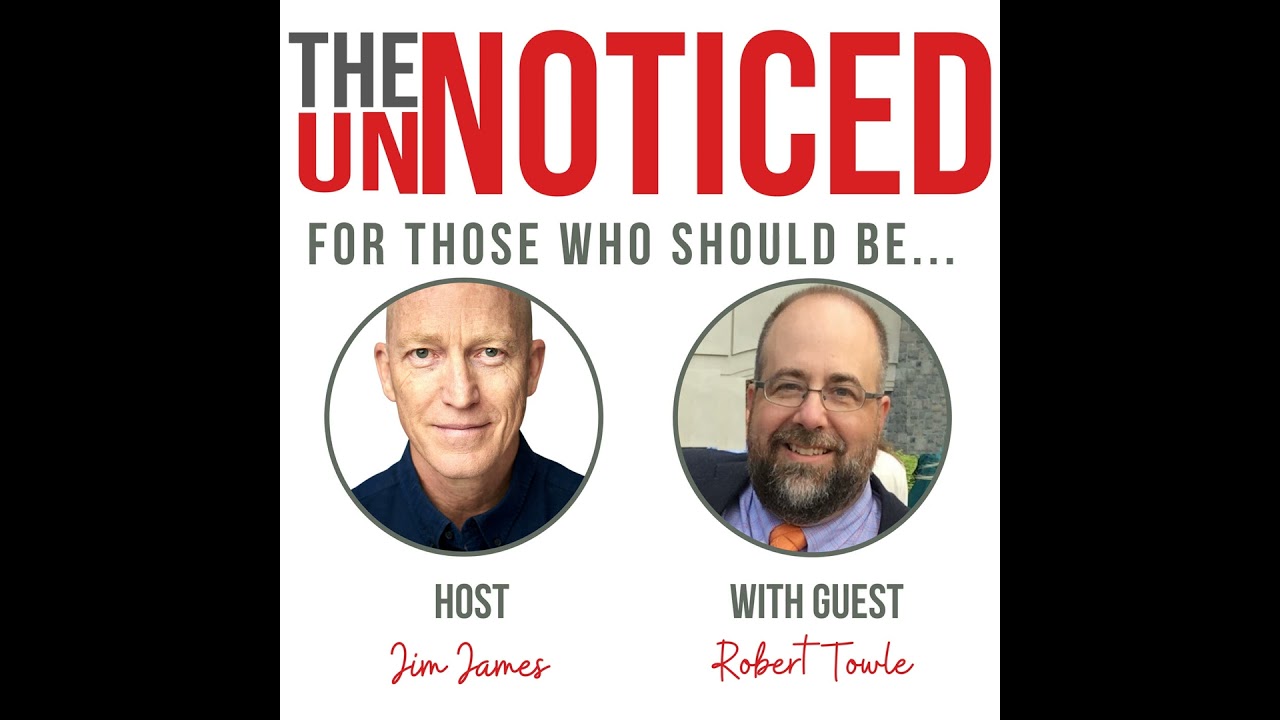
Robert Towle, a former CFO turned entrepreneur, shares workplace tactics from his book Don't Be Dumb. He uses awards like "golden shoes" and the "Fish Principle" to make work fun, argues that owning your communication platform matters for credibility, and swapped his suit for Hawaiian shirts to build a memorable personal brand.
Chapters
Hello and welcome to Robert Tell, who's joining me all the way from Radford in Virginia. Welcome.
Thank you, Jim. Really glad to be on the show today. Thanks for the invitation.
Well, you know what? I have to have you on the show because you have the most amazing Hawaiian shirt on, which is bringing the sunshine to me over here in the UK. It's a bit damp as always, but we're going to talk about your book, which is called Don't Be Dumb, but also The communications and the journey that you've been on going from being a corporate finance CFO to being an entrepreneur and coach to entrepreneurs. Is that right?
That sounds great. Absolutely.
Great. So Robert, let's just talk about your book, Don't Be Dumb, in a sentence or two. Do you want to just share with us about the content of that book?
Sure. Well, I'll start off, Jim, with the title, which is the one point with the publisher where I got into a confrontation over. Because they were like, oh, that's so negative. And I'm like, it's not negative. It's, it's about being smarter. It's not that I don't do stupid things every day, all day long, but it's about attempting to not be dumb. And it comes from advice my dad gave me when I was like 13, which didn't please my mom, where she was looking for him to give me nice advice over the breakfast table. And he just looked up at me over his coffee and says, yeah, don't be dumb. And it stuck with me all these years. Not that I've always followed it. But it's a unique way to get the point across of you can do better. Try not to make mistakes, but if you do, how do you recover? And that sets the context for the book of how do you lead and develop as an entrepreneur? How do you recover from mistakes that you make as rapidly as possible? How do you become more resilient and how can you rise more rapidly in your business and grow your business, especially in these challenging times?
Okay. Well, there's a lot of things to unpack there, aren't there, Robert?
There are.
Yeah. Where should we start? I mean, the Don't Be Dumb, and one of our favorite movies, of course, is Dumb and Dumber over here. But as an entrepreneur, if you're building a business and you're trying to grow, you inevitably get more people within your company. So you talk about rising as a company, as an entrepreneur. What sort of learnings have you got in the book about helping everyone else to follow your journey and be with you and help you? To get the business to grow?
I've had a lot of examples in my career, even, even back in corporate finance of interjecting fun into the workplace. So even for example, we would do something like a golden shoes award where it was an old pair of sneakers that were spray painted gold and put on a stand. And every month we would give them to the employee that exhibited the best customer service of walking a mile in their customer's shoes. And they were really just an old pair of sneakers that had been spray painted gold, but people really wanted this award and wanted to see who got it the next month when we would have our monthly meetings about things. And, and it interjected some fun in a unique way, and they would display it in their cubicle or in their office until the next month. Until then, the next person got it the next month. So it's always been part of my approach is how do you, you know, you're spending a lot of time at work.
Yeah.
And you want to have a good time and your team members are what gets you to success and the people that work for you. And I came across a number of years ago, something called the Fish Principle. And it was actually based off of a fish market in Seattle where it'd been just a regular market outside in Seattle, but a new owner came along and found a way to make it fun. And so suddenly they're singing songs about the fish. They're throwing the fish back and forth. They're interacting with their customers in a playful manner. Meanwhile, you know, stinky fish, cold outside. If there's any place you wanted to be miserable, you could be miserable there. And instead they turned it completely around to where now it's a tourist attraction. People come to this fish market and buy fish there. They've actually gone on and done consulting, teaching other people how to interject fun into the workplace. And, you know, how do you every day make a difference to your stakeholders, to your customers, to your employees, interject fun. Being there and being present for your customers, as opposed to being distracted by whatever you've got behind the wall that you need to work on, whether it's paying the bills or your marketing plan, and how do you engage with them every day and have fun with your employees? And it makes a huge difference. It really does.
You know, I heard about a baseball team as well that wasn't doing so well, but they started to make it an entertainment-based sport rather than a performance-based sport. And they also put the fun back into the whole baseball as an event and also equally successful making the, you know, the business into one of entertainment rather than just playing a sport.
You're spot on, Jim. And I actually had an example in my history that I started off being irritated, to tell you the truth, was when one of my favorite teams was, it still is, the Houston Astros. But their farm team at the time was out in Tucson, one of their smaller teams, the development league. And they would come out and have a— and play each other once a year. And I sat there and went to it and got to see them there locally in Tucson in a small stadium, which is really fantastic. And I looked at these players and they looked really different than they did on TV. And I'm like, what's going on? These guys don't look the same, but their numbers and their names are on their jerseys. And I realized that they traded their jerseys with each other. And were imitating each other's stances and approaches to baseball and just having a grand time out of it, just having so much fun. So I got over my irritation of, wait a minute, I wanted to see them play like they normally do, and realized they were making it so entertaining for themselves, for their fans. The game didn't count for anything anyway. It was just an exhibition game. So why not have fun with it and enjoy it and make it an experience for the fans?
So do you think then part of the don't be dumb message is around don't sort of overworry the work and to try and make it fun as if it was not work, but life in general?
I think, I think you're right, Jim. And I think it even ties to when I talk about recovery strategies. So many entrepreneurs get tangled up in not wanting to make mistakes. And the reality is you're going to make mistakes. You're going to get yourself in bad situations. And don't take it so seriously. Find a way to turn it around. Find a way to improvise, adapt, overcome, improve. You can get yourself out of nearly everything if you don't take yourself too seriously and just go, wow, that was a bad idea. Now what do we do?
So can you give us an example then, Robert, of how one of the sort of chapters in your book has case studies? Can you give us an idea of one that you think is particularly relevant?
I can get you an idea of one that I ended up with what I would call the worst conference call in Kicking off a major project with a client that we'd worked on for 4 years and made the mistake. I made the mistake of using their conference call system versus my conference call system. And for the big introductory kickoff call with hundreds of people around the world and their conference call system, we had no control over it and it introduced everybody who joined. And so you start the call and it's beep, Jim just joined. Beep. Bob just joined. Beep. Sally just joined. For the first 10 minutes of a 30-minute call, interrupting constantly. 10 minutes of me being able to talk clearly. And then everybody started leaving and it also announced their departures. And I'm sitting there and I'm frantically talking to my IT person when I'm on mute between the beeps, trying to get him to change the system, which he can't because it's not our system. And hung up, finished the call. Dreadful, horrible call. Worst one I've ever had thinking that's it. We're done. We're, we're in London at the time. They may not even pay for us to fly back home. We're done. This whole assignment is finished and had to sit there and go, okay, what, what lessons have I learned out of this? Is first of all, you've got to own it. I made the mistake. I have to go down the hole now with a recovery plan, which is we can do another call tomorrow and record it on our system. But I have, I have a window of about 5 minutes. To get down the hall and save this. If I hesitate, we've lost it forever. But it— and I can't sit here and moan about my fate or my mistakes. I just have to find a way to recover. And I did, and it worked out, and it turned into like a year and a half assignment that worked very, very well because I got to them and I owned it and found them, but didn't just say, I made a mistake. I made a mistake and here's what I'm going to do to fix it. Here's how I'm going to improve and how we're going to recover. And people miss that. They get hung up in the, I made a mistake, which we all do. Yeah.
And you've got a couple of things in there. I think one is the need to go back and be proactive, but I think from the context of this podcast, the control of the platform that you have the communication on is really key, isn't it?
Oh, it was.
And today, are you recommending any particular platforms that you use or that some of the big companies that you've worked for? Are they all using Teams or are they using Zoom or are they using other tools?
There's pros and cons to both. I mean, traditionally I use Skype, but it got a little bit clunky over time and not nearly as good as it used to be and have used both Zoom and Teams. And there's pros and cons to both. I would say Teams has an advantage because you can also have a repository of documents and documents to be shared with people that you're interacting with. So when you're working on projects or have ongoing interactions, Teams, I think, wins that way over Zoom. Sometimes you get into upgrades and so forth. It doesn't work quite as well as you'd like. Zoom works very well for having the ability to interact with lots of people, but it also has limitations such as how long you can be on a Zoom call. Unless you have a Zoom account, they'll cut you off at 45 minutes. So you have to be willing to pay for that extra to have unlimited amounts of time. And so I'd say both, I would say it's a near tie between the two. It just depends on what purpose you're using them for.
Right. And the key, as you say, is that you own, you own the channel for communication. You've had to transition from being sort of a CFO, including from Pinkertons, the investigative agency, to being a Hawaiian shirt wearing business consultant and author. Can you just tell us some of the lessons as well that you've learned about that transition? Because it's quite different to represent a big brand or be part of a big brand. And then to build your own, isn't it, Robert?
It is. It is. And I think it took me a little bit of time. It may be back to the don't be dumb. Sometimes I am. It took me a while because in finance, you typically want to be wearing the brown suit or the blue blazer and the light blue shirt and the tie and sort of be in the background and not necessarily stand out, but be that voice of stability. But you're really not recognized or seen very often. You don't really want to be in that position. That's for the CEO to be in. to be the one that's more the outward recognizable figure. And it took me a little bit of time to figure it out with some good advice from my wife and others of, in consulting, you want to stand out. You, you are your brand. How do, how do people know you for who you are? And that's led to, you know, Hawaiian shirt wearing and being even known to the point where I got this one for a Christmas present this year of, from my wife of saying, here's another one that you can wear on the podcast. And other people have been on other podcasts and said, oh, there you are again, wearing Hawaiian shirt, or, oh, that's a different one. That's a Star Wars Hawaiian shirt. Where'd that one come from? And, and helping you be, have a place, cuz there's only so much space people have in their heads for brands and people and who they are and being known for something, whether it's something as simple as a Hawaiian shirt stands out where a light blue shirt and a blazer doesn't stand out a bit.
Yeah. I'm slightly embarrassed cuz I'm wearing a, a blue button-down collar shirt today. So you've got the high ground on the fashion today.
I don't know. I guess World War II bombers on a Hawaiian shirt might win today, Jim. I don't know.
But Robert, what part of your strategy then as an advisor for building your own brand has been the book? Yes. Can you just tell us how you've gone about writing that and how you're publicizing it and the impact that it's had on your business?
It was interesting because I wrote, it started off being random stories from Robert and it was going absolutely nowhere other than some interesting stories about, and I wanted to, after I'd been through, you know, Jim, I'd been through having a brain tumor that was removed and it was a really wake-up call for me, successfully removed, but made me want to give back from my experiences and see if I could take a different approach in things. And that's what the genesis of writing the stories down. I then found a way to link them using popular music as the beginning of themes of the, of the chapter and tying things together that way. And so that once I found the way to connect the random stories, it all just sort of came together. The impact has been really very positive. Published the book in October, took a fair road of time to get there between editing and getting it ready to be published and cover design and all that other good stuff. But it's had, you know, gotten incredible reviews on Amazon so far. Got reviews, pre-reviews that are in the book from people that I've worked with through the years, going all the way back to very early jobs that I had. And some of them aren't even published, Jim. A guy that I worked for, several of his experiences, or my experiences with him are in the book. He read it, stayed up at night reading it, downloaded it, read it, and then wrote me an email at 2 in the morning saying, Wow. Everything you're saying makes a lot of sense. And you've had some interesting experiences that I didn't even know about. And I endorse everything you've said in this. It was absolutely fantastic. And that wasn't even a public review, but it just woke up in the middle of the night and made me feel very good about the positive impact.
That's fantastic, Robert. And congratulations on getting a book published because I know it's not easy to do and getting free reviews and so many positive reviews. Congratulations indeed on that. And so in terms of helping you to build your brand, you're doing the book and how are you promoting the book? And how does that then kind of make a lead magnet for your consulting business?
Well, the idea is for it to be that lead magnet. So somebody says, okay, I can use this type of advice, or how do I apply that? I tried to give away elements of it, Jim, like at the end of sections, talk about here's action steps you can take. Here's an appendix with some tools you can use. So it wouldn't require somebody to come to me, but make them interested enough to where they can call and email and get help if they want some more help or some time with that. So how I've been publishing has been primarily through getting the reviews on Amazon, some publications on LinkedIn and Facebook of talking about things, as well as going to podcasts like yours and then publishing those out and linking to those. on LinkedIn and Facebook to get the word out about the book.
And Robert, are you doing that yourself or have you got people sort of helping you to do that? Because it is time-consuming, isn't it?
Yeah, I followed my old rules, Jim, of the time I've spent in India where you outsource things if you can. And I hired a firm to help find podcasts that would be a good fit. And so they do a lot of the heavy work of sending out inquiries. connecting and then coming back with, okay, we've got somebody Jim wants to talk to you or is interested. And then I take it from there and book the time, but it means I'm spending 10% of the time on it that I would be otherwise. So I can keep focusing on delivering to existing customers and promoting the book.
Now, is that very expensive, Robert, to outsource the sort of podcast bookings?
Relatively not, not horrible because they actually broke it down across like a 6-month period of time. With a fixed fee, with a fixed guaranteed number of podcasts. So it's broken down. So it's not horrendous.
Can you give us some indication of what that's costing?
I want to say it was like $1,800 a month across 6 months. So not free, but not $100,000 either.
Yeah. Okay. So affordable. And if it gets you one or two more clients, then—
And that's, and that's the key, you know, like to sell some books and We've had some good sales so far, but we'd always like more. I know you can understand that, but then leading to more engagements with clients, it doesn't take much in the way of engagements. And we've got some good interest. I've got some local clients here. I've got one international, one US client, and then another one that I'm working on right now. I have the passion for working with entrepreneurs. My grandfather opened his own shoe store when he got tired of moving. I helped him when I was growing up with that and that sort of returning back to that has a lot of meaning to me after applying those corporate skills to smaller enterprises.
And if there's one of the rules in your Don't Be Dumb that you could share just to give people a flavor, Robert, what do you think? You've talked about refreshing, for example, and growing. Can you give us one example from the book?
Well, I'm— to cut to the chase, Jim, is that my final section is about rising rapidly. And it's based off of a song that's called The Cape. And it's basically someone that tied a cape around their neck and thought they could fly. So they jumped off the garage and they kept throughout their life. But the message is they didn't know they couldn't fly, so they did. And that's about rising rapidly is don't be hesitant. Don't be afraid because you don't know everything. Don't be afraid because you're not perfect. Put on your cape and fly. You can do this. You can go forward and achieve great things.
But one does have to be careful, of course, of gravity, I guess, Robert, right?
Someone that's broken a few bones and done some stupid things. Yeah. Gravity is not pleasant, but you still pick yourself up and you keep moving forward.
Yeah. And I think to your earlier point about finding people like yourself that can help to guide and advise people seems to be really key, doesn't it?
Yes, it is.
So Robert, if you want to find out about you and find out more about Don't Be Dumb, of course I'll put a link to the book in the show notes, but how can they find you?
They could find me on LinkedIn or Facebook. There aren't that many Robert Towles out there, T-O-W-L-E. They could also find me on my business website is 636advisors.com. And I have a website for the book, which is dontbedumb.expert. That's out there so people could learn more about it.
Okay. It's Robert Toole joining me from Radford in Virginia. Thank you so much today for joining me on The Unnoted Show. Congratulations on your amazing success with your book.
Thank you, Jim. Really appreciate the support. Thank you.
You're more than welcome. Thank you very much everybody for listening to this episode of The Unnoted Show. And I will of course put Robert's details in the show notes. And until we meet again, I wish you the best of health. Stay safe. And as Robert says, Actually, you can do anything if you put that cape of invincibility around you, but do look carefully before you leap off the building.
More from Jim











2 people, infinite agents, 1 billion dollar idea #AIAgents #Startup #Productivity