This consultancy business created their own video studio to grow and #getnoticed
Digital Surgeons, a consultancy, built a TV-style studio to produce Forward Obsessed, a video-first podcast. They use Riverside to record, Premiere Pro to edit, and Descript to clip and repurpose segments for TikTok and LinkedIn, distributing through Anchor and Podbean with separate RSS feeds.
Chapters
Welcome to this episode of The Unnoticed Entrepreneur with me, your host, Jim James. And today we're going to Connecticut, New Haven, to talk with Robert Rosch, who's managed to do something very cool with podcasts and video. Robert, welcome to the show.
Jim, thank you so much for having me on. This is really fun.
It's going to be great because you are the executive producer for The Forward Obsessed, and it's a podcast that's been launched by Digital Surgeons. Don't wanna steal all your thunder here, but you've got lots of great juice for us here about how entrepreneurs can build a podcast as a platform. And you've also done some cool things with video, which is why I reached out to you on LinkedIn. So tell us all about Forward Obsessed and what you're doing with video and podcasting.
Thank you. Well, first of all, it's awesome to be here and we've got a lot of respect for your show. And so, um, it's really exciting. Forward Obsessed is a podcast that's Hosted by Pete Senna and David Salinas, who actually head up Digital Surgeons, that company that you just referenced. And Pete and David, they noticed that they have this incredible capability of when they sit down with a successful entrepreneur of digging deep into their story. And it's not just about those really high-level, you know, your LinkedIn posts, look at all this stuff I did and all the highlights. When you found a company, bring it to potentially like a public offering or sell your company. That whole process is incredibly fraught with difficult times and pitfalls and pivots and aha moments and a lot of personal, deep personal things that people go through. And so that's what Pete and David go through in Forward Obsessed, because people go through a lot, but they still want to take their idea and push it forward into the future with this incredible energy and inspiration. So that's the premise of the podcast. Every interview is with a different entrepreneur. We're about 14 episodes in. Our 14th episode is dropping really soon. And we've been having a blast with it.
Yeah. And I could see, but what's interesting is why I reached out to you, Robert, really as executive producer on The Forward Obsessed is that, you know, The Digital Surgeons is a consultancy, right? They're not a production company. They are not a therapist for entrepreneurs. So you've managed to create like a TV studio style podcast. So what was the decision behind that and what's been the impact of the business? And then we're going to talk a little bit about What you're doing with the video that you're creating and using, and I'm seeing on places like LinkedIn.
Sure. I think from an initial perspective, this is truly one of Pete and David's deepest passions. They love kind of diving in. And so in many ways, it is very passionately a beloved project for them. And you can tell when they're talking with these people, you know, this is what they love to do. And from the perspective of Digital Surgeons, You know, and anyone who started a podcast for their company know it's a legitimizing factor for the organization as well. For example, we've got the next episode we're about to record. We're going to sit down with the governor of Connecticut, Ned Lamont, and that's going to be a big episode. And we're going to dive deep into Ned Lamont's experience as an entrepreneur, why he became a governor, everything. Those conversations are really important because they show that not only is Digital Surgeons good at what they do, and if you visit the website, you can see that, But also they're really interested in bringing out these different sides of people who don't necessarily get asked these questions. And they want to show young entrepreneurs and young founders, and Pete and David are really big on giving back to these communities of entrepreneurs and young founders. They can show them that you can do it. It's a hard road. There's a lot of tools at your disposal, and there's lots of incredible people out there who have accomplished things that weren't seen as possible before. And that's the kind of feedback we've been getting on the show.
So, Rob, you're the executive producer on the show. Tell us a little bit about the strategy, because many companies create a podcast almost like a newsletter used to be published back in the old days when I used to do print A4, you know, magazines for companies. But you've taken a different approach. Just explain the approach that you've taken and why it's different to making it a promotional piece for digital surgeons.
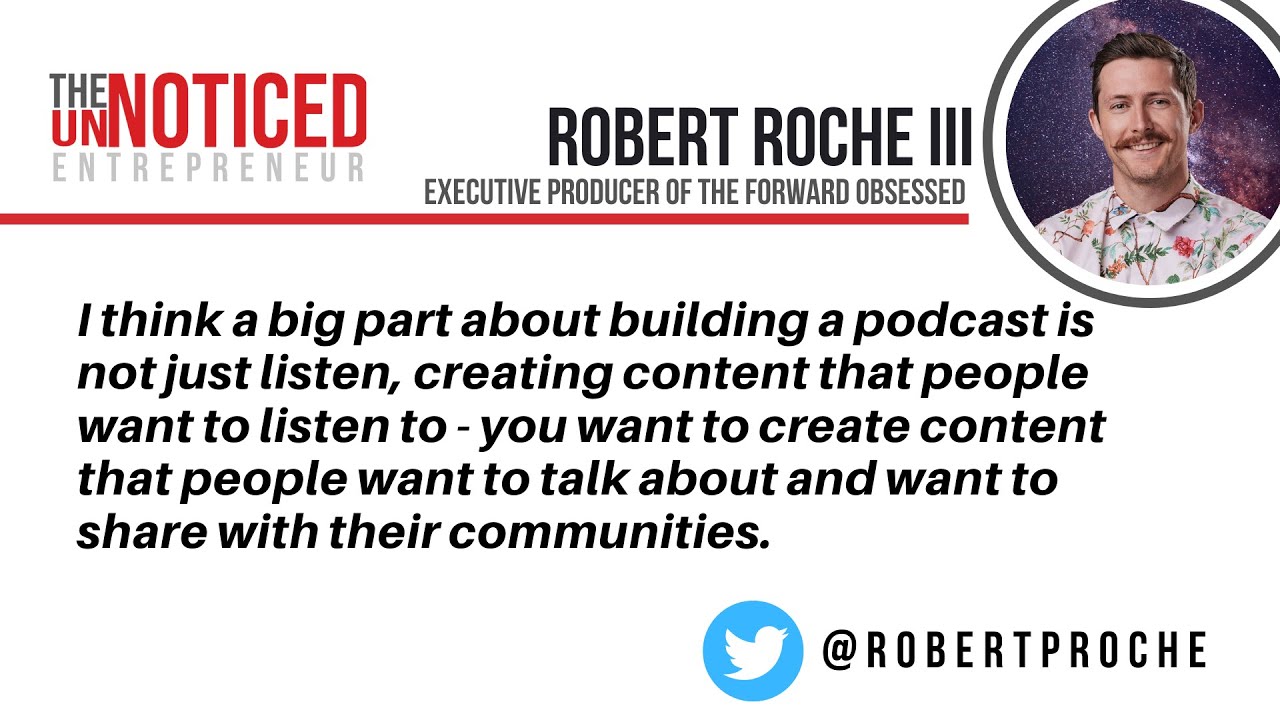
I think a big part about building a podcast is not just creating content that people wanna listen to. You wanna create content that people wanna talk about and wanna share with their communities. And just creating a podcast where you're talking into a microphone, you're doing your updates, or you're, you know, it's the same kind of format every week. It is helpful. And for people who are really interested and dedicated to you and your brand already, that's probably something that they really enjoy. But to really take it to the next level as a tool and as a conduit for interactions and communication with you and your company, you have to kind of take it to a point where there's excitement, there's dialogue, there's people coming back at you with questions. They're asking, oh, what was that book? What other books does this person recommend? And then we'll connect them with that person who was on our episode. And so now we're starting conversations. And so Forward Obsessed, right now it is a podcast. But Forward Obsessed itself is going to become a brand that's all about having these kinds of communications. Pete Sena is, it's like he's on fire with it right now. And there's a lot of incredible things coming down the pike, but it's how do we have these conversations? How do we create these ecosystems of brilliant minds who want to create and do new things together?
And Robert, having met Pete, I think, you know, it's obvious just how excited and how engaging they are, but I love the idea as well that You're making the podcast a conversation starter, that it's not a monologue. You know, although by definition a podcast is recorded and we broadcast it as opposed to, say, a live stream where there's chatting taking place, you're managing to make it into content people want to share. So what are some of the key elements that you're building into the content that make people want to talk about? Because in a way, that's the secret sauce, isn't it, of a successful radio show, song, Film, anything?
The first part of it is the actual conversational content. You've got people sitting in a room and you gotta have some structure in which, you know, you have your particular questions that you like to ask, that you like to create through lines between your episodes so that you can compare these brilliant minds and that you can actually contrast them with each other as well. So having some conversational structure, but not being too crazy about it. If you're going off on a tangent and it's awesome and you're really, everyone's vibing in the room. Then go. Don't cut them off and say, well, actually, I was going to ask you this. So I think having structure but with a really fun flexibility to it is important. And the other side of it is now that you're having that great conversation, how do you make it in such a format that the most people in the world can benefit from it and can benefit from listening to it? And in our case, we said we want people to see these conversations as well. And so a big part of Forward Obsessed podcast is from the beginning, we said, this is going to be a video podcast. Now, what a lot of people think about when they hear video podcast is, or what it used to be was, it was a, a YouTube channel. People sitting down, maybe they're podcasting, but it's more like a broadcast over YouTube cuz that's where video is. And what's been happening recently is there's been some really big shows that have been starting to, you know, transition into the podcasting realm as video. And what I mean by the podcasting realm is the apps. If you think of Spotify, they took on some major shows recently, and not only can you listen to it on Spotify, but you can watch it. So I was thinking, how do we do that? And also, how do we set the infrastructure so that this video podcast that maybe we're adding to Spotify can be added to every other podcasting app if they ever made that switch? And from my perspective, Jim, every podcast app is going to make the switch to video capability. in the future.
Yeah, Robert, you know, I met you because I, I was looking for the Forward Obsessed, you know, on LinkedIn, uh, saw Pete's post and I saw the video and I thought, that's a really nice clip, you know, and I figured if I clicked on that, I'd go to YouTube, but it took me to my podcast player on Apple. And that's where we started saying, wow, okay, how are you doing this? So for those of us that, you know, are just catching up, you're ahead of the game on this, Robert, from a production point of view. Do you wanna just take us through the steps? Not everybody on the Unnoticed Entrepreneur Show, my, you know, our listeners are podcasters, but I think you're introducing a new trend about the format.
Yeah.
And I'd love to know how you've discovered this and how people can deploy it in their own podcast.
Well, I'm really happy to be doing this because I went through a lot of trial and error, and if I can save anyone from that process, if I can help you, then this is gonna be, I'll be so thankful to do that. So, Well, it's something we'd be very grateful. All you have to do first is start with a video. You know, this, we're recording on Riverside right now. The export from this is going to be an MP4 that you can potentially post anywhere. And when you have that video, you have the capability now of posting it to Spotify as a video podcast, but also you can post it to Apple Podcasts, which is not something that everyone knows. So let's start with Spotify because it's simpler. Spotify, one of their subsidiary companies is called Anchor, anchor.fm. And that's using Anchor FM. It's actually free. You can post your podcast to Spotify as well as many other podcasting apps. If you enter in, you know, the RSS feeds on the back, you can set it up. Now, what I discovered was through Anchor, you can't post a video podcast. to Apple Podcasts. Apple Podcasting is really simple. And most people don't know that Apple Podcast apps actually use, or you can actually upload video to Apple Podcasts. And I discovered it because I noticed that NPR Tiny Desk Concerts is a small subsection of the NPR Podcasting Network. You could watch the Tiny Desk Concert on your Apple app. And I was like, what the heck is this?
Yes. Yeah.
How did they do that? And so I did a lot of digging and I found that at least one podcast publisher, possibly more now, I'm not sure, allow you to post video to Apple Podcasts. And so the one that I use is Podbean, P-O-D-B-E-A-N. And through Podbean, it is a paid account, just so for logistical purposes of people listening, you know, I pay, uh, just over $30 a month for it and I can upload my video to Podbean. And through Podbean, publish that video as a podcast with everything that has to do with the podcast, the description, all the other stuff to Apple Podcasts. And what that looks like is you can listen to it in the same way, but if you open the app and you actually click on the episode as you're listening to it, it'll open up and it'll show a video. And that's the video that you created maybe through Riverside. And so, uh, now here's the deal. Podbean, for example, will not post video to Spotify. And Spotify's podcasting publisher Anchor will not post videos to Apple. So they're still kind of competing there, which is why I actually have to have 2 active podcast publishing accounts.
I see.
One specifically to post to Spotify, one to post to Podbean.
Yes. So you have to have 2, in effect, 2 channels with the same content broadcasting, if you like, on almost like different frequencies in the old sort of broadcasting world. You've got like a DAB and an FM channel for the same content. And is that a function that Podbean has got and Anchor have got? Because obviously they're part of bigger platforms. What about some of the other platforms like Buzzsprout, for example, or Captivate? Do you know, Robert, if it's just because these 2 are integrated already into the bigger platforms, or do you think more and more of the podcasts like Libsyn and Captivate are gonna do this?
If they haven't yet, I can almost guarantee you that they will. If Buzzsprout isn't doing it yet, they will. And right now it seems like there's a bit of a divide between posting video to Spotify versus Apple Podcasts. So I don't know if they're going to have to decide at some point which one to do, or if there eventually is going to be some sort of unification or workaround where you can, from, for example, Buzzsprout, post your video everywhere. But from what I'm seeing from my research and just from general trends, I think this is how podcasting as an industry is going.
Yeah.
We now, these companies have the bandwidth to be able to send video out. You know, they can get access to these massive, you know, Google or Amazon servers and they can send video out in their apps. And I think it's gonna be happening more and more. And eventually, if you're not making video with your podcast, You're potentially missing out on an audience that would like to watch versus just listen.
Well, and I think that, you know, they talk about podcasts being listened to on YouTube, but the user experience on YouTube is so different, isn't it? It's so competitive and, you know, there's so many different things and it's hard to get it tidy. I quite like the tidiness of the podcast feed and also the show notes, for example, and the sharing. Robbie, from a post-production perspective, Creating video on Riverside is great. Like you, I, you know, use this platform as well. It's fantastic to get the high-quality, uninterrupted audio and video, both as consolidated and, you know, raw files. What are you using for the post-production? Because, you know, this is more content, and for most people, the post-production is actually the bottleneck. What are you using for your Forward Obsessed podcast to do the video editing of what essentially used to be an audio show?
It's a great question. And, you know, again, we've done a lot of interesting trial and error and we've found some things that we like. We might change it up. Pete always says something great that we're totally fine with changing technologies if it works better than the one we're using. We don't have to be stuck on a technology. If we find one that's better, we're gonna do it. What we're doing right now is once that video, let's say that interview is complete and I'm feeling like it's, you know, I might take it, for example, into Premiere Pro, which is an Adobe program to add in our introduction graphics, our outros, all that stuff. Once I feel like that video is good to go, you know, what I'd like to do is atomize that video into clips, turn a really long interview, let's say an hour-long interview, grab the 15 best moments that are beautiful that you could trim down into a 1-minute clip of your guest or your host saying something profound. And you want to turn that into clips that can be posted across the internet and be shared and be, you know, so from that video that you've exported, there's a program that we use that you mentioned actually earlier, Jim, Descript. And Descript is a fabulous program. You can upload your video to Descript. What it does is it opens your video in 2 panels. This panel right here has your video that you can watch as you're pressing play. This panel has turned your entire video into a transcript. And that's so brilliant because you can edit that transcript like you would edit a Word document. But every time you remove a sentence or a word or phrase, or even a whole paragraph, you're trimming little pieces of video off. And what that allows you to do is you can watch the video, you can read the transcript as you're watching it. And you say, Mike, this 2-paragraph section right here of Jim talking about you know, podcasting or whatever is such a great clip. I want to export that so you can select it in Descript. You can edit it right there. You can take it over to like another screen in Descript. You can edit it down. So it's a minute long. You know, you might have some cuts that you typically would see on social media. You can add subtitles using the transcript. You can change every way everything looks. You can put on templates and then you can hit export. And that whole process, once you get Practice with it. I mean, you can go through an entire episode, crank out 15 clips in just a matter of an hour or 2 if you're working really great.
That's fantastic, Robbie. Like you, I use Descript and there's another one from Germany called Type Studio, which is all web-based, which is actually doing some simultaneous translations if you want it into multiple languages, which is—
That's amazing.
So the tool sets are becoming fantastic. Robbie, I have to ask you, the acid test is engagement. You mentioned, I think you've got 14 or so episodes so far. I watched and I was like, oh, that's cool. But can you just tell us engagement, what sort of performance uplift, if any, is using VideoGetting for you on your podcasts?
I think that the primary engagement that we're getting is from people interacting with our social media clips. You know, you can post up a link to Spotify all day long and say, this is such a great episode, check it out. But if you have a video clip when you post that link, Exactly like how we met. You look at that, you're like, this is a high-quality clip, or this is really interesting. You've got subtitles, you've got, you know, especially if you can do what Digital Surges has done and build an incredible, beautiful video studio, the higher the quality, the better. And it catches the eye. And we've also found which social media platforms are really viral right now. If you take clips and you post them, for example, to TikTok, and by the way, in Descript, you can make it so it's a vertical.
Clip.
You can take a clip that's 16 by 9, a screen, and you can trim it down in Descript and that's your format. And then you can export it in that format.
It does what they call letterboxing, right? It's, these are different, what they call letterboxes from portrait to landscape and so on. So it's making post-production so much easier. And as you say, then the engagement levels through repurposing the content is fantastic. So if people want to find out more about you, Robert, and about the Forward Obsessed podcast, and they can listen to it or watch it.
That's right.
How would they do that?
Well, the best place to start is at fordobsessed.com, and there you're gonna see this gorgeous website we just built, but all this technology is built into it. And on every episode page, you can see the episode as a video on YouTube, but you can also click through to Spotify. You can listen and watch to any of the episodes, and they're really great. We've got a lot of fabulous ones coming. And if you subscribe to us on Spotify or on Apple Podcasts or whichever app that works for you, Then you can catch those episodes as they come in. And if you have questions about this, please come and hit me up. My name is Robert P. Roach III. I'm on LinkedIn, Robert Roach. And you know, I love talking about podcasting and this is one of my favorite industries. So please hit me up.
And Robert, I will of course put all of your details in the show notes. And I think you and I are gonna collaborate, aren't we? Using Descript as one can, as 2 Descript users. to embed maybe some showreel to illustrate what we've been talking about. And, you know, I'm a little bit geeky like you, but you're so much more advanced than me in terms of production. But I love the way that the Digital Surgeons have integrated podcasting to create conversations that are forward-looking and not just self-serving and are creating a whole sort of conversation around an industry and a location as well in a community. So Thank you for your work and for sharing that with me and my fellow Unnoticed Entrepreneurs today, Robert.
Jim, it's been a total pleasure talking to you, talking to your listeners. I hope to engage with your audience and meet some great people.
Yeah, we absolutely will. So I'll put Robert's details in the show notes as always, including a link to the Forward Obsessed podcast. And this is gonna change the way that we all consume content. And if you run a company, this creates all new opportunities, especially if you've got a product or service that has a visual element. then podcasting can become really also a very good way for product placement and product promotion in a way that just the audio itself didn't. So thank you so much for listening to this episode. A little bit of special technical bonus episode today on this episode of The Unnoticed Entrepreneur. Yeah.
More from Jim











2 people, infinite agents, 1 billion dollar idea #AIAgents #Startup #Productivity