This Lawyer Struggled Juggling 4 Businesses Until He Made 1 Change
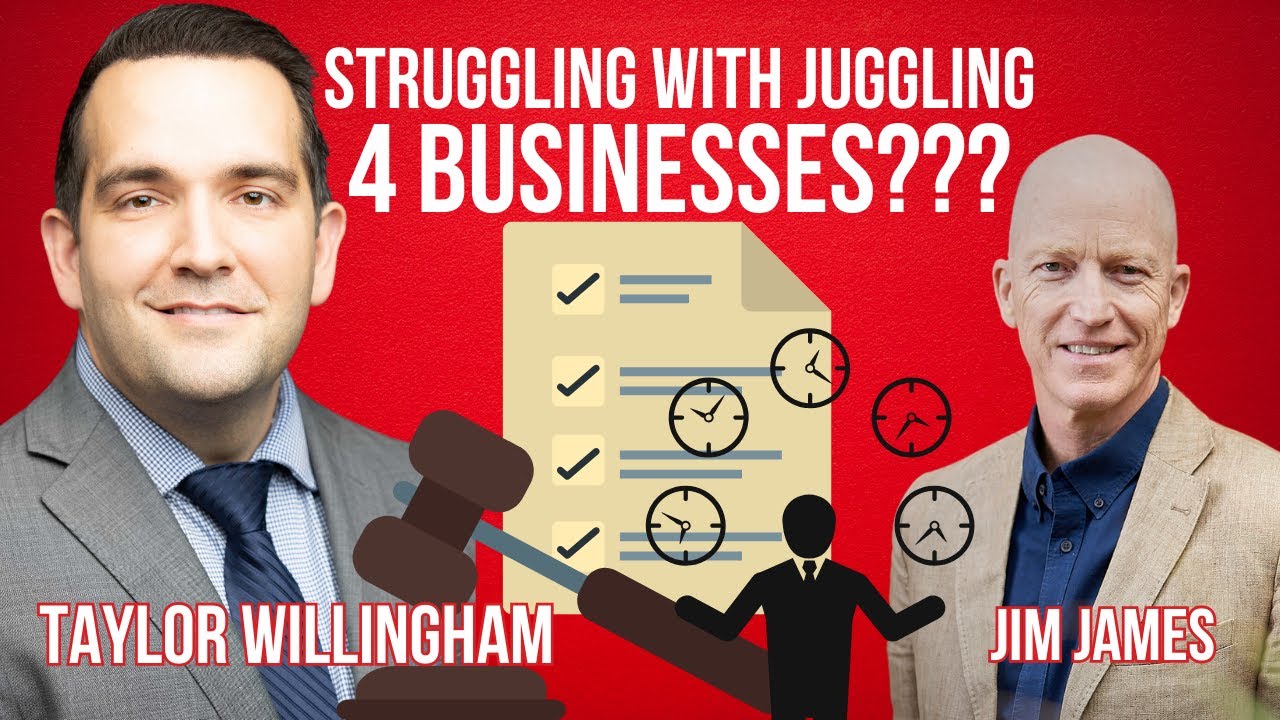
In this episode of The Unnoticed Entrepreneur, host Jim James interviews Texas‑based attorney and serial entrepreneur Taylor Willingham about the practical challenges of running multiple companies while maintaining a personal brand. Willingham outlines the four ventures he currently oversees – his law firm (Willingham & Galvin), a title company (WG Title), a real‑estate firm (Willinghammer LLC), and a struggling CRM startup (EP Firms). He explains how authoring five books both boosted his credibility and created a double‑edged sword, leading him to raise consultation fees and delegate work. Hiring a manager and eventually granting co‑CEO Jamie Ellis half ownership of WG Title solved operational bottlenecks, while leveraging the Nextdoor app, word‑of‑mouth, and quirky insights (e.g., left‑handed clients) refined his marketing approach. Willingham shares the painful lesson from EP Firms that founders must become the first marketer, and stresses the importance of daily habits, early mornings, and consistency. He also alerts listeners to the 2024 Business Ownership Information Act filing requirement. The conversation concludes with book recommendations (Atomic Habits, Tony Robbins, Extreme Ownership) and a call to visit his website for more resources.
Chapters
Hello and welcome to this episode of The Unnoticed Entrepreneur. You're joining me, Jim James, and we're going to talk to an entrepreneur who has faced and is facing an issue that is common to me and maybe to you too, which is we love to start new businesses. And often the new businesses, the shiny objects, are wonderful, but they create branding challenges and management challenges for us because We find ourselves running multiple businesses with multiple brand positionings. How do you solve the problem of running multiple companies where you're the founder of all of them? Today, I'm gonna be joined by Taylor Willingham, who is based in a place called Kinney, just outside of Dallas in Texas. Taylor Willingham, welcome to the show.
Thank you for having me on.
Well, it's my pleasure. And, you know, we're gonna talk about that issue that faces in a way, all of us as entrepreneurs, at least those of us that according to the Michael Gerber E-Myth, you know, we are managers stroke entrepreneurs as opposed to self-employed practitioners. Tell us about the businesses that you run and how you've been overcoming the challenge of being central to more than one company.
So I'm an attorney. That is my practice, my trade. So I have a law firm that I started. Willingham and Galvin. And over the years, I'm an entrepreneur, so I've started a bunch of other companies. The companies that continue to exist today is WG Title, Willinghammer LLC. WG Title is a title company, and Willinghammer LLC is my real estate company. And the last is a company called EP Firms that's hanging on by a thread. So those are the 4 that I currently run and operate.
And I love the way you explain it being hanging by a thread. Uh, yeah, what— deciding when to close down a business is, is another interesting topic.
You've written 5 books though as well, Taylor, um, in various aspects.
Can you just tell us about authoring and the role that being an authority through book writing Has made a difference to your business?
Yeah. So most people write a book for marketing purposes. Mine was actually, I got into it for the purpose of helping me focus on learning things that I felt like I wanted to know better than any other expert. And so for me, the first step was I just started writing. And as I started to write, I started to realize, well, other people, other attorneys are going to read this. And if I'm not correct on exactly what I'm writing, I'm going to be humiliated. And I don't like being humiliated. So one of the first things I started to do is I then started to research and made sure what I was writing was correct. And that first book, this one, Why Should I Care? I'll Be Dead. As I was going through, it helped me focus on exactly kind of the way I wanted to push my practice forward, why I was doing what I was doing. And then I started to really understand my practice. And so I fell in love with that process of writing. And so I continued to write. That led to my next book, which was Helping Your Parents with Long-Term Care. I think I have it. Right here, this one, The Most Boring Book Ever Written. But for me, it was extremely helpful. That book, probably if I could tell somebody, I redid it and made it a lot more, a lot better with my 4th book. And then I wrote my most popular book. It's done really well on Amazon and different things. And I think it's because I listened to what my clients were saying.
Yeah.
And said, I'm going to write a book exactly with the question that they're asking me is, do I need a will or a trust? I try to put humor, interesting historical stuff in there. And then I redid Helping Your Parents with Long-Term Care, and it's called Free Long-Term Care. And that is the book that I tell people, it's difficult subject. It's not the fun information, but It saves people hundreds of thousands of dollars at the end of life of basically how to structure yourself. So if you end up in a nursing home, you don't lose everything. But that process of writing those books, for me, what ended up happening is I really learned the information. There's one thing is you can say things and you can do things and really know your business. But when you write about it, it really hones in that focus on knowing your practice and your trade.
Taylor, what challenge did it create for you writing books? Because you become an authority, you become established as Taylor Willingham almost by definition. Then people want to talk to the man who wrote the book and whose name's on the door of the firm, right? And ironically enough, you kind of lock yourself in, don't you? And if you want to be an entrepreneur and have multiple businesses, it's almost a double-edged sword, isn't it? How have you overcome that problem?
Well, that is a problem I still deal with today. And I look at it as a wonderful problem because I remember back when I started and no one wanted to talk to me. And so I have to constantly remind myself that, hey, there was a time. So I actually love what I do, but it does consume me. And when you get consumed at being, like you said, talking about The E-Myth, the 3 different people that you have to be, the entrepreneur, the manager, and forgot what he calls it, the worker, the guy who does the work.
The self-employed practitioner.
Yeah.
And so when you're stuck doing all 3 roles, the business really can't grow very much. And it's a struggle and a balance that you have to fight through constantly. And so for me, I've really tried to hire a manager to help out. That's to get off the, to solve that problem of me trying to be the manager. But when you have a small business, everybody just comes to you anyway. Like you can hire a manager, but then they just go around and come right to you and go, I have this problem. So, but when you're sitting there and everybody calls in, wants to meet with you, what I finally had to realize I had to do because my calendar was like maxed out 3 months. Well, what ended up happening is it got maxed out. When I got to, you know, these people, they were like, oh, I already went somewhere else. You were just too far out. And so, one, way I solved the problem was I started raising my consultation fee on me while keeping other people's consult— my other attorneys lower or nonexistent to help them get business. And so people that didn't want to pay the consultation fee, they're like, oh, well, you can meet with so-and-so. That helped out. And so that brought my calendar to a manageable point and it saved me from also the people who weren't really interested in hiring me to do the business. So that was one way we, you know, scared me because I'm like, oh, but consultation fees, people aren't going to call it, you know, people aren't going to sign up. And so that was one way I solved it.
Yeah, that's interesting.
So is it a case that the book enabled you to then sort of generate a new price point for your time as literally the author, the authority for the business? Yeah.
And it's strangely family business in ways that I, you know, about 2 weeks ago, a guy came in and he's from New Jersey and his mom had passed away and I did his mom's estate plan. And so, when he came in, we were talking, he goes, hey, I'm going to tell you something weird. And he goes, you know, I was telling my coworker that I'm going to Texas in order to probate my mom's estate. And he's like, oh yeah, well, who are, you know, who's your attorney down there? And he goes, oh, my mom's attorney was Taylor Willingham and he's going to do the probate. And he goes, I have that guy's book. And he like pulls my book out and he goes, how did you meet with that guy? And he's like, he goes, oh, I just wanted you to know that story because that book apparently does work. And I was I was like, oh, well, look at there. We got something hundreds of miles away. I didn't even know. But for some reason, people think if you've written a book that you're too hard to get into and talk to too. So you have this double-edged sword, which most people, we write books because we want you to come to us.
Yeah.
Yeah. There's some irony there, isn't there? But Taylor, we started off this conversation with How do you be an entrepreneur and have multiple businesses when you're the name on the door? What's been your solution to that problem? Because you have 4, admittedly one hanging by a thread, but 4 businesses that you're running in addition really to the main business that you're running. How are you doing that from a marketing point of view?
So marketing-wise, You really have to listen to how people find you and ask the question. I have a wonderful opportunity in that I meet with my clients and the people that come in all the time and I notice things. So, you know, first off, recently the big one has been Nextdoor app. I never focus on it. I never go into it. 4 years ago, I set up my company there. And over the last year, repeatedly, people have been saying, oh, well, in the community there, you're well-known and everybody refers you. And so, it was a shock to me that I spent all this time on Facebook. I spent all this time marketing on all these major social media brands and here, Was an app. I just threw something up and it actually works the best. And about three days ago, I was like on Facebook fixing up my profile, and I'm like, why am I not on Nextdoor app right now working on that one that works? And so I stopped myself. I went over there, started building it up, and now I'm focusing my efforts towards there because you get you get into these habits. So law on estate planning, I learned that's how you get business is word of mouth. You have to build a reputation. It takes a long time and it's just doing the right thing for people and offering excellent service. Then I noticed weird things as I was doing people's estate plan. I noticed overwhelmingly that people that were coming in to do their estate planning were left-handed. I was like, why is this? And like, because we have 3-ring binders and they're always complaining about the 3 rings. And so I noticed, and then I started asking, well, who made the decision to come in out of you 2? Because usually it's a husband and wife to do this. And they would go, well, they'd always point to the left-handed person. And so I started going out and maybe someone out there in your network can help me with this. But I'm trying to figure out how you market to left-handed people because apparently they are the people who do their estate planning. And I'm assuming it has something to do with the brain about being organized. And I tell people this and they start laughing. Yeah, he's or she's the organized one. And so I found little things like that that now I know, but how do I take advantage of it? WG Title is completely different. WG Title, title companies, we are in one of the most competitive title company markets in the world. And my business was pretty small for a long time until I brought in Jamie Ellis, who now is the CEO and runs it. And she completely changed everything. And it was her obsession for perfection on how you deliver that changed everything. And so, I guess I could tell the story.
And maybe just tell us what is title for those of us that are, help me to understand what is title.
So title in the United States is when you're buying a property, a house, We have to make sure that the person who's selling it to you actually owns the property. We identify all the liens that are on the property, make sure that they're paid off, and then we facilitate what we call escrow, which is we facilitate the money transfer. So, no documents are filed or anything until everybody's paid and the actual transfer happens. I don't know, in Great Britain, do you guys use a similar system?
Similar system, yeah.
Seems to take forever for them to find the information, but in this day and age, But yes, okay, so exactly.
So yeah, so that's a big industry in the United States. And so we had an issue where I had probably the best escrow officer, that's what they're called that do it. His name's Michael Adams. And he just was known, our current Attorney General Kim Paxton was his Escrow officer before he became the attorney general. And he was fantastic. He was so good at doing the job. Him and my struggle was all the other stuff, which is the, do you give a gift basket when you close? And like all the little things that men usually don't think about. Like we're like, well, it's our, we're going to do our job and we deliver to you good title. And he's like, this is a female-dominated industry. So we just didn't connect on that. So he ended up getting brain cancer. And one day he just shows up in the office and he's limping and he goes, I don't know what's going on. And then come to find out he had a tumor on his brain. And luckily through that process, he's healthy and good right now. But during that process, I had just hired Jamie Ellis and she didn't ask for any additional pay, didn't ask to do anything. She just took over and did his job and her job. And one day I was walking out of work and I'm like, she's earned half of this company. It would be out of business without her. And so then I made the decision, I'm going to give her half the company because she's earned it. And that was probably the best decision I've ever made in business because she, once she became part owner, then it reorganized that she was in charge. And she's been able to get us to a point now that last year was one of the worst years in the real estate market for title companies, and we made it through it very well. Okay.
So, yeah, so interesting.
So as an entrepreneur, sort of, if you like, sharing the business where you maybe see the opportunity and someone else is able to do the operational side is a great learning.
Yeah. Yeah. And realizing that, that sometimes you just don't possess the abilities that are really needed. Like, I don't have that ability to really see the fine detail of what needs to happen with a title company in our market.
Taylor, if there's one, if you like, mistake that you'd say that you've made from a marketing point of view, either, you know, with Taylor Willingham or with the titles business, Or over your many years as an entrepreneur, what would you tell me not to do?
One mistake you'd say, Jim, don't do this.
Yeah. So, the hanging on the thread of EP firms is mainly because of me. And it's because I didn't want to be the marketer for it. I was trying to set up this— basically, what it is, is As attorneys, we have a problem, and that is we have no real good CRM system that exists. There's a lot of companies that have tried to create them. They don't really understand small law firms. They're programmers that create it. It's awful. And so I was like, I'm going to build one. So I hired a bunch of programmers. We started building this system. I was going to build the perfect system. And I got it to the point of it functioning. And then it became, now you got to market it. Well, in order to market, you have to pick up the phone and call people, call other attorneys and say, use this. And I'm not used to that type of marketing. I, in law, you cannot pick up the phone and call people and ask for business. That's, we don't allow that. So I kept hiring people to do it. And no one was having any success. I had a good friend that started a CRM system for pest control, and he came in and to show me like, how do you market it? And he sat down with the team and he started picking up the phone. And to that day, it was like 3 months of marketing. We hadn't had 1 sale. He made 3 in an hour. And it became very clear to me that either I'm going to have to pick up the phone and call people and market this and get it going with my sales team or let it go. Like, and that was, that was like the decision. And then we were right there and then that was 2022. And then everything blew up on us with deciding to throw interest rates to 8%. And I had to focus on my law firm and title company. And so it's still there. We're still hanging on. But the realization is, if you want something to work, you are the marketer. If you want to start a business and it's something that you have to accept and you have to do.
Yeah, I think it's, as you say, really, you are the owner, you're the visionary, you are the brand and bring in those first sales, especially at the beginning of the company, Taylor. That's a You know, a good, a good reminder, I think, for me as well. Taylor Willingham, over there in Texas, one piece of advice with all the businesses that you've, that you've run.
Is there one thing that you'd say really does work? Maybe it's the book writing, maybe it's something else you've done that you'd say really, really helps to move the needle in terms of getting a business noticed.
Um, in marketing, Yeah, marketing or anything else.
Okay. So in order to really get noticed, well, one of the biggest things is your reputation if you are a professional. So that type of business, you listen to every major person out there and they'll tell you it's the service that you offer. I mean, that's really the thing that gets you above and beyond. But Really, if I can, as I've watched, I've met with a lot of business owners because I do estate planning and part of estate planning is working with people with businesses and doing things. And it's consistency of effort. It is the everyday pushing and working towards the goals that you want because the reality is, is the way our world works, everything at every moment is growing or dying. You neglect your business for a month, you're going to pay for it. And it's those habits every day that you form of getting up. I get up at 5. I make myself get up at 5 in the morning for the purpose. Now, that doesn't work for everybody because in the 4 hours before any employee shows up, I have almost all my work done. And so when they're here, I can focus on them and getting those things done. And I used to not do that. And I used to be trying to do my work and being annoyed by my employees. And then I'd get angry at them. And it just didn't work. It wasn't effective. Yeah.
Yeah.
It's really, really sage advice, Taylor, that the consistency of showing up every day, that really it's relentless. Actually, especially these days when competition is so intense and technology, internet, and AI are making the pace of change so rapid as well. Taylor Willingham, if I can ask you for a book or a podcast that you're reading or that you've written that you'd share that you think would be of value to me, what would it be?
Atomic Habits is A great book. When I read that, that really, really opened my eyes to, oh, how to really start getting things forming and going. Tony Robbins' books are fantastic. His inner focus of you got to fix yourself is very, very valuable. I highly recommend as a business owner, if you can ever Make his Unleash the Power Within seminar. I think he only does it once. I mean, he's getting older and he can't do as many seminars as he's done in the past. So, but incredible way of really getting to know yourself because that's really focusing. And then Extreme Ownership is another one that was a breakthrough for me. Reading Jocko Willink's book and, you know, his first story of him having the blue-on-blue incident where they lost an Iraqi soldier to friendly fire and how horrific that was. And then all of a sudden him realizing, trying to, he's trying to point blame somewhere. And I saw myself listening to the story like, Oh, we have all these problems. Who am I going to blame in the company? And he couldn't really put his finger on it until he pointed it at himself. And that was, you know, when I read that, I'm like, my struggles are me. When clients complain, it's my fault. When things go wrong, it's my fault because I'm the one that has to put it in. And when you do that, yeah, it sucks at the beginning, but you fix it. If you point the finger at another person, you don't.
Taylor Willingham, the buck stops here, doesn't it, as an entrepreneur? If you want to find out more about you and what you do, how can they find you?
You go to my name, TaylorWillingham.com. That will lead you to my other businesses, my books. And I try to keep up on the law and put things out. For example, this is for any US-based businesses. This is a very big thing. They passed the law starting January 1st, 2024, and that is the Business Ownership Information Act. You have to file by the end of this year your ownership or substantial control in any business that you have. If you don't do it by the end of this year, it's a criminal act. It's very rare for the government in the United States to create a law that if you don't do something, you're committing a crime. And I'm scared about my clients 'cause I keep throwing this out and people ignore my videos and emails that this is a way that you could end up owing a lot of money and potentially have a criminal act of just not doing something, just not filing a piece of paper.
Taylor Willingham.
Well, I'm in the UK, so I think we're blessed to not have that. We've got some other legislation here to worry about. So if anyone wants to go, they can find taylorwillingham.com. Taylor, thank you so much for joining me. We've covered a lot of topics in a short amount of time. Kindred spirit and starting lots of businesses. So same page as you and also loving your wisdom and your insights. Thank you so much for sharing. Thank you.
Hey, well, thank you for having me on your podcast.
Well, it's been a pleasure, hasn't it, listening to Taylor over there in Texas? And, you know, his honesty and integrity and an acceptance of responsibility really are some key messages that have come over for me today. And if you've enjoyed this show, do please rate it or review it on your player and share it with another entrepreneur who needs to hear the insights of Taylor and my other guests.
And until we meet again, I just encourage you to keep on communicating.
Thank you for listening.
More from Jim











2 people, infinite agents, 1 billion dollar idea #AIAgents #Startup #Productivity