Tuning Your Leadership How Music Can Transform Your Mindset and Unlock Success
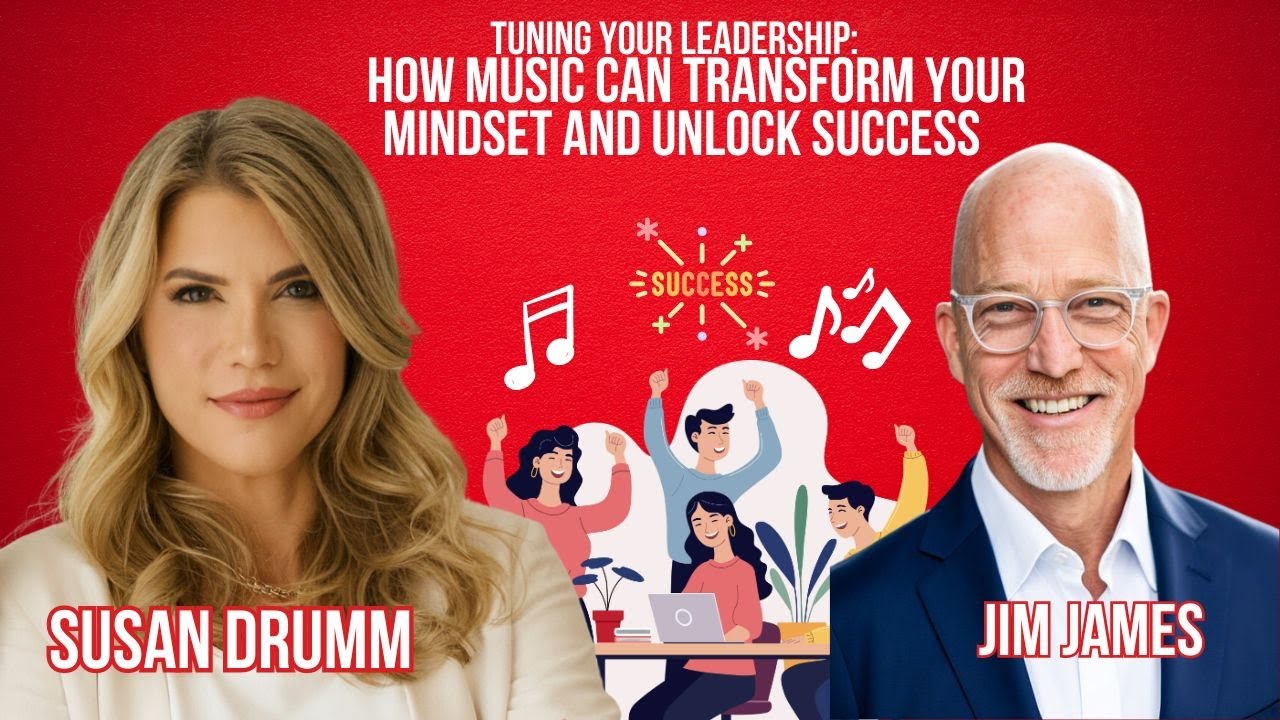
In this YouTube interview, host Jim James talks with Susan Drum, a USA Today bestselling author and leadership consultant, about her book The Leader’s Playlist. Drum explains how leaders develop entrenched mental patterns—often formed in childhood—that manifest as self‑limiting “playlists” (e.g., “I am trapped,” “I am excluded”). She argues that music can both reveal these hidden patterns and serve as a tool to disrupt and replace them. Drawing on neuroscience, she describes how specific songs can trigger neural pathways, acting as “interrupt” tracks that bring awareness to a pattern, and how new, purpose‑chosen songs can help re‑wire the brain into a more constructive state. Drum shares a detailed case study of a chief marketing officer whose “I am excluded” playlist was shifted using Adele’s “Hello” as an interrupt and Natalie Merchant’s “Kind and Generous” to build a new “peace and appreciation” playlist, resulting in improved team dynamics. Practical resources include a short online quiz that maps listeners to nine playlist archetypes, curated Spotify playlists, a masterclass on building playlists, and her own podcast The Enlightened Executive. The conversation also covers how the same methodology can be applied at the team level, the importance of refreshing playlists over time, and Drum’s broader consulting work that integrates music‑based interventions into leadership development.
Chapters
We all have a tune in our heads. Sometimes it's the good, heartfelt, uplifting tune. Sometimes it's a bit of a downtrending tune. But these become patterns in our own mind. And actually, my guest today is going to help us to use music to get into a much better, a stronger place regardless of where we are today. My guest today is a USA Today bestselling author. She's been running her own consultancy called Meritage for nearly 20 years, consults large companies and entrepreneurs through the EO organization. We're going all the way to Scottsdale, Arizona to meet Susan Drum. Susan, welcome to the show.
Thank you so much. Great to be here with you.
It's great to have you here because this is such a unique topic, music. I mean, we think of music as just what we've got in a playlist, but you've written a book called The Leader's Playlist. Tell us about The Leader's Playlist. What role does music play? And maybe also from a constructive point of view, how can we use music to help us to work on our mindset, for example, as entrepreneurs?
Absolutely. So as a high-level look at this, what I've noticed in working and coaching very senior leaders from large organizations, Fortune 100, all the way to, you know, amazing startups that grew to be the big oak tree, let's say, It's been fascinating to see how these leaders get stuck in patterns. And I would say the thing that I was most fascinated by is that leaders couldn't see the patterns they were in, but they were patterns nonetheless. And so, what I started to look at is what are ways for people to recognize their patterns and then disrupt them? And that became, in a way, my superpower of pattern recognition and pattern disruption. And one of the things that I discovered was that music is an incredibly powerful tool to disrupt patterns, to help people recognize when they're in a pattern, and to create a new pattern because of its impact on the brain, which is why it has this neuroscience component to it. And this is the piece that I think it's a technique that I use in coaching to help people really understand where they're getting in their own way.
Susan, let's just clarify. When we talk about music, you're not suggesting that we all take up the xylophone or get the harmonica out. Are you necessarily? Is that what you're saying? Is it that people play music or, I mean, with instruments or that we have playlists on Spotify or iTunes? Just tell us a little bit more from a practical point of view about the playlist.
Yes. When I say playlist, I refer to it in the book as both figuratively and literally. So, let's talk about the figuratively part. A playlist is— the title of your playlist is the pattern that you've got going on. And the way I formulate them or help leaders see them is they're usually I am statements. I am something. I am an imposter. Or I am a, you know, I'm treated unfairly, or I am pissed off, or I am, you know, not safe, or I am trapped. There are— and in the book, I go through 9 different vignettes of leaders in the hope that you see your one and one of them resonates for you and you see your own playlist through that. And so each one of these 9 short stories tells you a bit about the playlist that the leader had going on. But I'm also talking about literally using music. So once we start to recognize what is that pattern that's going on for you, and then how can you shift that pattern using music? And there's a whole component about what music does to the brain. So what I'm talking about is literally creating a playlist. And there's a playlist or an interrupt pattern interrupt song that you identify that will identify your old playlist. And then instructions on how to create a new playlist. What are the types of songs that you need to choose based on the shift that you want to make in your leadership?
That is fascinating because I find that there are some tunes that I listen to that are still from the 1980s. And I, I did, I did hear that our favorite music is when we were teenagers, is from when we were teenagers. But a lot of them are very melancholy British tunes which are not best for setting yourself up for, for example, the work of the day. So can you just tell us, where do the patterns come from in the first place, Susan? And And how do we then recognize what they are and start to put in place maybe more constructive music playlists?
Yes, well, part of the book I reference that our patterns get formed in childhood. They're really how we cope with challenges or wounds for a better term, right? And through that, we learn some patterns that can become superpowers for us and it's what makes us successful, but they're also often limited in their effectiveness. And yet we keep using them, or we use them in all circumstances when not all circumstances warrant that.
Yeah.
But if there's a little bit of a belief, like, if we don't do that thing, this bad element could happen to us again. So one of the things I noticed, and we talked a little bit about this, is There's for entrepreneurs in particular, there's some common old playlists that are running in the background. Two examples of those are either I am trapped, and so there are circumstances. It's almost like why we became entrepreneurs to begin with. Like I don't want anybody telling me what to do. I need to be the captain of my own ship. And yet, so we we we move forward thinking that we're free, and yet in the background there's always this fear that I'm going to get trapped. Oh, now I'm trapped. I've got to support this big team. Like, I'm feeling trapped and weighed down by, like, having to bring in revenue for all of them, right? Or, or I'm trapped into this huge loan that I've just taken out. And, and so even though we're trying to overcome it by doing things like become an entrepreneur, we find ourselves sort of— it's the monster we're running from. Is is is a good way to put it, and yet it you know we keep doing stuff to try to loot it, but it never really goes away. It keeps chasing us away. So I am trapped as one, and another one I've heard from from entrepreneurs a lot is I am all alone, which is the sort of feeling of gosh, it's all on my shoulders. It's all on me, even though they have a team or in some cases a big team. There's still sort of not a letting go and not a belief that other people can actually accelerate and support them in a way that they truly need to grow their business.
That's interesting, isn't it? And somewhat ironic that as entrepreneurs who seek freedom by doing their own business then feel trapped. I guess it's the ultimate responsibility, isn't it? That when you're an entrepreneur, the buck really stops here, right? And you can't escape. And the market tells the truth if you've got a bad idea. you're going to have a bad business. So Susan, tell us then about what kind of music choices— and hopefully also, uh, there are some positive sentiments that entrepreneurs have got used to about getting feeling trapped and being alone, but there must also be some kind of highs and some rush music as well when things are going, going according to plan.
Well, yes, and part of it is the way I, I have people identify what is this old pattern that they're maybe getting stuck with. A good place to look is what's something that's triggering you right now or has triggered you in the last month? And what did you say about that issue? Right? Because our triggers are our ruts for sure. You start to look at that and say like, well, that kind of thing, whenever somebody does that, that just triggers me. Well, all that is, and a rut, what a rut is, is a neural pathway that's been grooved in so many times. It's like, an 8-lane highway in the brain, right? And so we want to identify what are the 8-lane highways that are not serving you. There are some that are serving you or you wouldn't be successful, right? But some are not. And in some cases, some might serve you initially, but then, like, it seems like it's the 8-lane highway to heaven, but it turns out to be the 8-lane highway to hell. And so that's the piece that we want to to start to look at. Um, and I think, you know, I can certainly— I can share. I think it's helpful to hear a story about—
Yeah, absolutely.
—who I worked with and how we did this, because it really brings it alive. I think so.
And also, maybe some of the music choices. I mean, it's interesting whether, um, men and women have got different playlists as well, or maybe they're from the same genre. So Susan, I think a story would be great to bring home. So this idea that we've got tunes that maybe are comfort music for us or are in some way sort of a throwback and make us feel like we're in a place that we're in control again, for example.
Yeah, yeah.
If we're feeling out of control.
I'm just saying, what impact does the music have on you and what emotions might it bring up or how does it have you feel and is that serving you?
Yeah.
I recently had a girlfriend tell me that, you know, she was looking for love, right? And what she noticed— well, I pointed it out to her. Um, we shared a hotel room, um, in LA going to an event, and all of her songs were these like sad love songs. I said, my gosh, you know, do you notice that the music you're listening to is all about heartbreak? And while that's, you know, when we go through a heartbreak, think about this, like a lot of times that music's helpful because it allows us to feel and process emotions, which we want to do. But are you getting stuck in it? Has it become a rut? And for her, it certainly had become a rut. But anyway, that's sort of on the personal side, right?
But you're absolutely right because also if you think about it, when you're going to work, for example, you can put on certain kind of music in the same way that if you go to the gym or when you go for a run, for example, the tone of the music makes a difference. And just in the same way that when we have kids, I mean, we used to play piano music for the children because that helps them, doesn't it, to relax as kids?
Yeah.
So as you said, there's a lot of proven neuroscience around the impact of music, but I think what you're doing brilliantly in the Leaders Playlist is to is to call it out and make it something that we can start to embrace and understand. Susan, you mentioned you've got a story. Let's listen to that story because that'll help really bring it home.
Yes. And I want to— I just want to key on something you just said. We know intrinsically that music shifts our state, which is why we work out to music. What I'm suggesting in the story I'm going to tell is it actually can heal deep-seated patterning that originated in our childhood. If music can shift our state, we can actually use it to shift some of these deep-seated patterns. And that's what the Leader's Playlist is about. So how can we use it and superdrive it in a way that really benefits us? So the, the, the leader— I'll share, there was a biotech company in San Francisco, startup. but growing rapidly. And she was the chief marketing officer. And she got some feedback from her boss and her colleagues that she was a little too aggressively trying to insert herself into team meetings where she didn't really need to be there or needed to be copied on everything. And they viewed it as sort of like trying to control or wanting to be at all places at all times. And her perspective was like, look, I'm the Chief Marketing Officer. I need to know what's happening in these other areas of the company if I'm gonna be effective. So, sounds reasonable. And it was. But I'm also curious, like, hmm, what's happening to you when a situation presents itself where you haven't been invited to that team meeting? And I said, what emotions do you connect to when that happens? And she said, well, I feel angry and I feel like I'm excluded. And I said, okay, so let's just look at to see if this is a pattern that showed up for you. Where else in your life have you felt you've been excluded and you might feel angry around it? And we were able to go back, like just more recently she was divorced and her ex-husband had taken the kids to the old, you know, family lake house and they shared pictures with her and she feels excluded from a place she used to go to, right? We could trace, we go back, back all the way to her sister got all the attention. She was the vivacious one and she was sort of the mousy one and And she felt excluded many instances growing up, right? So she's hypersensitive to situations in which this occurs. It's almost like the phrase we might use is she's a clearing for it. She like, and, and, and therefore she's looking for it. She finds it.
Yes.
So she started to see like she had this, her playlist title was I Am Excluded, the old playlist title, I Am Excluded. That's what she named it. And so we wanted to do is find the music that would interrupt that pattern so that she could be more cognizant of when that pattern was happening. Because sometimes it's like the water you swim in, you don't even realize that you're in there. And for her, she chose the song Adele's Hello, because you know that song, it's like, hello, can you hear me?
We all know that song. Yeah, we wailed that down. Yeah, right. Yeah.
Sort of. And for her, then when she could start to feel this, like start to recognize the pattern, she would feel angry or excluded. She'd be like, oh, there's Adele again. Do I want to be Adele right now? Right. So it allowed us to use that music to really interrupt the pattern. But now we can also use it to create the new pattern. So for her, the new playlist, she chose it to be I bring peace and appreciation. That was like what she wanted to emanate. So therefore, she needed to find music that put her into that state. Remember I said music shifts state. What music has her feel peace and appreciation? And one example was for her, Natalie Merchant's Kind and Generous, right? So like she could get into that framework. And the more she played this playlist and we had some strategic ways she could use the playlist. The more she could practice that state, and the more she practiced that state, the more she relaxed the I am excluded state, and the more the world came to her. And so then the outcome, she now has, you know, a great relationship with her colleagues. She doesn't feel the need, and they come to her with the information that she needs. So she's got— she set up a coffee every other week with her nemesis who she never wanted to work with, and he didn't want to include her in anything. And now they've found like the happy medium of what works for both of them.
Susan, what a great story. And presumably they share AirPods, do they, when they— or you have the left out, the right away?
He never knew what she was doing, but part of it was starting to look for places in which she was included.
Right. And I think this idea of, of using music really to create sort of a safe association, right? Because quite a lot of people talk about doing meditation and mindfulness, but that connects you maybe to how you're feeling. But what's wonderful about your musical association is you actually connect to music that can bring you out of yourself and move you to the, to the new state, which is very constructive and proactive, isn't it?
Yeah. Yeah. And if you know anything about music therapy for, let's say, Alzheimer's patients, right? We've got Alzheimer's patients who are unresponsive and you put their favorite music on and they come alive. They— there's a measurable increase in eye contact, in happiness, in being able to come to have a conversation that they couldn't before.
Yeah.
And this can be seen on an MRI where all 4 regions of the brain are lighting up. So if music can do that, music can also help us in really powerful ways. And it's free.
And it's free. And what's also free is Susan, uh, on her website— we'll share it at the end of the show— a quiz which, when you take the quiz, will give you insight into 9 different playlists depending on the kind of state that you're in. So do stick around. Susan's going to share with us her, her quiz, which you can all take. Um, Susan, is there a difference, um, in terms of time of year, in terms of do people need to refresh this playlist? Do they need to sort of have a, like, a transition list? From a practical point of view, are we looking for keywords, for example, or is it just music that I like that I know takes me to a better place? a Van Halen, for example, I Might as Well Jump. I mean, who doesn't want to get up and move around for that?
Right, right.
So from a practical point, anyone listening going, yeah, you know, I do, I play, you know, Coldplay or Blur a lot, and I realize they're all a little bit suicidal. Even my, my daughters who are English, they listen to the music I listen to, they say, Dad, you know, and I'm like, yeah, we, this is what we listened to when we were kids. It's pretty, pretty immortal in British music, right? How do you help people to move to a new place? Is it they're taking music that they already know that's in a different part of their catalog, or are you helping them to go and discover new music?
Part of it is, again, noticing what music does to you. So a lot of times people say, was there a certain song? I'm like, that depends on how the music impacts you. Like, for instance, you know the song, Natural by Imagine Dragons.
Yes.
I had some— that was on someone's old playlist to represent them feeling not safe. And that's how they felt like they were not safe. And so they had to be a fighter. And they didn't want to keep being a fighter. I also had that on someone's new playlist, as they need to kind of get in the game. They were sort of hanging back and sort of waiting for everybody else and sort of timid and So for them, that was part of their new playlist. So same song, but it had a different impact and a different meaning to each person based on what that cause was, right? So it's— there's not a different time of year, but I would say once you create your playlist and I say it's like, you know, I go through— I have a masterclass, by the way, that would actually take you through how to do this.
Right.
But it will help you see that the brain starts to like, after the music no longer has its impact, you need to switch out the song. Because certainly, haven't you had experiences where like, I love this song and it's new and then they overplay it and now you're like, I hate this song, right?
Yeah, exactly. Yeah, that's right. It sort of has had its time as we grow through it. So we do need to keep refreshing. And Susan, what about the impact on teams? Because music can obviously make a difference to one person. What do you counsel in terms of maybe for a team or environment? Any thoughts on that as well?
Absolutely. We can use the same process for the collective. And we do a lot of team development, team coaching in the work that we do. And so Part of it is like what part, what playlist is the team doing that's getting in their way? And what's the, you know, again, let's look at what is the cost of that. There might be a benefit that they're getting from it, but there's also a deep cost. And then what do we need to switch it to? And how can we make that, in other words, our anthem? Or something about how we're collectively working together to create it. So the same can be done with the collective, absolutely.
That's very interesting. So when I used to work in China, I was helping sort of turn around a company and I put music on in the morning so when people came in, because in Asia actually quite a lot of businesses play music when the staff arrive to kind of get them all in sync. So I'm very interested that you're that you're doing that, really. In terms of the kind of work that you've been doing yourself to promote the Susan Drum Enlightened Leadership, what have you been doing to sort of get the word out as an entrepreneur, Susan?
Well, it's, uh, my own podcast as well. So I have a podcast called The Enlightened Executive, and we bring on 2 different types of guests. Some will be practitioners and other coaches who bring a very unique modality, let's say, to leadership and want to share it with the world. But we also really try to highlight leaders who have done their own work. The tagline is, your personal evolution sparks your leadership revolution. And that is what I've seen. When you do the work internally, the world shows up differently and you lead differently. So we bring leaders who have done that and we talk to them about their journey. How did they used to lead? What was the mindset or what was present there for them? And what transformation did they have to go through to where they are today and what's different now in their leadership? And so I love hearing those stories. We just recently had one on that was just kind of fascinating to hear his journey as well. So that's one way. Obviously, the book, right, is a key piece and being on others' podcasts like yours. So getting the word out about these opportunities to unlock performance for leaders and entrepreneurs.
Yeah. And you're doing that brilliantly as well. And what about this quiz? Do you want to just take us through What do people do with the quiz, how that works for you?
Yeah, it's a short quiz that it's on susandrum.com. You'll see it, right orange button in the right corner. And it'll highlight to you where you might have a superpower and where you might have that liability or something that gets in your way. And what we've done is once you go through the quiz, Then you'll get an email that will show you what chapter that, that particular result is linked to in the book so that you could go back and look at that story, see what resonates. And there will also be a QR code in the book that will take you to that leader's playlist. So, we've got playlists set up on Spotify. that are examples for you. And like I said, it's very personal. So that music may not work for you. It may, but it could at least get you started. It'll give you some ideas for like, yeah, that song resonates or this one doesn't. So, so it's a way to continue the conversation for yourself.
And I think from a marketing point of view, Susan, that's genius because you've really got engagement through the book and then back to Spotify and then back into you for your— well, I guess for your consulting work as well as your masterminds and your work group. So it sounds as though you've managed to complete the whole life cycle of engagement for people that are interested in what you're doing.
Oh, well, great. I hope so. That's what we would hope for.
Yeah, no, no, absolutely. Absolutely. And Susan, you're obviously someone that thinks a lot about everything that you do with your consulting. What would be a book or a podcast that you learn from?
Oh my gosh, there's so many wonderful— I'm a book Audible junkie, so I listen to a lot of books. You know, The Untethered Soul by Michael Singer, it's a really powerful book. More recently, the one I'm listening to is called Us by Terri Real. And I just see a lot of it. Well, it's mostly about the relationship with your significant other. I see so many connections to also how we relate to our teams and our colleagues. So I am always listening from that angle and I learn a lot from, you know, sort of we are who we are. Believe it or not, a lot of people say, no, I'm very different at work than I am at home. I would say that's a lot of energy spent if that's true, because usually I help leaders come into their more authentic self, because truly we actually are who we are in everything we do. So those are 2 examples of things that I've found powerful.
Susan Drum, that's very powerful. And you gave that story as well about the executive in a high-tech firm, but still acting out behaviors that really were residual from childhood.
Yes.
Coming back into the office, right? It's amazing how we don't let those go. But music, as you say, can really help create a touchstone for moving away from those behaviors. Susan Drum, if you want to find out more about you, where can they go?
So there's susandrum.com, and that's D-R-U-M-M. So yes, my last name sounds like an instrument with 2 M's. And I write about music. I don't know how this happened.
It's perfect. What a perfect connection. So Susan Drum from Scottsdale, Arizona, thank you so much for joining me today, bringing really fascinating insights into an area that I never really would have thought of. So excited to have you on the show. Thank you.
Oh, thank you so much for having me.
Well, it's been my pleasure. So Susan's been sitting there very wonderfully. Her dog, uh, for those of you that are going to watch this on YouTube, has been sitting there absolutely patiently waiting for this whole interview to go through. Binky, my beagle, has come and gone. Uh, he's— he doesn't— doesn't want to sit here anymore.
So, gosh, she had a good long walk this morning, so she usually sleeps during the day.
So, so Susan and her obedient pup joining us all the way from Arizona. And really think about the music in your life, right? And I'm going to really think about the music that I play And realize that it could be an instrument, pardon the pun, for moving my mind state rather than it being something to entertain me. It could be something also that helps to reframe me and my mental state. So if you've enjoyed this show, do please leave a review and share it with a fellow unnoticed entrepreneur because, you know, we don't want anyone to go unnoticed. And until we meet again, just encourage you to keep on communicating.
Thank you.
More from Jim











2 people, infinite agents, 1 billion dollar idea #AIAgents #Startup #Productivity