Use The Glow Method For One-Call Sales Deals At Your Medical Spa
Alex Schlinsky shares the GLOW Method, a four-step system that delivers 60 prepaid patients in 90 days for medical spas. He walks through his seven-step framework for building an irresistible offer and explains why niche markets have far more potential than most agencies realize. His mission shifted after his father's stroke and his own open-heart surgery.
Chapters
Hello and welcome to this episode of The Unnoticed Entrepreneur. Today I'm with Alex Slinsky, who is in Tampa Bay, Florida. Alex, welcome. Thanks for joining me.
Thank you so much for having me, Jim. It's been awesome to be here.
Well, look, you have had open heart surgery. You run a 7-figure mastermind. You're an expert at helping entrepreneurs to get noticed, and you do so with some really interesting and unique ways. So I'm really excited to hear from you today, Alex. Tell us, how do you help entrepreneurs to get noticed and why?
Yeah, I love that question. I love the idea of this entire podcast. There's such a sea of entrepreneurs and marketers out there that feel like they're just getting slammed over by everyone else because they're just getting lost consistently in how do I step out of it? How do I become more unique and more original? One of the things we were talking about prior to this recording was the idea of stepping into your own greatness by not trying to copy other people, But by being unique, one of the main elements of what we do in Prospecting on Demand, the mastermind, is come up with an IP, right? So anytime I do a speaking engagement at an event, normally what my IP is called the one-call close. We call it the $1 million one-call close method. And a lot of people know me because of that specific piece, Jim. So they ask me, hey, will you come to my mastermind or my event to talk about the one-call close? We have someone that works with medical spas and she helps them generate leads and prospects, but you've probably heard that before 10,000 times for any sort of business. I help roofers get more projects. I get more dentist clients. I get more people for the chiropractors. How do you step out? Well, what she offers is the GLOW Method, a 4-step process to getting 60 prepaid patients in 90 days. And then she does TikTok Reels that are very funny and very unique that allow her to stand out rather than being the banal standard like everyone else. And That's really the way that we help people stand out, creating unique, interesting content, also building out your own intellectual property to separate yourselves from other people versus throwing stones at them and saying they're not doing as good.
Yeah, you've raised a lot of different issues there, Alex, as well about just the depth of competition that there is now for entrepreneurs, especially in the service business. So in your mastermind, for example, Just tell us, how does that work for an entrepreneur? Because as you rightly say, discovering your greatness is part of the journey, isn't it, to standing out? But how does the mastermind help someone to identify really what their core offering is going to be?
Love that. The first thing that we do is try to avoid the talk or concern about market saturation. We all live in a bubble. So I think people that listen to this podcast think that every person on the planet understands What a marketing agency does and that there's, you know, you're outnumbered so significantly and your competition's crushing you, where really the numbers are so drastically in your favor. If you run like, let's say a med spa agency, for example, you might be one agency to, you know, 2,000 med spas. The reality is most people, most agencies cannot manage more than 50 clients maximum. And that's the large majority. If you multiply that number to the amount of med spas there are, there really is no competition. hundreds of thousands of agencies can thrive because of the millions of med spas that there are. And then that goes down by down for every niche. So that's the first thing we do, try to avoid that concern because the fear mindset based on, oh, I'm worried about what my competition is doing is how people stay unoriginal. It really is the great irony of it all because focusing so much on the competition, you end up trying to copy them and all you end up doing is just becoming exactly like them. In every way. So that's number one. Number 2, in terms of how we specifically do it in the mastermind, is we help them develop their own IP based off of a 4 to 5 step process. Because what we found in sales is when you overcomplicate things, a confused buyer does not buy. So what we want to do is simplify it to a 3 to 5 step process with a very specific promise of what we can accomplish. A standard marketing agency will say, we offer leads or we offer clients. What our clients will say is we promise 20 guaranteed patients in 30 days or your money back. So we have a very specific framework called the irresistible offer that is 7 specific steps to help you build this IP and stand out from the crowd. And then how you actually promote that in a unique way, usually through advertisement and also specifically stating, this is how we're different than everyone else, not withholding yourself from saying how we're different, but actually Utilizing that as a marketing angle.
Okay. So you mentioned 7 steps. Is it fair to try and squeeze in what those 7 are?
Yeah, absolutely. I'm more than happy to do so. I'll break these down for you pretty simply. Here they are. Number 1 is the pain. So what are the problems that your avatar is dealing with? Number 2 is the solution or ascension promise. So what is the offer that you're going to provide for this pain or problem? What is the outcome? And this is where a lot of people get lost in the agency space. They'll be like, well, we're going to do Facebook ads for you. We're going to do 5 posts a day. They don't care about the mechanism, right? They don't care about how the sausage is made. They just need to make sure that they understand what the promise is, the result is. This is the biggest piece of advice I can give to you on this podcast. Focus on the solution. Number 3 is the results and the benefits and features. This is where people ultimately get really bogged down in the weeds, but we need to know what the customers are going to see both tangibly and intangibly. One of the keynotes that we try to help our clients utilize when they're building out offers is making sure that you're helping them Make more money and saving time. A lot of offers in the marketing space are really focused a lot on how to make more money. People always wanna make more money in general. There's no one that will listen to this podcast today, Jim, and say, no, I don't wanna make more money. Everyone wants to make more money, but a lot of people really wanna spend— have more time available to them. And that's a really valuable framework for your offer. Number 4 is the value and risk mitigation. So what's your risk reversal? Do you have any guarantees? Do you have social proof to make it overwhelming for them? Do you have any buying strategies to make it easier for them to buy from you? Number 5, your positioning, which is all about how this Unnoticed podcast is about, which is how are you creating that like, know, and trust factor, the trust, the authority, the credibility. Once again, that comes down to probably social proof and how your profiles are all set up. Number 6 is the sales strategy. So how you are generating your leads, your prospects, your opportunities, your audience targeting, how you're price anchoring, and then if you have any urgency or scarcity. So. If you have any reason for them to buy from you immediately, or if you only work with a certain amount of people, or if you have exclusivity. And then lastly, of any irresistible offer in the 7th step is gonna be objection handling. What are the most common objections that you receive and how can you handle them before they bring it up? If you're capable of handling objections prior to your prospect bringing them up, it increases your authority significantly to the point that they already think, well, Jim knows everything that I'm gonna ask already. I might as well work with them. So. Those are the 7 steps.
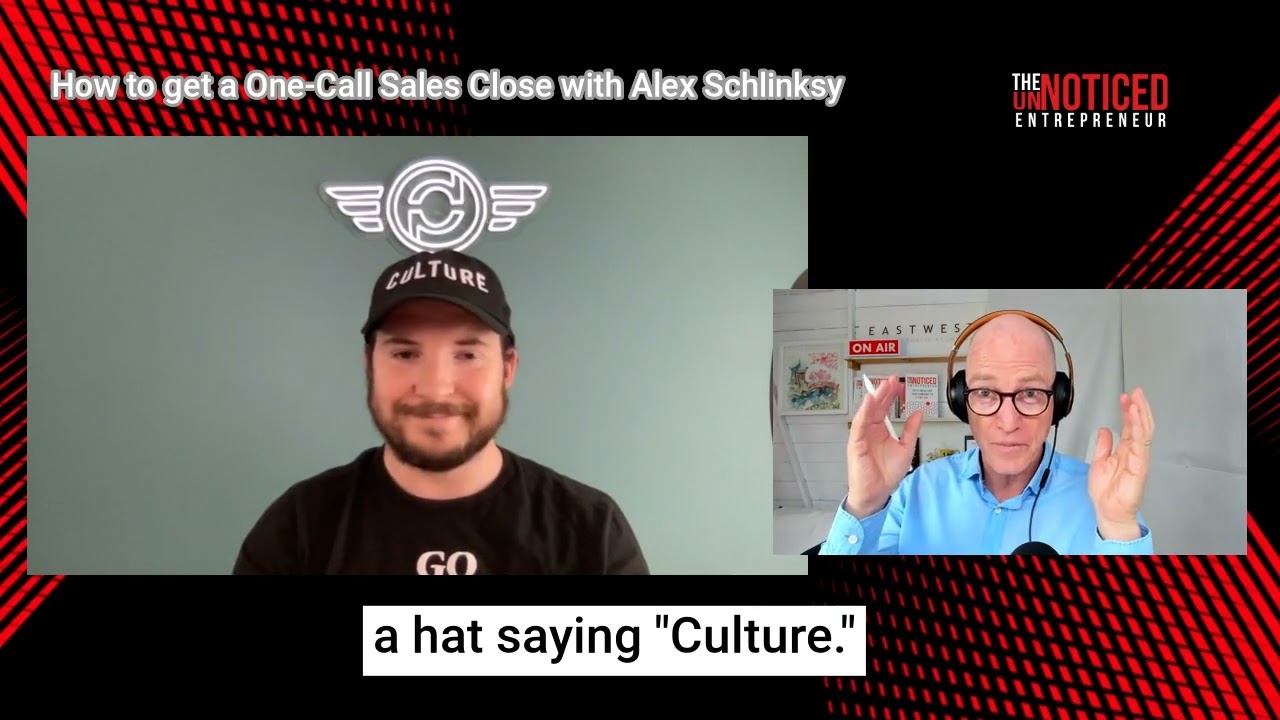
Well, Alex, this sounds wonderfully comprehensive. Now, you, you've also talked before we started recording about kind of the limited nature of your mastermind, which I was interested in, and about the importance of authenticity. And for those people that can't see, Alex is wearing a hat saying culture. Tell us about why you think purpose is also a key part of helping a client of yours to get noticed or the entrepreneur to get noticed.
I think one of the problems in the world that we live in today is like a severe lack of intention. I don't want to go so far to say as a severe lack of integrity, but I do think intention and integrity are very closely matched. A lot of people run companies with the sole purpose of generating more revenue and then a secondary purpose of delivering for the person that they brought in. So one of the angles we would say is if Jim James joined POD, what we say is, hey, we're not looking to find another Jim James immediately after you pay. Once the payment's made, now the job begins because the mantra of my company is client success over client acquisition. That's our internal mantra, our number one most important element of what we promise to our mastermind community, which is why we get great results for them. And then the biggest mantra for what we're trying to build for our clients is helping them build a business that facilitates their life, not at the expense of it. What we found is that this type of transparency and intentional focus allows people to generate so much more growth and fulfillment. It's wild. And I have a very valuable thing for the audience to consider here. There's a daily journal topic that we have our clients do, and it is, what is the one emotion that you felt today more than any? And a lot of entrepreneurs are very fearful of this journal because a lot of the times it's anxiety, stress, or frustration. Those are like 3 of the most common words. When you multiply that out over 365 days and realize more than 300 days are that, it's pretty crazy because the idea of entrepreneurship is choice, right? We have the choice to do what we want. And it's crazy that you would choose to feel frustrated, anxious, or upset about it. So that's why intention is so important to us. When I said earlier that everyone wants to make more money, the reality is it's like running on a treadmill, right? You run a lot, but you don't get anywhere. And this is why burnout is so common. And that's why we have a boutique company. In order for us to back up what we say on client success over client acquisition, we can't just magically bring on 30 people a month and then still deliver the same quality of There is just diminishing returns. People will ask me, well then, Alex, why do you run this company? Because I have intention of what I want. I want to build a community and a culture of people that I love and consider family and that I want to help and that have personal relationship with us and make a huge impact on their lives and my life. And I can't do that with 100 people or 150 people. I can do it with 55 or 60 people. And I'm okay with that because of the intention that I've chosen. That's really important to me.
Yeah. So what's also really interesting, Alex, is listening to you. I know that you had a medical issue that gave you a sense of purpose. Do you want to talk about how that medical issue sort of focused for you? Because I think you're absolutely right. Most entrepreneurs start a business and think it's got to be about scale. But what you're really talking about there is about control, aren't you? As well. And focus on what's really important to you. Do you want to share with us just, you know, How you translated some of the things that happened to you into also the way that you're able to share that story, to magnify your own story, to help others.
Yeah, absolutely. And I have 2 of those stories kind of back to back that are pretty interesting. One, how I started my business, and then one, how my personal health crisis only made me really understand my mission even more clearly. When I was 15 years old, a freshman in high school, my dad was a financial advisor from his own doing. He had created his own business by himself over the last year and a half prior to that, he was a funeral director. Um, and it was very challenging for him because obviously lots of people pass away that shouldn't pass away, unfortunately. And I'm the youngest of 3 sons and he couldn't handle that anymore. So he created this financial planning business. He did amazingly well for himself. Life had changed for the better. And then unfortunately he had a massive stroke when I was 15 years old. Thank God he's alive and well today. So no terrible end to the story, but he was out of work for about 2 years. And what we quickly realized in my family. My dad didn't have a business. He was a freelancer. And as soon as he got sick and you are working with people's money, it was pretty evident that they had to find someone else to support them. And now money got tight and things got stressful. And obviously my dad wanted to get back to work, but he couldn't. And it took me a little bit of time, probably 8 years or so to get through the trauma of it, but also to realize what my mission statement was as being an entrepreneur, which was learning from that, you know, error that my dad had. Which was not building a system and process and team around him because it wasn't clear enough. It was just him carrying the weight on his shoulders. And I wanted to avoid that. So I had the opportunity to be featured in The Entrepreneur magazine. And I wrote about how my dad's health crisis created clarity for me on how I can help people avoid that. Because a lot of people I ended up working with had their own children and so much greater stakes, but they're moving in their business without realizing, hey, like there's no one to run this business if God forbid something happens to you. And a lot of people want to avoid the mortality or morbidity talk, but it is very relevant and it just is. And especially from someone that is 29 or 30 years old telling you, and then I had my own experience when I was 28 years old. I was told that I had to have open heart surgery, which I did when I was 29. I had to wait 10 months, Jim, from the time that I was told till the surgery because of COVID So I had to wait, which was terrible. The waiting was definitely the worst part. I can confidently say 0 out of 5 stars. I do not recommend heart surgery. But it did create such strong purpose for me after the surgery, even more so realizing that now my individual story is going to impact people so much. When I was going through the experience, my mom would say, you know, Alex, this is going to be part of your story. It's going to help you impact more people because when a 60 or 70 or 80-year-old tells you to care more about your time and be more cognizant with your life, the younger generation kind of pooh-poohs that. Ah, whatever. He's old. When a 30-year-old who has a 5-month-old son at that time, or now he's 15 months old, tells you, hey, I almost died when I shouldn't have. And I almost lost everything. And I worked very hard for 10 years without purpose to create something that I would have never had the fruits of my labor. Maybe you should focus a little bit more on fulfillment and enjoying it rather than the never-ending hustle culture and cycle of let's work harder. So that's how I ended up creating so much more clear mission statement for the people I work with. So one of the main elements that we actually track, Jim, in our mastermind is numbers of days off per month. That is a really important metric that we track, not just profit or revenue or sales calls. How many days you took off, things that you were fulfilled with, and how many days did you write in the journal fulfilled or happy or tranquil? And that's what we're looking for in our community.
You know, Alex, that all really resonates for me. And this isn't about me and my health challenges, but I think, you know, as we get older, we find more and more of our peers start to not be around or enjoy good health. But Alex, this is also a show obviously about getting noticed. And as an entrepreneur, you're helping within your mastermind, but share with us how you're using speaking and going to other events to get you and the brand of your company noticed as well.
Yeah, absolutely. So when we talk about fulfillment and intention, the thing that fulfills me the most by far is speaking on stage. There's something about doing podcasts that are very fun, but it's a one-to-one format. And then there's audience that you don't know, that's anonymous, that's listening after the fact. But being in person and seeing someone's eyes light up or watching their attention, which is the most valuable asset we have, time and attention, watching them be solely focused on you when obviously attention is the hardest thing to get right now because of so much stimuli available to you. We have a computer in our pocket at all times with literally infinite amount of material that you can watch. So The idea of capturing and keeping attention, not just to be noticed, but to continually be noticed is so important to me. And the way that I do it is I work with different companies that help me get positioned on podcasts like this and also stage speaking. Because anytime that you do any opportunity where you put yourself out there, what ends up happening is you don't know who the anonymous listener is that finds it interesting, that emails you back, that says, hey, I want you on this podcast. I want you coming to this event. In the next month, I'm speaking at 4 separate events, my event in Chicago, then Columbia University, the Ivy League college in New York City, later this month, Digital Marketer event in Austin, Texas, and then Boise, Idaho, speaking at an event for copywriters. All of these have come from either initial outreach or them seeing me at other events, podcasts, or group speaking. If you can get yourself out there and avoid being afraid of What happens if I say something stupid or bad? It gets lost into the ether. No one remembers. There's so much information out there. It's totally okay. But if you can capture just insight from one person and value to one person, that one person might have a connection that changes your entire life. So I'm a big believer of that.
Yeah. And you were talking about the different kind of topics you're talking about as well. So do you want to share with us, you've got your authentic story, but actually it doesn't sound as though you're talking that much about prospecting on demand, for example, to Columbia University graduate students. Are you? So share with us how you feel like sharing the message as a, as an entrepreneur, and then how that's impacting the business.
Yeah, I love that. What I've found is a lot of people try to pigeonhole themselves into the content that they can provide, but then it puts you into a position of saying you're either a master of all or a master of none and a jack of all trades, right? Like either one of those. I think there's a balance that you can find. For the majority of speaking that I do at events for entrepreneurship, I do the one called Close Training. Which is my sales positioning that I talked about earlier in the podcast. But it doesn't mean that there's other things I can't talk about. People want to know that I work with the Miami Dolphins or that I was a UFC media member, or that I didn't know I ran an agency for 4 years, or that I had open heart surgery at 29 years old. People are intrigued by these stories because that's what the human condition is, wanting to listen to someone that inspires you to do the next thing that you want. So I'm always open and available to speak on any topic outside of really like numbers. That's pretty much the only thing. I'm not a numbers guy, so I try not to talk about anything related to numbers or cryptocurrency or anything like that. Someone asked me to come speak at their crypto conference. I was like, I don't think I'm going to be able to do what you're looking for, but feeling comfortable to step out of your comfort zone. Like, I love talking in general. So the idea of talking about different processes and different things to different people is valuable. Who knows who's going to be in the audience in Colombia? Who knows what the next speaking opportunity holds? I believe greatly in the idea of when opportunity comes knocking, you bust down the door. So if I'm going to get a chance to speak at Columbia, I'm going to do it.
That's really interesting that you've raised this issue of being diverse in what you talk about, because there is this sort of current of thinking that you become the subject matter expert on something very niche, and then you're really just repeating kind of what you said last time. And with the internet, people have often seen or heard it before, haven't you? So You've got to innovate. Is there a, would you say there's an underlying theme across all those talks you're giving, Alex? Is there an underlying sort of unifying Alex Schlinsky brand message?
Yeah, for sure. Intentionality and confidence. I'm a big believer of being really intentional with what you do in your life. Like we already spoke about with the idea of always making more money or always getting to the next thing or what's next. I love the idea of serenity and tranquility, especially after, you know, my surgery. But before I had my surgery, I was a person of great anxiety and stress. And even today, in some ways I still am. But the reality is some people don't understand that. Some listeners right now are like, yep, I totally understand anxiety and stress. And other people don't deal with that. They don't have that type of personality shifts. When you deal with that, it ends up creating such a weird sense of how life could be. And creates such an unfair feeling of I'm not good enough, or I'm not capable of, I'm not doing enough, or I should have done this, or I should have been there, or I'm going to compete against someone else. Life is so precious. The time that we have is so incredibly valuable to us that we really need to take the time to consider what we really want from it. Defining our win is so key to me. So I'm a big believer of actions over outcomes, intentionality, and confidence. Those are my main themes that I bring up. No matter what I talk about, whether it's prospecting, sales, entrepreneurship, getting noticed, or talking about, you know, my heart surgery.
And they're wonderfully positive messages. And love your earlier point about there are so many clients out there, the agency should not worry so much about finding clients, but about finding out who they are. And as you say, being intentional and showing up as themselves, and that's, that's okay. And that's great. And that is essentially Will be great. There is one, one thing you'd mentioned that you do as an agency. I just wanted you to touch on, you talked about the video that you guys do. Let's just share about that. Can you, as a bit of a lighthearted moment at the end?
I think it's great to talk about this. So my business partner, Brian and I were trying to consider, you know, what could make us different in the space? Because just like you, even though we're great at coaching, it doesn't mean that we don't feel these feelings as well.
Right.
We're human beings just like you. Like, oh, it's a saturated market. How do we stand out from the crowd? Even though we're not trying to bring on a lot of people, we still have some seats available. How do we like manage that? How do we separate ourselves? And one thing we thought that would be really fun as we were in St. Martin drinking shots together, frankly, was what if we took shots on Facebook Live and tried to book sales appointments for our clients? Do you think people would like that? So in 2018, we did our first ever Cold Call Shotline, where we compiled leads from our clients and acted as if we were their appointment setters, called the leads on their behalf, and basically on Facebook Live tried to book the sales appointment. If we could, we wouldn't have to take a shot. If we could not, we would take a shot. And the great irony of this unique content is one, it's definitely attention grabbing because people want to see other people get drunk online. That's the truth. Two, it's very authentic to us to not be afraid of just showing who we are. And then 3, the great irony of it really is they don't know which, which result they want. They do want the sales appointment, but they also really want us to take the shot. So it's very funny that we ended up actually iterating on this in 2 different ways. We have 3 shows total now. The other one is the Hot Wing Hotline, where we buy the hottest hot wings available from Buffalo Wild Wings, which the American listeners should know what that is. I really recommend don't doing that. It's terrible. It's definitely worse than the cold call shot line. It's a horrible experience. But we do that and people love it. And then we have another one where we do the Wheel of Misfortune, which is just a wheel. that tells you to like do a silly accent or say a silly word. So I've booked sales calls with my fake, really bad British accent. And Brian has done it with a fake, very bad Texas accent or saying belly button or some random thing. So things that are enjoyable to us that we look forward to doing, that's very unique, but also showcases the coaching that we're doing. And if you can find something like that for your business, it will really help you stand out and also enjoy it ultimately.
Alex Schlinsky joining me from Tampa Bay, Florida. Hey, I've enjoyed, I love that anecdote at the end and I love those ideas. And I guess at some stage you do hot wings with a shot and with an English accent, and then you've got all 3 at once. Alex, thanks for joining me on The Unnoticed Entrepreneur today and sharing, you know, amazing wisdom and insight and practical benefit for people that are listening today. For my listeners, thank you so much.
Thank you so much for having me.
You've been listening to Alex Slinsky over there in Tampa Bay. And of course, as always, I'll put all of his details in the show notes from Prospecting On Demand. Thank you for listening to this episode of The Unnoticed Entrepreneur with me, Jim James.
More from Jim











2 people, infinite agents, 1 billion dollar idea #AIAgents #Startup #Productivity