What is a magazine of you, and how can you publish one? With Matthew Stibbe.
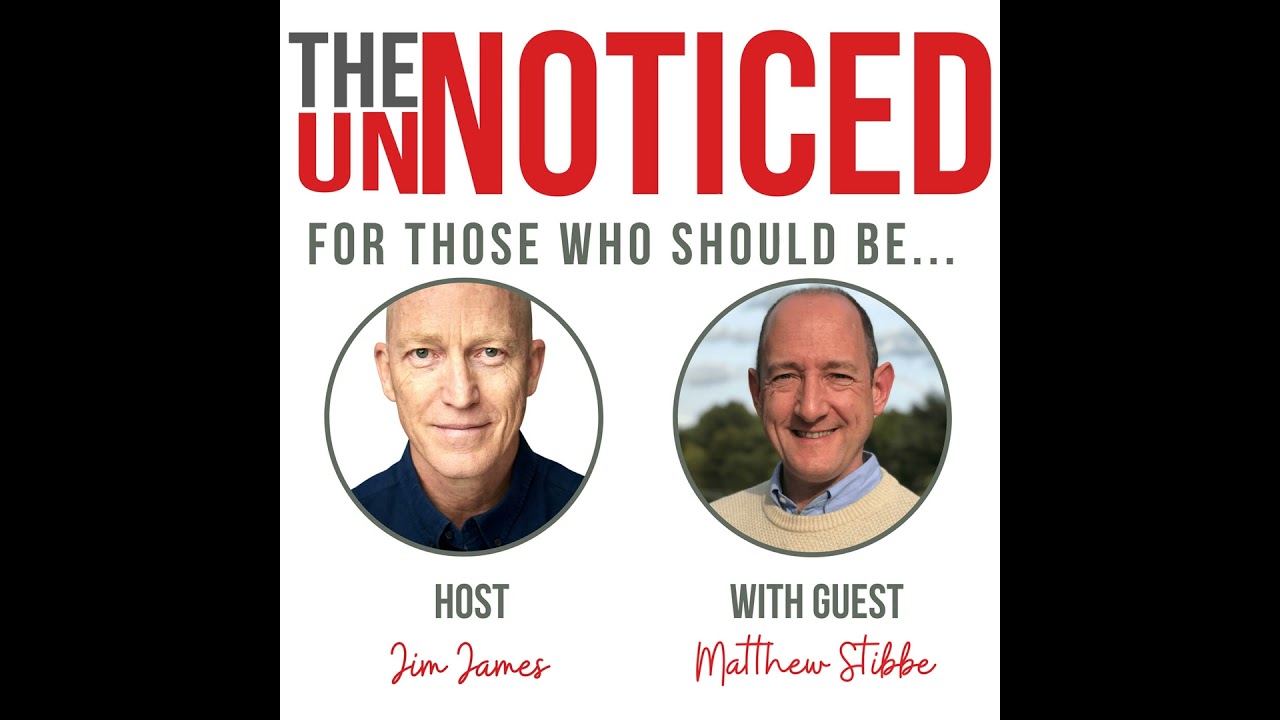
In this episode of The Unnoticed Entrepreneur, host Jim James interviews Matthew Stibbe, founder and CEO of Articulate Marketing and former gaming entrepreneur. The conversation explores how entrepreneurs can break out of anonymity and become noticed. Stibbe argues that the first step is to avoid being a "round pebble"—trying to please everyone—and instead choose a distinctive niche or angle. He critiques the common tech‑centric positioning of many B2B firms and illustrates the power of emotional hooks through examples such as Apple’s "Think Different" campaign, Subaru’s safety narrative, and Virgin’s cheeky tone. He introduces the concept of the "Magazine of You," a personal‑owned media strategy where founders publish content (blogs, podcasts, social streams) that reflects their expertise and speaks directly to their audience, thereby turning content into a self‑served advertising channel. Stibbe discusses practical ways to overcome confidence barriers—rehearsals, low‑stakes environments, habit formation, and choosing a comfortable medium. He recounts his own early entrepreneurial journey with Intelligent Games, highlighting how early adoption of new technology (the Canon CLC‑10 printer, early blogging) gave him a differentiation edge. He warns against the "man in the mirror" mindset—talking about oneself rather than the customer—and urges businesses to look through the window, using the customer’s language to build trust. Finally, he outlines how Articulate Marketing itself gets noticed: a two‑decade SEO‑rich blog, partnerships (e.g., HubSpot), live events, podcast guesting, LinkedIn thought leadership, and personal blogging on geekboss.com. The interview ends with contact details for Stibbe’s blog and consultancy.
Chapters
Hello and welcome to this episode of The Unnoticed Entrepreneur. Today we're staying in London and we are going to meet Matthew Stibber, who is the founder and CEO of a company called Articulate Marketing. Matthew, welcome to the show. Hello.
Hello, Jim. Nice to be here and thank you for having me.
Well, thank you because you've got a career as an entrepreneur. You built a big gaming company and now you've got a marketing consultancy and you've been an author. So Tell us from your experience, how should entrepreneurs get noticed?
Well, I think it starts by doing something interesting and different. What I would advise everybody to do if they want to be noticed is avoid being a round pebble. So if you are trying to be inoffensive and not alienate anyone and not say anything controversial or uninteresting for fear that you might lose a potential customer here, or you might irritate somebody over there. That's a very bad place to be. In the words of a former editor of mine, when I used to write for Wired magazine, she said, Matthew, if you want to write about everything for everybody, you're going to be a really lousy writer and you'll be competing with thousands of wannabe freelance journalists who want to write for Wired. Pick a thing you want to write about and be really good at that. And in my naivete and arrogance, I thought it would be great to write about business jets. So I spent several years flying in the back and sometimes in the front of some very fabulous jets. And Sure enough, there aren't a lot of people who review business jets and it was quite a nice gig for a while.
Well, it sounds like a really great niche to pick, to be honest.
Don't be a rounded pebble.
Business jet sounds like a really great niche. You weren't a niche writer on cat or dog food. That would seem to be the other end of the spectrum. But you run a company called Articulate Marketing and you work with a lot of big companies. Can you give us some ideas of positioning, good and bad, that you've seen entrepreneurs and businesses make?
Well, sure. The perennial problem amongst big tech companies, and I've worked with a few of them over the years, and I'm not picking any of these out by name, but you've seen them out there. They tend to talk about the technology. So we would say speeds and feeds, you know, we've got this many gigahertz and this many megabits and this many megapixels. And it tends to be very insular. It's like they're looking at their competitors and they're doing tables of features and they're working all of this out in order to differentiate. We need a little bit more of this and a little bit more of that. slightly less money. So the moment you step back from that and you start addressing and understanding your customers, your audience perhaps is a better way of putting it, and their validated needs and their attitudes and their beliefs, and you talk to them, you can move towards a position of differentiation like Steve Jobs achieved for Apple, where he didn't put such Dell HP 9742 XP, it's got more megabytes than those guys. He just had a picture of Miles Davis and Think Different, right? And he was appealing to deeply understanding his audience, which were creative, often solopreneurs. People had an eye for design. And that was enough of an audience, enough of a customer base for them to sell Apple computers and to turn that business around. Because remember when he took over, the business was practically going to go bust. So that's one way of positioning, right? To really get in touch with your audience and find some emotional hook. There's a really interesting video by Sonia Marciano about enterprises and differentiation and branding. And she uses the example of Subaru. So in America, Subaru has this tremendous reputation for safety. And so people are buying it for various reasons and they understand their audience and they understand who are buying it. In Europe, I drive a Volvo.
Why?
I'm interested in a safe, comfortable car, but safety is an important factor. So they found a thing that they can differentiate, they can tell a story around, but it's a story. They're telling you something that appeals to you emotionally, and it's substantiated with the intellectual, with the data, with the evidence. It's not, our Volvos have this steel, and it's like, it's a safer car. So I think finding a way to emotionally connect with an audience is really important. And I sometimes use the analogy, most IT companies are selling cold, dead fish. And Apple is selling sushi.
Right. That's a wonderful analogy. Now, when you think about how popular Apple is and how successful it is as a brand, you know, world's, I think, most valuable brand trades with maybe one or two petrol companies at the moment. Why is it though, Matthew, that everybody doesn't do this? Because it's not as though Apple is a new secret or Tesla. Why is it that so many companies, big and small, fail to find that emotional hook.
Well, of course, Apple have been able to parlay that initial success into technological differentiation and product differentiation and lightness and thinness and processor power and other things. So, you know, it's hard to say to a small business audience, be more like Apple because, you know, what experience do we have of running a trillion-dollar company? But other things that you can do at that early stage of, you know, you haven't got the resources of a multinational. You can invest in the tone of voice. So if you look at Virgin Airlines, right, all airlines basically are functionally the same. You sit in a seat, you go from one place to another, you go from an airport, maybe the food's slightly better, there's slightly more choice of videos, you get an ice cream. Certainly in the back of the plane, there's almost no differentiation. So what does Virgin do? They have this incredibly cheeky, rather sexy, saucy sort of British seaside humor, and that sort of helps them differentiate. And I think that can be something that's accessible to any business. And in fact, from that, you can build a website that has this potentially shiny copy. You don't have to be cheeky. You can be very serious. If the rest of your competitors are rather frivolous, you can be serious. If everyone's zigging, you need to just zag. And if you've got, everyone has a website that's got pictures of skyscrapers, you need a picture of something else on your website. So you need to find a way that just sound and look different. And maybe some people, you might need a little bit of help with that. You need to go and find an agency or an expert, help with the naming, help with the positioning, help with the visualization, but it doesn't have to cost megabucks and you don't need to be a multinational to do those things.
Right. And really just to perhaps unleash your creativity. And you have a concept, Matthew, called the Magazine of You. And I know you've got a background as an editor and a journalist, but the magazine of you, is that something that you think every entrepreneur or company could have?
I think it's possible, right? Years ago, I remember seeing a stand-up comedian talking about her craft, her art of stand-up comedy. And she said, as a comedian, your obvious is your truth. Your obvious is your talent. The thing that you know, because you are an expert in your business, you're an expert in your field, Whether it's installing swimming pools or sorting out IT problems or, you know, going to Mars, right? So what you need to do is to think about the thing that, you know, your obvious, and find a way to translate that, make that relevant, useful, and interesting to people who might buy your product. So you need to understand a little bit about them and their needs and their pain points and what keeps them awake at night and what they're excited about and what they think is interesting and what they don't think is interesting. So what you know on the one hand, what your audience is interested in on the other, and then the magazine of you is about how you communicate that and how you build that bridge. And for me, historically, that's been writing blog posts, because as you say, I'm a writer, I think by typing, but it can be a podcast. It can be your Twitter stream if you're into that. It can be your Instagram stream if you like photography. The magazine of you is for your customers. It's about them and things they're interested in, but you are the originator of it. You are the author of it. And here's the business secret behind the magazine of you. If you can build the magazine of you, instead of renting advertising space in other people's magazines, literally, if you buy advertising or metaphorically, if you're putting out paid adverts on Google or buying your way into somebody's Facebook stream, right? People will come to you because you've got something interesting to say. People will subscribe to your podcast, blog post, Twitter stream, LinkedIn messages, whatever the medium is. And then it's all you all the time, and you're not having to pay anybody for that, right? They're coming to you because you're saying something interesting. So the magazine of you, it has an advertising purpose, but it's to advertise you and it's to introduce you and your thoughts and your ideas in the right context to the right people.
Hey, Matthew. One of the common elements of entrepreneurs is they're often busy fixing many problems and they're not all starting as, if you like, creators from a content perspective, which the magazine of viewers, the way you've described it, kind of implies that they might need to be good and feel self-confident about how they write, how they sound, how they look. What's the workaround for the entrepreneur who may be a little bit shy or isn't so confident about the way that they sound? Because not everyone feels confident that way. So how can they do that?
It's a really interesting thing. Obviously, I feel very comfortable writing. So writing is my medium, but I've heard from people, oh, you know, I'm nervous about public speaking, so I don't want to do a webinar. But when I talk to them one-to-one, they're confident, they're fluent, they're expert, they're well-informed. So what's different? What's changed? It's the perception that they're being scrutinized and judged, the risk that they think they're going to alienate somebody or say something stupid or whatever, or be revealed perhaps for not being as expert as they see themselves. But the moment you say to yourself, I'm doing it for the audience, I'm trying to share something and I'm willing to take a little bit of a risk, I'm willing to be a little bit humble about it, I'm willing to be a bit vulnerable, right? The stakes can be lowered. And one of the things we do when we do webinars for our clients is we say, you know, yeah, okay, maybe people are coming and maybe they're They aren't, but I'm going to be on the other end of this. I'm going to be recording. You just talk to me, right? Like we did in the rehearsal, like we did if I was a client in a coffee shop or in a meeting room. You'd be incredibly confident because you're an expert at what you do. Just tell me that stuff. And suddenly they feel completely fine about it. So, I think if people can find a way of sort of end-running around their own neuroses and anxieties, and if they can find a medium where they can feel comfortable and, you know, maybe a bit de-risked, and they get over the fear of saying something that might be dangerous or alienating, because basically when you start, you've got an audience of none. So who are you offending? Anybody? And lastly, I think the critical thing I think here is time is often a factor and the antidote to time and the pressure of time and the stress of it is to create a habit. So if you blog every day, if you were going to do, you know, a LinkedIn thing every day, if you're going to do a Twitter thing every day, but Frequency, commit to it, make it a real part of your routine. And I remember when I started blogging back in 2000 and whenever, you know, I used to get up early in the morning and the first thing I did every day was write my blog post for the day. I used to write a blog post every day for like week in, week out. And that's how that blog launched and became successful for me. Nowadays, maybe I'd be doing podcasting. There's a medium for everybody now.
Yeah. And I think that's a really great point. There is a medium for everyone. And also, That these are skills that can be learned and a confidence that can be built, that actually no one was just born into doing this. Everyone has had to learn it as a skill, as we would with many other things as an entrepreneur. Matthew, you've been an entrepreneur. You had a gaming company. Do you want to just tell us a little bit about the gaming company and also how you got that company noticed? Because that's often as interesting as the way that you give consulting Now to clients.
How did I get started at Intelligent Games?
And how did you get Intelligent Games noticed? You built it to 70 people.
Get noticed. Yeah. Going back in time for me, you know, somebody once asked me, have you been an entrepreneur your whole life? And I said, not yet. So how did I get Intelligent Games noticed? Well, I started it in the kitchen of my flat, the first place I lived in on my own when I left university. Well, I had done a couple of games when I was at university, but Intelligent Games as a proper business, and I hired a designer and he used to come and work in the sitting room. So he would be designing things and I'd be writing things in my study and we'd be working in the— so how did I get it noticed? At that time, printers meant a dot matrix printer, you know, you, and it went beep, beep, beep, beep, beep, beep, and it did little black and white things and it looked really crappy. And Canon came out with a thing called a CLC-10. And it was a first inkjet printer you could buy. And it had a scanner on top and a color inkjet. You had to have this very shiny paper. You had to go and lease it from Canon. It was thousands of pounds and it was the size of a fridge. Well, I went and got one. I leased one of these things and I was able to use that with Richard's help doing the design and me writing the things. And I'd edited and designed the Oxford University magazine for a couple of terms when I was at university. So I knew how to use desktop publishing. So I was able to use desktop publishing plus a color printer, plus the amazing artwork of Richard Evans. And we produced game proposals that we then sent to publishers to say, you know, hey Maxis, we want to do SimRainforest, which eventually became SimIsle. And we proposed another game for a naval war game. And we proposed another game about Wall Street. And anyway, these proposals went out and it was just me, Richard, and our CLC-10. And the interesting thing there was as a geek, I've always had that story in mind because there's always the next CLC-10. For some people, it might be podcasting, right? That probably is now mainstream, but there's another thing, another technology solution that if you find it and adopt it and you're an early user of that and it allows you to be different from everybody else, that can be incredibly powerful. And back when I started Bad Language, which is now the Articulate Marketing blog, blogs were quite uncommon and blogging was the next CLC-10 for me.
Well, that's really fantastic though. I love that idea that you can take a new technology and use that in itself to differentiate your business, even if the business itself is not differentiated. And you talked also, Matthew, earlier on about, you know, companies not doing that because of them building businesses and brands for the man in the mirror. Matthew, explain what you mean by that little phrase.
Well, the man, or should we say the person in the mirror, tends to be The reflection or the mental thought process that I have acquired all this expertise, for example, in the world of Articulate Marketing, I have started a technology business and our clients, they're running these businesses with 20, 30, 50, 500 people. And the thing that helped them succeed was the mastery of some particular piece of technology, right? They were experts in Microsoft SharePoint adoption, or they were experts in data manipulation, data engineering, or whatever it was that got them there. So they get up in the morning and they think that person, you out there, the customer, probably think the same way I do, right? And you're interested in the things I'm interested in and the things that got me to where I am in my career, probably the things that are motivating you. And therefore, if I talk about the stuff that I know about in my language and I package my products and services in my language, because you are like me, you will automatically understand and want them.
Right.
But in reality, most people have their own thing they have to do. They've got their own problems. They're the expert in their own business or their own part of the operations of the company they work for. And they're not really spending a lot of time thinking about the thing you sell or your products or your services or your competitors. You know, for example, if you need an IT support company, maybe once every 3 or 4 years, you might go out to tender and you might spend a couple of days as an owner-manager thinking about IT support, right? It is not like the main thing in your life. And so you want an IT support company, or you want a computer manufacturer or a car company to talk to you about your issues in your language when you're ready for it. Understand me as a customer. Don't tell me about you. And that way you can start the conversation and earn the trust and get into a relationship with a customer by talking about their issues in their language. And when they're ready, you can start saying, well, of course, This is what we can do for you, and this is how we can help, and this is why you can trust us. But you've earned the trust, you've earned the engagement long before that conversation, before you get to talk about your products and services. I divorced about 9, 10 years ago, and I was back on the dating scene rather unexpectedly. And I realized very quickly that if you go out on a date and you just talk about yourself all evening, the person you're with gets very bored very quickly and doesn't think you're that interesting or clever or worth seeing again. If you sit back and you ask them very nice questions and you learn more about them and what's going on in their world, they think you're fascinating at that point. So it's the same relationship, right? Talk to them about their issues in their language. And that's the antidote to the person or the man in the mirror problem, I think.
Yeah, that's wonderful. You say more look through the window rather than looking in the mirror. And Matthew, what about yourself?
Good analogy. I like, I'm going to steal that.
You know, you just give me that inspiration there, Matthew. What about for yourself finally, Articulate Marketing? How are you getting that business noticed?
Well, we're lucky because we have almost 20 years of blogging that has given us a very attractive SEO profile and backlink profile. So we get found a lot on Google for, you know, questions like, how do I improve my organic traffic? Or should I hire a marketing agency or a marketing person? These sorts of traffic and contact generating blog posts. Increasingly, we're working in partnership with our clients and our vendors. So we're doing quite a lot of work with HubSpot at the moment, and they're working with them and supporting them also helps them support us and find us customers. When I started Articulate, I did quite a lot of live events. Microsoft used to let me use their meeting room in central London, and I used to host writing breakfasts, how to write about your business, how to do blogging. And some of my earliest customers came from those very small, very simple events. And I think we should start that again now that the COVID restrictions have evaporated. I think I think though, we also do quite a lot of things like this, you know, guesting on podcasts and trying to get the word out a little bit. That's becoming a big thing. More LinkedIn engagement and quotes, thought leadership. And I write my own blog now. My old writing blog sort of got folded into the Articulate Marketing blog. So I now blog at geekboss.com, and I'm writing about management and leadership and a little bit of marketing, a little bit of aviation, and a little bit of Lego.
Matthew Stibber, thank you so much for joining me. In terms of a final place people can come to see you, is that that blog you just mentioned?
I'd love it if anyone wanted to look at geekbots.com. If you want to find Articulate Marketing, we're at articulatemarketing.com. If you would like to talk to me, I'd love to hear from you. articulatemarketing.com/meet, M-E-E-T. That's my online calendar. You can book up a time. We'll have a chat. Come on over. I'll put the kettle on.
Well, that's a fantastic offer. Matthew Stibber, thank you for sharing so much wisdom with me and my fellow Unnoticed Entrepreneurs today. Thank you so much for joining me.
It's been my pleasure. Thanks for having me.
It's been fantastic. So you've been talking to Matthew Stibber. And of course, as always, I'll put all of my guest contact details in the show notes. Thank you for joining me, Jim James, on this episode of The Unnoticed Entrepreneur.
More from Jim











2 people, infinite agents, 1 billion dollar idea #AIAgents #Startup #Productivity