Which of the 4 'Villains of Listening' is holding you back?
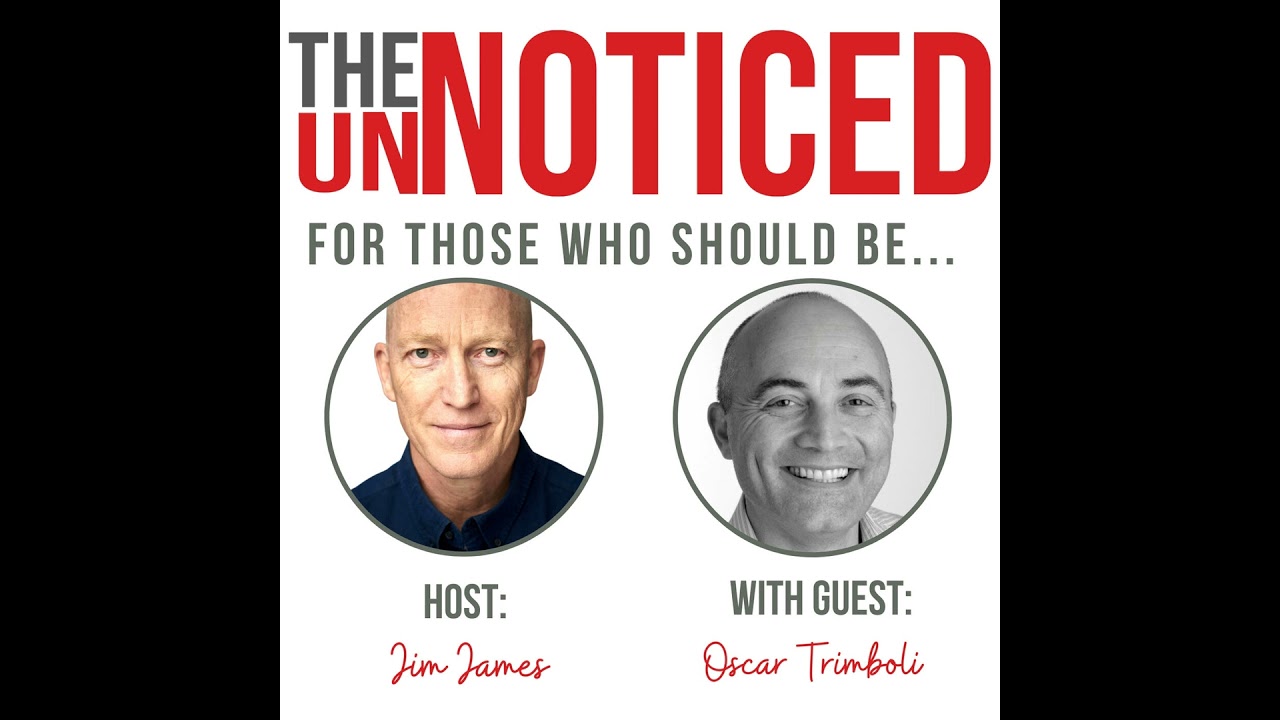
In this interview on The Unnoticed Show, host Jim James talks with Oscar Trimboli, a deep‑listening expert and entrepreneur, about why most people have never been taught how to listen effectively and how that gap hurts businesses. Trimboli explains the research‑backed "4 Villains of Listening" – Dramatic, Interrupting, Lost, and Shrewd – and how each manifests in work and personal life. He describes the Listening Assessment (a 20‑question quiz built with behavioral scientists and validated across English‑speaking cultures) that identifies a primary and secondary villain, and the follow‑up 90‑day challenge that helps participants develop the opposite “superhero” listening style. Trimboli shares neuroscience‑based listening hacks: humans speak ~125 wpm, can listen up to 400 wpm, and think ~900 wpm, meaning listeners only capture ~11 % of a speaker’s mental stream. He recommends three simple prompts – “Tell me more,” “And what else?” and a strategic pause – to surface hidden meaning. Cultural dimensions of listening (e.g., the Eastern concept of “ting” and the value of silence) are explored. Trimboli also recounts his entrepreneurial journey: early failures with blogs, pivot to podcasts, creation of listening‑themed products (playing cards, jigsaw puzzles, books, a podcast series), and the role of publishing, community‑of‑practice newsletters, and data‑driven automation (Evaluation Solutions assessment platform integrated with Infusionsoft CRM). Participation metrics (≈11 k quiz takers, ~33 % opt‑in to the challenge, ~20 % complete all 13 weeks) illustrate impact. The conversation ends with Jim reflecting on his own listening villain profile and thanking Oscar.
Chapters
If you're in Italy, it's Trimboli, and if you're speaking English, it's Trimboli. So if you want to speak Italian or, or English, it's completely up to you. I answer to both. But there is a long story about the head of the mafia in Australia in the 1980s was a very famous Trimboli.
Well, Oscar, you are in Sydney, not Italy, so what we'll do is we'll avoid all mafia and not be too afraid. But we are going to talk with you today about Deep listening. And you're an expert on deep listening. And, you know, it'd be really great for you to share with us how listening impacts entrepreneurs.
Thanks, Jim. For many of us, we've never been taught how to listen. We know maths, we know wine, we know red wines, we know fruity wines, we know cheese that's soft and hard, but we have no language around listening. So for me, what I'm trying to do is honor a conversation I had with a vice president once who took me aside at the end of a meeting, and I thought it was get fired, Jim. She said to me, you need to stay behind at the end of this meeting. And I thought, what have I done wrong? She took me aside and said, if you could code the way you listen, you could change the world. And it never really made any sense because all I was doing in that moment was cheering that I wasn't sacked. But as a marketing director at Microsoft at the time, I pondered the question, is it possible to code how people listen? Because we can do it for maths, we can do it for English, we can do it for chemistry. We have the periodic table of elements and setting up this assessment tool that you've taken the time to answer 20 questions is a way of coding how to listen. Longer term, I'd love there to be automated tools that are applications or an add-in inside of Zoom that could tell you your speak-to-listen ratio. As a simple example, imagine a percentage bar going across the top of the screen. And listening is crucial because the more senior you are in the organization, the more listening you do during your day. The more sales you do during the day, the more listening you should be doing. Unfortunately, that's not the case. And when you're dealing with complex, collaborative, constrained, or conflict situations, listening is one of the most important superpowers you have as an entrepreneur because you can bring people along in the journey with you. It's a big difference between hearing what somebody says And listening. And the difference between hearing and listening is the action you take. So a lot of employees get frustrated with business owners who keep telling the business owner the same thing and the business owner doesn't do anything with it. Listening is when you act on it.
So do you want to just take us through the, the 4 different kinds of listening you've got, Oscar? Again, I'm not going to tell you which one I am. I'm going to try and choose the best one, but I'm sure you'll you'll, you'll be able to see my results. But take us through the 4 different types, Oscar.
So the history of this assessment, we have done a lot of work with behavioral scientists, market research companies, and some computer software people, 2 and a half years with some academics to not only create a quiz, but to prove it's valid across English-speaking cultures. And one thing that's really important to know, Jim, is that listening is situational, it's relational, and it's contextual. So you'll listen differently in many different situations. You'll listen differently to a police officer than you will to a school principal. You'll listen differently to an actor than you will to an accountant, for example. So the 4 villains of listening came out of this research, and they are the dramatic, the interrupting, the lost, and the shrewd. Let's spend a bit of time with each of them. If you're a lost listener, don't worry, you've just forgotten everything I just said because you're drifting off somewhere else. You might be thinking about something I said earlier on. The lost listener is just completely lost in their devices, or something in the conversation creates a trigger for them to think about a holiday that they wish they had, or maybe they're thinking about lunch, but they're completely lost. But equally, something the speaker might say about the issue might lose them as well. So the lost listener, roughly 22% of people in the 11,000 people who've taken the quiz so far. The next one is the dramatic A dramatic listener loves listening to your story. They engage with you really well. And what they try and do too much of is connect with you. So if you say to them, oh my God, I'm really struggling with this staff member, they'll say, oh, you think you've got a problem with the staff member? Wait till I tell you about mine. Or if you think you've got an awful customer, wait till I tell you about mine. Or if you think your bank manager is a pain, wait till I tell you about mine. They love the spotlight being back on them. And what they love is connection, but they don't understand the difference between empathy and sympathy. The next villain is the interrupting listening villain. This is the most overt listening villain. They're the quiz show contestant that presses the buzzer, anticipates the question and the answer, but gets it wrong. They value time, so productivity really matters to them. They have a mindset that I've heard that before, so let me just jump in. And let's get to it quicker. So their intention isn't wrong, but they're just impatient. And then the final listener, which I'm going to speculate, Jim, people from your profession tend to over-index on the shrewd listening villain. These people are problem-solving machines. Although they'll give you great face, they'll go, wow, yeah, tell me, fascinating. And you'll feel like from an outsider's perspective, They're really engaged and listening. But if you had closed captioning to see what was going on in their mind, they would be saying something like this. By the way, I'm a shrewd listener at work and I'm a lost listener at home. And when you do the quiz, you'll get a primary and you'll get a secondary. And most likely the primary is who you are at work and the secondary is who you are at home. Now, I always say labels are really good on food jars and pharmaceutical products, not people. We're labeling your behavior, not you. So the shrewd listening villain, their closed captioning goes, oh my God, I studied this long. I'm such an expert in this field and you've got such a basic problem. I can think about 3, 4, 5, 6 problems you haven't even thought about that you need to know about. And what the speaker senses, they can see the cogs going on in your wheel turning over, going through the issues. And their mindset is, stop trying to fix me and just listen to what I've got to say. So they're the 4 villains of listening, dramatic, Interrupting, lost, and shrewd, or the DILS of listening. That means something different in the United States, so I apologize. One of the great things about listening is all of us think we're above average. 74.9% either rate ourselves as well above average or a long way above average. 3 quarters of us think that we are above average listeners, and that's our first villain is Self-awareness. And we have 5 levels of listening when we take people through the foundational set of listening. And the first level is knowing what your barriers are. Most of us aren't even aware what gets in our way because we were taught to focus on the speaker when it comes to listening. Absolutely the wrong place to start your listening. Now don't get me wrong, I'm not saying don't listen to the speaker. I'm just saying don't start there. You need to start by listening to yourself. And Jim, here's the— I'd say the dirty little secret of listening. Until you know your villains, you can't introduce yourself to your superheroes. And for each villain, we have the alternate superhero. And if you take some time with the quiz and sign up for the 90-day challenge, which you may or may not have done, which is at the bottom of your 5-page report, you'll start to discover which one of those superheroes can emerge for you. As you explore the world of listening. Now, Jim, one of the things I would say is if you're an entrepreneur listening to this right now, can I give you a little neuroscience hack that most people don't know?
Yes, please do that. Yeah.
3 numbers you need to know: 125, 400, and 900. I speak at 125 words a minute. You can probably speak at 200 words per minute if you're an auctioneer. So if you're auctioning cattle or you're a horse race caller, you can speak at about 200 words per minute. We know you can listen at up to 400. We know that blind people can listen to audiobooks at 3 times speed and have complete comprehension. So there is a disconnect between the speed at which you listen and the speed at which they talk. So genetically and neurologically, you will get distracted. And don't think, Oscar, teach me how to stop being distracted. This is not about mindfulness. If you'll be distracted, ironically, that will help you reset your attention much quicker. You can only listen continuously for 12 12 seconds. That's right. You can only listen continuously for 12 seconds. Now, the last number I gave you was 900. That's how many words on average somebody can think at. And here is the ninja move for the entrepreneur. If the prospect you are talking to, the customer, the investor, the supplier is thinking at least 900 words per minute, if they can only speak at 125, it means you are listening to 11% of what they're thinking about. Get an unfair advantage and learn these 3 simple questions. If you can learn these 3 questions, you'll get the next 125 words out. And often that'll be the difference between you knowing their problem and you knowing their customers' problems. And when you know their customers' problems as an entrepreneur, you've got a customer for life. So those 3 questions you want to get really good at are really simple questions. Please don't use these questions in sequence. All it will signal is paying attention. So question number 1 is, tell me more. Question number 2, and what else? Now that can be shortened to just, and, but do it in a respectful way. Now when you do this, sometimes you'll notice that they take a breath in, their shoulders go back, their spine is erect, and then they'll breathe out and they'll say, These phrases, they'll use the word actually or so. Tell me if you've heard this one, Jim. Actually, Jim, now that I think about it a little longer, I think it's more important that we talk about this.
Yes, absolutely. You uncover the problem behind the problem, don't you, Oscar, then?
Yeah. And so question number 1, tell me more. Question number 2, and what else? And question number 3, listen to this one carefully. It's the shortest. It's the most powerful. Done well, it's really skillful, and yet done poorly, it can intimidate. By the way, Jim, that ting means to listen in Mandarin, and ting not pronounced correctly also means to stop, doesn't it?
Yes, it does. Yeah, well, it's in different tones. There are 4 tones.
So when it comes to listening in China, listening is 6-dimensional. It's about seeing, sensing, feeling, respecting, and being present and focused. That's what Ting means. Now, one of these critical skills the East teaches us in ancient cultures— Polynesian, Inuit, Aboriginal cultures, Māori cultures, Eastern cultures like Korea, Japan, and China— use this really well. This phrase is really used often. Here it comes. Now don't worry, nothing went wrong with any of the recording. There's no coincidence that silent and listen have exactly the same letters. And if you can just practice that, you will listen and hear things that other people will never get told because you took the time to listen to what's not said. And you will uncover much, much, much more than the next person who merely engages in a dialogue with the very first thing people say. Tell me more. And what else? And just pause. In the West, Jim, we've got this weird relationship. We call it the pregnant pause, the awkward silence, the deafening silence. And yet in the East, it's a sign of wisdom, respect, seniority, and authority. It's not uncommon for there to be long pauses in Eastern meeting places, are there? No.
And of course, that's why also in Asia, they like to drink tea, which is a long form, whereas we have a cup of coffee. And in espresso, and in China, we have a tea that actually you wash the leaves 4 or 5 times before the pot is even finished. Oscar, that's very, very powerful. So we've got 1, tell me more, 2, and what else, and 3, the silence. Of course, if you start the conversation with silence, they might think you're being a bit intimidating, mightn't they?
Yeah, and that's the warning or the little caution at the beginning. The last one needs to be used skillfully when you're in some kind of relationship and trust has been developed. But what my clients tell me, particularly those who are entrepreneurs, they often say, oh, I haven't got time for that. All this listening stuff takes time. And I said, so does launching the wrong product. So does losing a great staff member. So does winning a customer where you heard the wrong thing. All of these are really unprofitable ways to spend our day. It's also not a great use of our time and money. So although it takes just a little bit longer at the beginning, what you do is you start to listen to what they're thinking and what they mean rather than merely what they say. Let your competitors listen to what they say, and if you listen to what they mean, you'll have a customer, an investor, a supplier, an employee for life.
Oscar, that is such an academically rigorous explanation. It's fantastic and bulletproof. You've obviously been working on this for many, many years. Can we just switch gears just slightly onto you and how you are sharing your message? How does Oscar Trimboli get noticed? Share with us your entrepreneurial aspects because that's also inspirational.
I'll tell you about my failures first. I think that's when you meet a real entrepreneur, where they're going to tell you about their failures first up. So I want to zoom you into an industry conference I was attending. It was 7 and a half years ago. And next to me was a good friend of mine now, Dermot, originally from Ireland. And we were in, in this workshop and I just said, we were asked to share a problem that we're working on. So I was blogging 2 and a half years straight, very regularly on the topic of listening and nobody, not a single person was engaging. With what I was doing. I said, Dermot, you know, you're a wise man. And I'm not going to do his accent any credit, but he basically said, you idiot, if you're talking about listening, you do a podcast, you don't do a blog. You know, if people are interested about listening, they probably want to listen to it. So I started that, another spectacular failure until I discovered this wonderful book by 2 authors, Dan Gregory, Ciarán Flanagan called Scared, stupid, and simple. And they basically hypothesized that you can do all the ambitious, inspirational, and aspirational work you want, but most people relate to their weaknesses more than they relate to their strengths. Thus the villains of listening. So although initially I was writing about the aspirational listening superheroes, nobody could relate to them because they were these artificial gods of listening that nobody really related to. But I have not met a single soul this planet that couldn't relate to the 4 villains of listening. I think the thing I do well is publish. Now, does that mean publish a book? No, it just means share your ideas with somebody else. So publishing could be webinars. So I run a community of practice where people on my newsletter list come in once a month and it's completely free. And I use that as a way to test ideas, new ones and old ones, get feedback from those people. But they also share with me The current contemporary problems they're dealing with in their workplaces. And if I listen carefully, they give me gold. They give me lots of great opportunity for me to think about. One of the things that emerged was this, that the deep listening playing cards came out of a conversation where people said, Oscar, why don't you put all those tips you talk about into a set of playing cards? So I did. And then somebody else said, hey Oscar, why don't you make a jigsaw puzzle and make it into a game? So we did. And then why don't we make an assessment quiz? So we did. Why don't you write a book? So we did. Now, did I listen the first time in each of those cases? No, absolutely not. I got my own villains to deal with. I think the thing I've done well, we're nearly 100 episodes on the podcast. We won an award from Apple a couple of years ago for the category we were in because it was such a different take on the communication topic to talk about listening, to interview expert listeners, to deconstruct what good listening is and how to make that commercial. A lot of the client work that came about only last week in North Dakota and Atlanta. All of those came about from interviews that I'd done 2 years ago and 4 years ago. These people had heard me and continued to follow me and they were ready to buy this year. I didn't know anything about them. Some of them were on my newsletter list, some were not. But again, publishing, just going through the process of speaking to people out loud. Someone will connect with that. And so put yourself in a situation where an audience is present. In the old days, I used to speak at public events and now up at midnight and 2:00 AM on the East Coast of the USA or doing evening sessions in Hamburg or Munich or London or even in Copenhagen. So many opportunities have come about through COVID to extend the work I do in, around the world. So I think to answer your question, lots of mistakes, Jim, but I made them and I got the ideas out there so I could get the feedback. So I think the key to my success, much like my marathon running, is persistence and some kind of plan.
Oscar, that's fantastic. And I've taken the test and I will tell you that it's very elegant. Which platform do you use, by the way, to create your online scoring?
We actually work with a third-party software organization called Evaluation Solutions who do assessment tools for people or all around the world. And that integrates with our CRM system, which we use Infusionsoft. And it's a really good tool. The quiz gives us rich information about people who take the quiz that we then connect them into a 90-day challenge. So once they've taken the quiz, we stay in touch with them. About a third of our audience opt in for that, Jim. And then about 20% of those people go through all 13 weeks. But very quickly we get to notice patterns in behavior, which newsletter copy they connect with and which newsletter copy they don't in those 13 weeks. And the 13-week challenge that people are doing now is completely different to the 13-week challenge we did 2 and a half years ago when we started this off.
Oscar, we could talk for much longer, or rather I could listen to you talking, and I haven't even said tell me more and what else, and I haven't done silence. I, I will just tell you that I was a shrewd listener, or I am in this situation apparently, or today, and a dramatic villain is my sub-villain. So I think I definitely need some superheroes for that. Oscar Tromboli, joining us from Sydney, the Listening Man. Thank you so much for joining me and sharing all your wisdom today on The Unnoticed Show.
Jim, thanks for listening.
It's been my pleasure. I've listened and learned. Thanks so much to everyone as well for listening to Oscar Tromboli from Sydney. And I will, of course, put all of his contact details in the show notes so that you can take the test and sign up for his 90-day course. In the meantime, until we meet again, I wish you the best of health, That you are safe and that you are listening to what's going on around you.
More from Jim











2 people, infinite agents, 1 billion dollar idea #AIAgents #Startup #Productivity