Why is the cash in the pigeon holes for an entrepreneur and how do you fly to get it?
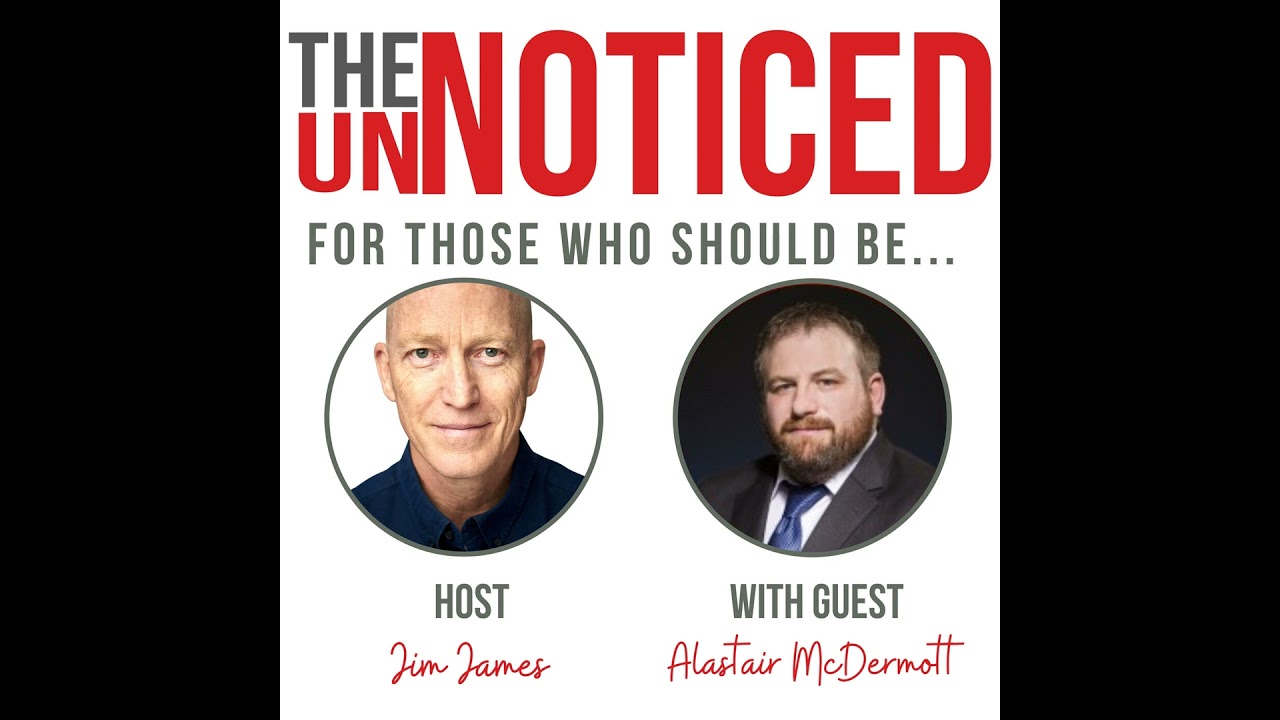
Alistair McDermott says 95-99% of consultant revenue comes from referrals, but authority marketing through podcasts and blogs scales better. He recommends niching down, publishing consistently, and investing in decent audio and video gear to appear more credible.
Chapters
Welcome to this episode of The Unnoticed Show. Today, I'm delighted to have Alistair McDermott, who's joining us all the way from Galway in Ireland. Alistair, how are you?
Jim, lovely to be here. Thank you.
Good. Now, you are helping invisible experts to become visible. Can you help us understand, Alistair, how do you help experts to become visible?
Yeah, sure. So, this is a problem that I encountered myself. And so it's near and dear to my heart because I realized I had this problem that I wanted to kind of build my authority, become more well-known, become recognized in my field. I realized, well, you know what, it's like I'm wearing this cloak of invisibility, like from Harry Potter. So I needed to remove that cloak of invisibility in some way. And I kind of, you hear this advice, you know, put yourself out there, but it's not so easy. And there's, I think that there's a process that you've got to go through. And so I started figuring that out. And the one thing that I think is really important is if you take the phrase recognized authority in your field, is that last part in your field, you actually have to niche down. You have to specialize. I think that's the really difficult part for a lot of people because a lot of people who I talk to are very smart consultants. They're experts. They're generalists. They're really good at doing lots of different types of problem solving. It was very difficult to actually niche down.
Well, you know, I think you're absolutely right. There's this whole issue about the riches are in the niches, but the anxiety is that you're leaving money on the table and that it's not possible to get enough money, if you like, from an individual niche. I'm going to call it a niche rather than a niche. So how does that work then, Alistair? Because if you're, you know, an authority in one field, how can you get enough recognition to get enough business to be sustainable?
Well, you've got to pick a field that's big enough. You've got to— there has to be enough business in that niche. You can't niche down too much, but it's basically you're a big fish in a small pond. That's the way it works. The way that the world works now with Google search and things like that, it's only the top people in a particular field are going to come up top of the search results. The top people are going to get the most recommendations. You know, there's an advantage in being top of the pile. If you're not top of the pile, then go find a smaller pile and be top of that. That's the way it works. And I'm not saying this is just for Google search. This applies to the whole concept of being recognized as an authority. You become known as a go-to person for that one problem, for that one area.
So I was thinking about this the other day and wondering to what degree are you really just having a job description? then? Because you see on LinkedIn now, people say, you know, I do this and they become the fuckingized authority in podcast creation, for example, or lead gen. You know, how, how are they able to, if you like, be broad enough to get a new business and not be just pigeonholed into one area, do you think, Alistair?
Okay. So first thing is I have to, I have to take up when you say the word pigeonhole, because that's one of those trigger words for me. Pigeonhole is, people use it in such a negative way. And I was listening to Blair Enns. talking to David C. Baker, his co-host on the Two Bobs podcast. And he was saying, you know, the pigeonholes are stuffed with cash. Why are people always giving out about pigeonhole? And so that's kind of my view on it. It's pigeonhole is, it's such a negative kind of concept or term, but it's because like we're usually multi-talented, smart people. And we don't like this idea that, you know, we're going to be constrained in some way. But the reality is that if you niche down, usually it opened up a lot of opportunities for you. And usually the problem area is much deeper than you initially realize, the scope of the problems, the depth of the problems. It's just, there's a lot more, there's a lot more, there's a lot more there that will fascinate you than you think may be there from a kind of a surface visit to the area, you know? Yeah. So that's the first thing. And I think, you know, when you go deep on any kind of specialization, there's a few different ways you can niche down, a few different ways you can specialize. But when you start to go deep, deep, you realize, hey, this is actually fascinating. And there's a lot more here for me.
And do you think that applies to companies as well as individuals?
Oh yeah. I mean, it depends on the size and scale. So, and it also depends on, on like, there's a few different factors. Like, for example, I think that if you're right at the very start of your career, that you can't niche down because you need to build a certain breadth of experience so that you can make a good specialization decision later. Because you do need to have a bit of a broad experience in order to niche down because you need to be able to say, well, I do like this and I don't like that. I like these kind of people. I don't like working with those kind of people. So you do need some of that. And then on the other end of the spectrum, you take somebody like Seth Godin or Mark Schaefer or somebody like that, who like these kind of, let's say, industry experts where they're very broad. They are so big at that point. They've built such a massive audience that they don't need to be niched down because they're just so big at that point. And I think the same applies to companies. that reaches a certain size, they don't need to niche down. But for a lot of us, particularly for solo consultants, for independent consultants, and very small businesses and very small firms, niching down can give us this tremendous advantage when we're competing with somebody and they have a general experience and we have this specialist experience. It's almost no comparison. It's apples to oranges. It's not the same. And it just makes you stand out.
So you've sort of chosen your pigeonhole stuff with cash. I love that idea that there's this sort of pigeonhole there. RMB, see, now I guess it would be. What about letting people know that you're in that pigeonhole? Because I guess that's the anxiety is you think that if you're in that niche, you can be invisible. And I guess hence to your podcast, for example.
Yeah. So, okay. Well, the way I look at it is, so to start, First of all, we need to get some broad experience so that we can actually end up in a position where we have enough expertise to be an expert, because you have to be an expert to become an authority. So you have to have truly developed some expertise, and it's usually quite broad. And then what you need to do at that point, and when I say you need to, if you want to choose this journey of authority, you need to do this. You don't need to do this if you don't want to become an authority, but if you do want to become an authority, then you do have to pick a field. It just goes along with it. I don't think it's possible to be an authority without being an authority in a specific area. It just doesn't make sense. Yeah, and there are these people, you know, you see people who seem to be generalists, but usually they're not really generalists. They are specialists in some particular area, like Gary Vaynerchuk is an example. And he will answer questions in a very authoritative manner on a whole range of topics. But actually, when you dig into it, he does have expertise in, he's got a huge deep expertise in wine. He's got a huge deep expertise in video production and in social media and absolutely an expert in those areas. And probably in growing a business and growing a media team and those kinds of things as well. But they're in specific areas and not kind of this broad, I don't think there's a generalist. It's always in multiple areas, you know? So, but to go back to answer your question, I think that we start off with this broad knowledge and develop some expertise. And then we get to a point where we want to have more impact. We want to be able to charge more, to command higher fees. We want to work with better clients, bigger clients, help more people. And for some people, that journey to authority is the route forward. For other people, they go different ways. Other people build out their referral network and they go to, you know, they do a lot of networking and things like that. And that's their route forward. And in fact, I did some research. I surveyed over 1,000 consultants. And what I found was that referrals were the number one source of business for about 95 to 99% of consulting businesses and B2B businesses. And that wasn't just at the small consulting firm stage. That was from 1 to 10, firm size 11 to 50, and firms size 51 to 200. When I surveyed, they all said that referrals networking was the number one source. So that really fascinated me when I saw that.
So that's a bit alarming, isn't it? So many people rely actually just on points of contact rather than inbound marketing, for example. I understand.
Well, this was what led me down this road of examining this in more detail because I found that so fascinating. And so like there's a certain point where networking doesn't scale anymore. And in particular, like now when it's hard to run networking events and go to networking events and to travel, you know, you want to have something else. And so this, so My preferred route forward is, and I'm a little bit more of an introvert. I like to create content. I like to write. I like to record YouTube videos and podcasts and things like that. This is as extroverted as I get. And so that's what this kind of route to authority gives you is the ability to do this inbound marketing. So inbound marketing is content marketing or authority marketing or education marketing. And that's what you're doing. You're educating your clients about the problem and the solution to their problem. And building your authority with that.
So I think that's a great way to start to look at how you do that, Alistair. So you make that sound kind of easy. How can an entrepreneur then build that out from a practical point of view? And, and I know you've also done some research into how people sound and look and that making a difference too. So can we just talk about how you get to being from, you know, being at home on Zoom to sounding and looking like an authority? Because they're not, it's not a simple path, is it?
Yeah. Okay. So I may make that sound easy or make it sound simple, but it's not easy. And I'm speaking to you, I just put up a video on LinkedIn yesterday where I looked back over, over about 15 years of my LinkedIn or sorry, of my YouTube video history. And I look back at some of the older videos and it's so, it's cringeworthy. I don't actually recognize myself. It's so bad. And it's, you can have a look at that if you check out my LinkedIn or my YouTube. And that video is called Putting in the Reps. And it's about getting some experience. You have to start, like, you don't learn to swim by reading books about swimming. You actually have to get in the pool. And so you have to start. And particularly like the route to authority, one part of that is you have to demonstrate your expertise, which effectively means publishing, which means talking. Speaking and writing in public. You have to expose your ideas and your thoughts to the public. And you have to do that in— there's lots of different modes and methods that you can use. We like podcasts, the two of us. I'm starting to get more into YouTube and into video. And some people would prefer to write blog posts. Seth Godin has been writing a blog post every day for decades. So there's lots of different ways to do it, but you do have to start. And if you look back at anybody's start, their first stuff, it is, you know, it, you look back and you go, okay, that, that didn't look great, but they kept doing it. For example, if I go back to Gary Vaynerchuk, if you look at some of his videos from Wine Library TV from, you know, the first year or two that he did it, you know, it's, it's amateur looking, but he's still worth $200 million today, you know, so it's, it's, it's not. easy. It is simple. You have to start, you have to start somewhere, pick a niche and start, you know, one thing I would suggest is start to do some deep research into that niche, into that specialization, start to dig more into the problem and talk to a lot of clients in that area and start to look for patterns and start to learn more about that problem than anybody else, because this is the thing that the specialization will give you. It will give you a deeper understanding than other people have. Go back to David C. Baker. He wrote a book called The Business of Expertise. He is the co-host of the Two Bobs podcast, which is a great podcast to listen to. One thing that talks about is drop and give me 20, is this concept that if he's sitting beside somebody on a plane and they're a true expert in their niche, they should be able to tell him 20 things that would surprise him about that area that he wouldn't have known You know, being outside it. So can you— so the concept is, can you tell me 20 things? And by the way, I'm nowhere near 20 yet, but are there things that you have learned about your niche, about your specialization, that other people who are generalists might not know because they just haven't spent enough time in that area? So that's a good way of kind of benchmarking your progress.
Yeah, I mean, perhaps we could even just start with 10. Would be a good start, wouldn't it? So I think it'd be like with any long journey, right? You have to start With the beginning. Now, one of the things that you have written about also is about sounding good on your latest, you know, LinkedIn post. Alistair, do you want to just talk about that? I've had Jimmy Cannon on the show who's wonderful talking about, you know, voice and projection and breathing and so on. And I, I'm still trying to implement what he's taught. Can you share with us what you've learned about sounding authoritative? Right.
Well, so I haven't done any of that kind of work and maybe I should, but what I have done is I heard about a guy called Professor Norbert Schwartz from the University of Southern California. And I came across a study that he had done with some colleagues, some colleagues from Australia as well. But what they did was they took some high-quality audio of some scientists and researchers speaking, and they took the original high quality and then they downgraded it several levels as well. And so they took the original and then they took the downgraded version and they asked people to rate the quality of the researcher's work. They asked them to rate how likable they were, how intelligent they were. And what they found was that you are more likable, more intelligent sounding, and your work sounds more important when you have higher quality audio. They did the same test with video, the same results. And so what that says to me is that if you want to come across as an authority, you know, you don't want to sound like you're kind of dialing in from a bathtub or something, you know, you don't want to sound terrible audio quality. You want to work on that. So I think there's a minimum bar that you should meet. And I think it's really important and more important now for people when we're working remotely. You know, it's a bit the same, you know, I'm sure if we walk into a room wearing a nice suit, you know, you get a certain level of respect, you know, you're seen in a certain way. And I'm sure there's some part of that. Now, I didn't ask Professor Schwartz about that. Well, I, you know, I would imagine there's part of that to it as well. But some of it is from the cognitive of having to process and the difficulty in trying to hear what people are saying. So for example, we're both wearing headphones right now, and that gives us better audio quality here on Zoom, just a minute advantage over Zoom if we're not wearing headphones. But that's one thing that podcasters might do, for example, to get better quality. So there are little things that you can do to make your audio and video And then there are big things. You can spend more money on equipment. You can see that I've got a really nice picture and that's from spending a lot of money on camera and things like that and having good lighting. But it can be as simple as, you know, sit so you're facing the window rather than have the window behind you. So the window's lighting your face rather than not, so people can see you. You know, putting in, get a $20 or $30 LED light that will light you up and that will make more difference than spending money on an expensive camera if you don't have good lighting, you know. And then I would suggest spending You know, £100, £200 on a good microphone. I think that makes a massive difference.
Yeah, I think you're right. I can turn off mine. There you go. I just bought some lights the other day because I was kind of shocked at a video that I did with somebody and I thought, oh crikey, I sound and look like I'm in a dingy room, which is fine for the podcast, but terrible for the video. So as you say, as we would have in the past invested in a nice suit or a nice watch in Asia, people judge you by the watch that you wear. So minimum investment in the technology that you use to relate to people through the internet is really key, isn't it, Alasdair? Really interesting survey, that.
Yeah. Yeah. And I think it probably, and I don't have evidence to back this up, but my guess is that this probably applies to people who are in jobs as well, who are doing remote calls with their team. You know, your boss might rank you as a better employee, or a potential employer might rate you as a better interviewer, a better interviewee, than the next person. So you might get a job because you've got a better setup. You know, I can imagine that that's going to become really important in the future.
Yeah, no, I think that's also really, really important to get people to think about how they appear online. Do you think that is also then for businesses, Alistair? Because we've been talking about the sort of invisible entrepreneur or expert. How do you think that translates when it's not a solopreneur, but an entrepreneur running a business with 10, 20, maybe 30 staff?
Well, I think that if you've got staff who are making video sales calls, that they should have really good video equipment. I think you should seriously think about investing in that. I think that if you're making videos for YouTube and places like that, that you put a bit of effort into looking good. I think it just makes sense.
Yeah, it's a bit like, do you remember The Jetsons? Do you remember she used to not answer the door or the phone until she had her phone face. They were sort of 30 years ahead of the game. And how do you, Alistair, get yourself noticed? My final question for you as an entrepreneur yourself. Yeah.
Well, so what I'm doing is, first of all, I started a podcast about 8 months ago. So we're now at episode 40. So, and that's released weekly. It's called The Recognized Authority. And it's about helping people on that journey to authority. So that's one thing I'm doing. I'm actually just finishing up on a training course that I'm doing with a company called Video Creators on YouTube, which is interesting because one aspect of creating videos for YouTube is, you know, the actual recording of the video and the editing and all that part. But the other part is what are YouTube— what do they want? And incorporating things like story and tension and things like that in your videos. And that's been really interesting. I'm kind of thinking about 3-act structures and creating tension and things like that. So blogging for the longest time, but that blogging wasn't effective until I niched down. That was actually the real problem that brought me to this whole area was I was trying to create a podcast and I was writing lots of blog posts and I was trying to plan a podcast. And so I started planning my podcast in 2014. So when you go back to, it seems very simple, it seems very easy. Yeah, it took me 6 years to get this right. So I hope to accelerate people on that so you can maybe do it in 6 months instead. Do what I say, not do what I do.
But Alistair, if people want to hear more about you and find out more about your podcast, how can they find you?
Yeah, sure. If you go to therecognizedauthority.com, spell it any way you like, UK or USA versions, therecognizedauthority.com, and you'll find the podcast, you'll find all the links there. You'll even find, if you look on the homepage, you'll even find a guide called That Sounds Good. Which is a free guide to audio and video equipment you might find useful.
Alastair McDevitt, joining me all the way from Ireland. Thank you so much for joining me as an increasingly visible expert and authority that you are on the subject. Thank you.
Thank you, Jim.
More from Jim











2 people, infinite agents, 1 billion dollar idea #AIAgents #Startup #Productivity