Why Niches Can Be Risky Ditches for Business Growth
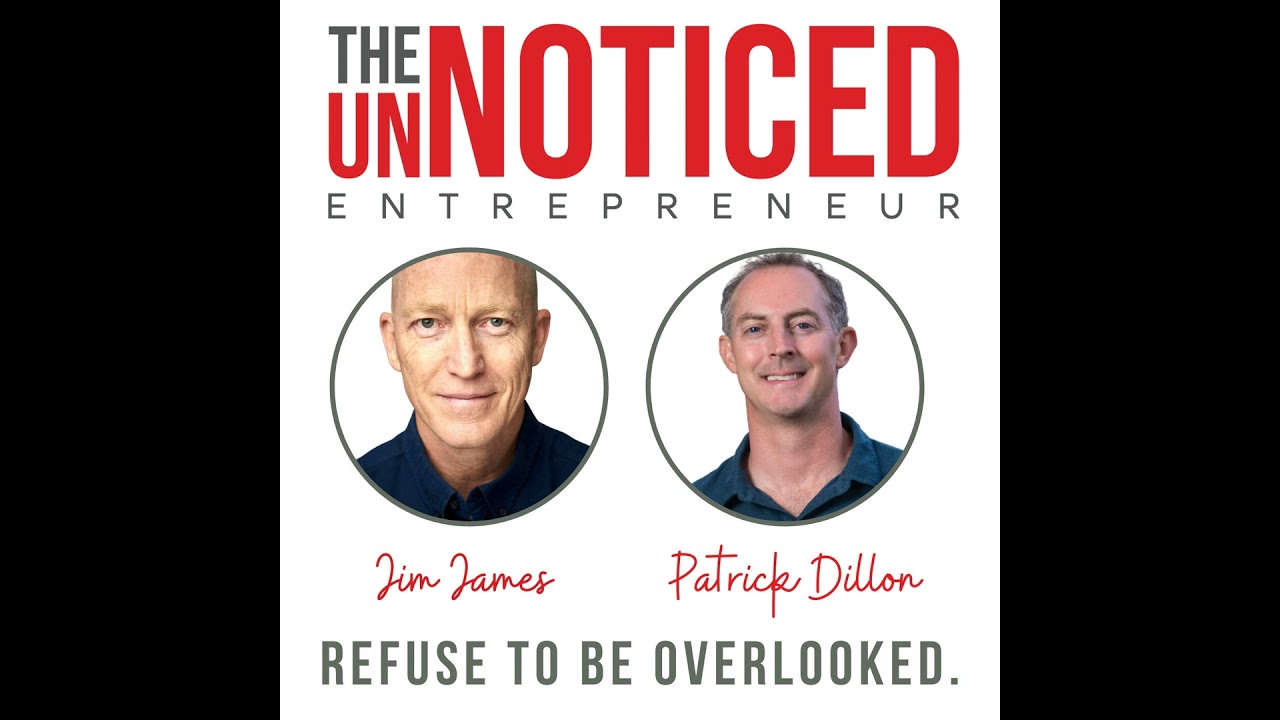
Pat Dillon, CEO of Wise Digital, argues that betting your business on a single niche is risky. He moved from one vertical to ten $1M revenue streams across 30-40 industries, and now 67% of new business comes from his website through SEO rather than referrals. He built Nest, a platform bundling ADA compliance, call tracking, and lead management for small and mid-size firms.
Chapters
Hello and welcome to this episode of The Unnoticed Entrepreneur with me, your host, Jim James. And I'm going to take you all the way to sunny San Diego because in San Diego we've got a chap who is very wise. In fact, he's the founder and CEO of a company called Wise Digital. And Pat Dillon is going to join us and talk about the power of building a business and the danger of niches and why those niches may just be ditches and actually could misdirect and even kill your business if you're not careful. So looking forward to hearing his slightly counter, uh, cultural theory about the way we need to build a business. We're also going to talk about any mistakes that he sees businesses making when it comes to digital and ways that you yourself can build your business. So Pat, welcome to the show.
Thank you, Jim. Nice to be here.
It's wonderful to have you. You know, we know that you've been an entrepreneur since the age of 12, and then you are now in San Diego. So I'd love to hear a little bit about your story and then tell us what Wyze does and how you help companies make the most out of digital presence.
Yeah, thanks. So I guess, you know, just where I came from, I grew up in Wisconsin. So, you know, 3,000 miles away from San Diego here. Got sick of the cold. Just, you know, if I could never shovel snow again for the rest of my life, I'd be happy. That's about it. And I want to see palm trees. So, I studied business, you know, in college and I was very successful during college selling actually knives door-to-door for a company here in the States called Cutco. Their top rep in the state of Wisconsin all through college. And then I went on to help run events and promotion and sales training for them for 15 states for about 5 years after. And got the itch to go back into being an entrepreneur. And a buddy of mine from that business and I moved to San Diego. He moved here before me and finally convinced me to come out and we started our first business in 2006 was a crowdsourcing fashion company. And that eventually became a software business. And we had a couple products and our second product was kind of a breakthrough success. It was the first private label version of Groupon. So our clientele was media companies, newspaper, radio, TV, and we were helping them develop a competitive program to fighting off Groupon in their markets. And the platform ended up being very successful. We had 50,000 small businesses on it. And I really liked working with small businesses. My parents owned small businesses. And so, we eventually found a path into working with them. We developed a digital marketing agency that we franchised nationwide. And Had almost 1,000 clients selling social media and websites and SEO and stuff like that. And that just became a business model I really fell in love with. Wow.
So really serial entrepreneur. And I, by the way, I agree with you with the cold. I loved Singapore where I lived for 12 years. England, getting used to the weather. I'm still not getting used to it again, but bad. So I think San Diego is a, I can only dream what that must be like living there. But Pat, you're also a Forbes contributor, so you have taken what you've learned and you're sharing it kindly. Tell us a little bit about what San Diego Digital and Marketing does, you know, under the Wise umbrella. And also tell us, when I look at your website, I can see any number of industries. Now, received wisdom is that we should all niche down, have one industry that we focus on, become an expert subject matter, you know, known Da da da. How are you going against that prevailing theory, and is it working for you?
Yeah. So, you know, a lot of a lot of things led to my my thinking on that, and and my theories on that is that you know when we had Deal Current was the software business, we worked with 48,000 small businesses, and 83% were restaurants. And that's a really tough niche to be in. Restaurants are generally not great run businesses. They're not very profitable. They have tiny margins. They're always coming into trouble. Actually, I have another couple businesses. One of my commercial janitorial companies, my partner in that first business has another janitorial business and all of his clients were restaurants and COVID hit and his business got destroyed. Because they all got into so much trouble and they weren't organized. So, getting federal grants and PPP money and all that stuff took a long time. And so, when I had the software business, having all that focus in one sort of niche was, it was really stressful. Lost a lot of sleep over that. And when I moved into the digital marketing agency sort of world, and I've been in that for like 12 years now, I've had probably really in-depth conversations with 10,000 business owners in the last 12 years, and so many of them focus on one vertical, one niche, one— and it just seems like over time, everybody who does that gets into trouble. And you have digital marketing agencies that focus on just chiropractic or just dental or just legal or just plumbing or just like we're doing a lot in the ketamine space right now. There's marketing agencies out there that just do ketamine clinics. I mean, there's federal regulation that'll come out and really affect that business's future, that industry's future. And so, you know, the idea of just focusing on that one thing is so risky to me. And, you know, and what I've done with Wyze is really focus on A number of verticals. The idea is we want to have 10 pillar verticals, all which produce a million bucks a year in revenue. And then I know we're going to have an extra $10 million a year from everything else that comes in because we work in 30 or 40 industries right now.
How interesting.
But there's so much that are shared between all those different industries. Like you do something in legal, it's really innovative and it works really well. And that transfers to accounting or to insurance or to mortgage. And so, you know, I, I just want to have less risk in my life today.
Pat, I think, you know, you've also highlighted, you know, what for investors is a, is a very prudent strategy about having a balanced portfolio. And yet in, in business, we're told to niche, niche down, and it creates this tremendous risk. And I've seen as well with some clients that I work with on a consulting basis, they've employed agencies that specialize in a certain industry and each one of the clients is the same for the agency. And actually what they do is they seem to cut and paste the same solution for each of the architecture businesses, right? And you end up looking at basically the same way, the same design work for all of their clients.
And those marketing agencies are so blind to like what works in other industries because they don't know, they don't do any other industries. What they become really good at is selling those businesses on working with them. They don't really become great at the work.
Yeah, Pat, I think that's a fabulous, fabulous insight. And I think in a way counterintuitive and yet really grounded in basic economic theory as well. So brilliant to see you've got so many pillars. You've got 10, I think you mentioned there. And the other thing that You know, we were talking about before we started recording was how most small companies are encouraged to grow by word of mouth, right? What have you done to build Wise as a digital agency? Have you relied on word of mouth? I mean, you've been in San Diego for a long time, and yet it looks as though you've got diverse clients and also across the whole country. It's not just San Diego, your client base.
Yeah, I'll pull up something I think that's going to be helpful in this. I haven't really relied on word of mouth, I think, for a number of reasons. I think, listen, I've talked to, again, 10,000 business owners over the last 10, 12 years. And the first question I ask a business owner when I start talking to them is, where do they get new business? How do they grow their business? And 99.9% probably of small business owners say referrals. Yeah. And referrals are the byproduct of doing a good business. It's not a marketing strategy. It's not a strategy for growth. And there's a lot of pitfalls in relying on referrals, right? You're not in control of the direction of your business, for one. You'll never get into new verticals or new size clients, right? Like we work with a lot of law firms and most law firms we work with are 10 to 20, 30 people. Well, one of our largest clients is an 80-person law firm, and we never would've met them through referrals. They're in a completely different market across the country. Another one of our clients is one of the largest accounting firms in the country of Australia. I've never been to Australia. Nobody on my team has. They found us online. And that's, I think, one of the big issues in worrying about referrals is people You know, you're just going to get the same stuff you have now. And maybe businesses want to grow bigger and better and more profitable, and you're not going to do that with referrals. And I'll find something in a second that will show you where our business comes from. But, you know, I think if you look at the last 2 years where I've really been honing in and collecting all the data, 67% of our business has come from our website. So developing marketing for our own business, just like we do for others, has been pivotal to the growth of the business. And we've been growing at about 60% a year for 5 years.
So Pat, that's so impressive in terms of growth and also geographical. I guess the guys in Australia also want to work with you because you're also in a sunshine place. Their place is blessed with nice weather as well. But you mentioned, Pat, about the website. Do you want to just share with us what is the strategy around the website? I know that one of your business partners is a tech whiz and you actually come from a background of building out tech platforms, right? So for those of us that are not big tech, for example, like me, can you give us some sort of fairly simple instructions of what we should look for or what we could do in our own businesses?
Yeah. Yeah, absolutely. I mean, I think that the one thing that we really wanted to do here that was different than my first agency, and I've been involved in 3 agencies because I bought out my investors in the first agency and did a merger with that. And then I moved into the second or the third one, the chief technology officer of the merger company and I really saw eye to eye. So, He and I started Wise Digital together. And, you know, what we really wanted to do for small and mid-sized businesses was provide them a competitive advantage with technology paired up with award-winning services. And that was different than most agencies. That's, you know, I'd say less than 1% of agencies in the world have their own technology. We own our own website platform. It's called Nest. It's fully baked in with all of the tools that a small business needs, like ADA compliance, which in the US since 2012, websites have fallen under the Americans with Disabilities Act. So it needs to be accessible to people with disabilities, like the blind who use screen readers. Reporting and lead tracking and dynamic call tracking and all these things sort of baked into the solution, whereas Other agencies go out and find, you know, out-of-the-box products and then try and hobble them together. And it's always a mess and it doesn't work. And, you know, Fortune 500 and Fortune 5,000 businesses have access to tools that are different than small and mid-sized businesses. And so, you know, we wanted to put together a solution that, you know, brought them those advantages. So then we could just worry about doing really great service.
You're absolutely right. Otherwise, many companies end up with an integration and with Zapier as being the holy grail, right? It's kind of what we used to call middleware or, you know, like companies like BEA used to create middleware or glue for these things.
Yep.
So, you're building out an offering for these mid-sized companies, this technology plus strategy. Is it all websites or are you also doing, you know, traditional speaking? You've got your Forbes, for example, writing position. How is that working for you in terms of brand awareness for you as an entrepreneur?
Yeah, I mean, so speaking about Wise for a second, we've got 12 services and about half a dozen software products. Wise itself I think one of the genius ideas we had was to make WISE a client of WISE. And in fact, WISE is the largest client of WISE. So we probably deploy every strategy, every tool, and every service for the marketing agency to help market the business itself. By and far, I mean, websites are a big portion of our business. Websites are the only thing on the internet that you actually own.
Yeah.
Right? You don't own your YouTube page or your Facebook page or your Yelp page. Those businesses can make changes to those pages anytime they want. They can take down it for any reason. You can fight tooth and nail to get it back. It could take a year. We've seen that happen time and time again with so many different types of business models. And it's like, you would think it's for the cannabis businesses, but it's sometimes for the plumbers and chiropractors. And so it's really important to invest in your website as the foundation of your business online. But once you get beyond that, there's a lot more at play. And based on, you know, your industry and your budget and your timeframe and your goals, that's where we develop those custom strategies to develop the right ROI for your business. But for sure, you know, hands down for my businesses, both the marketing agency as well as some other businesses I own, like I own a couple commercial janitorial businesses. And SEO has been the most profitable thing we've ever done in those businesses. In fact, my first software company, DealCurrent was the name. It was a daily deal software platform. We ranked number 1 on Google organically through our own SEO efforts for 8 years for daily deal software globally. And that brought us 5,000 prospective clients. We signed 900 of them over a period of 7 years. And that was like NBCUniversal.
And so doing SEO, is there a tool, Pat, that you could recommend for people like me that are not tech experts to do SEO, or does one really need to outsource that?
Yeah, I mean, I think it's important to outsource it personally because it's not one tool and it's not one person. Like, I think the misnomer is a lot of people think, oh, I'll just go hire a website designer to build me a website. Depending on the complexity of a website, we'll have anywhere from 8 to 12 people working on a project from 8 to 16 weeks. And we, in fact, we had one client this past year where we took almost 13 months to build them a website because it was so big and so complex. And, you know, SEO is also, I think, pretty similar to that. You need about 2 or 3 really technical experts to do it right. And it's changed so much over time. There are some great tools, you know, for keyword tracking. We use SE Ranking. A lot of people use SEMrush, you know, just to identify what's going on on your website. Screaming Frog's a great tool, but unless you're somewhat trained or knowledgeable, you don't know what you're looking at.
Yeah, no, I think that's right, Pat. And it's such a big issue. Let's just move on though, because, uh, yeah, it's a, it's a huge issue. And I think, as you've rightly said, we need to find some, some experts to help us. I know I do as well.
Um, yeah, we have a lot of great videos on our YouTube channel that kind of help the novice business owner and entrepreneur learn about that stuff. So, that's a great place to go.
Thank you for that. And we'll, we'll put a reference to that at the end and in the show notes as well. But Pat, you know, I always like to ask entrepreneurs, not, not in an insulting way, but just sort of a guidance to others. Is there a mistake that you feel that maybe you've made that you'd be willing to share as an entrepreneur on the getting noticed side? You've been so successful, but maybe there's been one thing that you've done that you don't recommend that the rest of us try.
Yeah, I think, you know, a big mistake is giving discounts. You know, as business owners, we're so often in the beginning inclined to give someone a discount so we can get that case study or we can get that new client or, you know, get that review or whatever. It's always bit me in the butt. I think for the most part, it's not a good idea to discount your products and services unless it's built into your business model. The other one is just saying yes too often, especially in a service-based business, which most of my businesses now are service-based businesses. Saying no more often than yes is actually the way to win. No to the right— if it's the wrong type of client, the wrong budget, the wrong attitude, the wrong know, level of cooperation, you know, it's, it's just really important to determine who comes in, uh, to the business.
Really, really interesting. And that sets the profile, doesn't it, for the, for the company and also the kind of people that you hire? Because otherwise you're trying to find people with different skill sets or different levels of seniority to handle the different kind of client profiles that you've got. I always found that, uh, having a kind of a profile of an ideal client Really helped inside the company in terms of delivery of services and systems as well.
One of the greatest tips I can have that, you know, on that exact thing is, uh, I think a year into our business with Wise Digital, and keep in mind, we started out with 50 clients because 50 clients came over from the first agency to start Wise Digital with 4 key people. But about a year in, We were still having problems with some clients. And I took the entire team to this great space for a one-day sort of event where we all got together and I put up a bullseye on a big whiteboard. And in the center of the bullseye, we started putting the clients that were the perfect fit for us. They had the right attitude. They had good budgets. They wanted to grow, they were in the right industries. And then we started sort of spreading out the clients until we had all the clients on the dartboard. And that was one of the best exercises I think we've ever done as an agency. And we still think back to that where, gosh, we really got a handle on who we wanted to work with with that exercise.
Yeah, that's a wonderful exercise. And what were on the axes, Pat? If people were to look at doing that now with their existing or future—
It was really just, it was a dartboard. So it was concentric circles in. So in the middle on the bullseye were the exact clients we wanted to work with. On the outer edges of the dartboard were the clients where like, if they didn't hit the dartboard too, we're like, we're firing them.
Right. So—
And we actually probably fired 3 or 4 clients out of that exercise.
And that's a nice feeling, isn't it? To say to a client, thanks, I don't need your money.
Yeah.
We used to do that and do, you know, size of budget and intent to to commit, you know, to a period of time, uh, and also that they had a particular innovative technology that we knew we could succeed for, uh, for them in, in the media market. So we had a few in our scoring card as well when I ran EastWest PR in Singapore. So, so that's a great tip, Pat. Um, in terms of one piece of advice for my fellow unnoticed entrepreneurs about what to do to get noticed. Could you give us, you know, after all of these amazing businesses over such a long period of time, could you give us one, if you like, recurring sort of success, uh, tip that you'd, that you'd recommend?
Yeah, I mean, I, I believe so strongly in our core discipline in Driving North of SEO, and that's Where I think if I look at my software business, my janitorial businesses, my marketing agencies, consistently investing in making sure Google understands what we do as a business, what products and services we offer and where we offer them is absolutely the greatest ROI you're going to see in marketing. Typically for our clients, it's a 30 to 50x ROI.
That is incredible. You know, Pat Dillon as the CEO of Wise. I can see why you call it Wise, by the way, because, you know, it's wise words. Pat, obviously you're a considered man as well. Is there a book or a podcast that you'd like to share with my fellow unnoticed entrepreneurs as we are either driving, walking, traveling?
Yeah, there's a book that my— I think Maybe my whole team is reading right now called Smart Brevity, and that's that's been a great one. I think for us is you know in a professional services business time is money, and I think oftentimes we've had people on our team that just go long winded on stuff, and you could have said that five minute thing in thirty seconds. And you know in professional services everyone on the call is it's. we're spending that person's time. So that book's been really helpful to get more clear and concise about what we're trying to say.
Smart brevity. We'll have to look for that one. And yeah, when we ran the PR firm, you know, of course we used to say, you know, time is money, right? And of course, that's one of the reasons why I try and keep this podcast at sub-25 minutes so that the entrepreneurs who are listening are also paying for their own time, as indeed you're kindly sharing on your own dime as well. Pat Dillon, if you want to find out more about you and Wise, how can they do that?
Yeah, I think the best place to do is go to my website, wisedigitalpartners.com. And, you know, if you have a business and you'd like to talk about marketing, you could book me there or my email, patrick@wisedigitalpartners.com.
Pat Dillon, thank you so much for joining me from San Diego and sharing, you know, an inspiring story about being an entrepreneur, but also some other wise things, which I'll wrap up after we've given you a chance to say goodbye.
Great. Thank you so much.
Well, we've been listening to Pat, who's kindly shared, you know, a huge amount of wisdom. But one of the main takeaways for me is about, to some degree, ignoring or recognizing the fundamental weakness in the niching strategy. We've kind of all got carried away with the riches and the niches, and so many people find it so easy to say, but actually there's a lot of strength in diversity. And that, I think, is a key element. But also what he's done really cleverly is to use SEO to have diversity, but still to get lead flow. And of course, we think about niching because then we're known so that we can get referrals. But if we use the internet properly and SEO, we're letting the technology bring the clients to us rather than word of mouth. And that creates a sustainable and kind of beyond organic growth, creates plainly in case of Wise Digital, exponential growth. And ultimately, that's what we want as entrepreneurs. So thank you so much to Pat for sharing those insights. And of course, I will include his details in the show notes. And thank you to you for joining me, Jim James, on this episode of The Unnoticed Entrepreneur. Hope you've enjoyed it. If you have, do please follow the show and review the show on your player because that really helps because it's part of SEO. If the players know that you like the show, They'll show other people. Thank you so much for listening. Until we meet again, just encourage you to keep on communicating.
More from Jim











2 people, infinite agents, 1 billion dollar idea #AIAgents #Startup #Productivity