Your ideas and knowledge shouldn't just be kept in a jar, share with your audience and make value
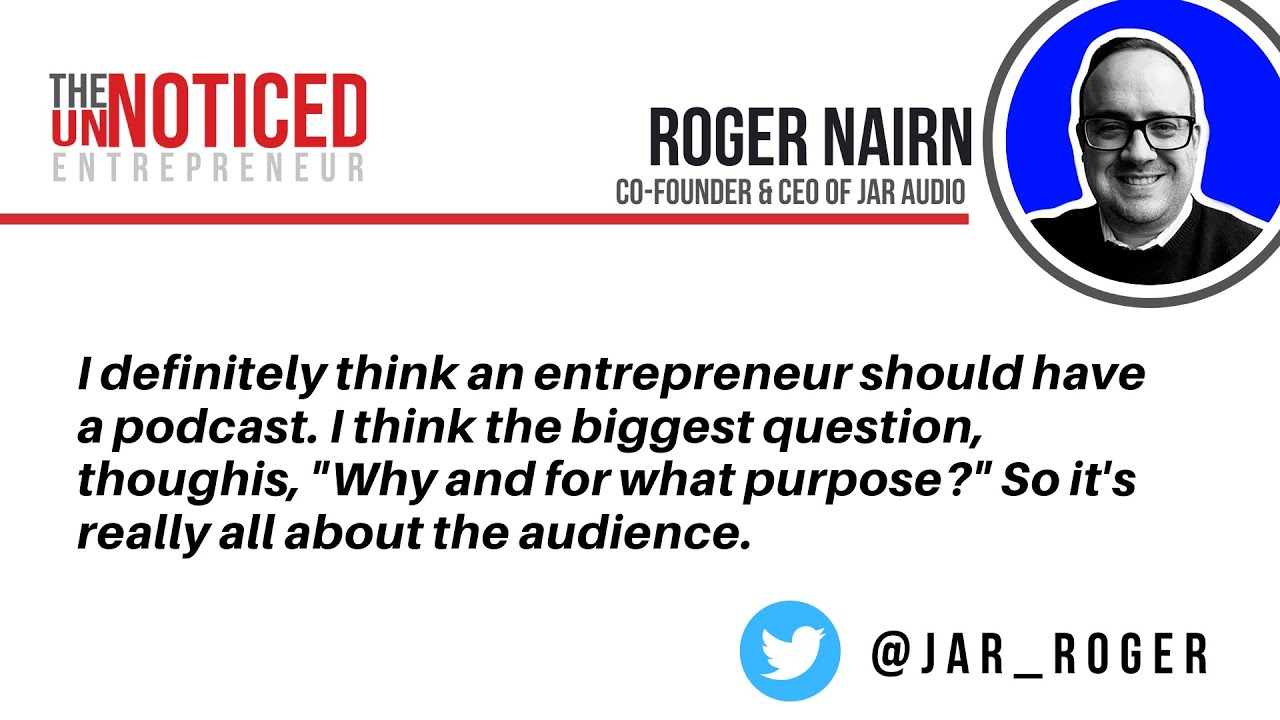
Roger Nen, CEO of JAR Audio, explains how entrepreneurs can build brand intimacy through podcasting instead of hard-selling. A podcast costs $2,000 to $50,000 per episode depending on format. T-Mobile's "Mobile Diaries" uses storytelling to position the brand as a thought leader.
Chapters
Hello, welcome to this episode of The Unnoticed Entrepreneur with me, Jim James. And today we're going to Vancouver, Canada to talk to Roger Nen. And we're going to talk about audio and the impact that audio can make on getting noticed as an entrepreneur. Roger, welcome to the show.
Thanks so much, Jim. Hi, everyone.
Now there are over 4 million podcasts. Should an entrepreneur have a podcast, Roger? And if so, how should they go about getting one?
Yeah, I definitely think an entrepreneur should have a podcast. I think the biggest question though is why and For what purpose? So it's really all about the audience. You know, you can have a podcast with no audience; that's also allowed. My very first ever podcast, I just did for fun as an entrepreneur. Sorry, as a hobbyist, and I did not care the size of the audience at all. I just wanted to talk to really fascinating people. But if you are in a business and you start a podcast, you need to ask yourself: Who's this podcast for? Not just that, what value can you deliver? through your podcast. And let's remember that value can be helping them out, answering questions, but it could also be giving them a laugh, making them cry, telling great stories. You know, these are all the things that brands can do in spades, and they're doing it in all sorts of different formats. We just think that the intimate format of podcasts are the best format these days to do so.
Now, Roger, you are the CEO and founder of a company called our audio over there in Canada and have to agree with you about podcasting and being intimate. You've also raised an interesting issue around the function of the podcast and about it being, you know, playing different roles with the audience, but you didn't mention the word selling. Do you want to just explain to me the difference then between podcasting and, for example, advertising, which is your background?
Yeah, I mean, Typically when we deal with a brand, I remember speaking with a client, we would put podcasts in the sort of high up in the funnel side of the marketing funnel or your sales funnel. This is an awareness opportunity. This is a brand building opportunity. And so when we're talking to brands, we're giving them, or they're giving their audience useful, helpful content that can serve a number of different purposes. And, you know, I came from the advertising space and advertising of course needs to be hard hitting and hard selling, and it is, But remember, this is a bit more different. This is a bit softer, nuanced. It's not a push medium, it's a pull medium. You know, your audience is saying, I wanna listen to this show. I want you to send me an episode every week, every 2 weeks, and put it in my ears on my own time, and I don't want you to waste it. And so it's really important that these shows cannot be advertising because nobody wants to listen to that. Nobody's gonna listen to a 30-minute ad. Instead, you need to create really engaging, Awesome content that just happens to be brought to you by your brand.
Roger, let's just talk then about the process of making a podcast. Let's assume that my fellow unnoticed entrepreneurs would like to start a podcast. Do you wanna just take us through the stages that you at JAR Audio go through to give people some idea of what's involved?
Yeah, for sure. We always start off with a discovery session. You know, pre-COVID, we would sit in a room with a bunch of fancy colored markers, and we would have a full sort of concept conversation and audience conversation with our clients. Now we do it a lot, you know, remotely over Zoom, but really we dig into sort of the why behind this podcast needs to exist. Now, from a brand standpoint, it could be because you're trying to attract a new audience, or it could be you're trying to nurture your existing audience. Or if in the case of one of our clients, Expedia, they had a brand challenge, which was people don't see us as a helpful enough brand. We want the podcast to help. Sorry, help us help them and have them see us more helpful. So we created a podcast that did that. Once we've uncovered the why behind things, we talk about sort of the what. Okay, we know the brand challenge. What sort of podcast could serve that brand challenge? Everything from like what the format of the show could be. Is it a one-on-one interview style like we're doing like right now? Is it a panel style where we're really sort of bringing a bunch of alternative views to the conversation and a moderator is kind of managing that conversation? Or Or is it, you know, maybe some fictional storytelling, which is incredible for a brand to tuck into, or sort of a documentary style? So once we've uncovered kind of what that could be, we then develop some ideas on the specifics of what that show could sound like. We look at, you know, what are some of the competitive shows out there? What are they doing? Where are some of the audience interests lying these days? But then where's the kind of blue ocean opportunity? Where is there nobody serving that podcast space? Once we've done that, we then look at who's the host, who are the guests, what are we saying to these guests? You know, our hosts need to obviously interview them, but there is sort of a format to the conversation. Is it free range or are we kind of like peppering them with some specific questions that we want to sort of take the conversation down? We're then doing all the recording, you know, as we're doing right now. This is all done remotely. There's an incredible amount of technology these days that allows us to do that. We're shipping equipment all around the world for every interview we do. We send them the right equipment because Frankly, we don't trust that everybody has the right equipment these days. So Amazon is our friend. We're sending them all the right equipment. As just a side note, you know, in some cases when they send the equipment back, we're donating it to local schools, which I think is really cool. You know, while we're doing all the recording, we're then getting into the editing. All the editing, all the post-production side of it, finding the right music, finding the right sound effects, making sure all the ums and ahs are taken out, making sure that the conversation is pacing properly and that there's an actual sort of logic to it. And then our full marketing team takes over. We distribute the podcast to all the major podcast distribution platforms— Apple, Spotify, you have Google, Amazon— and then our marketing team makes sure that it's getting into the right ears as much as possible, as long as possible. And then we kind of rinse and repeat with that. We're taking in a lot of data. We're learning from who's listening, how long are they listening for, are they dropping off anywhere, are they skipping anywhere. We're using all that data to inform our future episodes and, you know, rinsing and repeating really. Yeah.
Wow. Okay. That's wonderfully comprehensive, Roger. And I love the idea that you're sending the kit and that presumably is microphones, headset to all of your guests. And that's a really good idea. Out of my budget, but if you're doing corporate shows, I can see.
It's a good idea, but it does pose its logistical challenges. But again, you know, that's what we're, that's what we're here for. I will say just if anybody's going to be doing that. Sending some of the equipment and having them actually use it on the day of the recording is a whole different ballgame.
Yeah, I was gonna say, not to mention the training that goes along with it.
So, well, we do, we do train them. Yeah.
Okay, well, okay, so I think what you're also raising here, Roger, is the degree of professionalism, attention to detail, and also investment in a podcast that a company makes. In your experience, what would be the minimum sort of threshold for an entrepreneur who's thinking about having a podcast and need to step over to have a podcast that actually accomplishes some objectives for them?
Yeah, I mean, you're gonna have varying degrees of quality and you're gonna have varying degrees of service level. And what I mean by service level is, you know, if you're a larger brand, a larger organization, you're gonna want to have a certain level of service that allows you to sort of shepherd the podcast through the organization, but also Make sure that it's meeting all of the sort of brand and content checklists and getting into the right places within the organization and leveraging. So to answer your question, it ranges anywhere between $2,000 an episode upwards to $50,000 an episode. It really depends on a lot. You know, there's a lot of variables that go into it. I mentioned earlier the different formats. So different formats are gonna also result in different pricing because there's different production Complexities that need to go into it. You know, if you're gonna be hiring an outside host, are they a sort of lesser-known voiceover actor? Are they an ex-journalist or are they a celebrity? That's gonna play a huge factor into things. You're gonna get different returns on those people though. You know, if you hire a celebrity, you're gonna get a lot more sort of marketing bang for that buck. If you hire a journalist, you're gonna have obviously an existing audience that perhaps is attached to that person. So it very much can vary.
Yeah, Roger, that's really, really insightful. Now, some people might want to be involved in the production process and maybe, you know, they don't have the budget or they've got some people in-house. In your experience, can a business, if you like, collaborate rather than just outsource to a company like JAR Audio, or does that not work?
You know, in a perfect world, we would be doing everything and we do offer that sort of do-it-all-for-you service. However, we do recognize that some organizations have really great in-house writers, for example. Who have a real strong understanding of a certain topic. And so we'll lean on them to do some writing. Now that doesn't necessarily mean that all writers translate perfectly to audio or podcast audio. And in that case, we'll do some training or we'll work with them on sort of how to tweak their language or whatnot. But again, it very much depends. We do have certain opportunities where we'll offer an à la carte style process. And I mean, I think that no matter what our clients are doing, everything we do is collaborative. You know, at no point are they handing over the entire reins of the brand to us. We are very much working directly. It's like working with a marketing agency. You know, you're not going to see the ad before it goes out. You know, in our case, you're not going to hear the podcast episode or the rough cut or the, you know, the script draft until you're going to see it before anything moves forward. So we've got a process to make sure that There's the legal side of it, the quality control side of it, but also it works for the brand.
Roger, you've raised an interesting point there about the ownership because there's some nuances, aren't there, about copyright? You know, actually, if you pay a freelancer to do the work, they need to sign off that they don't own the IP. Yeah, do you want to just take us through the copyright and IP issues so that you're not being paid to create something that The entrepreneur says, well, hang on a minute, I own that. And they go, oh no, actually the creator owns it. How do you reassure people with that?
Yeah, every step of the way you wanna make sure that, you know, any IP is transferred over to you as an organization. And that is everything from a writer to purchasing any stock audio on the marketing side of things, any stock photography, anything you're essentially touching, you wanna make sure that the full rights are on your side of the fence. You know, any lawyer will help you, not any lawyer, but any lawyer with that experience will easily be able to help you in that realm. But we always err on the side of we don't have the rights versus we do. And then when we, you know, we need to get the rights, we find the best way to work together to get them.
So Roger, do you think there's a kind of a good model where you help a company maybe for 12 months or X number of episodes and then transition to them because maybe they need the help to get something started but can't afford the cost of outsourcing every episode in perpetuity? Talk us through how that might work for someone who wants to get it started, needs your help, but with a view to maybe owning it later to manage production.
Yes, some of the brands we've worked with have done that. Now, I will say that it's really important to communicate that upfront so that every step of the way can be a learning lesson or a knowledge transfer versus kind of like waiting until the end and then kind of having to reverse engineer the whole thing. So yeah, we've worked with whether it's on the client side, and then they wanted to kind of transfer it in-house, or they've wanted to perhaps take it in and slice and dice it on their own into different forms of content, you know, taking the audio, turning it into a video, taking the audio, turning it into a blog post, you know, those are all really awesome ways to leverage the podcast into more content, better ROI, for sure. And so yeah, there's a number of different scenarios in which we'll do that.
I can see that really. So that I think that gives the entrepreneur A sense of not being locked in, right? That at some stages they needed to have continuity but didn't have the budget they could carry on. Roger, that's really, really helpful. Now, in your experience, just share maybe a client case study with us of a company that's come to you and what have they done with the podcast? Give us an idea of how it can play a role in a company's brand strategy.
Yeah, for sure. So, you know, one of our shows right now is a podcast for T-Mobile. So very large American communications company, specialize in mobile Communications.
Originally German, of course. T-Mobile is originally German.
That's right. Yeah, that's right. They've got this incredible in-house content team. They're all ex-journalists. Anyways, their mission is to sort of explore the world of mobile and what from a sort of sociological and psychological standpoint mobile is doing to all of us. And so we did a podcast with them called Mobile Diaries, which really You know, it's kind of like Radiolab, but for the mobile, you know, mobile communications space, real in-depth look into, you know, the ins and outs from like a social, psychological, anthropological standpoint of mobile communications. So we looked at mental health, we looked at dating, you know, we looked at the work environment, sort of the mobile work experience. We talked to mobile natives, you know, anyways, it was just an incredible in-depth look into a really fascinating topic that just happened to be brought to you by a That's a wonderful, wonderful example of, as you said earlier, making the podcast about participating in a community and leading a conversation rather than selling a product or a service.
Now, Roger, you're an entrepreneur. You co-founded JAR Audio over there in Vancouver. How have you been getting your own business noticed? As you know, that's part of the conversation that I love to have with my guests on the show.
Yeah, I think the biggest thing is, first of all, just reputation, you know, producing great content, producing great work on behalf of our clients. We ask them for referrals as well. Doing interviews like this, though, you know, give us an opportunity to have a point of view out there in the community. I just got back from Podcast Movement in Dallas where I was speaking on stage. So speaking opportunities. We also do some digital advertising of our own, you know, through Google and LinkedIn and things like that. And the biggest piece, though, is we produce a fantastic blog that has all sorts of you know, insight, tips, tricks on not just podcasts, but podcasts for the business community, you know, kind of businesses interested in getting into the podcast space, whether that's, you know, for your own organization or if you're an agency on behalf of your clients. And so if you go to jaraudio.com/blog, there's all sorts of really great content on there. We also have a newsletter which we— which goes out weekly and is designed to, again, you know, educate everyone on the podcast space.
Well, I'm not going to pick you up on the one platform that you have?
We don't have a podcast yet. It is in production.
Oh, okay. You said it.
But, uh, you know, it's one of those things where our brains, when it comes to podcasts, are so focused on our clients that, you know, we just haven't gotten to it ourselves. I mean, you know, it is a lot of work and, you know, it's why clients hire us. And so, as you can imagine internally, when, you know, when all the team's focused on growth through it, through just the clients that we're serving, it kind of goes to the back of the line.
Yeah, no, look, I completely understand that. Um, and you're not the first agency.
Trust me, we feel really guilty about it.
Well, I, I promise not to turn the screw there, Roger.
No, no, no, I'm turning the screw as we speak.
Okay, yeah, he's doing it. Just for the, just for the record, I'm really not trying to impose any guilt here at all. Roger, where do you see it going? Because obviously audio is good, Video is seen to be more powerful with YouTube. Final question, is it worth investing in a podcast or should entrepreneurs really just go straight to video, straight to TikTok?
So first of all, I say that, you know, absolutely they should be investing in podcasts, but again, it depends on why and what. And there's gonna be some things that you're gonna be served better with video, and we're a fan of video as well. But keep in mind that anything we do in audio can also be transferred to video, whether we're recording an interview or there's an animation opportunity to connect. There is a huge audience on YouTube that listen to podcasts. In fact, it's the 2nd most popular podcast platform these days behind Apple. And so we do not, you know, ever ignore— there's more than one video platform, but we don't ignore YouTube by any means. But, you know, I think if anybody has really invested in video, they'll understand that it's Not a very flexible medium. You know, if you do want to, for example, re-record something or edit something or go back in and do it again, you know, you're having to get the crew, get the lights, you know, figure it all out yourself, you know, figure it all out as to the continuity side of it. Audio is a lot easier to kind of slice and dice and insert down the road. So again, thinking about your content and the longevity of it, the updatable-ness of it, it's not really the right language, but you want to just kind of consider that when you're getting into production.
Yeah, Roger, look, I think it's great. It's a great medium to get started, isn't it, in content production that's dynamic, more dynamic than text. Roger Nen, CEO of JAR Audio over there in Canada. If people want to find out more about you and, you know, have a talk with you about your amazing podcast production capabilities, where can they find you?
Yeah, check us out at jaraudio.com. That's J-A-R audio.com. Also check us out on LinkedIn and on Twitter.
Roger, thank you so much for joining me and sharing your wisdom with me and my fellow unnoticed entrepreneurs today about podcasting and really how affordable and how accessible this is as a medium. Thank you.
Thanks everyone.
So thanks for joining Roger and I today on this show. And if you've liked it, please do share it with a fellow entrepreneur or review it on your player. It really helps to get those reviews. And if you're thinking about a podcast, check out Roger's fantastic blog. And it is a medium that you can either Do yourself, produce yourself, or go to an expert like Roger, who I'm sure will be more than happy to have a conversation with you. And until we meet again, thank you for listening to this episode of The Unnoticed Entrepreneur.
More from Jim











2 people, infinite agents, 1 billion dollar idea #AIAgents #Startup #Productivity