Become Dangerously Smart with AI (in 32 minutes)

Jim Kwik presents a five-step system to use AI without letting it weaken your thinking. Separate compression work (repetitive tasks AI handles) from contribution work (creativity, judgment, leadership). Use progressive prompting levels, simulate high-stakes scenarios for practice, and learn by starting simple then adding complexity.
Chapters
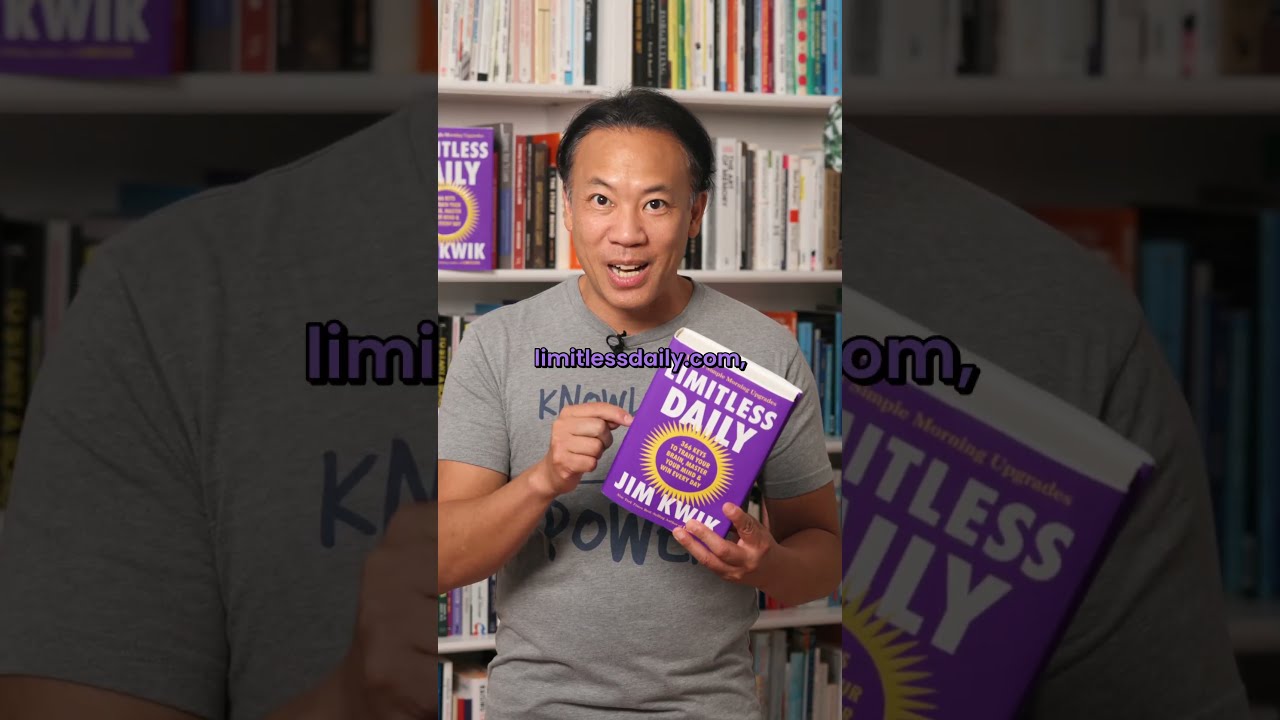
Right now, most people are using AI to quietly retire their own brain and calling it productivity. Every prompt that thinks for you instead of with you is a small deposit into a habit that eventually chips away at your ability to think and could leave you completely dependent on a tool that doesn't actually care whether or not you succeed long-term. That's not a small problem. That's tragic. Because AI can also do the exact opposite. Used and employed the right way, it can help you become dangerously smart. For most of my childhood, I was told my brain was broken, but that same broken brain became the brain that Hollywood A-listers and Olympic athletes and Fortune 500 CEOs trust to train their own brains. And in this video, I'm going to break down a 5-step system for using AI to increase your HI, your human intelligence, become more valuable in your career, and prepare yourself for opportunities that don't even exist yet. Because the people who thrive in this new world will not be the ones who use AI the most. They'll be the ones who use it to become smarter than they were before. You'll learn 5 counterintuitive ways high performers use AI to become more capable. The 5th one is a big one. More valuable, much harder to replace. Whether you're a business owner trying to help your employees use AI more effectively, a leader trying to make better decisions, or someone who wants to move up in their career, this will give you a very proven, practical system that you can begin using today. Let's start with step 1. Protect your genius. Think about the average workday. You open your inbox to answer a few messages, then you reformat a document, then you summarize a meeting, then you search for information you know you saw somewhere, then you update that spreadsheet, clean up some notes, rewrite the same paragraph, and you sit through a meeting that could have been an email. By the time you reach the problem that actually requires judgment, creativity, strategy, your brain is already depleted. It's already tired. You use your high-quality attention on the lowest-value work. Does this sound familiar? And this is where AI can be really helpful, not replacing your intelligence, but by protecting it. Research reviewed by Stanford's AI Index found that generative AI can improve productivity in specific workplace tasks and often provides especially large gains for less experienced workers. Right? It can automate things. In one field study involving customer support agents, access to AI assistance increased productivity by approximately 14%, with the largest benefits going to newer workers. That matters because AI can compress the time it takes to organize, to summarize, to compare, to format, and produce a first version of, of something, right? But you have to know where to use it. I want you to imagine that all your work falls into one of two zones. The first is your compression zone. These are the tasks where the goal is to take something large, messy, repetitive, time-consuming, and make it smaller, clearer, more organized. AI is excellent at helping you compress work like this. The second zone is your contribution zone. This is where your personal value enters the work. It includes your judgment, your intuition, your creativity, your curiosity, your empathy, your taste, your leadership, your ethics, right? Your Your responsibility and decisions that affect other people. This is where you decide really what matters, where you recognize the issue nobody has said out loud, where you understand that an answer may be technically correct but completely wrong for that person, that team, that situation that's in front of you. This is where your genius lives. The mistake in using AI to replace your contribution zone simply because it could produce something that looks finished. Imagine you're. Preparing for an important leadership meeting. You could ask AI, tell me what decision I should make, but that hands over the part of the work that makes you a leader. Instead, you could ask, I'm going to give you the meeting notes, project updates, and outstanding concerns. Organize them into key decisions, risks, unresolved questions, and fill in the information gaps. Don't make the final recommendation. Now AI is compressing the information. You are still contributing your judgment. Or imagine that you, you own a business and have collected hundreds of customer comments. You could ask AI to tell you what product to build next, or you could say, analyze this customer feedback and group it into repeated frustrations, desired outcomes, objections, and unmet needs. Include representative examples from the data, but don't decide which opportunity we should pursue. Now AI has organized the landscape. You still choose the direction. This distinction is so critical. AI should prepare your intelligence for the work that matters. It should not remove you from the work that matters. Here's, here's an exercise you could use. Next workday, write down everything that you did and then circle the contribution tasks so you could tell the difference. And then ask which compression tasks consume the most time, which contribution tasks receive the least attention. That gap is your opportunity. Here are a few prompts, right, that you could use in, let's say you're in the compression zone. Turn these notes into a concise briefing with 5 sections. Key facts, decisions, unresolved questions, next actions, and risks. Compare these 3 documents and identify where they agree, where they conflict, and what information is still missing. Summarize this material for an executive who has 5 minutes to understand it. Preserve the important details and clearly label anything uncertain. Organize this unstructured information into themes. For each theme, include the supporting evidence, exemptions that do not fit the pattern. Create a first draft using only the information I provide. Mark every place where additional context or human judgment is still needed. This is your first principle, to compress the work around your genius so you have more attention to invest in the work that will reveal it. Because if you're spending your entire day formatting, sorting, searching, rewriting, you are not protecting the part of your mind that can create the greatest value. Step 2, how to communicate with AI. Most people use AI as if they are placing an order at a drive-through. Write an email, give me ideas, summarize this. Then they take whatever appears on the screen, judge the entire technology by the first response. That's the lowest level of AI use. You asked a broad question, so you received a very broad answer. Are you a high achiever constantly seeking that next level of success? Welcome to the Kwik Success Program. It's a deep dive and support system to master your life and scale to new heights in personal and professional achievement. Included is our exclusive monthly book club where we process transformative of ideas from amazing books to level up your learning and your life. We also bring the author to the club to answer your burning questions. You could also participate in monthly live coaching calls with me where your questions meet my decades of expertise. Simply go to kwiksuccess.com. That's kwiksuccess.com. And choose the plan that works best for you. The smart users climb the prompt ladder. Each level gives the AI more useful direction and requires more clarity from who? From you. There are 5 levels. Level 1 is the request. This is what most people do. Write my presentation about leadership. AI has to guess almost everything. Who is the audience? What kind of leadership? What's the goal? How long is the presentation? What should people think? What should they feel? What should they do afterward? When the prompt is vague, the model fills the gap with the most likely average answer. That's why so much AI-generated work sounds polished but forgettable. Level 2 is the context. At the second level, you explain the situation. I'm preparing a presentation about leadership for new managers at a growing technology company. That's better. Now AI understands who the audience is and where the information will be used. Level 3, the outcome. Next, you tell it what the work needs to accomplish. The goal is to help new managers give clearer feedback, handle difficult conversations, and build trust with their team. Now it has a target. Level 4 are the constraints. This is where you add borders or boundaries that shape a useful answer. The presentation should be 15 minutes long, use simple language, include one relatable story, and end with a practical action that managers could use during their next one-on-one meeting. And avoid corporate jargon. Constraints improve creativity because they narrow the problem. When everything is possible, the answers become generic. When the goal and the limits are clear, the model can make more useful choices. And level 5 is the standard. At the top of the ladder, you show AI what quality looks like. You might provide examples, previous work, brand guidelines, a framework, a data source, a rubric for judging the response. You could say, here are 2 examples of presentations that reflect the clarity and the pacing that I desire. First, identify the patterns they share, then create the new outline using those principles without copying the original language. This is sometimes called grounding the model. You are reducing how much it has to guess by giving it relevant material and a clearer reference point. Official OpenAI guidance recommends giving clear, specific instructions, including the necessary context and refining prompts based on The response. It also recommends separating instructions from source material and being explicit about the desired format. But the real value of the prompt ladder is not just that AI produces better work. It forces you to become clearer, a better thinker. You have to define the situation. You have to identify the result. You have to recognize the constraints. You have to know what quality means. And those are the same skills required for Human intelligence, right? Leadership, communication, delegation, problem solving. Now let's use it for learning. I need to understand financial statements well enough to participate confidently in leadership meetings. I'm a beginner, but I understand basic business terminology. Build a four-week learning plan using realistic examples, short explanations, metaphors. And frequent quizzes focus on interpretation and decision-making rather than memorizing all these definitions. The prompt ladder begins with a simple shift. Stop asking AI to guess what you mean. Clarify what you mean. The quality of your prompt often reveals the quality of your own thinking. And if you cannot explain the problem clearly enough to brief the tool, That may be a sign that you don't understand the problem well enough yet. Build a board of minds. At this point, AI is helping you protect your attention and communicate your goals more clearly, but that still doesn't make you irreplaceable. To become irreplaceable, you need to see what other people miss. You need the ability and the range to examine a problem from several perspectives and points of view before deciding what to do. I mean, in business, A strong board doesn't exist to tell the leader how brilliant every idea is. Sometimes AI will do that. It'll placate to you. It exists to ask difficult questions, to expose your cognitive biases, your blind spots, and bring different forms of experience into that room. You can use AI in a very similar way. Instead of asking for one answer, ask for several intelligent perspectives. Imagine you are thinking about launching Some kind of new product or service. A basic AI prompt might be, is this a good product idea? And that invites a very shallow answer. Now imagine asking something like, analyze this product idea from 5 perspectives: the ideal customer, the chief financial officer, the operations leader, the strongest competitor, and the employee responsible for delivering it. What opportunity and risk would each person notice? The customer might ask whether the product solves a real problem they're facing that's keeping them up at night. Finance might ask whether the margins are making sense. Operations might notice complexity that the strategy team just missed. A competitor might see how easy the idea could be copied and duplicated. The employee might recognize that the timeline is, is impossible. You are still making the decision, but now you are making it with a wider field of vision. This is especially useful because human thinking is shaped by what? By our experience. Your background, your schema helps you see certain things quickly, right? But it can also make other things invisible. Intelligence grows when you can hold several of these perspectives at once. Here are a few ways to build your board. The stakeholder board. Ask AI to examine the problem through the people affected by it. Who are the 5 stakeholders most affected by this decision? For each one, explain what they want, what they fear, what they may resist, what success would look like to them. This is a valuable, very valuable exercise before a change in your company, a negotiation, a product launch, or a difficult conversation. The expert board, choose several forms of expertise. Analyze this problem through the perspectives of a behavioral scientist, an experienced operator, a financial wealth strategist, and a communications PR expert. What would their recommendations agree with and where would they conflict? Now you're looking for the intersection between disciplines. The time board asks the same question from different points in time. What will look like the best decision after 1 week, 1 year, and 5 years? Where might the short-term, long-term incentives conflict? This helps reveal second-order consequences. A decision can create an immediate win while building a future problem. It can also create short-term discomfort that leads to A stronger long-term position. The opposition board. This may be one of the most important ones. Ask AI to disagree with you strongly. You could say, I currently believe this is the right strategy. Build the strongest possible case that I am wrong. Identify my false assumptions, the evidence I may be ignoring, and the conditions that would cause this plan to fail. If this feels uncomfortable, I would say good. Your goal is not to feel validated like AI often does. Your goal is to become more accurate. Your goal is to get better results. Confirmation bias can pull your attention towards evidence that supports what you already believe. When AI simply agrees with your premise, it can amplify that problem. So give it permission to challenge you. Use prompts like, what would a highly experienced person find naive about this plan? What am I treating as fact that is actually an assumption? What information could completely change this recommendation? What is the strongest objection somebody could raise? Where could this work in theory but fall in practice? What would I regret not considering before moving forward? This is how AI can improve your judgment, not by making the judgment for you, but by making it harder for you to ignore what you don't want to see. AI can produce false or incomplete information, and in a very confident tone is not proof of, of accuracy. When a decision depends on facts, ask for sources, prioritize primary evidence, verify important claims yourself. The Board of Minds help you expand the conversation before You narrow the decision, and that is one of the clearest signs of an irreplaceable thinker. They don't rush to prove they are right. They create a process that makes it easier to discover where they are wrong. Everything we have covered so far helps you work more efficiently and make stronger decisions, but there is another level. AI can help you practice the moments that determine your future before you have to perform them in real life. Call this the pressure lab. Think about how professionals prepare in high-stake fields. Pilots use flight simulators. Athletes rehearse mentally their plays. Emergency teams practice scenarios before a crisis occurs. They don't wait for the real event to discover where their preparation is missing or where it's weak. But every day in their professional life, that's exactly what many people do. They walk into the job interview without practicing difficult questions. They enter the negotiation without hearing objection. They give presentations, right, without rehearsing the moment someone challenges them, maybe their numbers. They have a difficult conversation without considering how the other person may even respond. Then they wonder why they froze, right, or why they fled. AI gives you a simulation environment. You can recreate the pressure before the pressure is even real. Let's say you want to move into a leadership role. You could ask AI for common interview questions and, and read the answers. This may help a little, but the pressure lab works differently. You could say, act as an executive interviewing me for a director-level role. Ask one question at a time. Challenge my vague answers and increase the difficulty based on My responses. Don't coach me until the interview is complete. Now you have to retrieve examples, think under pressure, and communicate clearly. Then afterward, ask, evaluate my answers for clarity, strategic thinking, evidence, confidence, conciseness. Identify where I sounded technical rather than leadership level. Then ask me to try those answers again. The pressure lab is also one of the best ways to learn. Most people use AI to simply give you information or organize information or simplify information immediately. Sometimes that can be useful, but if you want to build expertise, don't ask it to remove every difficulty. Don't let it take away all the friction. That's like going to the gym and asking your friends to lift the weights for you. Ask it to collaborate with in difficulty, right? The brain is capable of changing in response to learning and experience. We know this property is called neuroplasticity, your brain's ability to rewire, to remodel itself based on newness. And training research suggests that factors such as progressive difficulty, feedback, active practice, right, application, can influence how effectively new knowledge and strategies are really developed and retained. That means AI can become a great tutor, a great coach that grows with you. So what if you started by asking, teach me the foundation of this topic using a practical example. Then ask me 5 short answer questions. Give me one question at a time and don't reveal the answer until I respond. And then once you understand the basics, you could say, give me a realistic scenario. That requires me to apply this concept rather than repeat just the definition. Add incomplete information and competing priorities. Make me explain and justify what I would do and why. And finally, challenge my answer as an expert who believes my reasoning is incomplete. Now you're climbing through levels of ability. Understanding, recall, application, decision-making, defense. This is progressive challenge for your thinking. Just like you do progressive resistance for your muscles, this is for your mental muscles. You could also tell AI not to save you, not to rescue you. If I get stuck, give me the smallest useful clue instead of the full answer. Ask a question that helps me find my mistake. Don't rewrite my response. Show me the weakest part and make me improve it myself. Or increase the difficulty whenever I answer correctly twice in a row. This is how AI becomes more than a convenience. It becomes your coach. Practice the beginner advantage. Use AI to ask the questions you are afraid to Ask other people. One of the greatest threats to intelligence is pretending you already understand, right? It's our ego. This happens more often as people become more successful. People fear looking bad. They fear looking unqualified, so they just nod. They stay quiet. They leave the meeting and search for the answer later, or worse, they never fill that gap at all. AI removes some of that social pressure. It gives you a private place to return to the basics. And this is powerful because mastery often depends on understanding the fundamentals more deeply than everyone else. I learned this through, through my own journey. After my brain injury, I struggled with things other students seem to understand very naturally. For a long time, I tried to hide that struggle, but my life began to change when I stopped pretending and started asking different questions. Instead of asking, Why am I so slow? I began asking, how does my brain learn better? Instead of trying harder with methods that were not working, I started studying the process of learning myself. That curiosity opened a new path. Your mind is like a parachute, it only works when it's open, right? The same principle applies now. You may be an executive who does not fully understand how, how certain financial metrics work. You may be in marketing but feel lost when the conversation becomes technical. You may be a founder who hears people discussing machine learning and APIs and automation or agents and assume you should already understand all that. You may be a new, a new manager who has never been taught how to give feedback. Those gaps don't make you unintelligent. But ignoring them can keep you stuck. So use the beginner advantage. Choose one topic people in your field assume you deeply understand, but you don't understand deeply enough. Then begin at the simplest level. Explain this to me as if I have no background on the topic. You know, use plain language and one real-world analogy. What are the 5 terms I need to understand before anything else will make sense? And then something like, explain the relationship between these terms using one practical example. What do beginners usually misunderstand about this? Now explain it at that next level of complexity. This is so much different than asking AI for a summary. You're building understanding inside yourself layer by layer. You can also use the 3 simplifications. Ask AI to explain the same idea 3 times. Explain this simply. Make it even simpler without removing the essential meaning. Explain it through an example from my work. If the explanation becomes inaccurate as it gets simpler, ask the model to correct it. Or explain this to me as if I'm 5 years old, right? This process helps you identify the core idea, behind the language, then use the teach-back test. Close the response, explain what you learned out loud in your own words, then type or speak your explanation into AI. When you teach, you get to learn it twice. When you teach, you get to know what you don't know. And then ask, did I understand this correctly? Ask AI, what did I miss? And what did I explain inaccurately, don't replace my explanation. Help me improve it. Help me repair it. Now you're not simply reading. You're finding the edge of your understanding. And that edge is where learning often begins. The beginner advantage is especially useful in changing, in changing careers, let's say. A title can become outdated. A tool can become obsolete. An industry can change. But the ability to return to the beginning ask clear questions, build competence quickly, can travel with you, and you take that everywhere, anywhere. That's why I believe that if you can learn anything, like we're all about quick learning, you can prepare for almost anything, that everything is figureoutable. You don't need to predict every change. You need to trust your ability to respond to change. AI could support that ability by making knowledge more accessible, Helping you organize a new field of understanding, giving you real-world examples, testing your understanding, and allowing you to practice without fear of judgment. But you still have to remain the adapter, the quick learner, right? The limitless learner. AI cannot supply your curiosity. It cannot decide what deserves your attention. It cannot care about your future more than you do. That part is yours. How this makes you irreplaceable. Let's bring the 5 steps together. Why does the system make you harder to replace? Because each step strengthens a form of value that goes beyond basic output. When you protect your genius, you invest your attention in judgment, creativity, leadership, human connection. When you climb the prompt ladder, You become better at defining problems, setting standards, and communicating more clearly. When you build a board of minds, you expand your perspective and make stronger decisions. When you enter the pressure lab, you practice important skills until you can use them when the stakes are high, when they're real. When you practice the beginner advantage, you remain adaptable enough to learn what the future demands. That's the real opportunity of AI. It can help you become more than a faster version of who you already are. It can help you expand what you're capable of doing, what you're capable of being, but only when you use that with intention. If you use AI only to produce a higher volume of average work, you will be competing with everyone else who has access to the same exact tools. If you use it to increase your judgment, your understanding, your communication, and the range, you start building the human intelligence advantage that is much harder to copy because a tool may be available to everyone, but the human intelligence— you, the limitless thinker using it— is still unique. There you have it. Here is your action for this week. I want you to choose one situation where the result matters to you. There's some stakes here. It could be an upcoming meeting, a job interview, a test, a presentation, a sales call, a negotiation, a difficult conversation. Now, don't ask AI to handle it for you. Ask it to prepare you for it. Have it challenge your assumptions, simulate the other person, ask the difficult questions, and show you where you're thinking is wrong or weak, then take what you learn and use it in the real world. Because the goal is not to become more dependent on artificial intelligence. That's cognitive offloading. That's cognitive surrendering. It is to use artificial intelligence to strengthen your human intelligence. If you want to go deeper with this, I want to share with you a project I've been working on for the past couple years, and it's my brand new book, Limitless Daily. And Limitless Daily is a 5-minute practice every morning, just a one page a day for 365, 366 days, to use your brain and direct your mind to create the days and the life you desire and most deserve. If you struggle with burnout, if you struggle with wisdom, if you struggle with your intuition, if you struggle with overload, if you struggle with imposter syndrome, fear of failure, fear of success, negative thinking, I created this as a resource It's not a book that you put on your shelf after you read it. This is a daily practice. Because after Limitless, people were asking for another book. And I was like, there are a lot of books out there and I love books and I will write other books. But I think people don't need a book as much as they need a new practice daily. And it's all about how to lean into your human intelligence in a world of AI. How do you remain deeply human and valuable in society, to your family, to your friends, to your work? We're in a world of technology. If you want to join us on a 1-year journey, we'll read it together, go to limitlessdaily.com. That's limitlessdaily.com. And we have some amazing bonus gifts as a thank you for joining us during our book launch. And I'm really proud of this work. All right, this is your brain coach, Jim Kwik. Until next time, keep learning, keep growing, and always be limitless. Limitless.
More from Jim





The Library of Minds: Brain Coach: How to Stay Sharp When AI Does the Thinking | Jim Kwik